 Drapehaus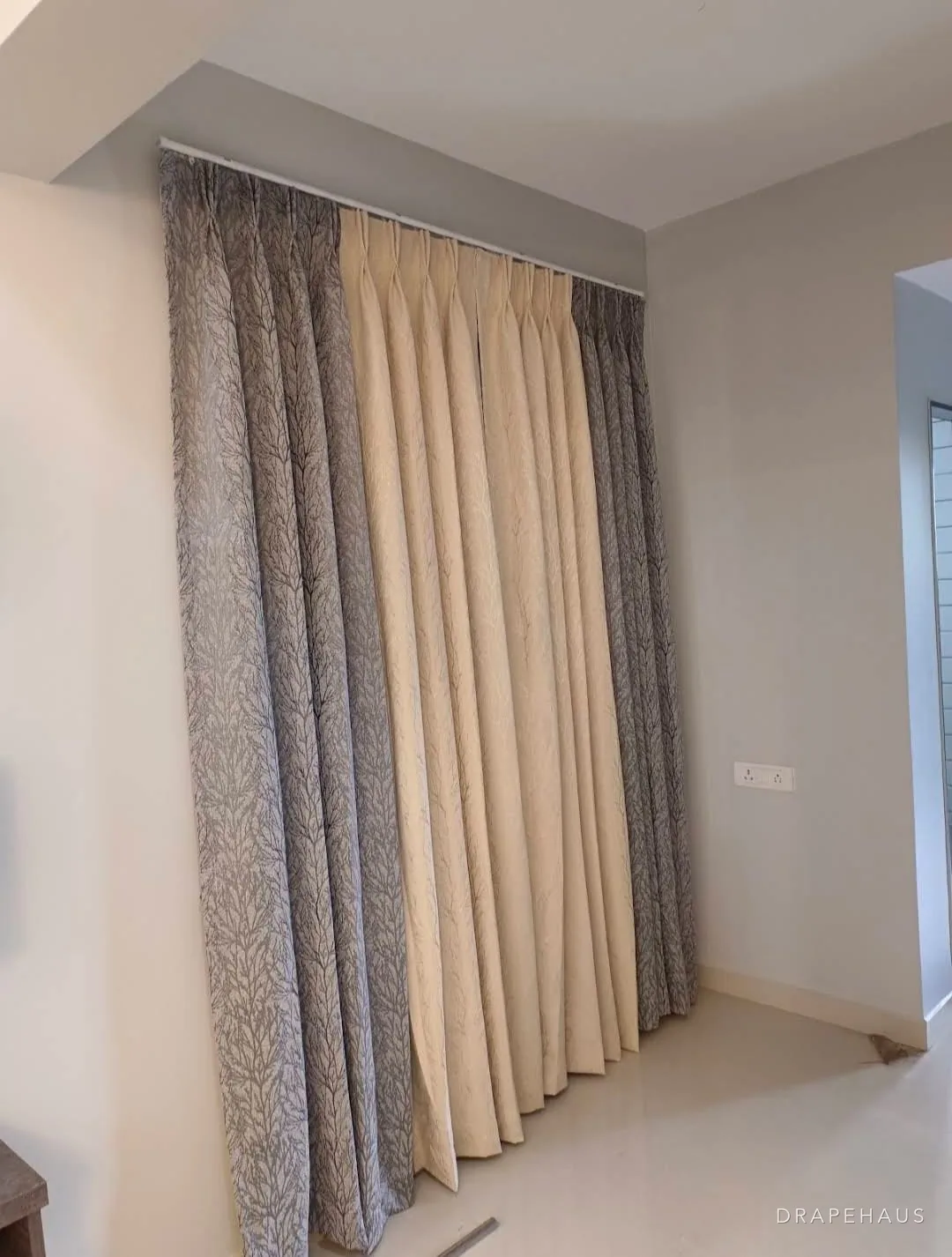
Drapehaus
Preparing the room
Drapehaus
Preparing the room
The Details Matter.
A good curtain on a bad track is a bad curtain — and near the sea, a good curtain on untreated steel is a rust stain running down your wall within one monsoon. We specify tracks, poles and fixings for the weight, the drop and the corrosion load of the actual position.
Fabric
Heading
Opening
Track length
330 cm
about 73 cm past the window each side
Fullness
2.25×
fabric to track
Fabric width
7.3 m
finished, before hems
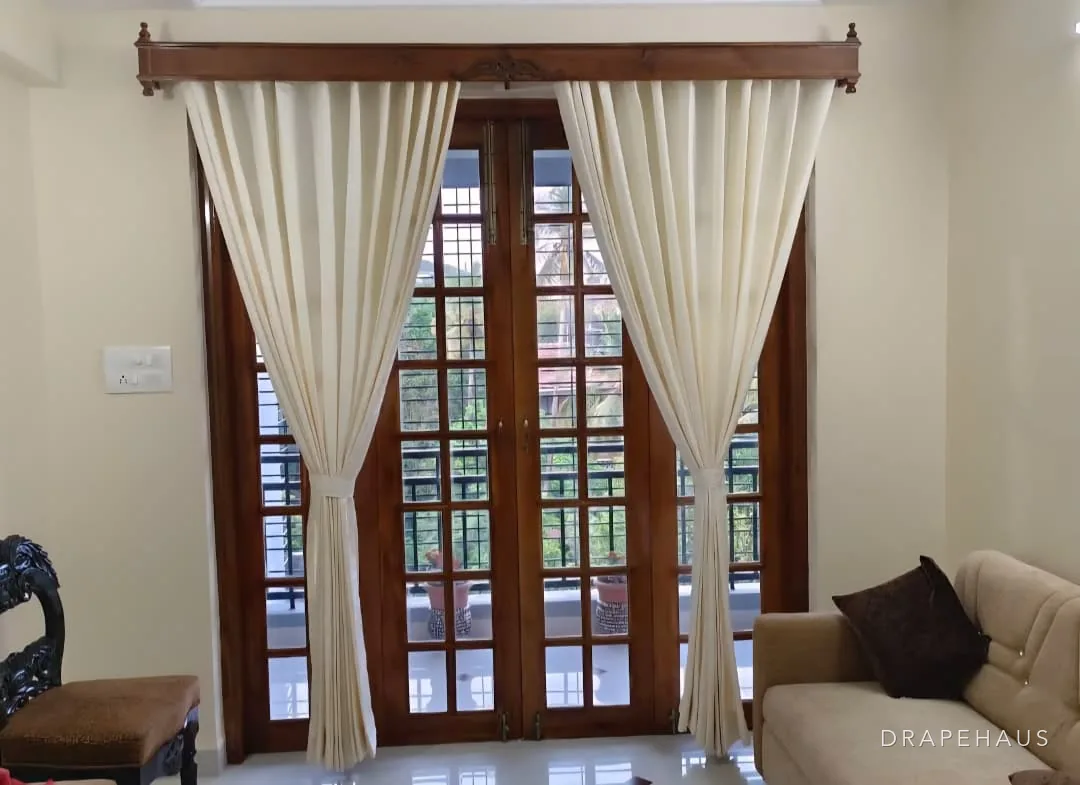
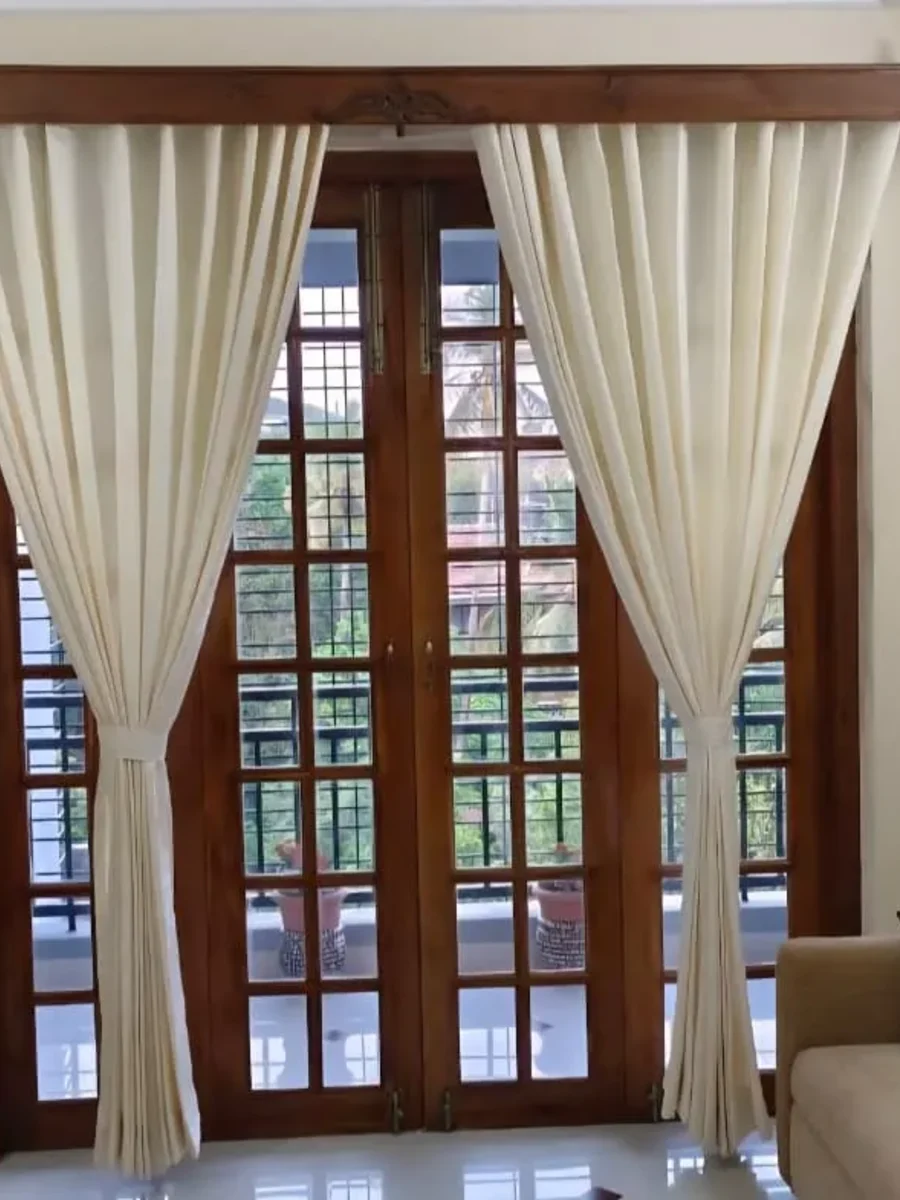
Run the track past the window by the stack, and the open curtains frame the glass instead of covering it — the room keeps its light and the window looks wider. Needs wall space either side; we check that, and the fixing, on site.
What we fit
In short
By the Drapehaus studio · How we write
Is it right for you?
Curtain hardware is the part of a window treatment nobody notices until it fails. A track that drags, a pole that bows in the middle, a bracket that pulls out of the wall or a finial that weeps rust onto white plaster will spoil the finest curtain. In a coastal house the hardware carries three loads at once: the weight of the fabric, the daily pull of opening and closing, and years of salt air and monsoon humidity.
Good hardware is specified, not picked from a rack. The questions are how heavy the curtain will be once it is lined and interlined, how wide the opening is and where the brackets can go, what the wall or ceiling is made of, and how close the window is to the sea. The answers decide the profile, the metal and finish, the bracket spacing and the fixing.
This matters most in the houses we work in: tall windows in heritage rooms with laterite walls, wide sliding openings onto verandahs, double-height living rooms and rental villas where curtains are drawn by many hands. If your curtains are short, light and inland, a standard track will serve. If any of those conditions apply, the hardware needs the same care as the fabric.
Your options
Hardware choices divide first into tracks, which hide the mechanism, and poles, which show it. Within each there are systems for long spans, curves, layering and motors.
Swipe for all 6 →
The honest view
Specified hardware lasts as long as the curtain
A track or pole matched to the weight, span and corrosion exposure keeps running smoothly for years, rather than sagging, sticking or rusting within a monsoon or two.
Coastal metals do not stain walls
Marine-grade stainless, anodised aluminium and properly powder-coated components resist salt air, so there are no rust streaks running down lime plaster below the brackets.
Fixings that hold in old walls
Resin anchors bond into laterite and old masonry, where ordinary plugs crumble their way out under the steady pull of a full, interlined curtain.
Curtains hang and draw better
The right track lets a curtain stack back neatly, fall in even folds and draw with one hand, which is what makes a well-made curtain look well made.
Ready for motors later
A track chosen with motorisation in mind, and a power point placed at the right end, allows motors to be added later without refitting.
More work at the start
Finding what is behind the plaster, calculating curtain weight and planning bracket positions takes time at the survey, and sometimes a small test fixing, before anything is ordered.
Coastal finishes have limits
Even good finishes need care near the sea. Powder coating protects only while it is intact, and brass and bronze darken unless polished. Nothing metal is maintenance-free on an exposed wall.
Recessed and motorised systems need planning
Ceiling channels and power points are simple during building work and disruptive afterwards. Deciding late can mean a surface track where a recessed one was wanted.
Poles limit long spans
A very wide window may need passing brackets or a centre support that interrupts the draw, which is one reason we often recommend tracks for large openings.
Side by side
The four systems we specify most, compared on the criteria that decide which suits a window in a coastal house.
| Surface track | Curtain pole | Recessed track | Motorised track | |
|---|---|---|---|---|
| Visibility | Hidden by heading | On show, decorative | Only a slot | Hidden, motor at one end |
| Heavy curtains | Very good, uprated profiles | Good if sized up | Very good | Very good |
| Long or wide spans | Excellent | Needs passing brackets | Excellent | Excellent |
| Bays and curves | Bent to fit | Jointed elbows | Possible, planned early | Many profiles bend |
| Ease of drawing | Smooth | Some friction | Smooth | Push-button |
| Salt-air durability | Good in aluminium | Depends on metal | Good in aluminium | Motor kept away from spray |
| When to decide | Any time | Any time | Before ceiling work | Before plastering |
Swipe to compare →
In heritage rooms a pole often suits the architecture best; everywhere else, a well-specified track is usually the more practical choice.
Rather see it in your own room?
We bring samples to the house, measure every window, and specify for the light and exposure you actually have.
Room by room
Wide openings to the verandah call for tracks that span without centre supports, often double for sheer and main curtain. Stack-back beyond the opening keeps the view clear.
A double track lets a sheer and a blackout curtain work independently. Ceiling fixing with the curtain close to the ceiling limits light leaking over the top.
Tall, heavy drops need uprated tracks, close bracket centres and often a motor, because the curtains are too high and heavy to draw comfortably by hand.
Timber or brass poles suit the proportions, fixed into laterite with resin anchors. Check the plaster at each bracket position before drilling, as old lime can be hollow.
Exposed to rain and salt, outdoor curtains need marine-grade stainless or anodised aluminium throughout, including screws, and tiebacks to stop them flailing in wind.
Use aluminium or stainless tracks and fixings only. Steam and condensation find any plated steel quickly, and a rust stain on a bathroom ceiling is hard to hide.
Robust tracks with strong gliders and, on wide windows, a draw rod or motor. Guests pull curtains hard and at the edges, which breaks weaker runners.
In depth — tap a heading to read
Salt corrodes metal by keeping its surface damp and conductive. Salt is hygroscopic, so wherever it settles it draws water from the air, and the combination of salt and moisture attacks unprotected steel quickly. Close to the sea, the international corrosivity scale (ISO 9223) places exposed sites in its most aggressive categories, and the effect falls away sharply with distance and shelter. A window facing onshore wind takes far more than one on a sheltered side.
The metals that last are those that protect themselves or are properly sealed. Marine-grade stainless steel resists pitting in salt air far better than ordinary stainless. Aluminium forms a protective oxide, and anodising thickens it. Powder coating seals steel or aluminium under a baked finish, and lasts as long as the coating is unbroken. Brass and bronze do not rust, but they darken and can develop a green patina unless lacquered or polished.
The weak points are often the small parts. A stainless track held up with plated steel screws will still stain the wall. We specify the fixings, brackets, gliders and end stops to the same standard as the profile, and avoid mixing dissimilar metals where moisture can bridge them.
Every track and pole has a weight it is designed to carry and a maximum distance between brackets. Both matter. A curtain made at a fullness of 2 to 2.5 times the track width, lined and interlined, can weigh far more than people expect, and a long drop multiplies it. Near the ends and at the centre of a pair, where curtains stack, the load concentrates on a short length of track.
We estimate the finished weight from the fabric, lining, interlining and drop, then choose a profile rated comfortably above it and set the brackets closer than the maximum where the load gathers. Sagging tracks, gliders that jump out and poles that bow in the middle are almost always a sign that the profile or bracket spacing was chosen for the window size rather than the curtain weight.
Choose the hardware for the finished curtain, not the bare window.
What is behind the plaster decides the fixing. Laterite is porous and friable; it holds a screw poorly and an expanding plug can crumble it from the inside. Old lime plaster may be hollow where it has lost its bond. Modern concrete lintels and slabs are strong but can hide reinforcement, and hollow blockwork needs fixings designed for cavities. We check each bracket position, sometimes with a test drilling, before choosing.
In laterite and old masonry we use resin anchors: the hole is cleaned, filled with a structural resin and a threaded rod or socket set into it, so the load is spread through the surrounding material instead of pressing on a small point. In concrete, correctly sized mechanical anchors work well, placed clear of edges. Ceiling fixing into a concrete slab is often the strongest option for heavy curtains, and it keeps the brackets off fragile walls entirely.
Where the surface itself cannot take a fixing, such as a thin false ceiling or a crumbling heritage reveal, we fix a timber or metal batten back to sound structure and mount the track on that.
Bay and curved tracks are bent to the measured angles or radius of the window, which means an accurate template rather than a tape measurement alone. Brackets go either side of each bend to stop the track twisting under load, and the gliders chosen must run round the curve without snagging. On a deep bay, we often plan the curtain as one pair drawing round the whole sweep, with enough stack-back beside the bay to clear the glass.
Tall and double-height windows raise different questions. The track is usually ceiling fixed, the curtain is heavy, and it is out of reach. Draw rods, cord systems or a motor make it usable. For access, we plan the brackets so they can be reached from a ladder or tower for future maintenance.
A motorised track is a strong track with a motor at one end driving a belt that pulls the leading gliders. It can be controlled by remote, wall switch, timer or a home-automation system, and it can close curtains automatically in the afternoon sun or when a house is empty. Many systems allow the curtain to be tugged gently to start the motor, which guests find intuitive.
Two decisions matter most. Power has to reach the motor end of the track, so the point should be placed before plastering or ceiling work where possible. And the motor itself should be kept away from rain and spray; on a verandah or next to an opening that stays open in the monsoon, a mains motor needs a sheltered position or a different solution. Battery motors avoid wiring but need recharging.
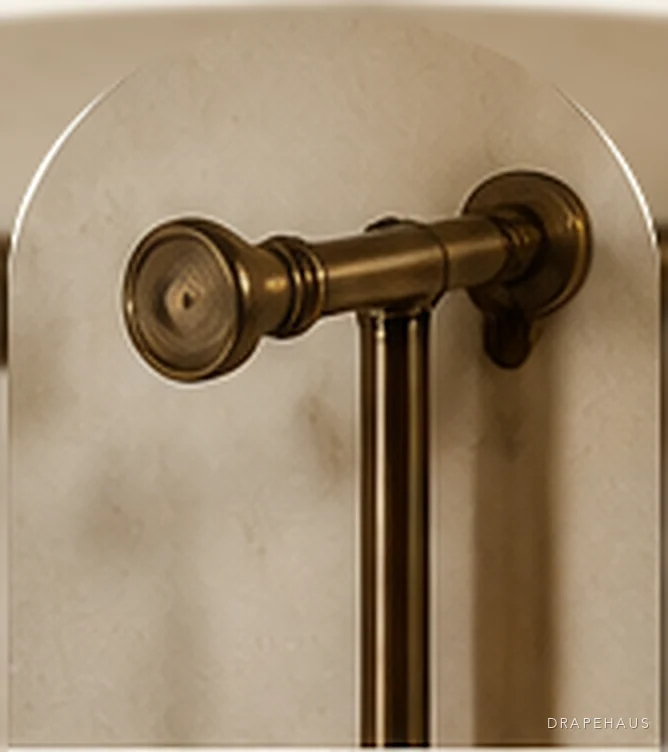
Finials stop rings sliding off a pole and give it a finish, from a simple ball or cap to a turned timber or cast brass design. On a coastal pole the finial is usually the part that shows corrosion first, because it is the most exposed and often a different material from the pole. We match finials to the pole's metal and finish and seal timber finials against humidity.
Holdbacks and tiebacks hold a curtain open neatly. Metal holdbacks are fixed into the wall at about two-thirds of the way down the drop, or aligned with the sill, and carry a real load, so they need the same fixing care as brackets. Fabric tiebacks, cords and tassels soften the look and are made from the curtain fabric or a coordinating trim. On a verandah, tiebacks are practical as well as decorative, keeping curtains still in the wind.
Living with it
On windows near the sea, wipe tracks, poles and brackets with a damp cloth every few weeks and dry them. Removing salt before it draws moisture is the simplest protection there is.
Dust and grit in the channel make gliders drag. A soft brush or vacuum nozzle along the track a few times a year keeps curtains drawing freely.
Oil attracts dust and salt, which then clogs gliders. If a track needs help, use a dry silicone spray made for curtain tracks, sparingly.
At the end of each rainy season, check that brackets are tight and that there is no rust bloom or cracking in the plaster around them, and report any movement early.
Polish brass and bronze if you want them bright, or let them darken evenly. Touch up any chip in a powder-coated finish before corrosion can creep beneath it.
Avoid these
Standard plated or painted steel rusts within a monsoon or two and stains the wall. Specify marine-grade stainless, anodised aluminium or sound powder coating, fixings included.
A plug that seems firm on day one works loose under the weight of a full curtain. Use resin anchors in laterite and old masonry.
A track sized to the window but not to the curtain weight sags. Estimate the finished curtain weight and choose the profile and bracket spacing for it.
A track that stops at the frame leaves the stacked curtain covering the glass. Extend the track beyond the opening so the curtains clear the view.
Adding power after the walls are finished means chasing plaster or running visible cables. Decide on motorisation, and place the power point, before finishing.
Checklist
Know the wall first
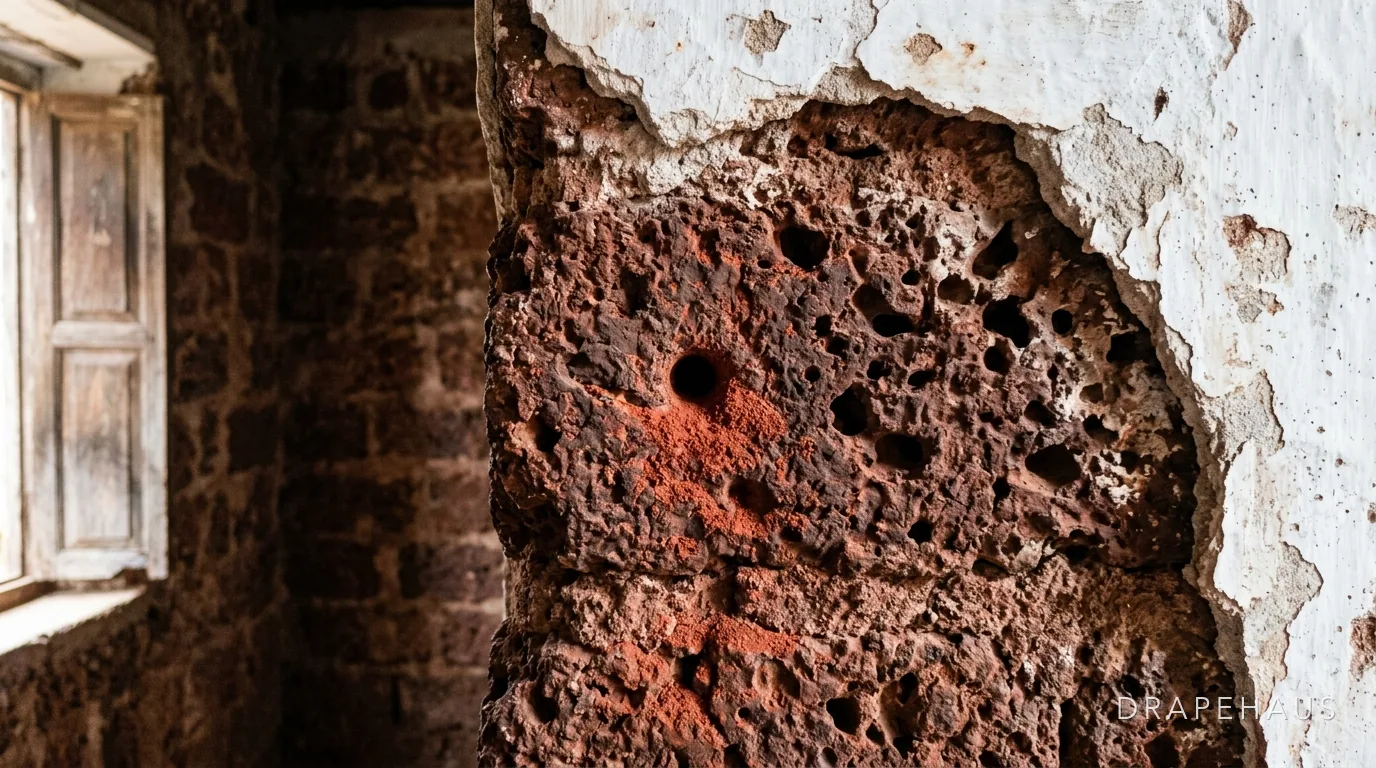
Laterite, lime plaster, old brick and modern blockwork all hold a fixing differently. Before we quote, we find out what is actually behind the plaster — and use resin anchors in laterite and old masonry, where an ordinary plug would pull out under the weight of a full curtain.
From the Journal
All articlesFAQ
Untreated or plated steel corrodes in salt air. Marine-grade stainless, anodised aluminium or powder-coated hardware lasts far longer in a coastal position.
Yes — with resin anchors. An ordinary plug can pull out of laterite under the weight of a full curtain.
Usually the track or its brackets are not rated for the weight, or the brackets are too far apart. Heavy curtains need uprated tracks and closer bracket centres.
Tracks draw more smoothly, carry heavy curtains well, span wide windows without interruption and bend round bays. Poles are decorative and suit heritage and traditional rooms, but rings cannot pass their brackets. For large, tall or layered windows a track is usually better; for a single window in a period room a pole often looks right.
Near the sea, marine-grade stainless steel and anodised aluminium perform best, followed by properly powder-coated metal. Brass and bronze do not rust but tarnish. Whatever the rod, the brackets, screws and finials must be of the same standard, because a single plated steel part will still rust and stain the wall.
It depends on the track profile and the curtain weight. Each track has a maximum bracket spacing from its maker, and heavy, interlined curtains need brackets closer than that, particularly where the curtains stack at the ends and the centre. We set the spacing from the finished curtain weight rather than a fixed rule.
Far enough for the curtains to stack clear of the glass when open. The stack-back depends on the fabric, lining and fullness; a heavy interlined curtain needs noticeably more room than a light sheer. We calculate it for each window, and where wall space is limited we may suggest a one-way draw.
Sometimes. It depends on whether the existing track profile accepts a motor and belt, whether it is strong enough, and whether power can reach the right end. More often a new motorised track is fitted, which is a straightforward change if a power point can be placed nearby.
Because the fixing is gripping crumbly laterite, hollow lime plaster or soft old brick rather than sound material. Expanding plugs can break up the surrounding material. Resin anchors, fixing into a concrete lintel or slab, or a batten back to sound structure solve it.
Next step
At a Drapehaus visit we measure each window and look at what is really behind the plaster, how close the window sits to the sea, and how the curtains will be layered and drawn. We bring track, pole and finish samples alongside the fabrics, so hardware and curtain are chosen together. We then calculate the finished weight, specify the profile, finish and fixings, and install everything ourselves, resin anchors and all. Book a home visit, and we will make sure the curtains hang from something built to last.
Fabrics for the climate
Specified for salt, sun and monsoon.
Measured on site
Every window, every time.
Fitted by our team
The people who plan it, fit it.
Rooted in Goa
A local workshop serving North and South Goa.