 Drape Haus
Drape Haus
Preparing the room
Drape Haus
Preparing the room
Sea-Facing Penthouse · Curtains
Sheer enough to keep the sea in view, strong enough to cope with sun, salt and wind, and long enough to run from slab to floor across a wall of glass.
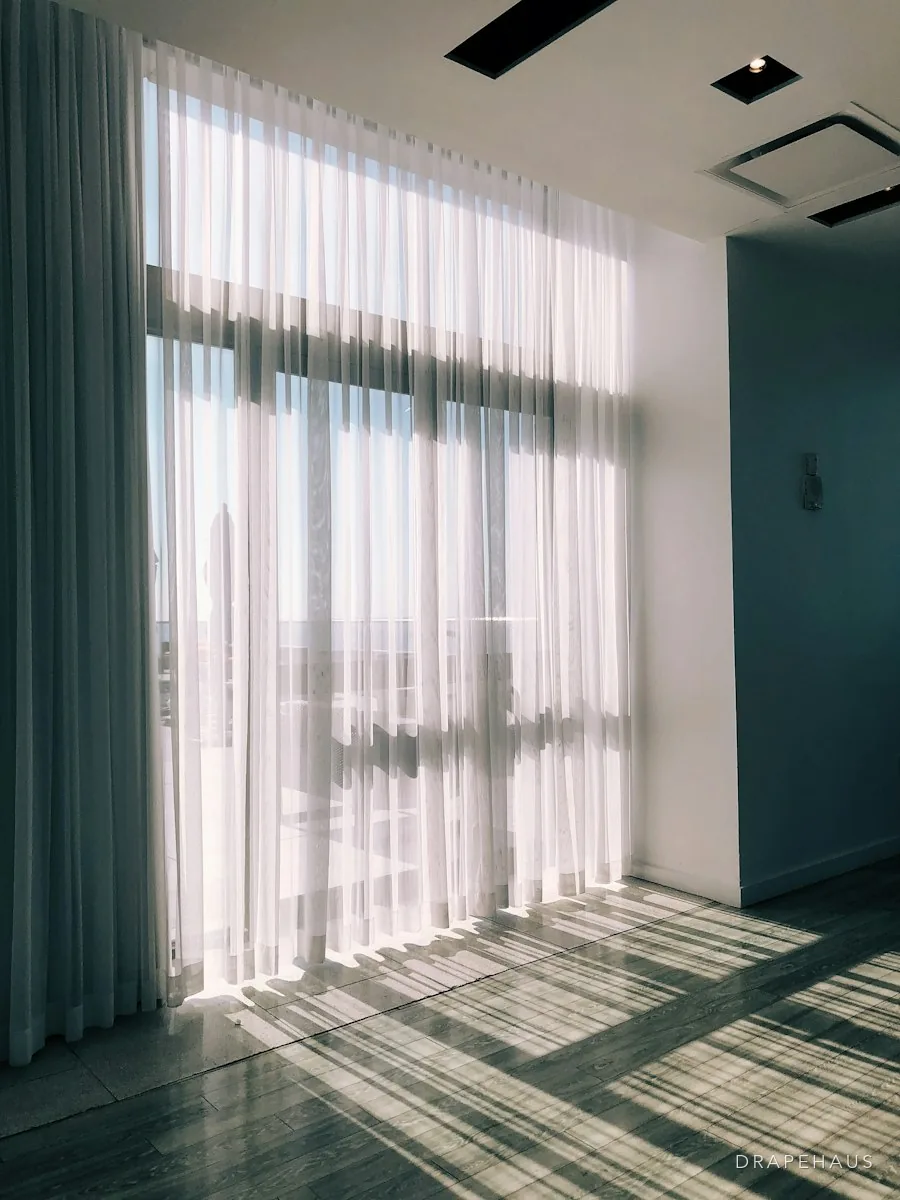
Sheer · Midday
Treatment
Time of day
Softens glare and keeps the view by day. After dark, with lamps on, a sheer on its own hides almost nothing — pair it with a lined curtain for the night.
In short
For a sea-facing penthouse, use a fine sheer as the everyday layer — it cuts the glare and heat but keeps the horizon — and add a lined or blackout curtain only in bedrooms and the media corner. Hang from a ceiling-fixed aluminium track, weight the hems so the fabric doesn't fly in the wind, and choose fabrics that resist fading in strong sun.
What your penthouse asks of curtains
See it in your penthouse
We bring samples to your home, hold them to your light and measure every opening — anywhere in North or South Goa.
In most penthouses the sheer is drawn more than half the day. It turns the hard afternoon glare into soft, even light, keeps the furniture out of direct sun and still lets you see the water. Choose an off-white or warm grey; bright white sheers glow in the sun and add to the glare.
A tighter weave gives more protection from heat, a looser one more view and breeze. Hold samples against your own glass at four in the afternoon — the only test that matters.
When the terrace doors are open, curtains on a high floor want to leave the building. Weighted hems — a chain or individual weights sewn into the bottom — keep the fabric hanging straight. Tracks that extend well beyond the opening let you stack the curtain against a wall, out of the airflow.
Avoid very light voiles on the doors you open most. A slightly heavier sheer moves gracefully rather than flailing.
Sea-facing bedrooms get the first light of the day reflected off the water, and at night the shore lights and passing boats. A double track with a sheer and a blackout layer lets you have the view by day and real darkness at night.
Make the blackout overlap at the centre and return to the wall at the ends so light doesn't leak around the edges.
Polyester and good polyester-linen blends resist sun and salt better than pure natural fibres. Solution-dyed fabrics hold their colour longest. If you love linen, line it — the lining takes the sun and protects the face.
In Goa
In the monsoon, wind-driven rain finds every gap in a high-floor slider. Keep curtains clear of the glass and the floor so they don't wick water, and dry them out between storms. Wash sheers after the rains to remove salt residue, which attracts moisture and dulls the fabric.
Check the track and gliders each year. Salt and fine sand build up in the channel and make curtains stick; a wipe and a dry silicone spray keep them running smoothly.
More for your penthouse
Curtains for other spaces
We measure and fit curtains across Goa — Panjim, Porvorim, Dona Paula, Mapusa, Candolim, Calangute, Assagao, Anjuna & Vagator, Siolim, Benaulim, Colva, Varca, Cavelossim, Margao, Majorda, Vasco da Gama, Canacona & Palolem, Ponda.
FAQ
A fine, UV-stable sheer for the main glass, on a ceiling-fixed aluminium track, with blackout curtains added in bedrooms. That combination keeps the view, cuts glare and copes with salt air.
Weighted hems, a slightly heavier sheer on the doors you open most, and a track long enough to stack the curtain out of the airflow.
Strong sun off the sea fades many fabrics quickly. Choose solution-dyed or UV-stable fabrics, or line natural fabrics to protect them.
Often, yes. A sunscreen roller blind behind the curtain gives the best glare and heat control. Our penthouse blinds page explains the options.