 Drapehaus
Drapehaus
Preparing the room
Drapehaus
Preparing the room
Blinds simulator
One arched window in a lime-washed Goan room, six ways to dress it. Pick a blind, move it, change the hour, and watch what happens to the light on the floor.
Roller · Midday
Treatment
Time of day
Light-filtering roller fabric: soft, even light and daytime privacy. For a bedroom, choose blackout fabric and side channels.
In short
Blinds differ less in how they look than in how they move: some roll, some fold, some tilt, some turn. That movement decides how much light, view and privacy you get at each setting. Use the simulator to shortlist two, then see the real fabrics at your own window.
Using the simulator
Choose a blind in the Treatment row: Roller, Zebra, Roman, Wooden slats, Vertical or Bamboo chik. The simulator opens on Roller.
Move the slider. It reads Raised for roller, Roman and chik, Tilt for wooden slats and vertical, and Bands aligned for zebra. At 0% the blind is fully closed.
Step through Morning, Midday, Golden and Night. Watch the patch of sun move across the terracotta floor, then the lamps come on after dark.
Read the four meters under the room, and the one-line tip beneath them, before switching to the next blind.
What the simulator shows
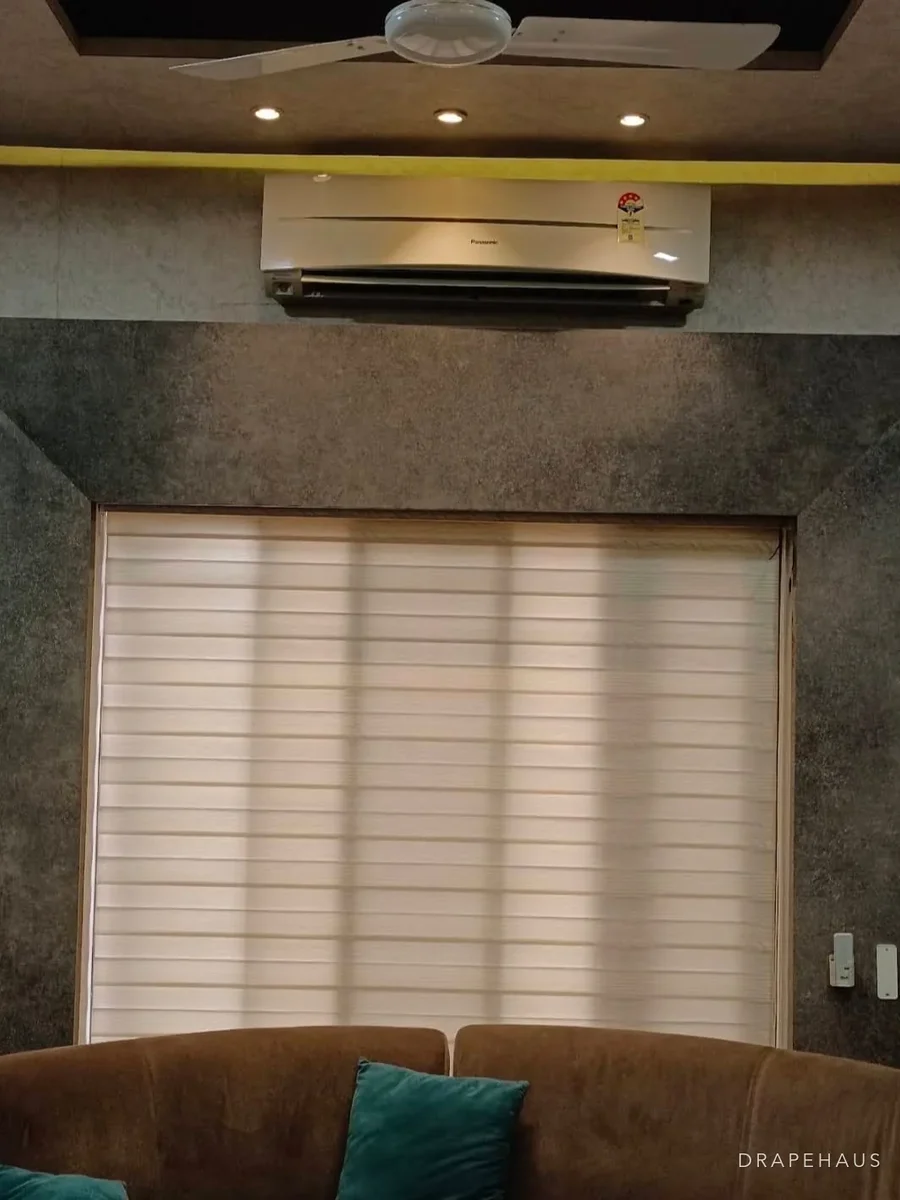
A roller winds a flat sheet of fabric onto a tube. A Roman lifts its fabric into soft horizontal folds. A zebra slides sheer and solid bands past each other. Wooden slats and vertical vanes stay down and tilt. A bamboo chik rolls up from the bottom and is tied.
In the simulator every blind is fixed to the wall above the arch, so it covers the whole opening, fanlight and all. That is how we would hang a blind on a window of this shape.
Daylight in is how much light reaches the room. View out is how much of the sea and palms you still see. Daytime privacy is how hard it is for someone outside to see in; after dark it becomes Privacy, lights on. Sun and heat cut is how much direct sun the blind stops, and it rests at a dash at night.
Each reads from None through Low, Some and Good to High. They are relative guides built from how each material behaves, useful for comparing one blind against another rather than for measuring a room.
Ask what the window has to do at the hour it matters most. A bedroom window matters at night and at dawn. A living-room window matters in the afternoon, when the sun is low and the room is full.
Try the same blind at Midday and then at Golden. A blind that feels right at noon can let too much low sun through at five o'clock, and the floor patch in the drawing shows it at once.
Living rooms need adjustment more than darkness, so blinds that change light without lifting tend to suit them: zebra bands, wooden slats, or vertical vanes on a wide sliding door. Set each to about halfway and compare the Daylight and View meters side by side.
Where the room opens onto a verandah and you want the breeze, a chik outside with a lined curtain or Roman inside gives you a day setting and a night setting on the same opening.
A blind lives in the window: it covers the glass and not the wall, sets to any height, and suits a window with a desk or a bed right under it. A curtain lives on the wall: it softens a room, takes up sound, and closes darker because it overlaps the frame on every side.
Neither is better in general. Many Goan rooms end up with both, the blind doing the daytime work and the curtain the evening. Our curtains simulator uses the same room if you want to compare them directly.
| Moves by | Closed, by day | Closed, at night | Best at | |
|---|---|---|---|---|
| Roller | Rolling up | Soft glow, no view | Good privacy | Clean, simple windows |
| Zebra | Sliding bands | Low light, no view | Some privacy | All-day adjustment |
| Roman | Folding up | Low light, no view | High privacy | Bedrooms, softer rooms |
| Wooden slats | Tilting | Near dark | High privacy | Steering light |
| Vertical | Turning vanes | Low light, no view | Good privacy | Wide sliding doors |
| Bamboo chik | Rolling and tying | Dappled, some view | Low privacy | Verandahs, breeze |
See it at your own window
The simulator narrows the choice. At the house we bring the real fabrics, hold them up to your light and measure every window.
In Goa
The simulator's window faces the sea for a reason. Most coastal rooms here take hard, low light from the west in the late afternoon, and that is the hour to test any blind. Switch to Golden and watch the sun stretch across the floor.
Then think about June to September. A house closed for the monsoon sits in damp air for months, so synthetic fabrics, faux-wood and aluminium outlast natural materials in rooms that will not be aired.
FAQ
This simulator runs in the browser, with nothing to install. It shows a typical Goan room rather than your own, so use it to understand how each kind of blind behaves, then we bring real samples to hold up at your window.
Each blind passes a different share of daylight when closed. Light-filtering roller fabric and bamboo let a good deal through; wooden slats closed flat let almost none. The drawing dims the room to match.
By day the outside is brighter than the room, so most materials are hard to see through from outside. After dark, with lamps on, the room is the bright side, and open weaves such as bamboo or sheer bands show what is behind them.
Blinds give finer daytime control and suit windows with furniture beneath them. Curtains add softness and absorb sound. In a large living room the two together usually work best, with the blind set for glare and the curtain drawn in the evening.
The simulator uses one colour per blind so the comparison stays fair. Colour changes how much light and view a fabric gives, which is why we choose the final fabric with samples in the actual room.