 Drape Haus
Drape Haus
Preparing the room
Drape Haus
Preparing the room
Stage & Auditorium · Curtains
The main curtain, the masking around it and the cloth at the back — made to measure for the stage you have and operated the way your team actually works.
Blackout · Midday
Treatment
Time of day
Near-total darkness — because the pole runs past the window and the curtain overlaps the frame. Light leaks at the edges, not through the fabric.
In short
A practical stage set has a house curtain (main tabs) in a heavy velour, black legs and borders to mask the wings and lights, and a black back drape or a white cyclorama at the rear. Use inherently fire-retardant fabric at generous fullness, hang it on a proper stage track, and motorise the main curtain if the stage is wide or used often.
What your stage asks of curtains
See it in your stage
We bring samples to your home, hold them to your light and measure every opening — anywhere in North or South Goa.
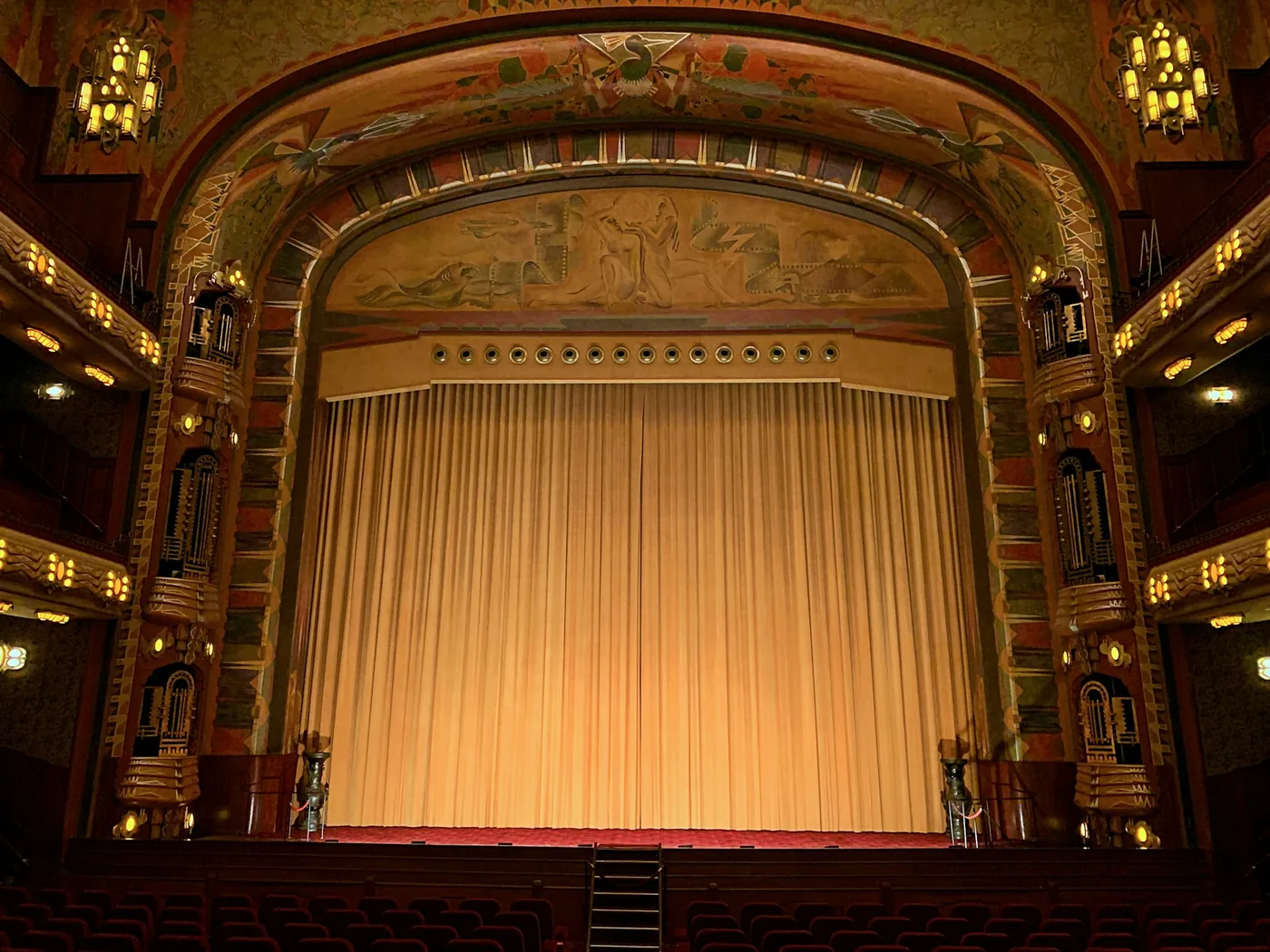
The house curtain, or main tabs, hangs just behind the proscenium and is what the audience sees before the show. Above it, a short pelmet or valance, sometimes called the house border, hides the track. Behind the proscenium, pairs of legs stand at each side of the stage to mask the wings, and borders hang across the top to hide lights and the ceiling; the first border, set just upstage of the main curtain, is often called the teaser.
At the back, you'll usually have either a black back drape, which gives a neutral void, or a cyclorama — a tight, joint-free white or pale-grey cloth that takes coloured light to create a sky or a wash. Many stages add a mid-stage traveller, a pair of black curtains halfway back, so a scene can play downstage while the set changes behind it.
Most stages in Goa use a traveller: two halves that draw from the centre to the sides on a track. It needs wing space for the curtain to stack, and it works on almost any ceiling. A guillotine, or fly curtain, rises straight up as one piece; it needs a fly tower or clear height above the stage at least as tall as the curtain, which few halls have.
Between them sit the tableau (or tab) curtain, which lifts diagonally to the top corners in drapes, and the Austrian or festoon curtain, which gathers upwards in scallops. Both look ceremonial and suit a church hall or a formal auditorium, but need more rigging and maintenance than a traveller.
Stage velour is sold by weight, and heavier velours hang straighter, block more light and absorb more sound. For a main curtain, choose a heavy weight; for legs and borders, a medium-weight black is usually enough. Ask for inherently fire-retardant velour where possible, because treated fabrics can lose their finish with cleaning.
Main curtains are normally made with generous fullness so they fall in deep folds when closed. Legs and borders are often made flat or with light fullness: flat masking is easier to store and re-hang, while fullness looks softer. Black is the default for masking because it disappears under light; maroon, red, navy and royal blue are the traditional colours for main tabs.
A small parish stage with a single pair of tabs works perfectly well with a cord-operated traveller. Once the opening is wide, the curtain is heavy, or the stage is used every day, a motorised track pays off: the curtain opens at the same speed every time, from a switch on the prompt side or the control desk, and no one has to haul a heavy velour in the dark. Plan for a manual override in case of a power cut.
In Goa
Many Goan halls sit closed for weeks during the monsoon, and heavy velour hanging in a sealed, damp room is a magnet for mould and a musty smell. Open the hall on dry days, run fans, and leave the main curtain partly open so air moves behind it. If the hall will be closed for the whole season, consider taking the curtains down and storing them dry.
Coastal halls near the beach belt from Calangute to Colva take salt on every track and carrier. Aluminium stage tracks and stainless fixings last; plain steel components corrode and jam. Keep the hall's windows blacked out with curtains or blinds so daytime rehearsals and matinées still look like evening shows.
More for your stage
Curtains for other spaces
We measure and fit curtains across Goa — Panjim, Porvorim, Dona Paula, Mapusa, Candolim, Calangute, Assagao, Anjuna & Vagator, Siolim, Benaulim, Colva, Varca, Cavelossim, Margao, Majorda, Vasco da Gama, Canacona & Palolem, Ponda.
FAQ
Velour, a heavy cut-pile fabric, is the standard for main curtains and masking. It hangs well, blocks light and absorbs some sound. Choose an inherently fire-retardant velour where you can.
Legs are tall, narrow curtains at the sides of the stage that hide the wings. Borders are short, wide curtains hung across the top to hide lights and the ceiling. Together they frame the stage picture.
A large, tight, joint-free cloth at the back of the stage, usually white or pale grey, that is lit with coloured light to create a sky or a wash of colour behind performers.
Yes. A motorised track opens and closes the main curtain at a steady speed from a switch or control desk. We recommend a manual override for power cuts.
We specify inherently fire-retardant or treated fabrics for stage work and pass on the documentation that comes with the fabric. Check what your licence or local fire officer requires before ordering.