 Drape Haus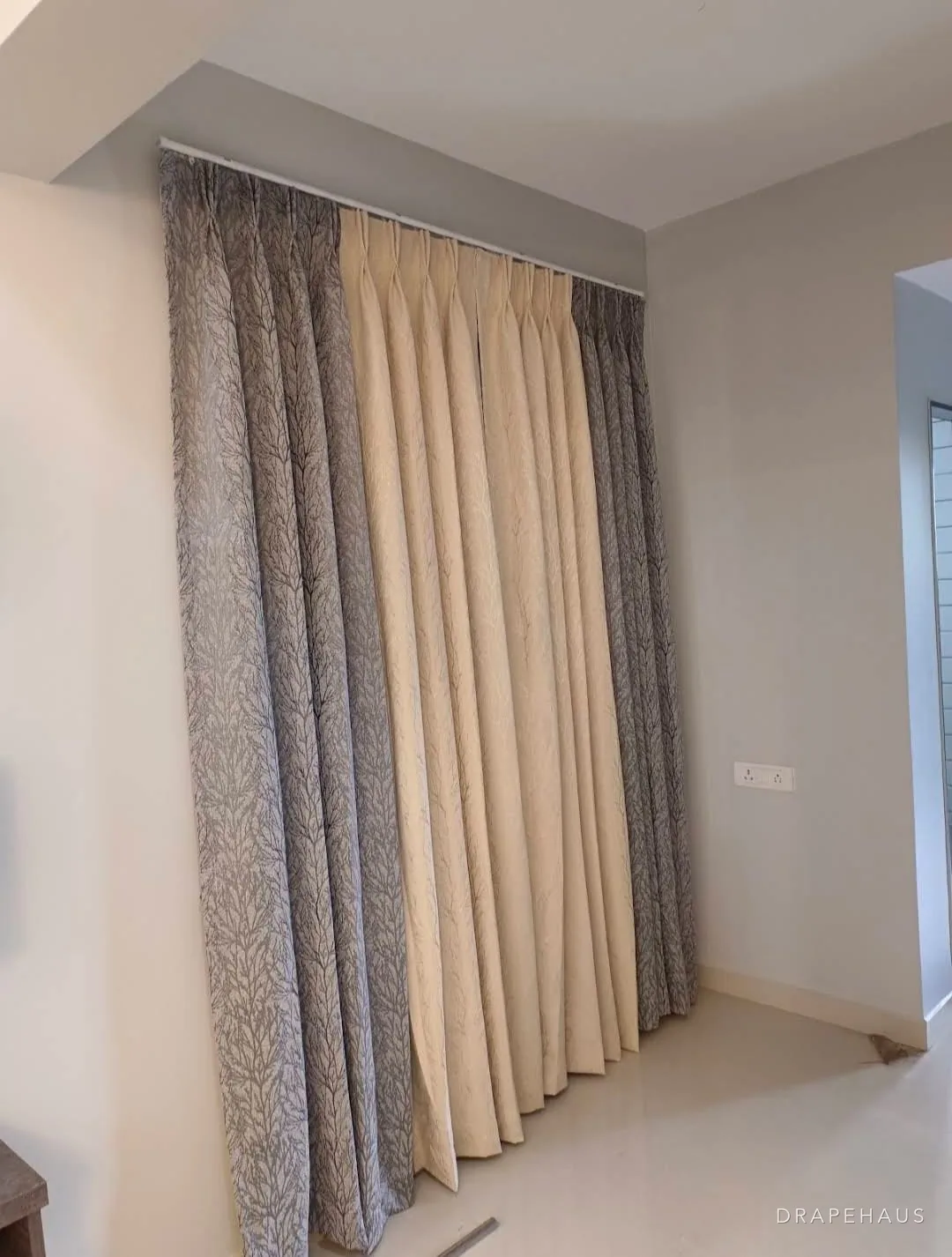
Drape Haus
Preparing the room
Drape Haus
Preparing the room
Hardware
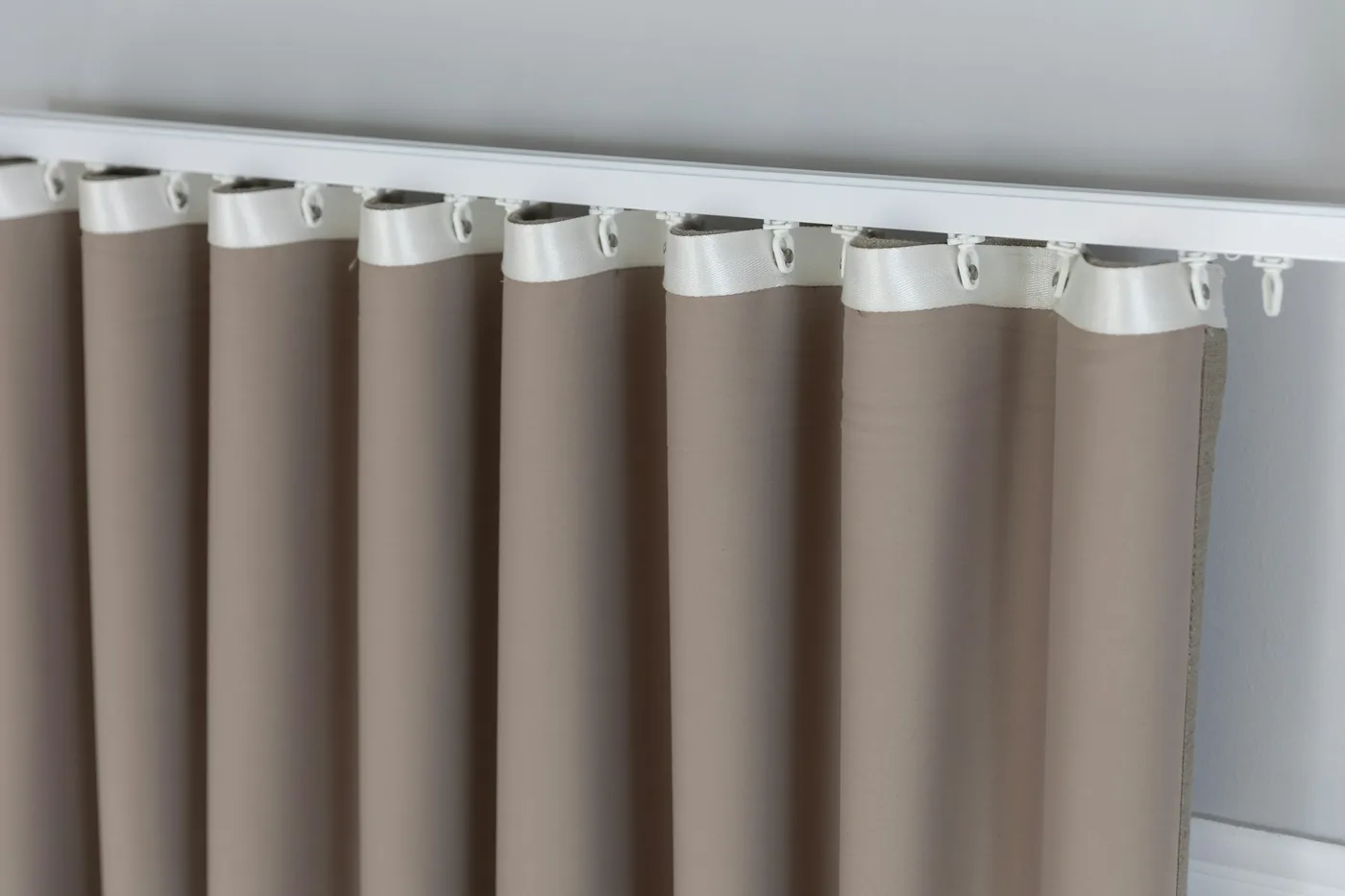
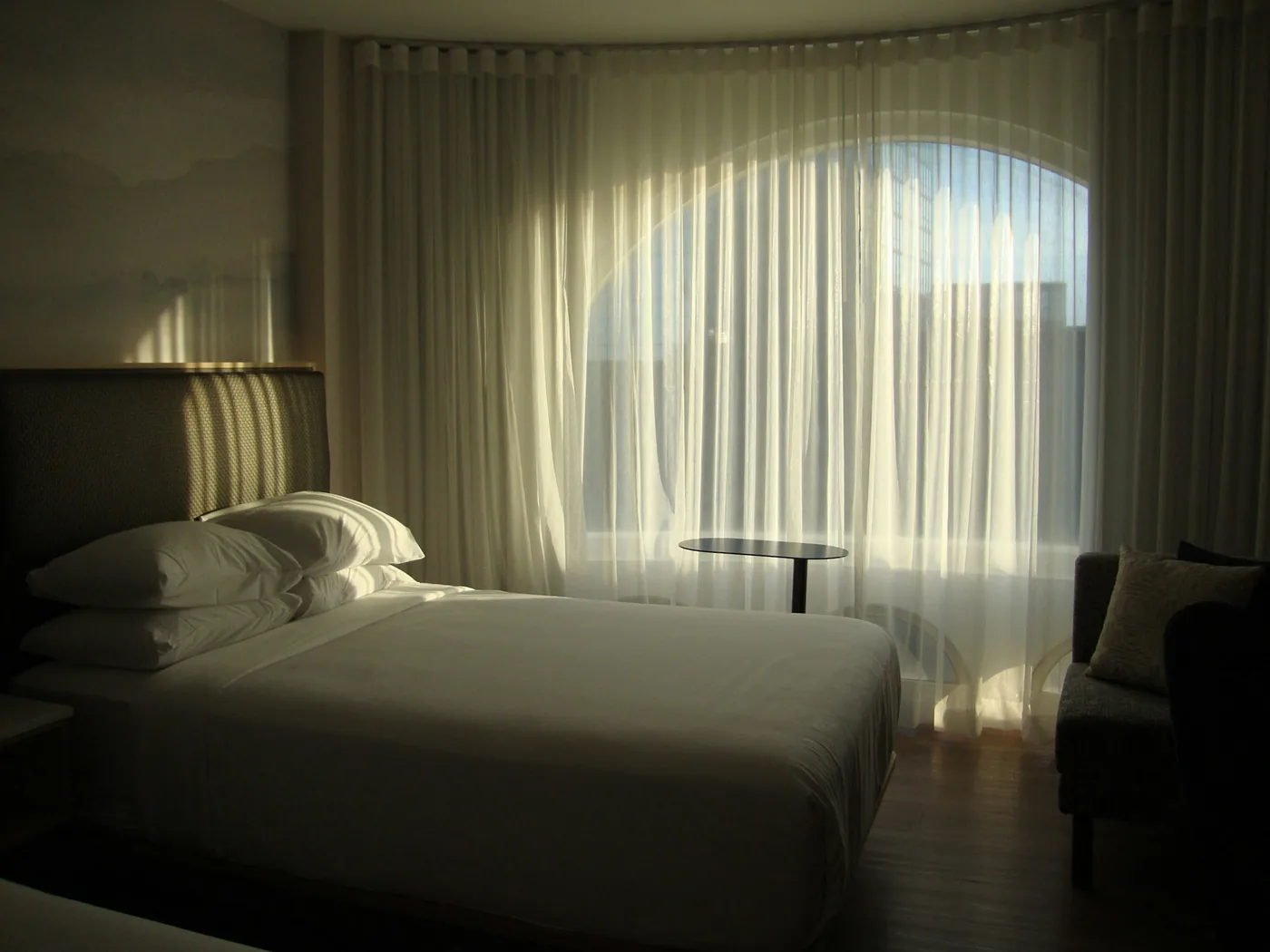
The hardware behind a motorised curtain: an aluminium track with a belt running inside it, carriers clipped to the belt and a motor at one end. Choose the track well and the curtain moves quietly for years; choose it badly and it strains, slips and stops.
Fabric
Heading
Opening
Track length
330 cm
about 73 cm past the window each side
Fullness
2.25×
fabric to track
Fabric width
7.3 m
finished, before hems
Run the track past the window by the stack, and the open curtains frame the glass instead of covering it — the room keeps its light and the window looks wider. Needs wall space either side; we check that, and the fixing, on site.
In short
By the Drape Haus studio · How we write
Is it right for you?
Every motorised curtain runs on a motorised track. The track is an aluminium profile with a channel for a toothed belt or drive cord; the curtain carriers ride in the profile, and one or two of them — the master carriers — are clamped to the belt. When the motor at the end turns, the belt moves and the master carriers pull the curtain open or closed, collecting the other carriers as they go.
That design is what makes a motorised track reliable, and also why it is a specific piece of hardware. It has to be straight, well supported and sized for the curtain; the motor has to match the weight and run length; and the motor end has to be planned for power and access. Get those right and the system runs quietly every day for years.
A motorised track is worth it on wide or tall windows, on heavy blackout curtains, in rooms where curtains are hard to reach, and in homes that are often empty. Our motorised curtains page covers the curtains themselves and how people use the controls; this page is about the hardware underneath.
The details
A motorised track is not a manual track with a motor attached. The profile is built to house a toothed belt or drive cord, the carriers are linked to it, and the master carriers at the centre are driven so two curtains close and overlap together. The motor head clips to one end and must sit where power and access can reach it.
We specify the track from the curtains it will carry and the shape of the opening. Straight runs are simplest; centre-opening pairs, one-way draws, very long runs and bends round bays or curved walls each need the right configuration. The motor is sized to the curtain's weight and length, with headroom so it never runs at its limit.
Power comes first in the planning. A wired motor needs a socket or fused spur at the motor end, ideally placed before plaster or a false ceiling is finished. Battery motors need no wiring and suit retrofits with lighter curtains. Either way the motor head needs room around it and a way to reach it for service.
Near the sea, aluminium profiles and sealed motor housings cope well, but grit in the channel makes any motor work harder. A track that is clean and straight is a track that is quiet.
Your options
The track is configured to the opening and the way the curtains should move. These are the arrangements we fit.
Swipe for all 6 →
The honest view
Carriers move together
The belt pulls the leading carriers evenly, so ripple-fold and pleated curtains keep their shape as they move.
Handles heavy curtains
A suitably sized motor draws long, lined curtains that would be hard work by hand.
Follows bays and curves
Bendable motorised profiles take one continuous curtain round shaped windows.
Integrates with the house
Tracks link to switches, remotes, timers and home-automation hubs.
Planning required
Power, access and track position must be decided before ceilings and plaster are finished, or retrofitted with more work.
Less forgiving of poor fitting
A bowed or misaligned track makes the motor strain and the belt slip.
Motor head takes space
The motor adds length or depth at one end that must fit the ceiling or pocket.
Side by side
Choosing between a wired and a battery motorised track, and against a manual track with a cord.
| Wired motorised track | Battery motorised track | Cord-drawn manual track | |
|---|---|---|---|
| Power needed | Socket or spur at the motor end | None; periodic recharge | None |
| Curtain weight | Light to heavy | Light to moderate | Light to heavy |
| Best for | New builds, heavy curtains | Retrofits, heritage walls | Simple wide windows |
| In a power cut | Pull-to-start, or backup circuit | Unaffected | Unaffected |
| Schedules and remote control | Yes | Yes | No |
| Child safety | No cords | No cords | Cord needs tensioner |
Swipe to compare →
If a false ceiling is still open, run power to every window you might motorise. Adding a cable later costs far more than adding it now.
Rather see it in your own room?
We bring samples to the house, measure every window, and specify for the light and exposure you actually have.
Room by room
Long, heavy curtains need a heavy motorised profile and a motor with headroom. Plan the motor end where power and a ladder can reach.
A double motorised track for sheer and blackout, ceiling-fixed or recessed, with quiet motors.
Long runs split into sections with their own motors let you open part of the wall and keep curtains light.
Battery motors avoid chasing old walls. Fix the track into joists or a batten, and hide it behind a pelmet if needed.
Works well on gentle bays with a bendable profile. Very tight angles may need separate straight tracks.
Rain and salt spray reach the motor. Keep motors indoors of the line of weather, or choose another solution.
A motorised track is usually more than a small, reachable window needs.
In depth — tap a heading to read
The starting point is the curtain. Fabric, lining, fullness and drop give its weight, and the opening gives the run length. The track profile must carry the weight without bowing between brackets, and the motor must pull it with margin to spare. A motor working at its limit runs hot, wears faster and stops on a damp, heavy day.
We weigh what we specify rather than guess. For very heavy or very long runs, splitting the opening into two or more tracks, each with its own motor, is often better than one large system.
Size the motor for the curtain you have, plus a margin — not for the brochure maximum.
A wired motor needs a socket or fused spur within reach of the motor end, usually above the window or in the ceiling. In a new build or renovation, the electrician can run it before plaster and false ceilings are closed. In a finished room, the choices are surface trunking, chasing the wall, or a battery motor.
Access matters for the life of the system. In a recessed pocket, leave an opening at the motor end so it can be removed without breaking the ceiling. On surface-fixed tracks, make sure the motor end is not hard against a wall or beam that prevents the motor unclipping.
A motorised track must be straight and level along its whole length. Any dip between brackets makes the belt run unevenly and the carriers bind. Brackets are spaced closer than on manual tracks, and fixed into the slab, into backing in a false ceiling, or with resin anchors into laterite.
Ceiling fixing is the most common, because it keeps the motor above the window line and closes light at the top. Wall fixing is fine where the ceiling cannot take the load; the brackets then need enough projection for the motor head and the curtain's folds. Our ceiling curtain tracks page covers ceiling fixing in detail.
Aluminium profiles and sealed motor housings tolerate humidity well, but salt and fine sand settle in the channel, and over time the belt picks them up. The motor then works harder, gets louder and may stop short. A clean of the channel each season keeps the system quiet.
Use stainless screws and brackets near the sea, and keep motors away from where rain can reach them through an open window. In houses closed for the monsoon, run the curtains open and closed every so often — remotely, if the system allows — so the belt does not take a set and the carriers keep moving.
People often ask whether their existing track can take a motor. Most manual tracks have no belt channel, so the honest answer is usually no. Replacing the track with a motorised one costs more at the start but gives a system designed to work together. Where the existing curtains suit a motor, they can often be rehung on the new track.
Use the curtain rod and track planner on this page to check the length the track should run, including the stack each side. We then confirm the configuration and motor position on site.
Living with it
Brush or vacuum the track channel each season to remove grit and salt.
In a closed house, run the curtains occasionally so the belt and carriers stay free.
Keep battery motors charged, especially before a long absence.
Pulling a curtain while the motor runs strains the belt. Use pull-to-start only when the motor is idle.
A new grinding or clicking noise usually means grit or a slipping belt. Have it looked at early.
Avoid these
Retrofitting power to a finished ceiling is disruptive. Plan it, or choose battery.
A motor at its limit runs hot and stops. Size with margin.
A motor sealed in a ceiling cannot be serviced. Leave a panel.
Dips between brackets make the belt bind. Fix it straight with close brackets.
Spray through an open window damages motors. Keep them inside the weather line.
Checklist
More in hardware
A good curtain on a bad track is a bad curtain — and near the sea, a good curtain on untreated steel is a rust stain running down your wall within one monsoon.
From the Journal
All articlesOur process
One team from the first visit to the last bracket, so nothing is lost between the person who specified it and the person who fits it.
FAQ
Rarely. Most manual tracks have no belt channel. Some systems offer retrofit drives, but replacing the track with a motorised one usually runs better and lasts longer.
Yes, with a track designed to bend and a belt that follows the curve. Tight corners are harder than gentle curves, so we check the angles before specifying.
At one end of the track, usually the end nearest a power point and with the most clearance. In a recessed ceiling pocket it needs an access opening for service.
It depends on the track profile and motor. We weigh the curtains we specify and choose a motor and track rated comfortably above that, rather than at the limit.
Wired motors do, at the motor end. Battery motors do not, which suits finished rooms and old walls, though they are best with lighter curtains.
A well-fitted, clean track with a quality motor makes a soft hum. Noise usually signals grit in the channel, a misaligned track or an overloaded motor.
Yes, on a centre-opening track the belt drives both halves from one motor. Two separate layers, such as a sheer and blackout, each need their own motor.
Most motors can be unclipped from the track end so the curtains can be drawn by hand until it is replaced, which is one reason access matters.
Yes, if the pocket is built wide and deep enough for the track and motor head, with backing and an access panel.
Next step
The best motorised tracks are planned while walls and ceilings are open. We visit, measure each opening, weigh up the curtains, decide configurations and motor positions, and tell your electrician where power is needed. In a finished room we look at battery motors and surface options. We then fit and set up the track, motor and controls together with the curtains. Book a home visit to begin.