 Drapehaus
Drapehaus
Preparing the room
Drapehaus
Preparing the room
Blackout curtains simulator
A blackout fabric stops light passing through it. Whether the room goes dark depends on something else: how the curtain meets the wall around the window. Close it below and look at the edges.
Blackout · Midday
Treatment
Time of day
Near-total darkness — because the pole runs past the window and the curtain overlaps the frame. Light leaks at the edges, not through the fabric.
In short
Blackout curtains use a lining that lets almost no light through; room-darkening and ordinary lined curtains let some through. With blackout, what light remains comes in at the sides and top, not through the fabric, so the pole needs to run past the window and the panels need to overlap.
Using the simulator
Blackout is selected in the Treatment row. Set Drawn open to 0%.
Tap Midday, the brightest setting. Daylight in reads None and there is no glow through the panels.
Switch to Lined and look at the sides and top of the curtain: a thin line of light appears. Switch back to Blackout and it is gone.
Tap Morning and Golden, then Night, and watch the meters stay at the dark end.
What the simulator shows
Blackout curtains carry a lining that is coated, or woven densely enough — often as a triple weave — to stop nearly all light. Room-darkening is a looser term: the fabric cuts most light but not all, so the room goes dim rather than dark.
A standard lined curtain sits nearer the room-darkening end. In the simulator it reads Low on Daylight in; blackout reads None.
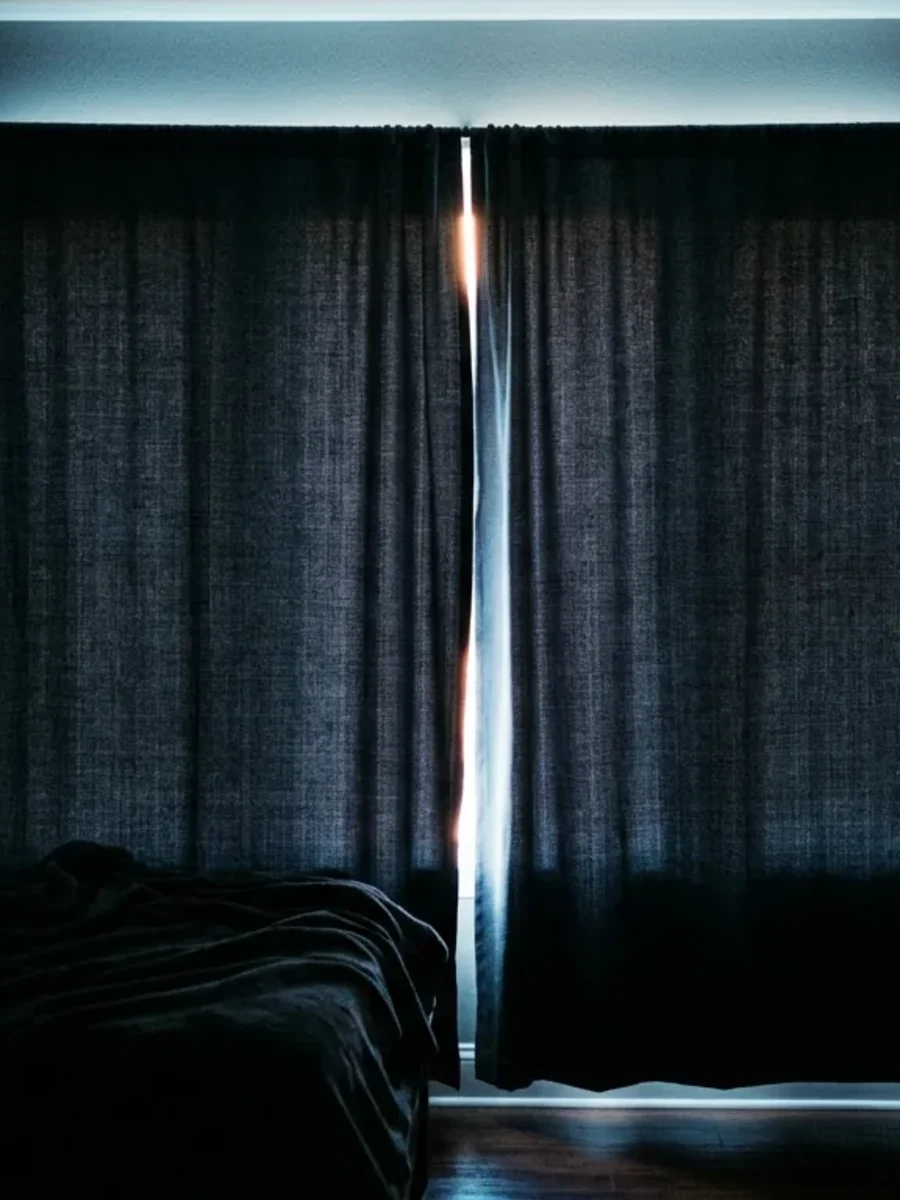
Once the fabric stops the light, what is left comes in round the curtain: at the sides, over the top, and where the two panels meet. In a bright room those thin lines are what wake you at six.
Three things close them. The pole or track runs well past the frame, so the closed curtain covers the wall beside the window. The panels overlap in the middle rather than just touching. And returns — the curtain wrapped back to the wall at each end — close the gap at the sides.
The pole in the drawing extends past the window on both sides, and the panels overlap when closed. That is why Blackout shows no line of light at the edges, while Lined, with an ordinary lining, still does.
Look closely where the panels meet and you will see a pale strip. That is the blackout lining, turned at the leading edge.
The benefits: darkness at any hour, full privacy with the lamps on, and the strongest sun and heat cut of any curtain in the simulator. They suit bedrooms, children's rooms and media rooms.
The trade-off: when closed, the room is dark all the way through, and drawn back, the curtain makes a heavier stack beside the window. That is why many bedrooms pair it with a sheer for the day.
| Lined | Room-darkening | Blackout | |
|---|---|---|---|
| Light through the fabric | Some, as a faint glow | A little | Almost none |
| Room at midday | Dim | Dim to dark | Dark, if the edges are closed |
| Light at the edges | Yes | Yes, unless the pole is wide | Only if hung too narrow |
| Best for | Living rooms, guest rooms | Bedrooms that allow a little light | Bedrooms, media rooms |
See it at your own window
The simulator narrows the choice. At the house we bring the real fabrics, hold them up to your light and measure every window.
In Goa
West-facing bedrooms take the hottest sun of the day, low and straight in through the glass. A blackout curtain cuts the glare and some of the heat that comes with it, which helps most on afternoons when a power cut stops the fan or the air-conditioning.
Blackout linings are dense, so air moves less behind them. In the monsoon, and in houses closed for months, draw them back so the glass and the fabric can breathe, or damp can collect behind them.
FAQ
Blackout lining lets almost no light pass through; room-darkening fabric cuts most light but not all. Either can still leak light at the edges if the curtain is hung too narrow.
Usually round the edges: at the sides, over the top, or where the panels meet. A pole that runs past the window, panels that overlap in the middle and returns at the ends close most of it. Our curtain rod length tool helps with the first.
They are the most complete answer for sleep and night-time privacy. If you also want daylight in the room, hang a sheer with them on a double track.
For: darkness, privacy and a good cut in sun and heat. Against: the room is dark whenever they are closed, they are heavier to draw and stack, and the dense lining needs airing in humid months.
No. The meters are relative guides. Real results depend on the lining, the colour, the width of the pole and how the curtain is fitted, which we plan on site.