 Drapehaus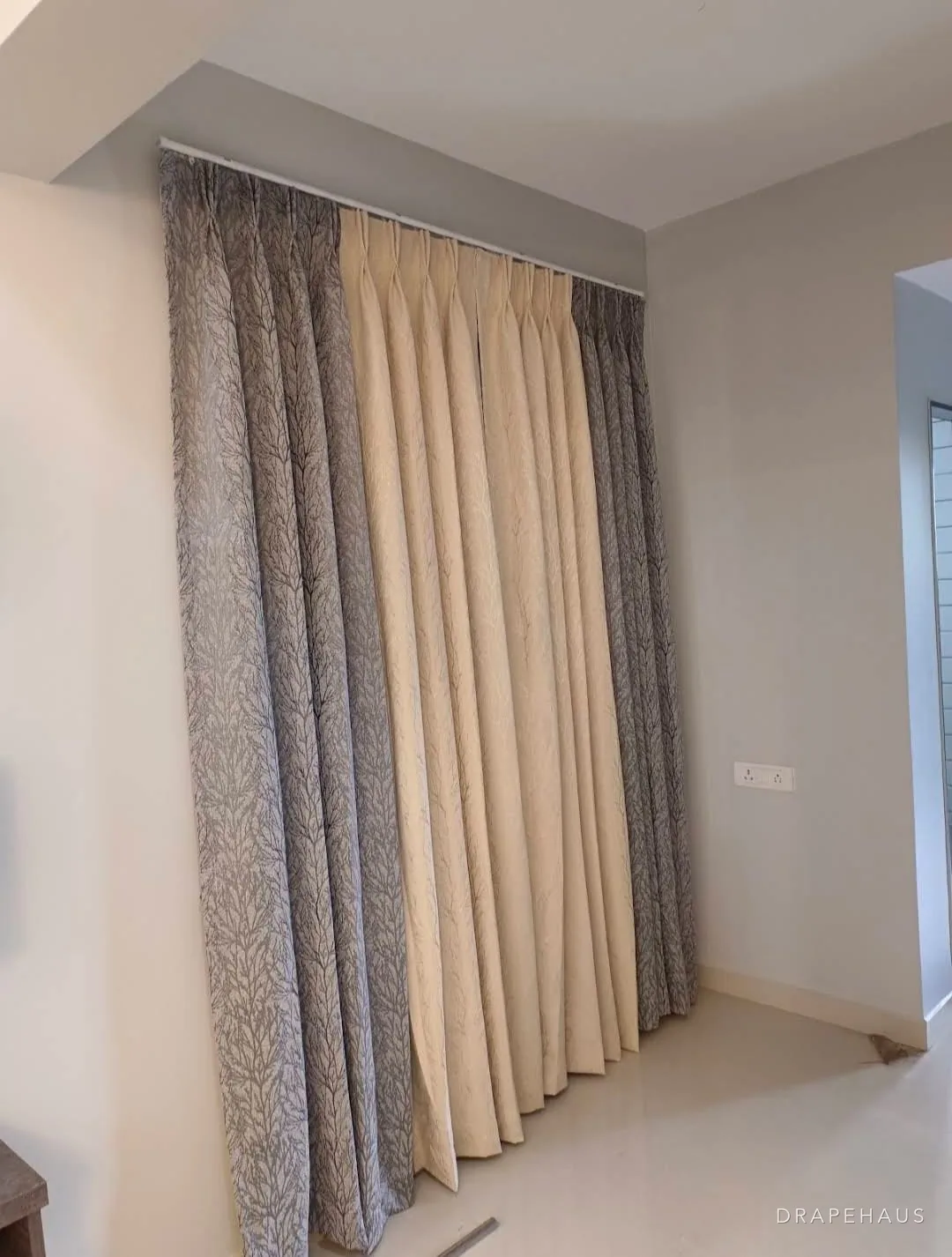
Drapehaus
Preparing the room
Drapehaus
Preparing the room
Curtain rod & track planner
Open curtains do not disappear; they gather into a stack. The planner works out how big that stack is and runs the track far enough past the window to hold it clear of the glass.
Fabric
Heading
Opening
Track length
330 cm
about 73 cm past the window each side
Fullness
2.25×
fabric to track
Fabric width
7.3 m
finished, before hems
Run the track past the window by the stack, and the open curtains frame the glass instead of covering it — the room keeps its light and the window looks wider. Needs wall space either side; we check that, and the fixing, on site.
In short
For a 180 cm window with lined pinch-pleat curtains in a pair, the planner gives a 330 cm track — about 73 cm past the window on each side. Sheers stack smaller, so the same window with sheer eyelet curtains needs only 230 cm. The heavier and fuller the curtain, the further the track runs.
Using the simulator
Set the Window width slider, from 60 cm to 600 cm, measuring the glass and its frame.
Choose the Fabric: Sheer, Unlined or Lined.
Choose the Heading: Pinch pleat, Wave or Eyelet.
Set Opening to a centre-opening pair or a single curtain drawing to one side, then read Track length, Fullness and Fabric width.
What the simulator shows
Stack-back is the width a curtain takes up when it is fully drawn open. If the track stops at the window frame, that stack sits over the glass, and a good share of the light and view goes with it.
The planner sizes the stack from the flat width of fabric on the track: about 12% of it for a sheer, 16% for an unlined curtain and 20% for a lined one. These are rules of thumb curtain makers use; interlining and heavier cloth stack wider still.
By the width of the stack. The planner runs the track past the window just far enough that the open curtains sit beside the glass, not over it — on both sides for a pair, on one side for a single curtain.
Because a longer track holds more fabric, and more fabric makes a bigger stack, it works the figure out step by step until the two agree, then rounds the track up to the nearest 5 cm. The drawing shows the result to scale, with the stacks in place.
Fullness is the width of fabric compared with the length of track. The planner uses 2.25 times for pinch pleat, 2.4 times for wave and 1.8 times for eyelet.
Pinch pleat curtains gather into tailored folds sewn at the top, and stack neatly. Wave curtains run on a track with carriers spaced to form soft, even S-folds; the planner stacks them about 15% tighter than other headings, since the folds nest together. Eyelet curtains use the least fabric of the three and slide on a pole, so their stack is the smallest for a given track.
The Fabric width result is the finished width of curtain the track needs: track length times fullness, before hems and side turnings. For that 180 cm window with lined pinch pleats, it is about 7.3 m of finished width across the pair.
Turning that into metres of cloth to buy — drops, pattern repeat, hems — is a separate job, and our fabric calculator in Tools handles it.
| Fabric and heading | Track | Past the window, each side | Fabric width |
|---|---|---|---|
| Lined, pinch pleat | 330 cm | about 73 cm | 7.3 m |
| Lined, wave | 305 cm | about 62 cm | 7.3 m |
| Sheer, eyelet | 230 cm | about 25 cm | 4.1 m |
See it at your own window
The simulator narrows the choice. At the house we bring the real fabrics, hold them up to your light and measure every window.
In Goa
Many older Goan windows sit close to a corner or between pilasters, with little wall to either side. If the planner asks for more width than the wall allows, a single curtain drawing to the open side, a lighter fabric or a wave heading all shrink the stack. We check the wall space on site.
Salt air corrodes plain steel brackets and screws, and the rust marks lime-washed walls. Near the sea, tracks, brackets and fixings should be made for it, and laterite and old lime plaster need fixings chosen for soft, crumbly walls.
FAQ
Around 15 to 30 cm each side is often quoted, but it depends on the curtain. A pair of sheers may need 25 cm; lined pinch pleats on the same window can need 70 cm or more. The planner gives the figure for your fabric and heading.
The ratio of fabric width to track length. At 2.25 times fullness, a 3 m track carries 6.75 m of finished curtain. More fullness gives deeper folds and a richer drape, and a bigger stack when open.
Wave, slightly. Its folds nest neatly on the track, so the planner stacks it about 15% tighter, even though it uses a little more fabric than pinch pleat.
It is the length of track the curtains run on. Finials, end stops and returns to the wall add a little, and are settled when the hardware is specified.
They are planning figures built on curtain makers' rules of thumb. We measure the window, the wall either side and the fixing on site before anything is ordered.