 Drape Haus
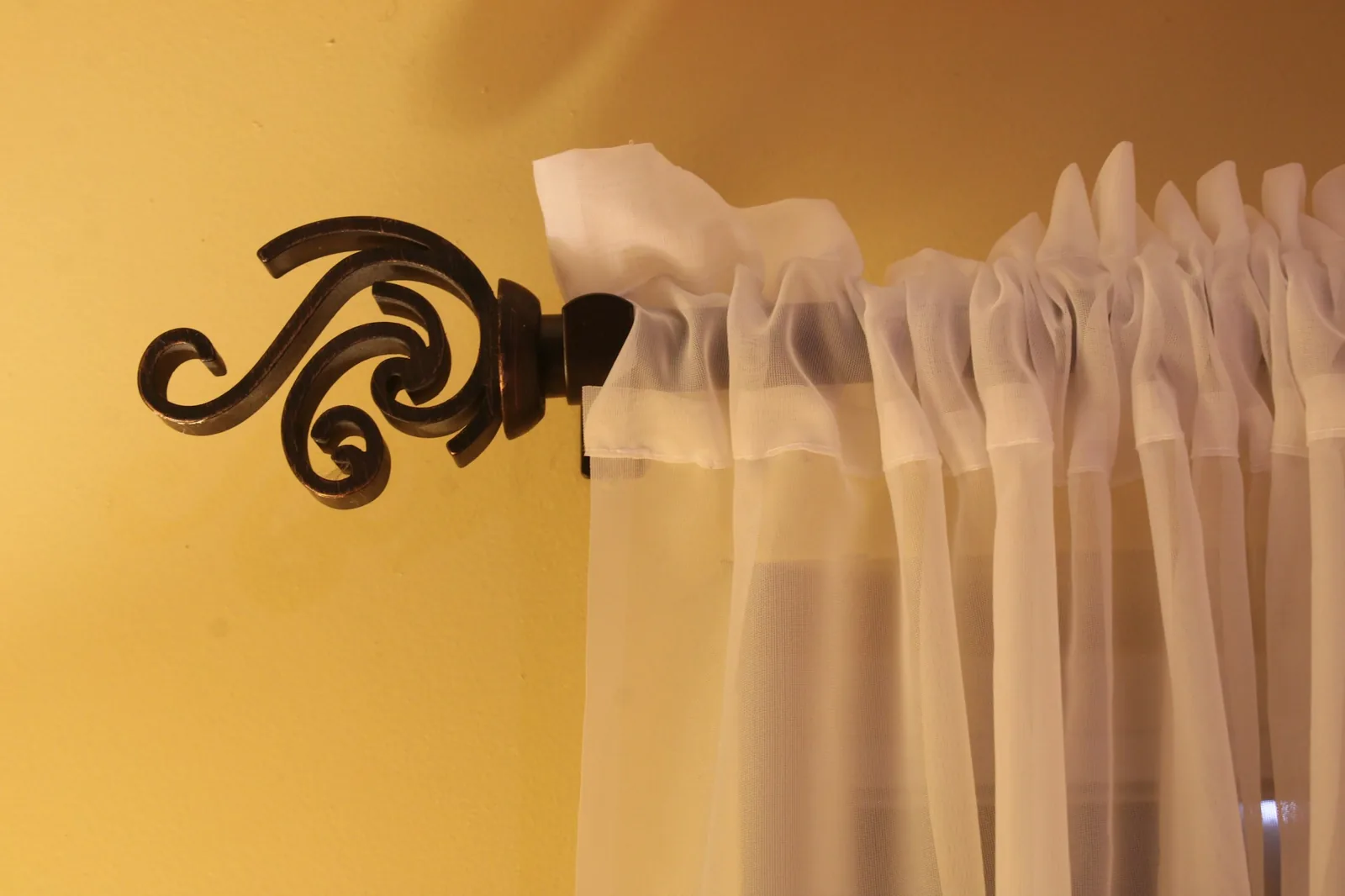
The best curtain rods are the ones chosen for the window they will hang at. A rod that looks right in a showroom can bow under a lined curtain, streak rust down a white wall within a monsoon, or swell and stick in a humid room. Choosing well comes down to four decisions: the type of rod, the material and finish, the diameter and brackets for the span, and the rings and finials that carry the fabric.
In a coastal state the material matters most. Salt carried on the sea breeze settles on every metal surface in a house, and in the monsoon it stays damp for weeks. Some metals shrug that off, some tarnish slowly, and some rust quickly and take the curtain with them. Below we compare the common rod materials honestly, then look at spans, double rods for layering, rings and the particular care that wooden rods need.
If you already know you want a rod rather than a hidden track, our curtain rods page shows what we fit. If you are still deciding, the comparison of rods and tracks on our hardware page is the place to start.
Types of curtain rods, and what each is for
A curtain rod, or pole, is a visible bar held on brackets, with the curtain hung from rings or threaded through eyelets. Within that simple description there are several distinct types, and each answers a different window. Picking the type first narrows the choice of material and size a great deal.
The most common mistake is buying a single rod for a window that really needs two layers, or an extendable rod for a span that needs a properly cut, supported one. The list below covers the types we see most in Goan homes, from compact flats to old houses with tall shuttered windows.
One type is worth ruling out early. If the curtain must hang from the ceiling, run round a tight curve, close tightly at the top for a dark bedroom or be motorised, a rod is the wrong tool. Those are jobs for a track, and no choice of rod material will change that.
- Single rod on two or three brackets: the standard choice for one curtain layer, ring-hung or eyelet.
- Double rod on shared brackets: two parallel rods, usually a sheer behind and a heavier curtain in front.
- Bay or jointed rod: sections joined by angled elbows so the rod follows a bay; rings stop at each joint unless passing brackets are used.
- Recess or wall-to-wall rod: fixed between two side walls with end sockets instead of finials, common in alcoves and dormer windows.
- Extendable or telescopic rod: two tubes sliding inside each other; quick to fit, but the step at the overlap catches rings and the thinner tube is the weak point.
- Tension rod: held in a recess by spring pressure alone, suitable only for a very light sheer or café curtain in a small window.
Curtain rod materials compared for coastal homes
Stainless steel is not one material. The Australian Stainless Steel Development Association advises that within five kilometres of the surf, grade 316 or a grade with equivalent corrosion resistance should be the minimum, and that wind and weather can carry marine conditions up to twenty kilometres inland. It warns that lower grades such as 304 will probably become tea stained, a brown surface discolouration that is cosmetic but very visible on a pale wall. Finish matters too: the same body notes that surfaces smoother than about 0.5 µm Ra are much less susceptible, so a polished rod generally holds up better than a coarse brushed one of the same grade.
Aluminium behaves differently. Anodising thickens its natural oxide layer, and powder coating bakes a durable paint film onto it. Neither rusts, because there is no iron to rust, and a quality anodised or powder-coated aluminium rod looks much the same after several monsoons, needing only a wipe. Powder-coated steel is another matter: it is sound while the coating is whole, but once a bracket screw or a dropped ladder chips it, salt reaches the steel and rust spreads under the paint.
Brass, iron and timber each have a place, but with conditions. Brass does not rust, yet it tarnishes, and the Canadian Conservation Institute notes that polishing is abrasive and removes some surface metal each time, so a rod polished every few weeks slowly loses its crispness. Wrought iron and plain or plated steel rust quickly in salt air unless their coating is perfect and stays perfect. Timber is unaffected by salt but responds to humidity, which we come to below. The table sets out how each behaves in a house near the sea.
| Material | Salt air | Monsoon humidity | What to watch for |
|---|---|---|---|
| Stainless steel, grade 316 or better | Very good | Unaffected | Prefer smoother, polished finishes |
| Stainless steel, grade 304 | Fair at best | Unaffected | Brown tea staining close to the coast |
| Anodised or powder-coated aluminium | Very good | Unaffected | Stainless fixings without insulating washers |
| Powder-coated steel | Good while intact | Rusts at chips | Damage to the coating at brackets and ends |
| Solid brass | Tarnishes | Unaffected | Frequent polishing wears the surface |
| Brass-plated or chrome-plated steel | Poor | Rusts under plating | Blistering and rust spots, then stains |
| Wrought iron, plain steel | Poor | Rusts | Rust bleeding onto walls and fabric |
| Sealed timber | Good indoors | Moves if poorly sealed | Unsealed ends, borer holes, warping |
Planning something like this?
We visit homes across North and South Goa, measure on site, and bring samples to see in your own light.
Finishes that rust or tarnish, and what to avoid in beach-belt homes
The finishes to avoid within sight or sound of the sea are plating over steel and paint over untreated iron. Chrome-look and brass-look rods sold at a low price are usually thin steel tube with a decorative plating. The plating is attractive and very thin; salt finds the cut ends, the screw holes and any scratch, the steel underneath rusts, and the rust lifts the plating from within. By the second monsoon the rod may be spotted, and by the third it may be streaking.
Mixed metals are the less obvious problem. Galvanic corrosion happens when two different metals touch and the join is wet with a conductive liquid, which can be rainwater or moisture absorbed into salty surface deposits. The stainless steel association notes that a stainless screw in aluminium is common, but corrosion of the aluminium immediately around it is quite possible, and that insulating the two metals with plastic washers, strips or sleeves prevents it. On a sea-facing verandah door or a window that is left open in the rain, that small washer is worth insisting on.
Brass deserves a fair hearing. In an inland room or an air-conditioned one, a lacquered solid brass rod can last for decades and suits a heritage drawing room beautifully. Near the sea it will darken, and the choice is between accepting a warm, dull patina and polishing gently with a soft cloth. What we advise against is brass-effect plating, which gives neither the durability of solid brass nor the rust resistance of aluminium. Our guide to salt-air damage covers the wider effects of the coast on a house's fittings.
If you love the look of black iron, a black anodised or powder-coated aluminium rod gives it near the sea without the rust.
Diameter, span and bracket spacing for heavy lined curtains
Rods bow when the load is too great for their stiffness over the unsupported span. The load is the curtain, and curtains weigh more than people expect. As simple arithmetic, a curtain made from twelve square metres of a 300 gram per square metre fabric weighs 3.6 kg before it is lined; add a lining, perhaps an interlining, the rings and the hooks, and a pair for a wide window can easily be several times the weight of a ready-made unlined set. When the curtain is open, most of that weight sits in two stacks near the brackets; when it is closed, it spreads along the rod and pulls hardest at mid-span.
There is no single honest table of diameters and bracket gaps, because a thin-walled aluminium tube and a solid steel bar of the same diameter behave very differently, and makers rate their own systems. The working rules are these. Choose a thicker profile as the span and the curtain's weight grow. Add a centre bracket wherever the rod would otherwise sag, and on long runs add more. If the rings must travel past an intermediate bracket, use passing brackets that let them slide over it, or the curtain will stop at the support.
The brackets are only as good as what they fix into. In laterite and old lime plaster, an ordinary plug can crumble its way out under a heavy curtain, so resin anchors that bond into the masonry are the safer choice; our guide to laterite and old walls explains why. In a concrete-framed building, fixing into the lintel or beam above the window is far stronger than fixing into a hollow block infill. Length matters as much as strength: the curtain rod length planner shows how far a rod needs to run past the glass so the open curtain stacks against the wall rather than over the view.
Choose the rod for the curtain's weight, not just the window's width.
Single or double rods for a sheer behind a blackout curtain
Layering a sheer with a heavier curtain is one of the most useful arrangements for a Goan bedroom or living room: the sheer softens hard west light and gives daytime privacy, and the lined or blackout curtain closes the room at night. On rods, that means a double bracket carrying two parallel rods. The sheer usually hangs on the back rod, nearest the glass, and the heavier curtain on the front, so the dress curtain frames the sheer when both are open.
A double rod needs more planning than two single rods. The bracket must project far enough for the back curtain to clear handles and sills and for the front curtain to clear the back one. Both rods need to extend past the window, and the front one slightly further, so each stack has its own space. The brackets carry the combined load, so they and their fixings should be sized for both curtains together.
There is a limit to what a double rod can do. Because a rod curtain hangs below the rod, light spills over the top of both layers, and a double rod on wall brackets will never make a bedroom as dark as a ceiling-fixed track with a returned blackout curtain. A popular compromise in older houses is to keep a handsome rod for the dress curtain and hide a slim track behind it for the working blackout layer. Our layered curtains page shows the combinations, and our guide to blackout linings covers the back layer itself.
Rings, hooks, gliders and finials
The small parts are where most rust stains on curtains begin. A plated steel ring or hook sits against the fabric every day; once it corrodes, each damp night transfers a little rust into the heading, and a brown mark appears that rarely washes out completely. Rings and hooks near the sea should be stainless, solid brass or plastic, and ring liners of nylon or similar let them slide quietly and protect the rod's finish.
Eyelet curtains carry their own rings punched into the heading, and those need the same scrutiny: eyelets made of coated steel can rust inside the fold where nobody looks. For ring-hung curtains, the small eye at the bottom of each ring takes a curtain hook, and the hook is often the least considered part in the system and the first to fail. Stainless or plastic hooks cost little more and remove the problem.
Finials stop the end ring from sliding off and finish the rod visually. Choose them in proportion: a heavy carved finial on a slim rod looks top-heavy, and a tiny end cap on a thick pole in a tall room looks lost. On rods that run wall to wall, recess sockets replace finials. Check that finials are screwed or firmly fixed rather than merely pushed on, especially in homestays and children's rooms, where they are pulled and knocked.
- Rings: stainless, solid brass or plastic, ideally lined
- Hooks: stainless or plastic, never plated steel near the sea
- Eyelets: check what the eyelet ring is made of before buying ready-made curtains
- Finials: in proportion to the rod, firmly fixed
Wooden curtain rods in humid rooms
Timber is hygroscopic: as the US Forest Products Laboratory puts it, wood takes on moisture from the surrounding air, and the exchange depends on the air's relative humidity and temperature. In practice, a wooden rod that is well sealed on every face moves very little; one with a bare cut end, an unsealed underside or a cracked finish takes up moisture unevenly through the monsoon and can bow, crack along the grain or swell so that rings drag. When we fit timber, every cut end is sealed before the finial goes on.
Borers are the second concern. University of Florida extension guidance notes that powderpost beetles lay their eggs only on bare, unfinished wood, and that wood which is painted, varnished, waxed or similarly sealed is less likely to be attacked. The same guidance warns that bamboo items are especially susceptible to some species. So a sealed finish protects against insects as well as damp, and an old exit hole or a crack is a way back in. Fine powder on the floor under a rod, or small round holes in it, are the signs to look for, and our guide to termites and timber explains how to tell borers from termites.
Used with that care, timber is often the right choice for a heritage room, where a turned teak-coloured pole and a lime-plastered wall belong together. Keep it away from windows that are left open in driving rain, re-coat the finish if it wears through, and check the rod each year after the monsoon. In a bathroom or an exposed sea-facing room, choose metal instead.