 Drapehaus
Drapehaus
Preparing the room
Drapehaus
Preparing the room
Wooden blinds simulator
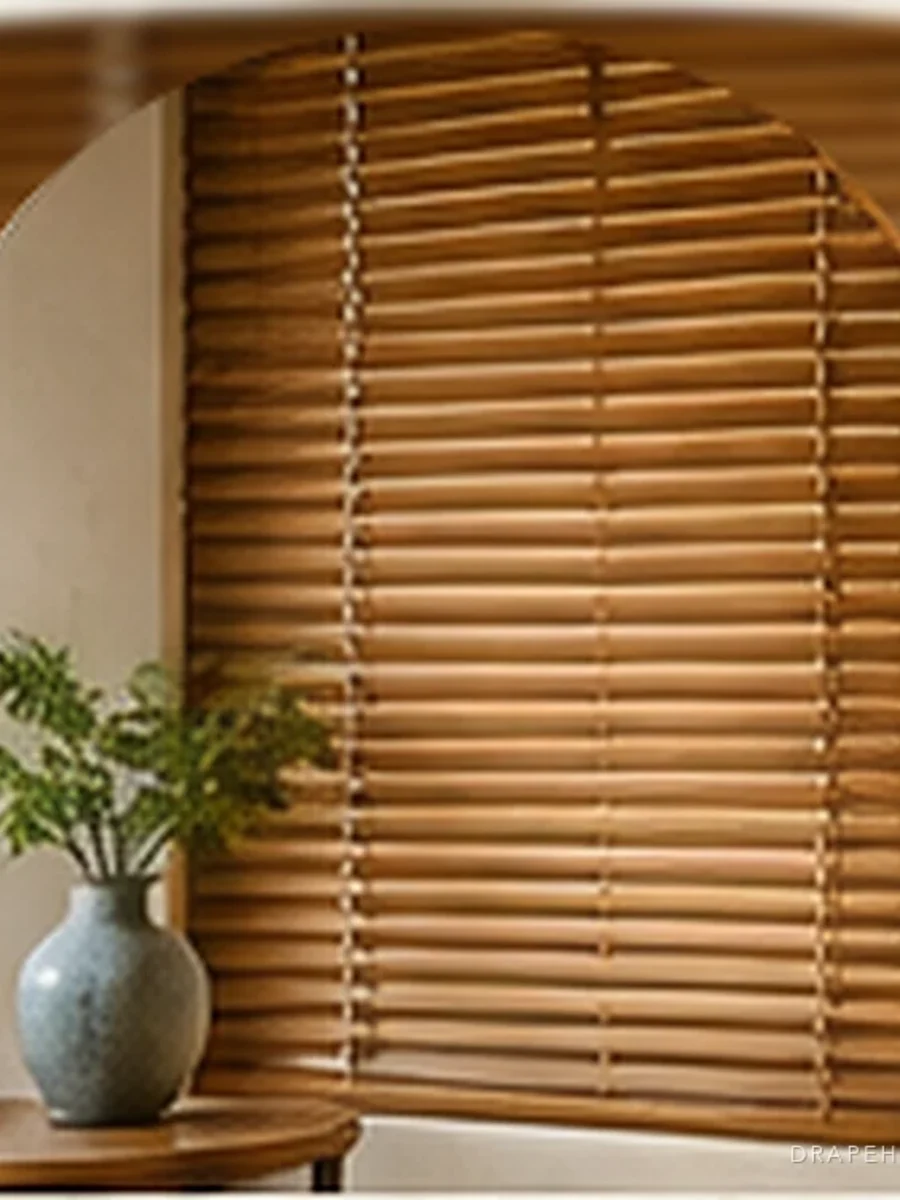
A wooden blind is a Venetian: horizontal slats on ladder tapes, turned by a wand or cord. The tilt, not the height, is what you adjust every day. Try it below.
Wooden slats · Midday
Treatment
Time of day
Tilt the slats to bounce light off the ceiling and keep eyes out. Closed, near-total privacy; open, a striped view.
In short
Tilting the slats lets light in while the slats themselves still interrupt the view. Part-open, a wooden blind keeps a room bright and private at once. Closed flat, it goes nearly dark. Fully open, after dark, it hides very little.
Using the simulator
The simulator opens on Wooden slats. Drag the Tilt slider to 0%: the slats close flat, Daylight in reads None and Daytime privacy High.
Move it to around 35%. Light comes in, the floor picks up stripes of sun, and privacy stays High.
Take it to 100%. The slats turn edge-on, the sea shows between them, and privacy drops to Some.
Switch to Night at full tilt: Privacy, lights on falls to Low. Close the slats and it returns to High.
What the simulator shows
Every Venetian works the same way, whether the slats are timber, faux-wood or aluminium. Ladder tapes or cords hold the slats at an even spacing. Turning the wand rocks all the ladders together, so the slats tilt in unison from flat and closed to edge-on and open.
A second cord lifts the whole blind into a stack at the top. The simulator leaves that out and only tilts, because tilting is what you do ten times a day.
Part-tilted, each slat catches direct sun on its upper face and throws some of it upwards into the room. The ceiling becomes a soft reflector, and the room is lit indirectly instead of by a hard patch on the floor.
The simulator shows how far the slats are open, not which way they face. In a real room the direction matters: angle the slats so a view up from the lane or garden meets the face of a slat, and go outside at dusk once to check.
This is what sets Venetian blinds apart. At a third of the way open in the simulator, daylight rises while Daytime privacy stays at High. No roller or Roman can do that without being raised.
At night the balance shifts. Lamps inside make the room the bright side, and every gap between slats becomes a window. Close them in the evening and wooden slats are among the most private blinds there are.
In a living room, timber slats bring warmth and a sense of joinery that suits terracotta floors and lime-washed walls. Tilt them through the day as the sun moves round.
In a bedroom, they close dark enough for a nap but not for true blackout: thin lines of light slip past the slat edges and the cord holes. Add a lined curtain for a room that must be dark.
| Tilt | Daylight in | View out | Daytime privacy |
|---|---|---|---|
| 0% (closed) | None | None | High |
| About 35% | Low | Low | High |
| About 50% | Some | Low | Good |
| 100% (open) | Good | Some | Some |
See it at your own window
The simulator narrows the choice. At the house we bring the real fabrics, hold them up to your light and measure every window.
In Goa
Real wood takes up moisture. In a bathroom, a kitchen, or a room shut for the monsoon, timber slats can swell and bow and rarely lie flat again. Faux-wood or PVC slats look much the same and ignore the damp.
Keep real timber for dry, lived-in rooms with a breeze through them. Near the sea, dust the slats often: salt holds moisture on the surface.
On a west-facing window, expect to close the slats a little further at golden hour than at noon. The low sun comes in almost level, straight through a gap that was enough to shade the room at midday.
FAQ
By the angle of the slats. Closed flat, they block almost all light. Part-tilted, they let light in and reflect some of it towards the ceiling. Edge-on, they let most light in along with a striped view.
By day with the slats part-tilted, very little. At night with lamps on and the slats open, yes, between the slats. Close them fully in the evening.
Real Venetians do lift into a stack, but day to day you tilt them. The simulator shows the tilt because that is where the light, view and privacy change.
Not in real timber. Steam swells the slats. Choose faux-wood, PVC or aluminium slats, which give the same look and wipe clean.
Closed, they stop direct sun well, and the simulator's Sun and heat cut meter reads High. Part-tilted they still keep much of the sun off the floor.