 Drapehaus
Drapehaus
Preparing the room
Drapehaus
Preparing the room
Wallpaper calculator
Wallpaper is counted in drops — full-height strips — not square metres. Add your walls below and the calculator counts the drops, fits them to rolls, and draws the walls papered in the pattern you choose.
Pattern
Walls (width in metres)
Roll width
Pattern repeat
Rolls to order
5
4 + 1 spare, same batch
Drops
12
3 per roll
Wall area
17.4 m²
before doors and windows
An estimate for planning, assuming 10 m rolls. Doors and windows rarely save a whole drop, so they are not deducted. We measure and count drops on site before anything is ordered.
In short
Two walls of 3.6 m and 2.4 m, 2.9 m high, on standard 0.53 m rolls with a 53 cm repeat, need 12 drops at three per roll: four rolls, plus one spare, so five to order. The repeat and the wall height decide how many drops each roll gives, and that matters more than the area.
Using the simulator
Type the width of each wall in metres under Walls. Use + Add a wall for up to six walls, and × to remove one.
Set the Wall height slider, from 2.2 m to 6 m, measured from skirting to ceiling or cornice.
Choose the Roll width — 0.53 m standard or 1.06 m wide — and the Pattern repeat: None, 27 cm, 53 cm or 64 cm.
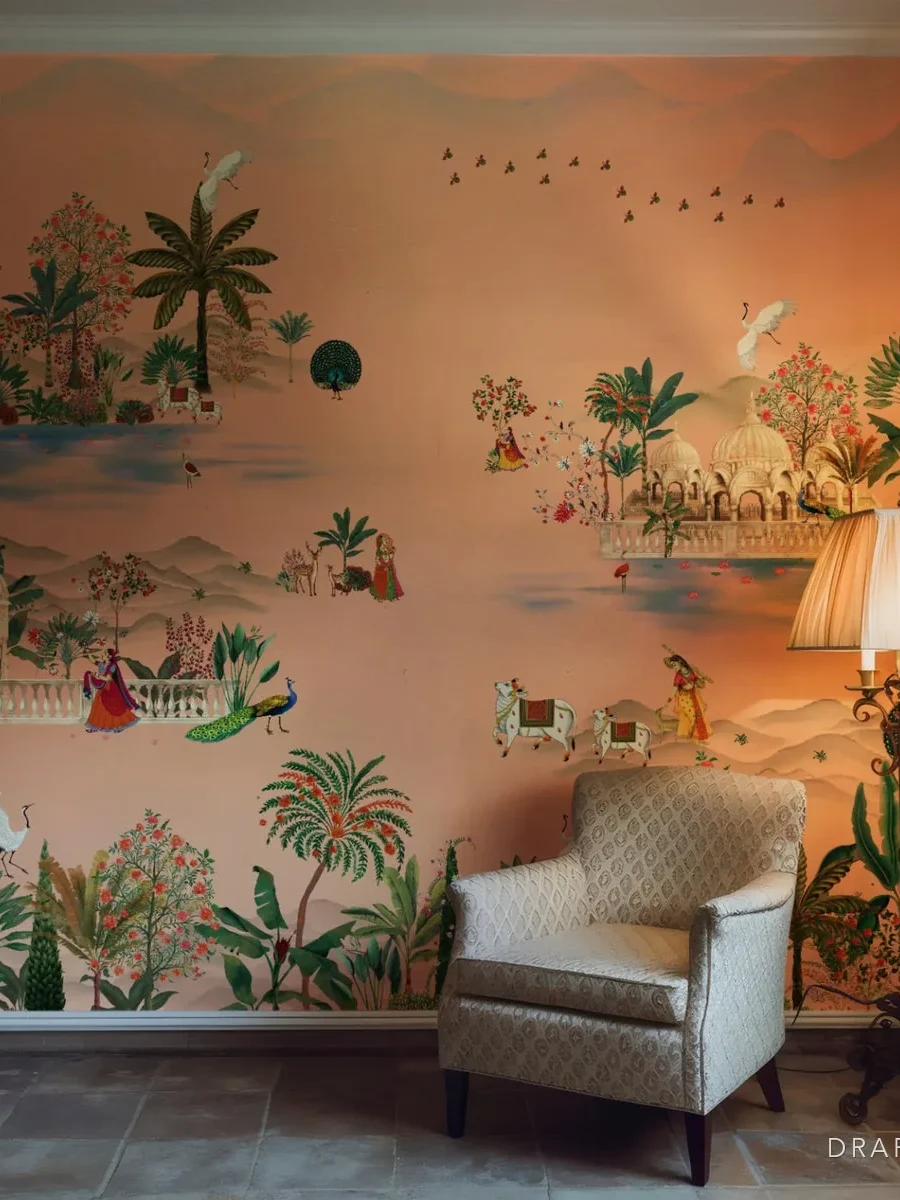
Pick a Pattern — Botanical, Damask, Stripe or Grasscloth — to see the walls papered at that repeat, then read Rolls to order, Drops and Wall area underneath.
What the simulator shows
Most wallpaper sold in India follows the European roll: 0.53 m wide and 10.05 m long, about 5.3 square metres. Wide rolls are 1.06 m by the same 10.05 m, twice the paper and half the seams.
Those are the two sizes in the Roll width row. Some papers, especially imported American or specialist designs, come in other widths and lengths; the label on the sample book is the number to trust.
First, each drop. The calculator takes the wall height, rounds it up to a whole number of pattern repeats, and adds 10 cm for trimming at top and bottom. Then it works out how many whole drops a 10.05 m roll yields at that length. Offcuts shorter than a drop are waste.
Next, each wall. Its width is divided by the roll width and rounded up, so a 3.6 m wall on 0.53 m paper takes seven drops. The drops for all walls are added, divided by drops per roll, and rounded up. One spare roll goes on top, from the same print batch.
A patterned paper has to line up across every seam, so each drop has to start at the same point in the design. On a 2.4 m wall, a plain paper gives four drops from a roll. Set a 64 cm repeat and it gives three — enough to add a whole roll to a room.
The drawing shows the repeat at its real size, with a faint line wherever one drop meets the next. Large repeats suit tall walls and big rooms; in a small room a 27 cm repeat or a stripe usually wastes less and reads more calmly.
The Wall area figure is shown before any openings are taken off, and the roll count ignores them. A door or window rarely saves a whole drop: the paper above and below still needs cutting from full lengths, and the pattern has to carry on across it.
A wall that is mostly glass is the exception, and that is one of the things we count on site.
Rolls are printed in batches, and colour can shift slightly between them. The spare means a damaged drop, or a repair years later, can be matched from the same batch. Keep it flat, wrapped and somewhere dry.
| 0.53 m roll | 1.06 m roll | |
|---|---|---|
| Roll size | 0.53 × 10.05 m | 1.06 × 10.05 m |
| Drops needed | 12 | 7 |
| Drops per roll | 3 | 3 |
| Rolls to order, with spare | 5 | 4 |
| Seams | More, narrower strips | Fewer, heavier strips |
See it at your own window
The simulator narrows the choice. At the house we bring the real fabrics, hold them up to your light and measure every window.
In Goa
Old Goan houses often have taller walls than a modern flat, which is why the Wall height slider runs to 6 m. On a tall wall, check how the repeat falls: a design that lands awkwardly at the top will be seen.
Paper only stays up on a wall that is dry and sound. Lime plaster and laterite walls need checking for damp and loose render before anything is ordered, and the monsoon months from June to September are the hardest time to hang. We measure, test the wall and count drops on site first.
FAQ
Because paper is used in full-height drops. The part of a roll too short for another drop is waste, and a pattern repeat adds more. Dividing area by roll area always undercounts, sometimes by a roll or two.
The design repeats every 53 cm down the roll. Each drop has to start at the same point in the design so it matches the drop beside it, which is why a larger repeat leaves more paper as offcuts.
It has fewer seams and often needs fewer rolls, as the comparison shows. Wide rolls are heavier and some are hung by pasting the wall, which suits an experienced paperhanger. The choice depends on the paper and the wall more than the count.
The calculator shows a pattern at its real repeat on walls of your size, which helps you judge scale. For the design itself, we bring large samples to hold against the wall in its own light.
Use it for planning. We measure each wall, check for out-of-square corners and uneven ceilings, and count drops on site before anything is ordered.