 Drape Haus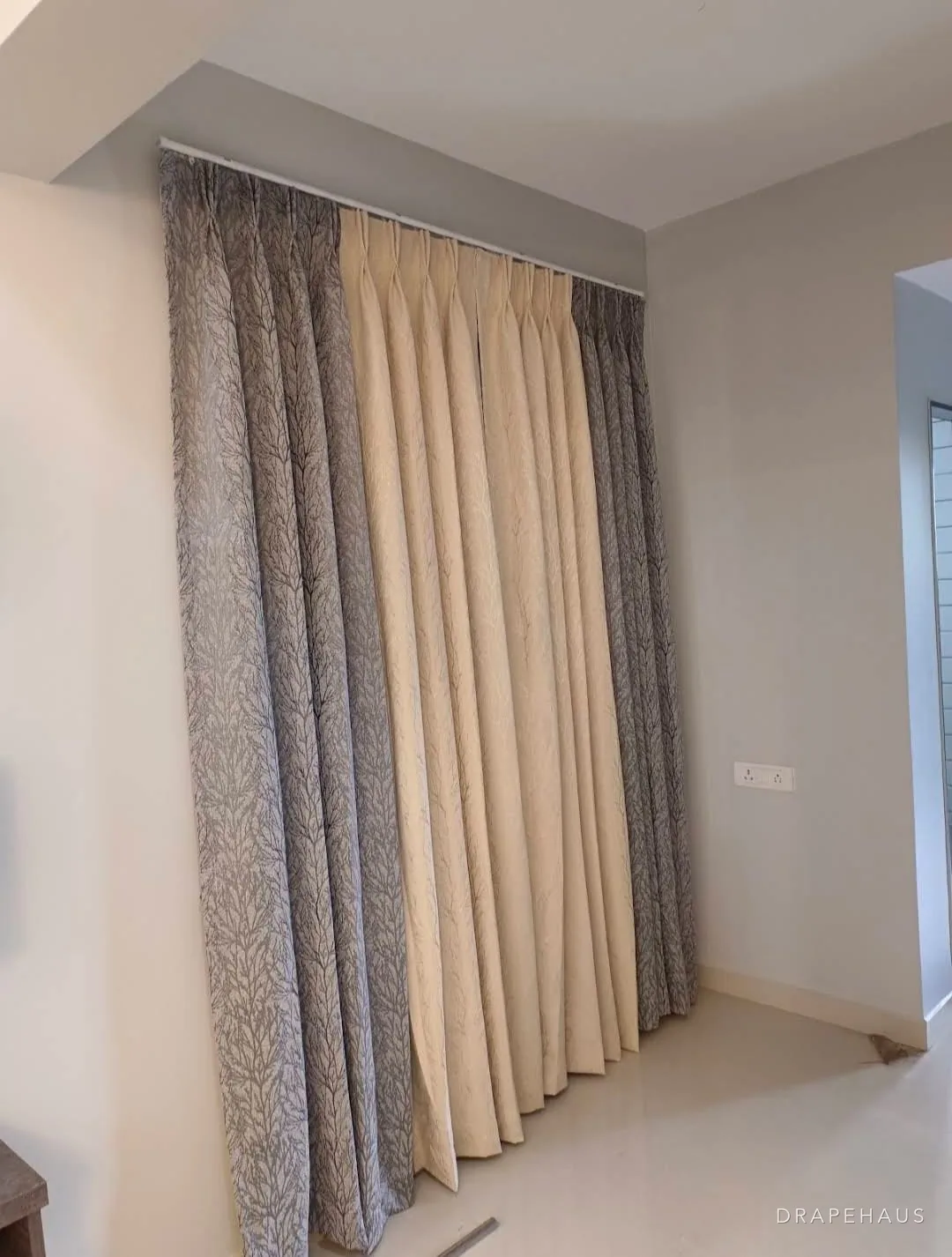
Partition design without building a wall comes down to four families of divider: a curtain on a ceiling track, a fixed screen of fluted or solid panels, a slatted or louvered screen, and a half-height divider such as a console, shelf or low panel. Each one separates a space in a different way. A curtain closes completely and then disappears. A fluted screen gives a permanent, solid-looking edge. Slats block the view at some angles and let air and light through. A half-height divider marks a zone and leaves the room open above eye level.
In Goan flats and houses the choice is shaped by things a solid wall would spoil: the cross-breeze between windows, the daylight from one side of a deep room, and the sense of space in a hall with a high ceiling. It is also shaped by rentals, where nothing can be built, and by houses that fill with family for festivals and need a guest corner for a fortnight.
Below, each type is explained with where it works, how it is fixed, and an honest account of what it does for sound, which is where most expectations go wrong. If you already know a curtain is the answer, our ceiling curtain tracks page covers the fixing in detail.
Decide what the partition has to do
Start with the job, not the material. Most dividers are asked to do one or two of these: hide something (a bed in a studio, a desk, a kitchen from the front door), mark a zone (dining from sitting in a long hall), close a space at certain times (a guest bed at night, a study during calls), darken one part of a room, or reduce sound. The first three are easy. Darkening is possible with the right fabric. Reducing sound is the hardest and is covered honestly in the last section.
Then decide whether it needs to move. A partition that is open most of the day and closed at night wants to be a curtain or sliding panels. One that is always in place can be a fixed screen, which can be more architectural and needs no daily handling. One that only needs to suggest a boundary can be half height.
The table matches common needs to the dividers that serve them. Most homes end up with one type in one place, and that restraint is part of what makes a partition look intended rather than improvised.
| Divider | Hides | Moves | Light and air | Sound |
|---|---|---|---|---|
| Sheer curtain on ceiling track | By day, partly | Yes | Both pass | Softens echo only |
| Lined or blackout curtain on track | Fully | Yes | Blocks light; air over and under | Softens echo; blocks little |
| Fluted or solid panel screen | Fully | No (or sliding) | Blocks both | Some, if sealed at edges |
| Slatted or louvered screen | At an angle | No (or sliding) | Both pass | Almost none |
| Half-height divider | Seated view only | No | Both pass above | None |
Curtain partitions on ceiling tracks
A curtain on a ceiling track is the most flexible partition there is. Drawn, it closes a space from floor to ceiling; pulled back, it gathers into a narrow stack at one end and the room is whole again. Because it hangs from the ceiling rather than a wall, it can cross a room anywhere, turn a corner, or follow a curve around a bed. Our ceiling curtain tracks can be bent round corners and recessed into a false ceiling so that only a slot shows.
The ceiling decides the fixing. A concrete slab takes fixings directly. A gypsum false ceiling cannot hold a loaded track on the board alone; it needs timber or metal backing along the track line, or fixings through to the slab above, which is much easier to arrange before the ceiling is closed. In older houses with timber ceilings, the track is fixed into joists or a batten spanning them. The stack, the bundle of fabric when the curtain is open, takes real space, so decide where it will park: against a wall, in a recess, or behind a cupboard end, rather than in the middle of a walkway.
The heading changes the look. Ripple-fold curtains hang in even, soft waves and look tidy from both sides, which matters for a divider. Pleated headings look more formal. Let the curtain finish just clear of the floor, so it slides without dragging and does not wick up water from a mopped floor, and fit a wand or a pull so that hands do not mark the leading edge.
Planning something like this?
We visit homes across North and South Goa, measure on site, and bring samples to see in your own light.
Sheer or opaque: privacy by day and by night
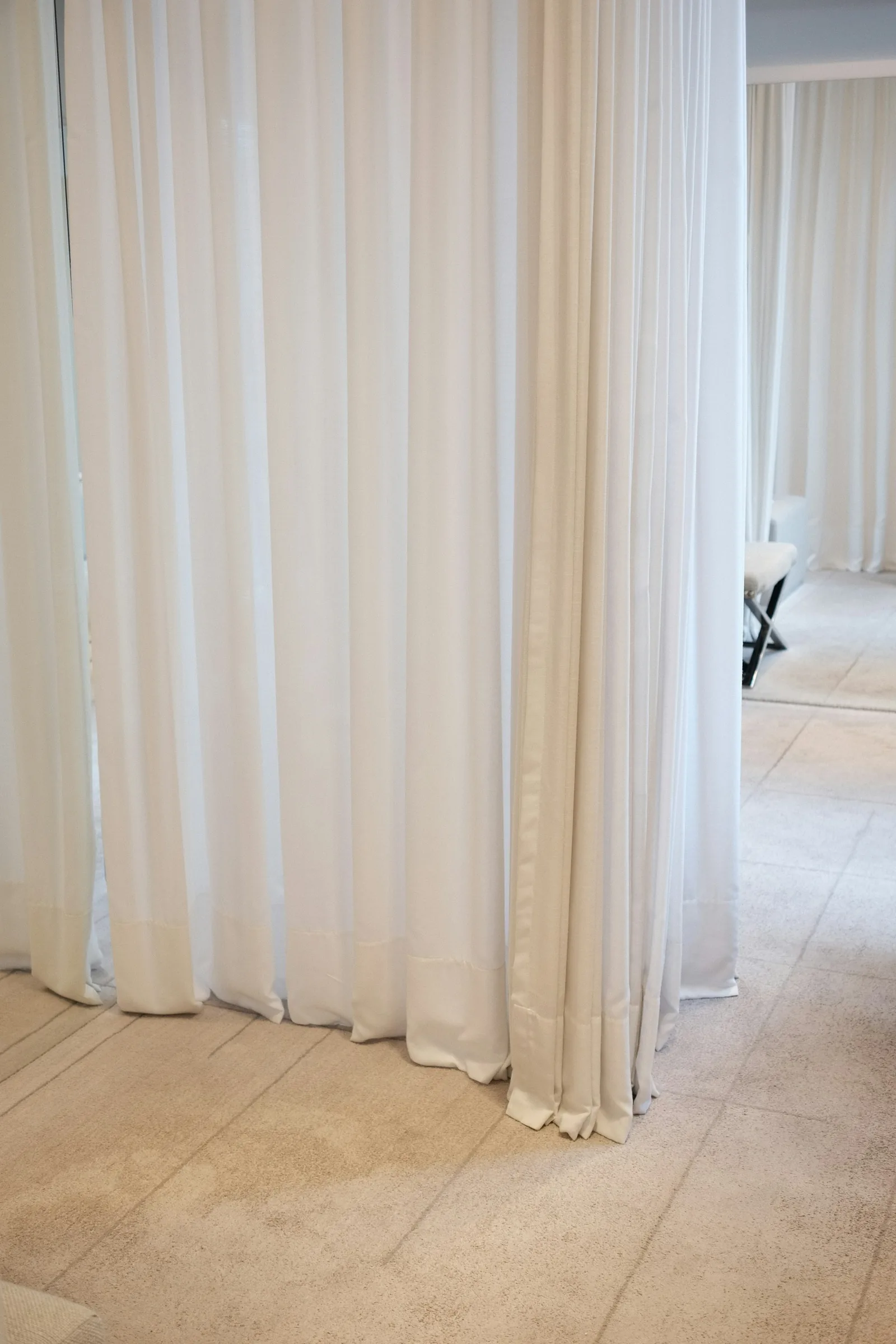
A sheer divider is the gentlest choice. It blurs the bed or desk behind it, lets daylight through to the darker side of the room, and moves in the breeze from the fan. It gives good privacy by day, when the brighter side is the one you are standing in, but it reverses at night: with a lamp lit behind it, a sheer shows everything in silhouette. If someone will sleep or change behind the divider, a sheer alone is not enough.
An opaque curtain, lined or with a blackout lining, gives real privacy and darkness at any hour. It suits a guest bed in the living room, a child's sleeping corner, or a studio where one person works late while another sleeps. The trade-off is that it cuts off light and air when drawn, so it is best drawn only when needed. A double track carrying a sheer and a lined curtain gives both options, at the cost of a slightly deeper stack.
A divider has no back. Unlike a window curtain, both faces are seen, so choose a fabric that looks good on both sides, or line it in a fabric that matches. Hems and side seams should be finished neatly on both faces. Our sheer curtains and blackout curtains can be made double-faced for exactly this use.
A sheer hides by day and reveals by night: with a lamp behind it, it shows everything in silhouette.
Fluted and solid panel screens
Where a partition should look permanent and architectural, a screen of fluted panels does what a curtain cannot. Vertical ribs catch light from the side, add height to the room, and give a finished edge that reads as part of the building. A fluted screen between an entrance and a living room, or around the end of a bed in a studio, gives a firm sense of enclosure.
The cost of that solidity is light and air. A fluted screen of full height blocks both, so it suits places where the space behind already has its own window, or where the partition stops short of the ceiling. Screens can be built on a light frame fixed between floor and ceiling, or as sliding panels on a top track so that they open like doors. Our fluted wall panels come in PVC and WPC, which suit humid rooms, and in MDF and timber for dry interiors.
On ground floors in Goa, where termites are a concern, keep timber or MDF screens off the floor on a non-timber base and leave the bottom edge visible so it can be inspected; our guide to termites and timber explains what to look for. Grooves collect dust, so a soft brush every couple of weeks keeps them crisp.
Louvers and slats that keep the breeze moving
Slatted and louvered screens are the most climate-friendly partition for a Goan home. They block views at an angle and let air and light pass straight through. That matters because many Goan rooms rely on cross-ventilation: during the monsoon the India Meteorological Department records winds that are mostly westerly to south-westerly, and in a flat with windows on two sides, a solid partition across the middle can stop the breeze altogether.
Slat depth and spacing decide how private the screen is. Deep slats set close together look almost solid from an angle and open up only when you stand square in front of them; shallow slats spaced widely are mostly decorative. Vertical slats block side views best, which suits a screen beside an entrance that should hide the sitting room from the door. Stand at the key viewpoints with a piece of card before deciding.
Our louvers are made in PVC, WPC, aluminium and timber, and louvers design ideas covers spacing, depth and materials in detail. For a partition that needs both openness and the option of closing, a louvered screen with a curtain on a track behind it gives both.
Half-height partitions that zone without closing
Not every partition needs to reach the ceiling. A divider that stops around seated eye level marks a boundary clearly while leaving the room open above, so the ceiling, the light and the air are shared. In a long hall it is often the right answer between sitting and dining areas, where people want a sense of two rooms but still want to talk across them.
Half-height dividers are usually furniture: a low bookshelf open on both sides, a console behind the sofa, a planter box, a bench with storage. They earn their space by holding things. A fluted or slatted panel fixed to the top of a low cabinet adds height without closing the room. If it holds books or plants, remember the rest of the house's rules: books want dry, moving air, and plant trays need emptying in the monsoon.
The one thing to plan is stability. A tall, narrow shelf standing free in a room can tip, especially with children climbing it, so fix it to the floor or make it wide and low. Our page on flats looks at partitions alongside the other furnishing choices for apartments.
What each divider does for sound, honestly
This is where expectations most often go wrong. Stopping sound passing from one side of a partition to the other depends mainly on mass and on sealing every gap. The National Research Council of Canada's building digest on sound transmission puts the theory plainly: for a large thin panel, insulation would rise by about 6 dB for each doubling of its mass, and sound passing through cracks may drastically reduce the insulation of the whole assembly. A curtain weighs very little, and a curtain partition has gaps at the top, bottom and edges. Slatted screens are mostly gaps.
Specialist acoustic curtains do exist. In a laboratory test reported at an Acoustical Society of America meeting, a curtain used as a room divider gave a frequency-weighted improvement of 17 dB, but only when a dense mass interlining was sandwiched between two absorbent face fabrics; the face fabrics alone gave much less. That is a heavy, purpose-made curtain tested in controlled conditions. An ordinary sheer or lined curtain in a flat will not come near it, and any gap round the edges lets sound through.
What fabric does well is absorb echo. In a tiled Goan room with plaster walls, a full curtain across a space softens the ring of voices and the clatter of a kitchen on both sides of it, which makes the whole room feel quieter even though sound still passes. A fluted screen sealed at floor and ceiling blocks a little more. For real speech privacy, for example a study where calls must not be overheard, you need a built wall and a door, which is a builder's job, not ours. Our guide to noise-reducing curtains and our acoustic panels cover the echo side in more depth, and a home visit is the simplest way to plan the right partition for your room.