 Drapehaus
Drapehaus
Preparing the room
Drapehaus
Preparing the room
Problem
Plenty of Goan homes cannot be drilled. Tenancy agreements forbid it, society bye-laws restrict it near structural elements, and in heritage properties the wall may simply be too valuable or too fragile to penetrate.
By the Drapehaus studio · 19 September 2026 · How we write
The no-drill options have improved considerably and now genuinely work within their limits. The important part is the limits, because the failure mode when they are exceeded is a curtain, a track and a piece of paint arriving on the floor at three in the morning.
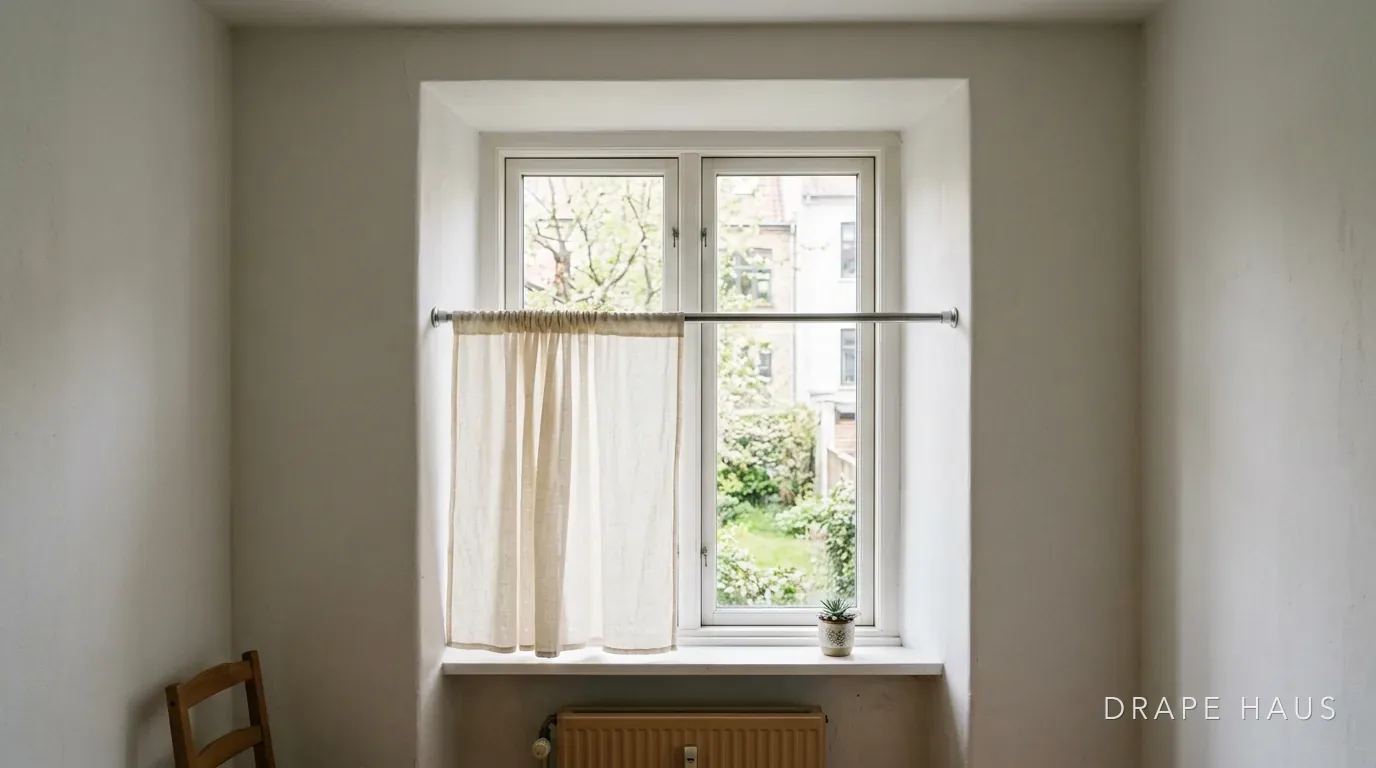
A tension rod works by spring pressure between two opposing faces, which means it needs a genuine reveal with solid sides. It cannot be used across an opening with no return, and it will not work where one side is a plasterboard return that flexes.
Within a sound reveal, a good tension rod will hold a light unlined curtain or a pair of sheers reliably for years. It will not hold a lined curtain, and it will certainly not hold anything interlined. Overloading one is the most common cause of a rod slipping, usually in the middle of the night when the room cools and the metal contracts slightly.
Width is the other limit. Past about a metre and a half, the rod sags under its own weight plus fabric, and the spring pressure at the ends is no longer enough to stop rotation. Two shorter rods on a wide window are better than one long one.
Modern adhesive mounting systems use structural foam tape rated for meaningful loads and are far better than the suction and hook products they replaced. On a clean, sound, non-porous surface they will carry a light to medium curtain.
The critical words are clean, sound and non-porous. Adhesive on lime plaster, distemper or any chalky paint bonds to the surface layer, and the surface layer then separates from the wall — so the fixing does not fail, the wall does, and the damage is worse than a drilled hole would have been.
On tiles, glass, painted concrete and sound emulsion over cement render, these systems perform well. On old Goan plaster we do not recommend them at all, which is unfortunate because that is exactly where drilling is most often prohibited.
Rather see it in your own room?
We bring samples to the house, measure every window, and specify for the light and exposure you actually have.
More on this — tap a heading to read
Many windows have a timber or aluminium frame that can take a small screw where the wall cannot. A frame fixing is a drilled hole, but it is in a component that is already perforated by its own fixings, and most landlords view it very differently from a hole in the wall. Ask rather than assume.
Pressure-fit blinds that clamp into the reveal without fixings are available for standard sizes and are a genuinely good answer in rentals, particularly for rollers.
Free-standing screens are the forgotten option. For a privacy problem at a single window, a folding screen solves it with no fixing of any kind, moves with you when you leave, and in a period Goan room often looks better than a curtain would.
Start with the reveal. Measure its depth, check that both sides are solid and parallel, and press firmly on each face: plaster that flexes, sounds hollow or crumbles at the corner will not hold a tension rod. Measure the width at top, middle and bottom, because old openings taper and a rod set to one width will be loose at another.
Then check the surfaces. Rub a damp finger on the paint; if it leaves a chalky mark, the paint is distemper or a weak emulsion and adhesive will lift it. Tiles, glass and glossy paint over cement are the surfaces adhesive systems like. Finally, read the agreement. Many clauses forbid drilling walls but say nothing about window frames, ceilings or existing fixings, and some landlords are happy for approved fixings to stay when the tenant leaves.
Many rental flats already have fixing points: an old curtain rod, brackets left by a previous tenant, hooks in the frame or a pelmet board. These are worth inspecting before anything new is considered. A sound existing bracket can often carry a new track or pole, and reusing it involves no new holes at all.
Where the existing hardware is in the wrong place or the wrong style, it can sometimes support a short extension or an adapter that moves the curtain line to where it is needed. We check what the old fixings are set into and whether they are sound, because a previous tenant's failing fixing is not a good foundation. Built-in features also help. Deep Goan reveals can take a pressure-fit blind or tension rod neatly, and a timber pelmet board can take screws without touching the wall.
The practical rule is to choose the fabric after the fixing, not before. Tension rods and adhesive track suit unlined cotton, linen-look polyester and voile, and they suit lightweight roller blinds. They do not suit lined, interlined, blackout-lined or velvet curtains, which are simply too heavy. Where darkness is needed in a no-drill bedroom, a pressure-fit blackout roller inside the reveal is usually more effective and more secure than a heavy curtain. It weighs little, fits closely, and leaves the room looking tidy.
For privacy and softness, pair it with a light sheer or unlined curtain on a tension rod. The combination gives most of what a lined curtain would, within what the fixings can carry. It is also easy to take away at the end of a tenancy, and both parts can usually be adjusted to fit the windows of the next home.
No-drill fixings behave differently here than in temperate climates. Adhesive foam tapes can soften in sustained heat and lose grip in the humidity of the monsoon, especially on surfaces that are slightly damp or on external walls that stay cool. Apply adhesive systems in the dry months, onto thoroughly clean and dry surfaces, and give them time to bond before loading. Tension rods are affected by temperature too. Metal expands and contracts slightly with heat, and a rod set in the cool of the morning can loosen in the afternoon or overnight. Checking tension at the start of the monsoon and again after it ends catches this before anything falls.
From a landlord's side, a few well-placed, properly installed fixings are often better for the property than repeated no-drill attempts that fail and pull paint away. Some owners of rental flats now fit a standard track or pole at each window themselves, so every tenant can hang their own curtains without drilling.
From a tenant's side, the goal is to leave without a mark. Adhesive systems should be removed slowly, with gentle warmth to soften the tape, rolling it off rather than pulling it straight out. Tension rods simply come out. Frame fixings leave small holes that can be filled and touched up. Keep any hardware you buy, because a good no-drill system can be adjusted and reused in the next home.
Diagnosis
WhyOverloaded, too wide, or mounted where one side of the reveal flexes. Thermal contraction as the room cools does the rest.
FixLight unlined fabric only, spans under about 1.5m, and solid opposing faces. Use two rods rather than one on a wide window.
WhyBonded to a chalky or porous surface layer that was weaker than the adhesive.
FixOnly use adhesive systems on clean, sound, non-porous surfaces. Never on lime plaster or distemper.
WhyBlanket clause in the agreement, often written without much thought about windows.
FixPressure-fit blinds, tension rods, or a free-standing screen. Also worth asking specifically about the window frame, which is often viewed differently.
WhyLined or interlined curtains are simply outside what friction and adhesive can hold.
FixChange the specification rather than the fixing. A lighter unlined curtain or a roller blind achieves most of the effect within what the fixing can take.
WhyHeat and humidity softened the adhesive, or the surface was damp or cool when it was applied, so it never fully bonded.
FixApply adhesive systems only in dry weather to clean, dry surfaces, allow full curing time, and keep them off external walls.
WhyThe end pads are hard or small, and high spring pressure concentrated on soft paint dents or marks the surface.
FixUse rods with wide, soft end pads, and add a thin protective pad under each end where the paint is soft.
WhyThe reveal is tapered or out of square, so the blind is tight at one end and loose at the other.
FixMeasure the reveal at several points, set the blind to the narrowest dimension, and pack the looser end evenly.
Checklist
Check the reveal has solid, non-flexing opposing faces
Keep tension rod spans under about 1.5 metres
Never use adhesive on lime plaster or chalky paint
Ask specifically about fixing to the window frame
Consider pressure-fit blinds for standard reveals
Match the curtain weight to the fixing, not the other way round
Test the paint with a damp finger before choosing any adhesive system
Look for existing brackets, pelmets and frame fixings before buying
Apply adhesive systems in dry weather, never into monsoon humidity
Check tension rods at the start and end of the rains
FAQ
Yes, for light curtains. Tension rods inside a sound reveal and modern adhesive track on clean non-porous surfaces both work well within their limits. Neither will hold a lined or interlined curtain, and trying is how people end up with a track and a piece of wall on the floor.
No. Adhesive bonds to the surface layer, and on lime plaster or distemper that layer is weaker than the bond — so the plaster comes away with the track and the damage is worse than a drilled hole. Adhesive is for tiles, glass and sound paint over cement render.
About a metre and a half with light fabric. Beyond that it sags under its own weight and the end pressure is no longer enough to stop it rotating and slipping. On a wider window, two shorter rods work far better than one long one.
Pressure-fit blinds that clamp into the reveal, tension rods, or a free-standing folding screen, which needs no fixing at all and moves with you. It is also worth asking specifically about the window frame — many landlords treat that quite differently from the wall.
Heavy blackout curtains are usually too much for tension rods or adhesive track. A pressure-fit blackout roller blind inside the reveal gives darkness more securely, and a light curtain or sheer on a tension rod can hang in front of it for softness. If a proper track is needed, ask the landlord about fixing to the window frame or ceiling.
They work less well than in dry climates. Heat and humidity can soften adhesive and reduce grip, particularly on external walls, porous paint or surfaces that were damp when applied. Use them only on clean, non-porous surfaces, apply them in dry weather, and keep loads well below the rated limit.
Sometimes, with the landlord's agreement. A ceiling fixing is still a drilled hole, but it is often less visible and easier to repair than wall fixings. In apartment buildings, check what the ceiling is made of and whether there is a false ceiling, and avoid areas with concealed wiring or plumbing.
Split the window into sections. Two or three pressure-fit roller blinds, or two tension rods with a support at the middle mullion, carry far more reliably than a single wide rod. Where the window has a frame with mullions, each section can be treated separately, which also gives better control over light.
Keep reading