 Drape Haus
Drape Haus
Preparing the room
Drape Haus
Preparing the room
Wall Panels
Panels that absorb sound inside a room — felt, fabric-wrapped, slatted timber on felt and perforated boards. They tame the echo of tiled floors and high ceilings and make speech and music easier to follow.
In short
By the Drape Haus studio · How we write
Is it right for you?
An acoustic panel is a soft, porous layer fixed to a wall or ceiling that turns part of the sound striking it into a tiny amount of heat instead of bouncing it back into the room. Fewer reflections mean a shorter tail of echo after every word, footstep or note of music. Speech becomes clearer, a film soundtrack stops sounding muddy, and a room full of people talking no longer climbs to a roar.
That is a different job from soundproofing, and the two are often confused. Stopping sound travelling through a wall into a neighbour's bedroom needs mass, airtight construction and decoupled layers: a heavier wall, sealed gaps, solid-core doors. A panel of felt or fabric on the surface does very little for that. If the complaint is that the family can hear the television from upstairs, panels alone will disappoint; if the complaint is that the room itself sounds harsh and hollow, panels are exactly the right tool.
Many Goan interiors are acoustically hard. Vitrified or Kota floors, polished lime plaster, high ceilings in older houses, glass sliding doors and sparse furniture all reflect sound. A new villa living room with a double-height void can ring like a hall. Rugs, curtains and upholstery do a share of the absorbing; panels take care of the large bare surfaces that soft furnishings cannot reach.
This guide explains the main panel types, how much of a wall actually needs treating, where to place panels for a media room or a meeting room, and how to keep porous materials clean and free of mildew through a long monsoon or a house left shut for months.
The details
Acoustic panels reduce reverberation: the way sound bounces between hard surfaces and lingers. Goan homes are full of hard surfaces — tile or stone floors, plastered walls, high ceilings, glass — and a living room or conference room can sound like a hall. A few panels in the right places make a clear difference.
They are not soundproofing. Absorbent panels do very little to stop sound passing through a wall to the next room or the neighbours. That needs mass, sealing and separated construction, which is a different job, and we will say so if that is what you need.
Placement matters more than coverage. In a media room, panels at the first reflection points on the side walls and on the rear wall do most of the work. In a conference room, panels opposite the screen and along one long wall improve speech for both the room and people on a call.
Fabric and felt hold moisture and dust, so in Goa we favour polyester felt and synthetic fabrics, keep panels off damp external walls, and plan for air-conditioning or dehumidifying in rooms closed for the monsoon.
Your options
All of these absorb sound. They differ in how well they handle low frequencies, how they look, how they cope with humidity and how much abuse their surface will take.
Swipe for all 6 →
The honest view
Clearer speech straight away
Taking the hard reflections out of a room shortens the echo, so conversation, video calls and dialogue in films become easier to follow without raising the volume.
A calmer room at full occupancy
In dining rooms and cafés, noise feeds on itself as people raise their voices over each other. Absorption breaks that spiral and makes the room more comfortable to sit in.
Can double as decoration
Fabric colours, felt shapes and timber slats let treatment become a feature wall, a headboard zone or a ceiling pattern rather than something bolted on.
Retrofit without building work
Most panels fix with cleats, rails or adhesive pads onto an existing wall or ceiling, so a finished room can be improved without breaking plaster.
Not soundproofing
Panels reduce reflections inside the room. They do not meaningfully stop sound reaching neighbours, bedrooms or the street. That needs changes to the construction.
Porous surfaces collect dust and damp
The same openness that absorbs sound also traps dust, salt and moisture. In a humid coastal house, panels need airflow and regular dusting to stay fresh.
Thin panels miss the bass
A thin decorative felt sheet mostly treats higher frequencies. Rumble from a subwoofer or a busy road needs depth, corners and sometimes a cavity behind the panel.
Fire behaviour varies
Foams and some fabrics burn readily. In commercial rooms and escape routes the material's fire performance has to be checked before it goes on the wall.
Side by side
Soft furnishings, rugs and building work all affect how a room sounds. Here is what each realistically does.
| Acoustic panels | Heavy curtains | Large rugs | Soundproof construction | |
|---|---|---|---|---|
| Reduces echo in the room | Strongly | Moderately | Moderately, at floor level | Only if absorptive layers are included |
| Stops sound reaching next room | Very little | Very little | Little, some footfall | Yes, the main purpose |
| Covers walls and ceilings | Yes | Windows only | Floor only | Whole envelope |
| Humidity care needed | Moderate | Moderate | Moderate to high | Low |
| Work involved | Fixing to existing surfaces | Track and making | None | Building work |
| Look | Fabric, felt or timber feature | Soft, textile | Warm, layered | Invisible |
Swipe to compare →
A hard-finished living room usually needs a combination: curtains on the glass, a rug under the seating and panels on the largest bare wall or the ceiling.
Rather see it in your own room?
We bring samples to the house, measure every window, and specify for the light and exposure you actually have.
Room by room
Treat the side walls at the first reflection points, the rear wall behind the seats and the corners. Dialogue sharpens and the bass stops booming without turning the volume up.
Glass partitions and a hard table make speech smear on video calls. Panels on the wall opposite the screen and above the table make voices clearer at both ends of the call.
A few panels behind and beside the desk reduce the hollow sound that microphones pick up in a bare room. Match them to a bookshelf or headboard wall so they do not look clinical.
Ceiling baffles or high wall panels keep the volume of a full room in check. Choose wipeable or replaceable surfaces near the kitchen pass, where grease and smoke settle.
Large volumes with stone or tile floors ring. Panels on the upper walls or the ceiling, out of reach of daily wear, treat the space without crowding furniture.
Steam and splashing are hard on porous materials. Use only panels designed for wet areas, and never in the shower zone.
PET felt is light, soft-edged and pinnable, so it doubles as a display board while softening the noise of play. Fix it securely at low level.
In depth — tap a heading to read
Covering every surface makes a room sound dead and stuffy, which is as uncomfortable as a room that echoes. The aim is to reduce reverberation to suit the use. A living room usually feels right with a modest share of its wall area treated alongside a rug and curtains. A meeting room or a home theatre wants more, because speech clarity is the whole point of the room.
We start by listening to the room as it is: clapping, speaking at normal volume, playing a familiar film scene. Hard parallel walls with nothing between them produce a fluttering echo that a single panel on one of the pair often cures. A room that simply sounds loud everywhere needs absorption spread across walls and ceiling rather than concentrated in one block.
Treat opposite walls alternately rather than lining both, so the room keeps some life and the panels are not wasted on each other.
In a home theatre, the most valuable positions are the first reflection points on the side walls: the places where sound from the front speakers bounces once before reaching the listener. A simple way to find them is to sit in the main seat while someone slides a mirror along the side wall; wherever you can see a speaker in the mirror is a reflection point.
The rear wall behind the seating is next, because sound bouncing off it arrives just after the direct sound and blurs it. Corners take bass traps. The wall behind the screen is often left darker and treated too, so it does not reflect light or sound back into the room.
Porous panels and coastal humidity need managing. Mineral wool cores and natural-fibre fabrics can hold moisture through the monsoon, and once mildew starts inside a fabric wrap it is difficult to remove. For most Goan rooms we prefer synthetic fabric wraps and PET felt, which take up very little water and dry out quickly when the air does.
Fixing matters as much as material. A panel stuck flat against a damp external laterite wall sits in a pocket of still, moist air. Mounting on rails with a small gap behind lets air move, keeps the panel off any moisture in the masonry, and often improves low-frequency absorption too. Before any panel goes on an outside wall we check it with a moisture meter; a wall that is carrying water needs that fixed first.
In a house closed for months, leave internal doors open, run a dehumidifier on a timer if power allows, and avoid sealing panelled rooms behind shutters with no ventilation at all.
Not every soft material is suitable for a wall full of people. Open-cell foam sold for hobby studios can burn quickly and give off dense smoke, and some decorative fabrics are no better. In restaurants, conference rooms, auditoriums and any escape route, we specify panels whose fire performance is documented by the maker and check what the building's own fire requirements ask for.
At home the same caution is sensible near lamps, heaters and electrical equipment racks. Keep panels clear of concealed downlights unless the fitting is designed for it, and leave ventilation space around amplifiers and projectors.
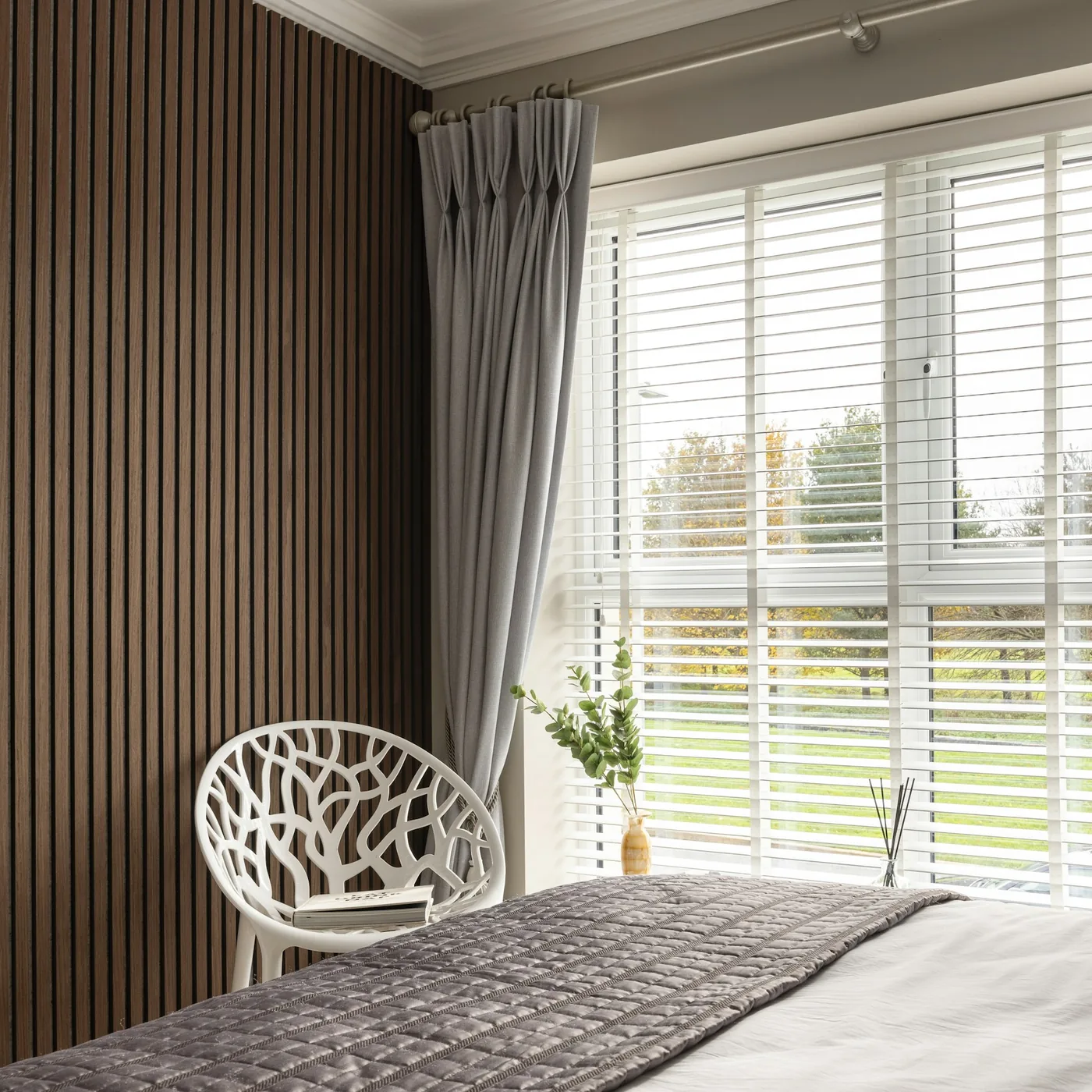
Acoustic treatment does not have to look like a recording studio. Fabric panels can be made to the exact width of an alcove, upholstered in the same weave as the sofa, or arranged as a grid that reads as a deliberate pattern. Slatted timber on felt passes as a fluted feature wall. Felt tiles can be cut into shapes for a playroom or a café.
Colour does the rest. Panels that match or sit one tone off the wall almost disappear; contrasting panels become art. In a heritage house with lime-washed walls, a soft, mid-tone fabric framed in timber sits more comfortably than bright felt.
Living with it
Vacuum with a soft brush attachment on low suction every few weeks. Dust in the weave gradually reduces absorption and holds moisture.
Lift spills from fabric or felt by blotting with a barely damp cloth. Scrubbing pushes the stain into the core and roughens the surface.
Check panels on external walls for a musty smell or darkening at the edges. Either is a sign of damp behind, which needs looking at before it spreads.
Run a fan or an air conditioner in dehumidify mode in closed media rooms during the rains. Still, humid air is what lets mildew take hold.
Fabric-wrapped panels can often be re-covered rather than replaced if the face is torn or stained, provided the core is dry and sound.
Avoid these
Panels make a room sound better inside. They will not keep a home cinema from waking the children upstairs. That is a construction question.
Thin egg-crate foam mainly absorbs high frequencies and leaves the room boomy. Choose depth and placement to suit the actual problem.
A single large panel in the middle of one wall helps less than the same area spread across reflection points and the ceiling.
Moisture in the masonry will mark and mildew the panel from behind. Check the wall first and mount on rails with an air gap.
Unknown foams and fabrics have no place in public rooms. Ask what the material is and how it behaves in a fire before it is fixed.
Checklist
More in wall panels
PVC, WPC, wood, fluted, acoustic and marble-effect panels, chosen for the wall they are going on as much as for the look.
Our process
One team from the first visit to the last bracket, so nothing is lost between the person who specified it and the person who fits it.
FAQ
No. They reduce echo inside the room. Blocking sound between rooms needs heavier, sealed construction.
It depends on the room's size, surfaces and use. We assess the room and place panels where they help most rather than covering every wall.
Yes. They make speech clearer in the room and on video calls, especially in rooms with glass walls and hard floors.
Polyester felt resists mould far better than natural fibres. Keep the room aired or air-conditioned and keep panels off walls that carry damp.
Yes. Slatted timber on felt, coloured felt in patterns and fabric-wrapped panels can all be the room's feature wall.
No. They absorb sound inside the room, which reduces echo and makes speech clearer. Stopping sound passing through walls and floors needs mass, sealing and decoupled construction. Panels can be part of a soundproofed room, but they are not the soundproofing.
They can if they are made of natural fibres, stuck flat to a damp wall or left in a sealed room for months. Synthetic fabrics and PET felt, a small air gap behind, and some airflow during the monsoon keep them fresh.
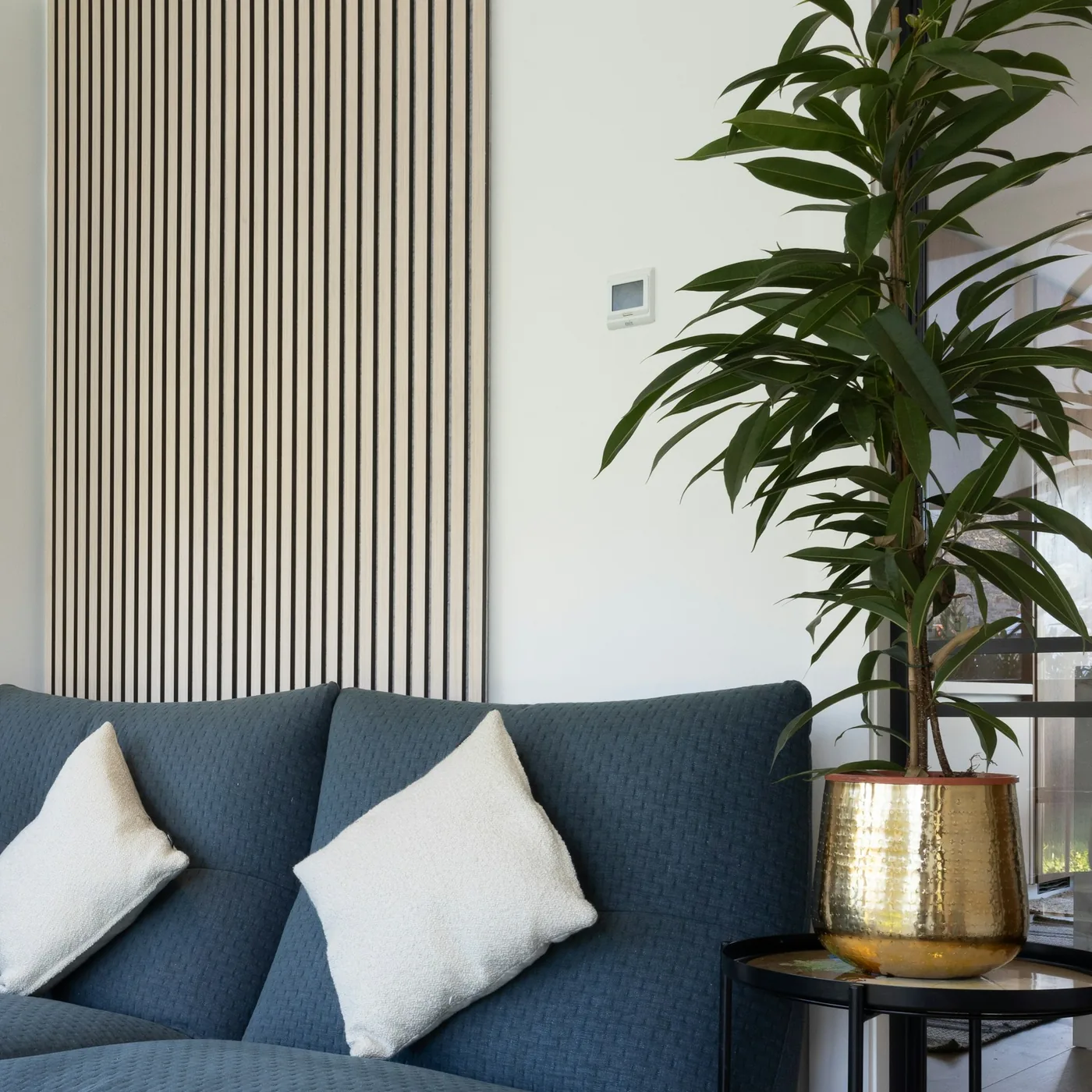
Slats mounted on a felt backing absorb a useful amount of sound through the gaps, which is why they are popular on TV walls. Plain slats fixed directly to plaster with no absorptive backing are decorative only and do little for echo.
Start with the first reflection points on the side walls, then the rear wall behind the seats, then the corners for bass. A low ceiling between the screen and the seating also benefits from treatment.
Next step
Acoustic treatment is easiest to plan in the room itself. We visit, listen to the space at normal use, check the walls for moisture and note the finishes that are causing the echo. We then propose panel types, sizes, colours and positions, make them to measure and fix them so they sit cleanly with the rest of the room. Book a visit and tell us what bothers you about how the room sounds.