 Drape Haus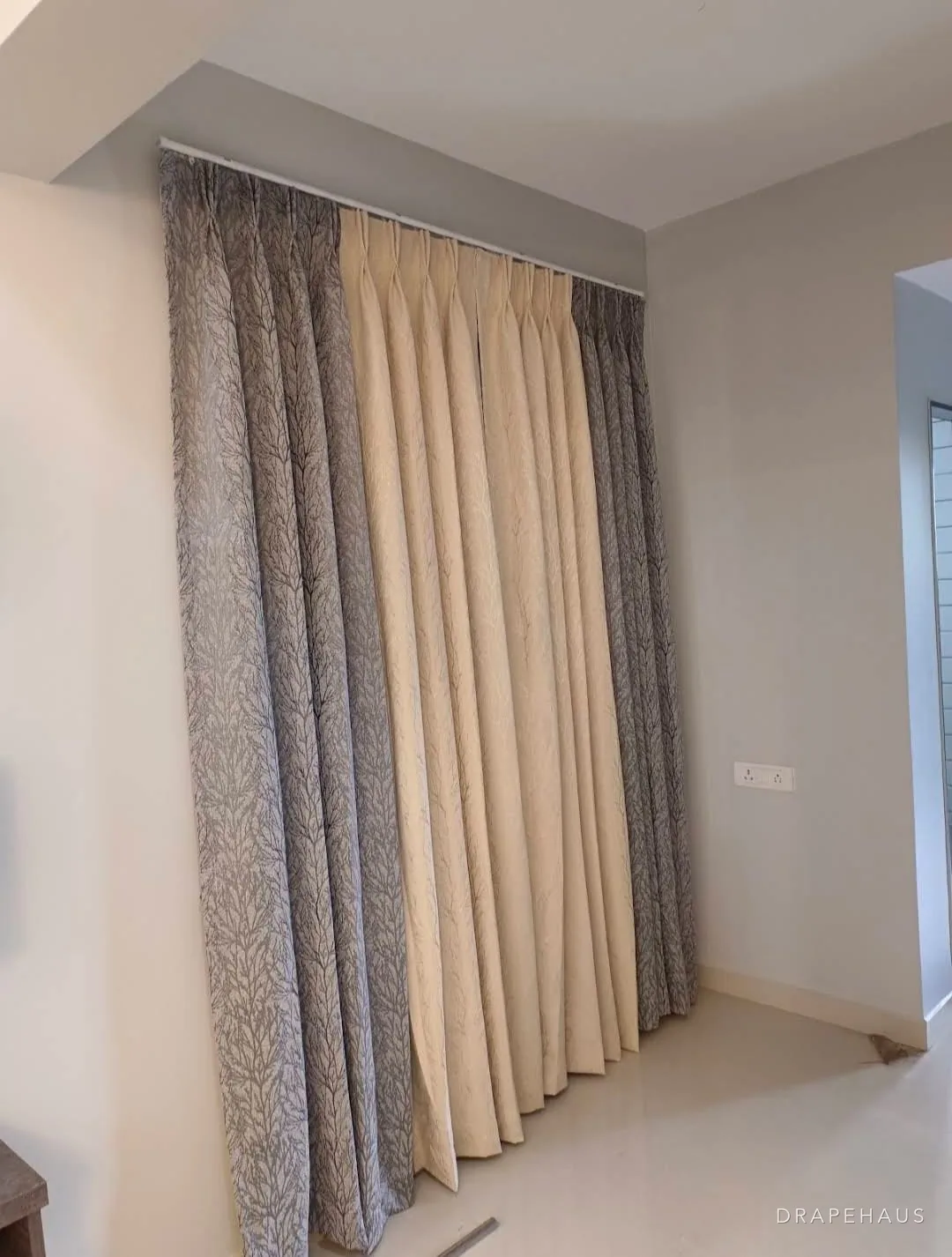

Noise-reducing curtains can help, but mostly in a different way from the one they are sold on. A dense, lined, generously full curtain is good at absorbing sound inside a room, which cuts echo and makes a tiled room feel noticeably calmer. It is much weaker at stopping sound coming in from outside, especially the low rumble of traffic or the bass of a sound system, because the window, its gaps and the walls let that sound past the fabric.
That distinction matters in Goa, where the noise people want to shut out is often loud and low: highway traffic, wedding-season sound systems, festival loudspeakers, construction, and neighbours on the other side of a thin flat wall. Fabric alone will not silence those. The right curtain, hung the right way, will take the edge off them and change how the room itself sounds. Sealing the window does the rest.
This guide explains how sound gets into a room, what fabric weight, density, interlining and fullness actually do, why curtains help tiled Goan rooms so much, the hanging details that matter, how to combine curtains with panels and rugs, and the humidity trade-off of heavy curtains. If you have a noisy bedroom in mind, our blackout curtains and velvet curtains pages show the heavier constructions we make.
How sound gets into a room
Sound reaches a room through every route it can find: through the glass, through gaps around opening windows and doors, through the window frame, through walls, the roof and floors, and along ventilation openings. The weakest route usually decides what you hear. A Canadian Building Digest from the National Research Council of Canada notes that sound transmitted through windows often limits a building's overall sound insulation, and that transmission through cracks may drastically reduce the noise reduction a window would otherwise give.
Opening windows are the classic leak. The same digest found that even a window with good weatherstripping typically rates 3 to 5 points lower on the Sound Transmission Class scale than an equivalent sealed window, and that the higher the window's rating, the more a given leak costs it. Louvred windows, gaps under doors and old timber casements that no longer close tightly are, acoustically, small open holes.
The kind of noise matters too. The digest points out that most outdoor sources, such as road traffic and aircraft, carry strong low-frequency content, and that much of their energy falls in the range where typical factory-sealed double glazing has a weak spot. Bass from a sound system behaves the same way. Low frequencies pass through light materials easily and are the hardest to stop with anything thin, which is exactly what a curtain is.
What fabric weight, density, interlining and fullness actually do
A curtain is a porous absorber. Sound waves push air into and through the fibres, and friction turns a little of that energy into heat. A 2022 study in the journal Polymers sets out the established principle: porous materials absorb medium and high frequencies effectively, but to absorb well they generally need to be at least a quarter of the sound's wavelength thick, which is why they do little at low frequencies in a limited space. A curtain is a few millimetres of fabric; the low rumble of a truck has a wavelength measured in metres.
Within that limit, construction matters a great deal. Research published in the Textile Research Journal by Pieren, Schäffer and Eggenschwiler showed that a curtain's absorption depends not only on the textile but on its drapery fullness and on the gap between the fabric and the wall or window behind it, or whether it hangs freely. Denser, heavier fabrics, deeper folds and an air gap behind the curtain all increase absorption, particularly as frequency falls. A flat, thin curtain pressed against the glass does least.
Blocking sound, as opposed to absorbing it, needs mass and airtightness. Research presented to the Acoustical Society of America in 2023 by engineers at the University of Adelaide, working with a curtain maker, tested a curtain with a dense mass interlining sandwiched between two absorbent fabrics and reported a frequency-weighted improvement of 17 dB in a room-divider test, with similar results over glazing. Read that with care: the paper carries a note that the research may not yet have been peer reviewed, and the interlinings described weigh 800 to 1,500 grams per square metre, far heavier than any ordinary curtain lining. It shows what a purpose-built acoustic curtain can do, not what a standard blackout curtain will.
| Factor | Effect on absorption inside the room | Effect on blocking outside noise |
|---|---|---|
| Heavier, denser face fabric | Increases | Small increase |
| Interlining or a second layer | Increases | Small; large only with a dense mass layer |
| Greater fullness, deeper folds | Increases | Little |
| Air gap behind the curtain | Increases, especially lower frequencies | Little |
| Overlaps, returns, floor-to-ceiling drop | Some | Helps by closing gaps around the fabric |
| Sealing the window itself | None | The largest single improvement |
Planning something like this?
We visit homes across North and South Goa, measure on site, and bring samples to see in your own light.
Why curtains change tiled Goan rooms more than they block outside noise
Walk into an unfurnished Goan flat or villa and clap. Tiled or stone floors, plastered walls, glass and often high ceilings reflect sound back and forth, so every voice, footstep and passing scooter hangs in the room. That lingering is reverberation, and it makes a room feel louder than the outside noise alone would. Absorbing it is precisely what fabric is good at, because it is mostly the middle and upper frequencies of speech, footsteps and clatter that bounce around.
Full-length, full-width curtains add a large area of absorbent material over what was a large, hard, reflective surface: the glass. The room's sound becomes shorter and softer, conversations are easier, and intrusive noise from outside, though not much quieter at the window, no longer echoes round the room. People often describe the change as the room becoming quieter, and in a real sense it has, even though the noise coming through the glass has barely changed.
So the honest promise of noise-reducing curtains is this: a clearly calmer, less echoey room, some softening of high-pitched outside noise such as voices and horns, and only a modest reduction in low traffic rumble or bass. For a living room that sounds like a hall, that is often exactly what was needed. For a bedroom beside a highway, it is part of the answer, not the whole.
Curtains are excellent at stopping a room from echoing and modest at stopping noise from getting in. Expect the first, not the second.
Goa's real noise sources, and what helps with each
It helps to be precise about the noise. Under India's Noise Pollution (Regulation and Control) Rules, 2000, the ambient limit for residential areas is 55 dB(A) by day and 45 dB(A) at night, with night defined as 10 pm to 6 am. The World Health Organization recommends keeping night-time road traffic noise below 45 dB Lnight to avoid adverse effects on sleep. The Rules also say loudspeakers and public address systems shall not be used at night except in closed premises, but allow a State to permit their use until midnight on cultural, religious or festive occasions on up to fifteen days a year. In other words, a few loud nights a year are within the rules, and a curtain has to be judged against those nights too.
Each source asks for something slightly different. High-pitched sources respond best to curtains; low-frequency sources need the window itself to be better sealed or upgraded. The table is a practical starting point rather than a promise.
| Source | Main character | What helps most |
|---|---|---|
| Highway and lorry traffic | Low rumble, constant | Sealed or upgraded glazing; heavy curtains help a little |
| Wedding and festival sound systems | Strong bass, episodic | Closing and sealing windows; curtains soften the upper range |
| Voices, dogs, scooters in the lane | Mid and high pitch | Dense, full, lined curtains with good overlaps |
| Neighbours through a flat wall | Mixed, through the wall | Wall construction; curtains do not help |
| Echo inside a tiled room | Reflected sound | Curtains, rugs and acoustic panels |
Sealing tricks: overlaps, returns and ceiling-to-floor drops
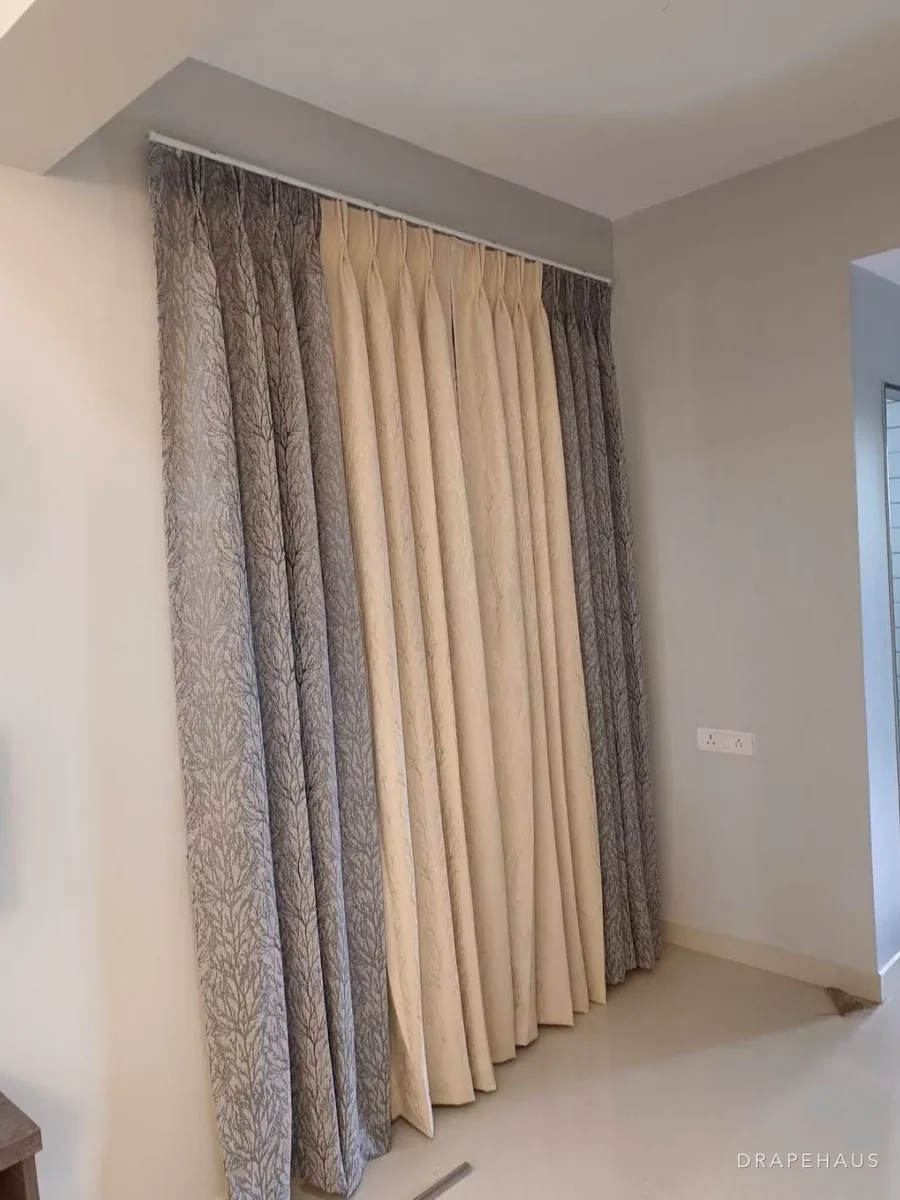
Because sound leaks through gaps, the way a curtain is hung matters as much as its fabric. A curtain that stops short of the floor, sits a hand's width below a wall-fixed rod, and leaves a gap of light at the centre and both sides is an absorber with holes round its edges. The same fabric hung from a ceiling track, falling to just above the floor, with the two halves overlapping at the centre and the outer edges returned to the wall, does noticeably more for both noise and light.
Two layers help. A sheer or lined curtain on one track and a heavy interlined curtain on a second, with an air space between them and the glass, give more absorption than a single layer and keep the room usable by day. Our guide on types of curtain rods explains why a rod, which leaves a gap at the top, is less effective here than a ceiling track.
The bigger gains, though, are at the window. Replacing perished seals, fitting a well-closing frame, laminated glass or secondary glazing are the steps that genuinely reduce traffic and bass. Those are jobs for a window or glazing specialist, not for us; we make and fit the soft furnishings, and we will say so plainly when a room's problem is the window rather than the curtain.
- Hang from a ceiling track rather than a rod, to close the gap above
- Run the curtain wider than the window and return the edges to the wall
- Overlap the two halves at the centre
- Drop to just clear the floor
- Use generous fullness and an interlining
- Leave an air gap between curtain and glass
Pairing curtains with acoustic panels and rugs in bedrooms and home offices
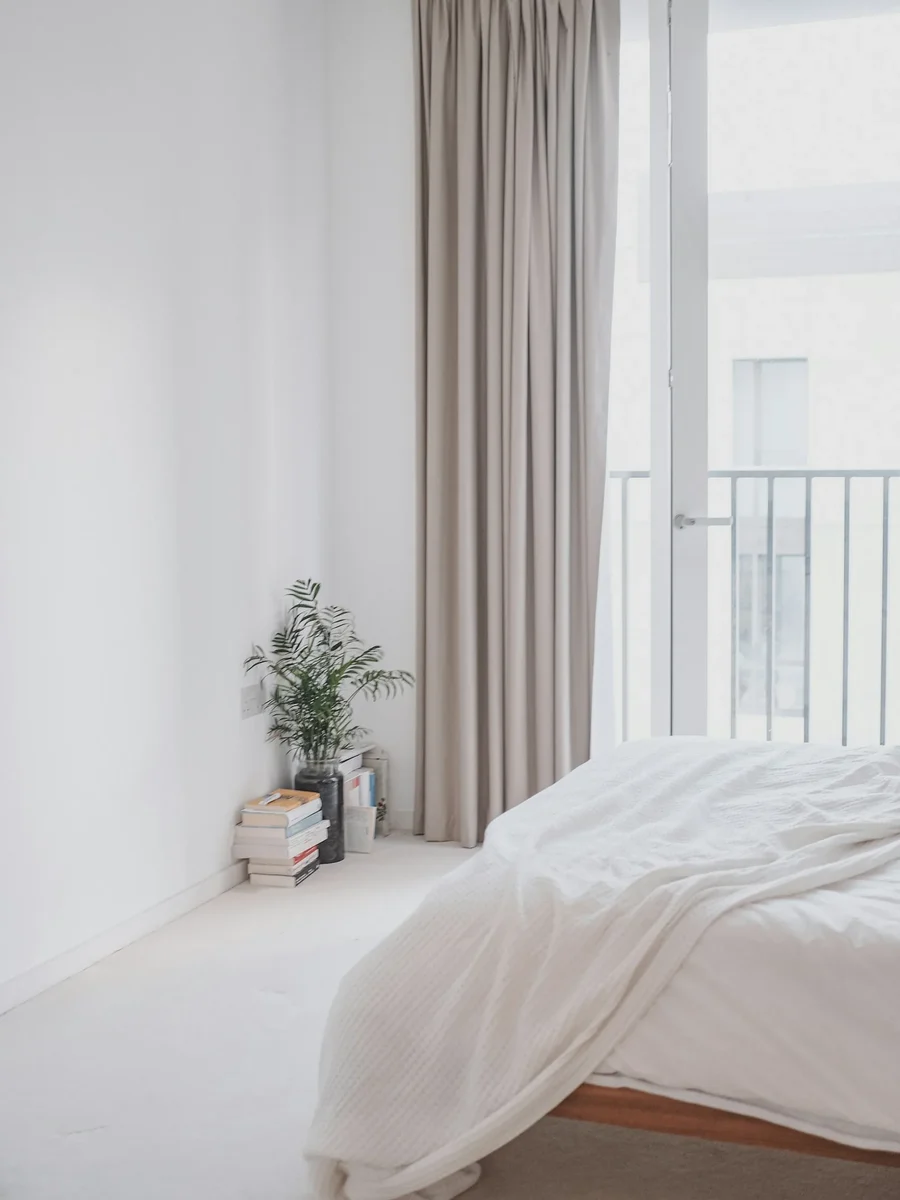
In a bedroom, a heavy lined or blackout curtain on a ceiling track, a large rug on a tiled floor and an upholstered headboard together change the room's sound far more than any one of them alone. Each covers a different hard surface. For sleep, the darkness of a well-hung blackout curtain often helps as much as the acoustic change, and our bedroom curtains page covers both.
In a home office, the priority is speech clarity on calls. Here acoustic panels on the wall opposite the screen, a rug, and full curtains over the window work together to take out the hard, bright echo that makes voices sound hollow. Panels, like curtains, reduce echo inside the room; they are not soundproofing and will not stop noise passing through a wall.
Rugs are the overlooked third element. A tiled or stone floor is often the largest hard surface in a Goan room, and a wool rug with an underlay absorbs footsteps and the general clatter of a household in a way nothing on the walls can.
The humidity trade-off: heavy interlined curtains in the monsoon
The constructions that absorb the most sound are also the ones that hold the most moisture. A thick cotton interlining, a heavy velvet and a deep, full curtain drawn closed against a window for weeks are a perfect place for damp air to sit. The Smithsonian's Museum Conservation Institute notes that stagnant air above 80 per cent relative humidity supports mould on cotton and linen, while polyester and nylon absorb little moisture.
That does not rule out heavy curtains; it shapes how they are made and used. Choose synthetic or synthetic-rich face fabrics and interlinings for rooms that are not air-conditioned, keep them away from damp external walls, draw them open on dry days so both faces get air, and do not leave them closed in a shut house through the monsoon. Our guide to velvet and heavy drapes covers fabric choice in more detail, and our monsoon take-down and storage service exists for houses that close for the rains.
If a noisy bedroom is keeping you awake, the most useful first step is to look at the room together: where the noise comes from, how the window closes, what the walls and floor are made of. We can then make the curtains that will genuinely help and tell you honestly what else is needed. Book a visit through our contact page.