 Drape Haus
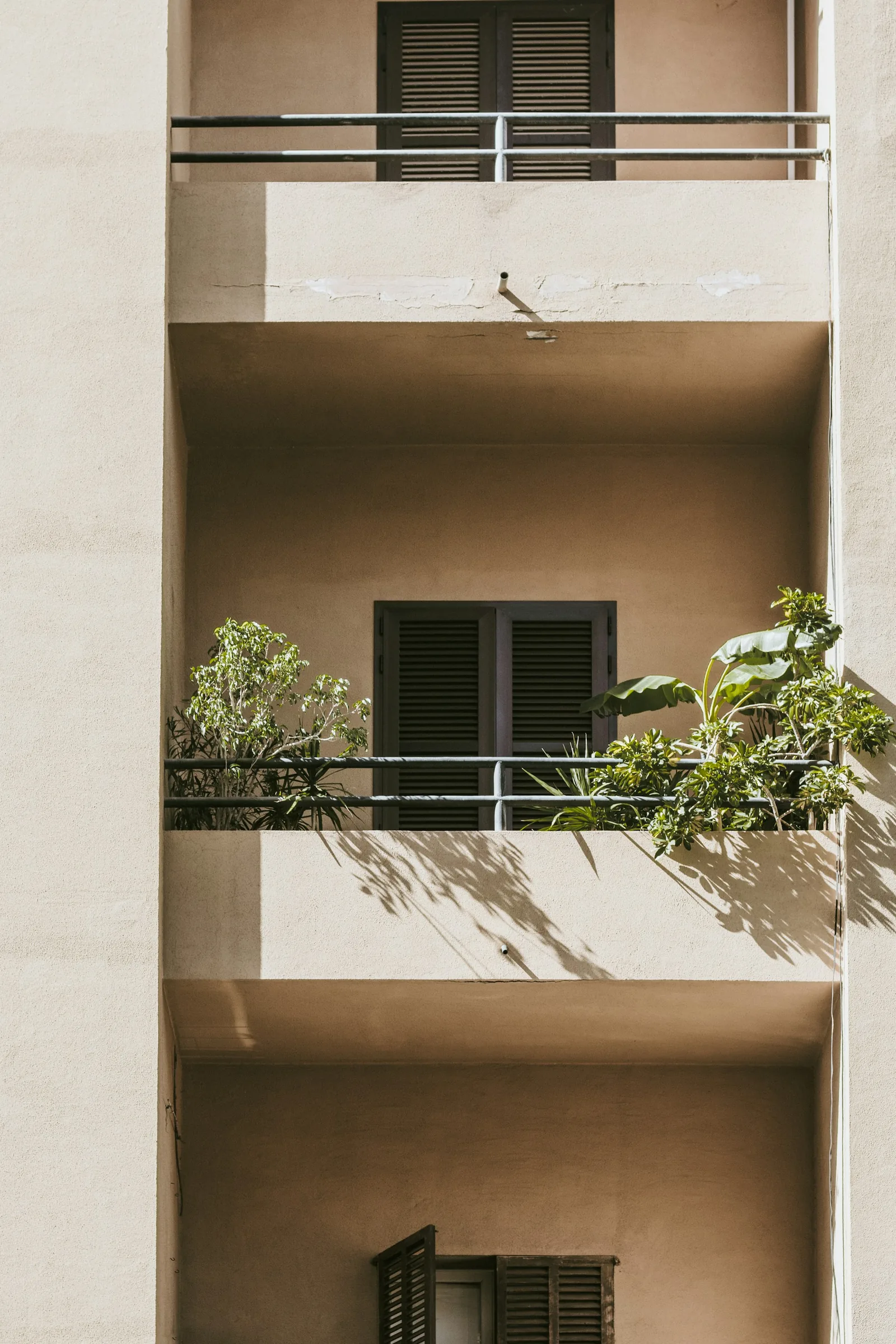
A balcony wall panel has a harder life than any wall inside the house. On a west-facing balcony it takes direct sun through the afternoon; from June to September it takes rain driven in on westerly and south-westerly winds; near the coast it collects salt. A finish chosen because it looked good on a living-room wall will often bubble, fade, warp or rust within a monsoon or two. The finishes that last are the ones made for exterior use and fixed so that they can move and drain.
In practice that means exterior-grade WPC cladding and louvers, UV-stabilised PVC where the wall is well covered, powder-coated aluminium near the sea, and good exterior paint, tile or stone where cladding is not wanted. It also means leaving indoor wallpaper, interior PVC sheets and untreated plywood indoors. Each of those choices is explained below, with the reasons.
This article is about the wall itself. For shade, seating, nets and floors, our balcony design ideas cover the rest of the space, and the balcony page goes straight to blinds, curtains and nets.
Which wall, and how much weather it really gets
Most balconies have three kinds of wall surface, and they behave differently. The back wall, the one with the door or window to the room, is usually under the slab above and gets the least rain but often the most heat from low afternoon sun. The side walls catch rain blown in at an angle. The parapet or the outer face of a solid railing gets everything. A panel that suits the back wall of a deep, covered balcony may not suit the parapet of the same balcony.
Sheltered is not the same as safe, especially near the sea. The Australian stainless steel industry association, which has studied coastal staining, notes that conditions are very aggressive in rain-sheltered areas, because the salt that settles there is not washed off by rain. The back wall of a covered balcony is exactly such a place: salt, dust and moisture build up on it, and fixings and metal trims there can stain sooner than on the open parapet. Plan to rinse it.
So before choosing a finish, stand on the balcony at four on an April afternoon and again during a squall if you can. Note where the sun falls, which walls get wet, how long they stay wet, and how far you are from the sea. Then use the table below as a starting point.
| Wall | Exposure | Usually suits | Usually fails |
|---|---|---|---|
| Back wall, deep covered balcony | Heat and glare, little direct rain, salt build-up | Exterior WPC, UV-stabilised PVC, louvers, exterior paint | Indoor wallpaper, MDF, interior PVC sheet in sun |
| Side walls | Rain blown in at an angle, partial sun | Exterior WPC on a sub-frame, tile, exterior paint | Anything without drainage behind it |
| Parapet or solid railing | Full sun, full rain, wind | Exterior paint, tile, stone, aluminium louvers | Most panel systems unless rated for full exposure |
| Glazed balcony | Behaves like a sunny room | Most interior finishes on a dry wall, with blinds | Vinyl paper on a damp outside wall |
WPC cladding outdoors: what rain and UV do to it
WPC, a wood-plastic composite, is the most asked-for balcony wall panel because it looks like timber without most of timber's problems. Research published through the US Forest Service gives a fair picture of its limits. Early products were expected to be fully protected by the plastic around the wood, but after more than a decade outdoors they showed wood decay, susceptibility to mould and degradation of the polymer. Manufacturers responded with additives, including fungicides, mildewcides and photostabilisers.
The same research explains why moisture is the key. When WPC takes up water, the wood fibres inside it swell, which stresses the material and can lead to microcracks. Weathering by sunlight, oxidation and rain changes the colour and, over time, the strength of the surface. Mould and stain on WPC are mainly a cosmetic problem, the author notes, but they are difficult to stop without periodic washing. Pigments and UV absorbers are added to protect against light.
For a balcony that means three things. Use an exterior grade, ideally one with a protective cap layer, and never an interior profile. Fix it on a sub-frame with an air gap, so that water can drain and the back can dry. And expect to wash it a few times a year. Our WPC wall panels page explains the grades we use, and PVC vs WPC wall panels compares the two materials room by room.
Planning something like this?
We visit homes across North and South Goa, measure on site, and bring samples to see in your own light.
Louvers as a balcony wall feature and a screen
Louvers, slatted panels with gaps between the slats, do more on a balcony wall than flat cladding can. Fixed over a plain wall with a small gap behind, they give depth and shadow, and a strip light at the top or bottom turns them into the main feature of the balcony in the evening. Because water runs off each slat and air moves behind them, they dry faster than a flat panel after rain.
They are also the neatest way to hide what most Goan balconies carry: an air-conditioner outdoor unit, a tangle of pipes, a water heater, a gas cylinder. A louvered screen in front of an AC unit hides it while leaving the air path open, which the unit needs to work properly; leave generous gaps and ask the AC technician how much clearance the unit requires before anything is fixed. A louvered panel on the side facing a neighbour gives privacy without blocking the breeze.
Material choice follows the exposure. Exterior WPC louvers suit covered balconies and give the warmest look. Powder-coated aluminium suits exposed and sea-facing walls, and spans furthest without sagging. Our louvers page covers sizes and finishes, and louvers design ideas looks at spacing and proportion in more depth.
Why indoor wallpaper fails on a balcony
Searches for balcony wallpaper are common, and the answer for an open balcony is that ordinary wallpaper is the wrong material. The US federal construction specification for wallcoverings shows how controlled its conditions are: rolls stored at 30 to 60% relative humidity, and the room held at a minimum of 15°C for 72 hours before hanging, during hanging and until the adhesive dries. It also tells designers not to put wallcoverings on the inside face of exterior walls at all, because moisture can build up behind them and cause mould. Those are US rules, but they show what the material expects.
An open balcony wall in Goa breaks every one of those conditions. The India Meteorological Department records 87 to 91% morning humidity through the monsoon, rain reaches most balcony walls at some point, and the wall surface heats and cools every day. Paste softens, seams lift, paper takes up moisture from the wall behind, and sunlight fades the print. It is not a matter of buying a stronger paper; the material and the adhesive are made for indoor rooms.
There are honest alternatives that give pattern and colour outdoors. Exterior paint, including textured and limewash finishes on older walls, can carry stripes, stencils or a painted mural. Glazed tiles, including patterned cement or ceramic tiles, give the strongest pattern and wash clean. Wood-look exterior panels give texture. The exception is a fully glazed balcony that is effectively part of the room: there, wallpaper can be treated like any interior wall, provided the wall stays dry, and our guide to the best wallpaper for humid walls explains how to choose.
Wallpaper is an interior finish. On an open balcony, get pattern from paint, tile or exterior panels instead.
Colours that age well in sun and UV
Colour on a balcony wall is a performance choice as well as a design one. Dark surfaces absorb far more sunlight than light ones, and get much hotter. Lawrence Berkeley National Laboratory's figures for roofs give the scale: on a summer afternoon a clean white roof reflecting 80% of sunlight stays about 31°C cooler than a grey roof reflecting 20%. A balcony wall is not a roof, but the physics is the same, and a dark panel on a west-facing wall will run much hotter than a pale one.
Heat matters in two ways. A hotter panel moves more, as the next section shows, and it radiates heat into the balcony and through the door into the room behind. A pale or mid-tone finish keeps both down. Colour change matters too: the Forest Service research notes that weathering changes the colour of WPC. Strong, saturated colours show fading most, while mid wood tones, warm greys and sand colours tend to look acceptable as they lighten.
A simple test before committing: ask for two samples of the finish you like, fix one on the balcony in full sun for a few weeks and keep the other indoors in a drawer. Comparing them side by side shows how that colour will age on your wall better than any brochure. Choose fittings and trims in a matching finish, so that a faded panel does not sit beside a bright new trim.
Fixing exterior panels: sub-frames, gaps and drainage
Plastics and composites move with temperature far more than the masonry they are fixed to. The Engineering ToolBox reference tables give PVC a linear expansion of 54 to 110 millionths of its length per °C, against 13 to 14 for concrete and about 3 for wood along the grain. Worked through, a 3 m PVC panel changes length by roughly 1.6 to 3.3 mm for every 10°C change in temperature, while 3 m of concrete changes by about 0.4 mm. A balcony wall that goes from a cool monsoon night to a hot afternoon in April covers far more than 10°C at the surface.
That is why exterior panels are fixed in a way that lets them move. Panels sit on a sub-frame of aluminium or treated battens rather than being glued flat to the wall. Fixing holes are slotted or oversized where the system calls for it, so that the panel can slide. Gaps are left at the ends and at corners, hidden under trims, so that a long run can grow in the heat without bowing. Our louvers are fixed this way on laterite walls and parapets, to a sub-frame anchored into sound masonry.
Water is the other reason for a sub-frame. The air gap behind the panels lets rain that gets behind them drain out at the bottom and lets the wall dry. Keep the bottom edge of the panels clear of the balcony floor, where water pools after rain, and never seal the bottom shut. Near the sea use stainless fixings, and on old laterite walls follow the advice in our guide to laterite and old walls: fix into sound stone, keep drilling to a minimum, and let the wall breathe.
Cleaning and maintenance through the year
A balcony wall needs a little attention at three points in the year. Before the monsoon, check that the panels are firm, that trims are in place, that the gap at the bottom is clear, and that the floor drains. During the rains, wipe off any mould spots as they appear with water and a mild detergent, using the panel maker's cleaning advice for anything stronger. After the monsoon, give the whole wall a thorough wash to remove the salt and grime that have built up, and look at every fixing.
The stainless steel association's advice on coastal staining is worth applying to every metal part of a balcony wall: a light and regular wash is best, and rain washing may be enough on exposed surfaces, while sheltered ones need rinsing by hand. Rinse metal trims, brackets and screw heads with fresh water when you wash the window behind them. Brown staining on stainless fittings is usually surface staining that comes off if caught early.
Fluted and grooved profiles collect fine dust in the dry months, which becomes a sticky film in the rains. A soft brush along the grooves every few weeks prevents it. If you are planning a balcony wall now, a home visit lets us look at the wall, its exposure and its fixing points, and bring exterior samples to test in your own light.