 Drape Haus
Fluted panels carry a run of parallel grooves or ribs that catch light on one edge and hold shadow on the other. The idea is ancient. Designing Buildings, the UK construction wiki, notes that fluting appears on the columns of all the classical orders except the Tuscan, with 20 grooves on a Doric column and 24 on Ionic, Corinthian and Composite ones, and that it gave columns rhythm and made them look taller and more slender. The same effects explain its popularity on walls today.
In modern homes fluting has spread far beyond the feature wall: TV units, headboards, kitchen islands, bar fronts, reception desks and wardrobe doors. It is a strong device, and strong devices are easy to overuse. The ideas below are about where fluting earns its place, which profile suits which job, and how to light and clean it in a Goan house.
For materials, fixing on laterite and our range, see fluted wall panels. This piece concentrates on design.
Flute profiles and how each catches light
Fluting is a family of profiles, and each behaves differently in light. Concave grooves, true flutes, hold shadow in the channel and leave a highlight on the edge between them. Convex ribs, usually called reeding, catch light along their curve and leave shadow only in the narrow joint. In everyday use both are sold as fluted panels, but on a wall the effect is distinct.
Half-round ribs read soft and continuous, as light rolls over each curve, and suit bedrooms, relaxed living rooms and coastal interiors. Square or rectangular ribs give sharp, graphic lines with a crisp shadow down one side, which suits contemporary rooms, offices and shopfronts. Wide flutes, with ribs several centimetres across, read as bold architecture from across a room and suit large walls and double-height spaces. Narrow flutes read as fine texture, almost like corduroy, and suit furniture fronts, small walls and anything seen close up.
Depth is the third choice. Deep grooves throw strong shadows that stay visible in flat daylight but collect more dust. Shallow grooves give a subtle texture that only comes alive with directional light. In Goa's bright dry-season light even shallow fluting reads well on a wall that takes side light from a window; on a grey monsoon afternoon it may almost disappear unless it is lit.
| Profile | Look | Best for | Watch for |
|---|---|---|---|
| Half-round rib | Soft, rolling light | Bedrooms, relaxed living rooms | Very narrow ribs on a big wall look busy |
| Square rib | Crisp, graphic shadow | Modern living rooms, offices, counters | Sharp edges chip on a hard-used counter |
| Concave groove | Strong shadow lines | Feature walls, columns | Grooves hold dust |
| Wide flute | Bold, architectural | Large walls, double-height spaces | Needs a big enough wall to repeat |
| Narrow flute | Fine texture | Furniture fronts, small walls, close view | Blurs into a shimmer at a distance |
Fluted TV walls and media units
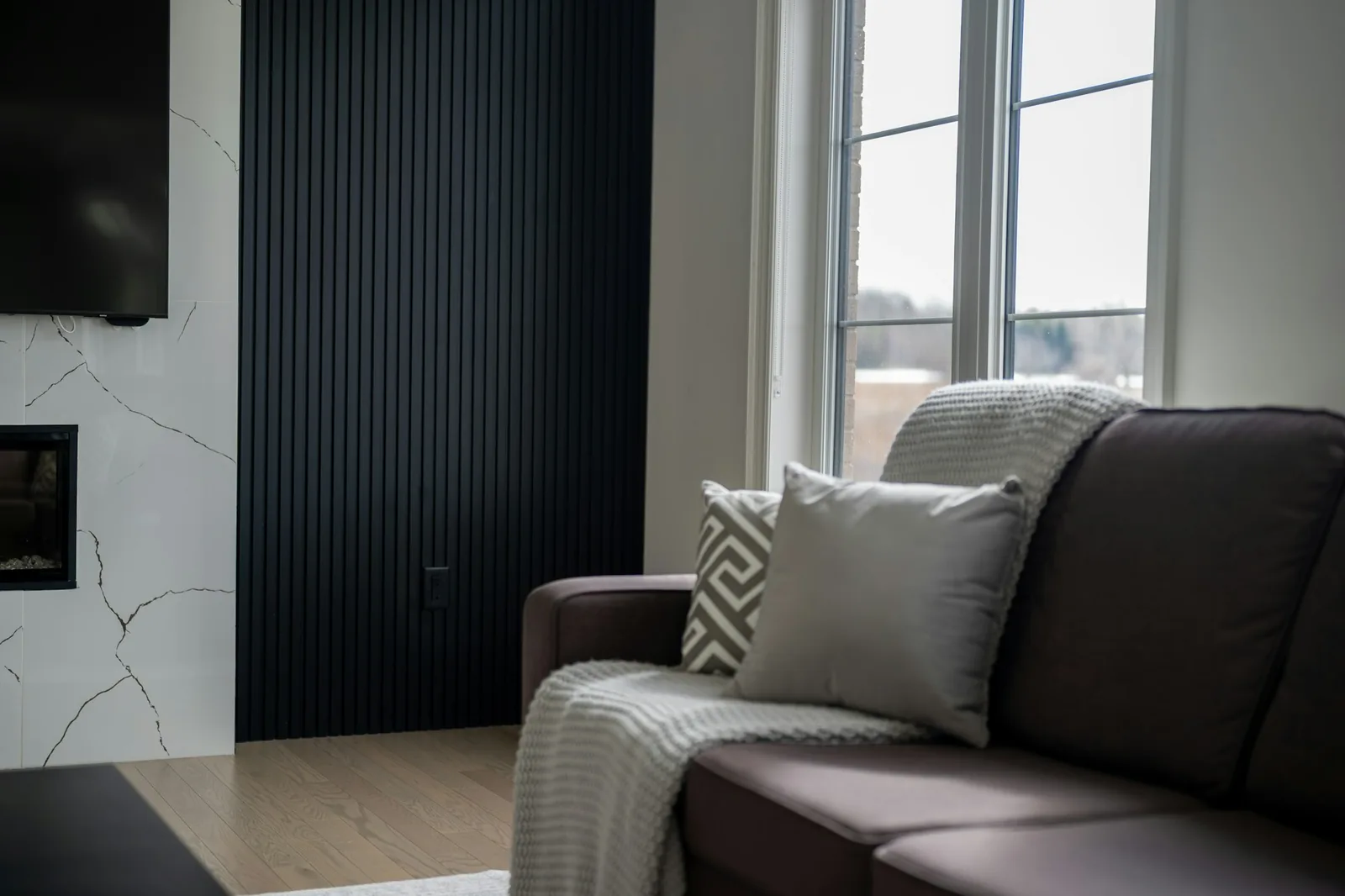
The TV wall is where most people first try fluting, and it suits the job. A fluted panel behind the screen breaks up a large dark rectangle, gives the wall depth when the TV is off, and hides the cables that would otherwise run down the plaster. The panel sits on a batten frame, and the cavity behind carries conduit from the screen to the unit below.
Proportion makes the difference. A fluted band a little wider than the screen, running floor to ceiling, frames it and draws the eye up; full-width fluting across a long wall can overwhelm the screen. A plain or stone-effect panel immediately behind the TV, with fluting either side, gives the screen a calm backdrop and leaves the texture to frame it. A floating media unit with a fluted front picks up the same rhythm at low level without more wall cladding.
Settle the details before anything is cut. Fix the TV bracket into solid wall or a strong block within the frame, never into the panel itself. Leave ventilation for set-top boxes and amplifiers inside a closed unit. Put sockets and cable outlets in a flat zone or a groove so they do not sit awkwardly across a rib. Our TV wall panels page covers the fixing side, and living room wall panels shows how a feature wall fits a whole room.
Planning something like this?
We visit homes across North and South Goa, measure on site, and bring samples to see in your own light.
Fluted headboards and bed walls
In the bedroom, fluting gives the bed wall a sense of enclosure and calm. The simplest version is a fluted panel the width of the bed, rising a little above headboard height, with plain painted wall above. A fuller version runs fluting floor to ceiling across the whole wall, with bedside tables floating in front of it and reading lights set into it.
Combining fluting with upholstery is where bed walls become special. A padded fabric headboard in the centre, flanked by fluted panels, gives softness where you lean and texture where you look. Fabric and panel can share a tone, such as oatmeal linen beside pale oak-effect fluting, or contrast deliberately, such as deep green velvet against dark fluting. Our headboards are made to size, so they can be set into a fluted wall with an even margin all round.
Goan bedrooms are often shut through the day with the air-conditioning off and cooled at night, so the wall behind the bed sees wide swings in humidity. PVC and WPC fluting cope with that. Painted MDF or solid timber are best kept to bedrooms that stay air-conditioned and dry. Either way, leave a small gap at floor and ceiling so air reaches behind the panel, and keep the bed a few centimetres off the wall. Our master bedroom wall panels page covers the options for that room.
Kitchen islands, bars and reception desks
Fluting on furniture fronts is one of its most effective uses. A kitchen island with a fluted end or front, a home bar clad in fluting, or a reception desk in a café or homestay gains a tactile, crafted look from a simple panel. Because these pieces are seen up close and touched often, they suit narrower flutes in a hard-wearing material.
In kitchens, keep fluting away from the hob and the sink, where grease and splashes settle in the grooves. The seating side of an island, or the end panel facing the dining area, works well. Choose a profile with rounded edges for anything at knee height, where bags, chairs and feet knock into it, and a finish that wipes clean.
For bars and reception counters in cafés and rentals, fluting helps the counter read as a designed object rather than a plain box. WPC takes knocks better than PVC, and a solid top edge, or a stone or timber counter that overhangs, protects the top of the flutes. Curved counters can use flexible fluted panels made to bend. Our café and restaurant wall panels page shows how panels are used in hospitality interiors.
Lighting that brings the flutes out
Fluting depends on light travelling along the face of the panel rather than straight at it. Light from directly in front fills the grooves and flattens the profile; light grazing down the surface puts a highlight on every rib and a shadow in every groove.
The simplest method is an LED strip in an aluminium channel, recessed into the ceiling or a shadow gap just in front of the panel, washing down its face. A strip at the base, washing upward, gives a softer, more theatrical effect behind a bed or TV. Wall washers or adjustable spotlights angled steeply onto the panel do a similar job where there is no recess.
Colour temperature matters. Warm white flatters timber tones and creamy finishes; neutral white suits grey, white or painted fluting and keeps colours true. Dimmable strips let the wall move from a soft glow in the evening to a quiet background by day.
Keep heat away from the panel. PVC and the decorative films on composite panels do not like sustained heat, so the LED driver should be ventilated and reachable rather than buried behind a panel, and older halogen fittings should never sit close to it.
Keeping the grooves clean in dust and damp
Every groove is a small ledge, and in Goa it fills from two directions. In the dry months, dust from lanes, building work and open windows settles on any edge it finds; near the sea a fine salt film joins it and draws moisture, so grooves on a sea-facing wall can stay faintly damp.
In the monsoon the concern shifts. With morning humidity between 87% and 91% from June to September, according to the India Meteorological Department, dust and skin oils in the grooves can feed a faint bloom of mould, especially in a dark room or a house shut for weeks. Research on wood-plastic composites published through the US Forest Service notes that mould can form on WPC surfaces, either from moisture taken up by the wood content or from organic matter built up on the surface; it does not weaken the panel, but it does mean periodic cleaning.
The routine is simple. Run a soft brush attachment down each groove, along the flutes rather than across them, every week or two in a dusty spell or a sea-facing room. Wipe PVC and WPC with a cloth dampened in water and mild soap, then dry the grooves so water does not sit in them. On painted MDF, use a barely damp cloth and never let water run down the face. Before closing a house for the monsoon, give the fluting a thorough clean so there is nothing for mould to feed on while you are away.
- Brush along the flutes, never across them
- Damp cloth and mild soap for PVC and WPC, then dry the grooves
- Only a barely damp cloth on painted MDF
- A thorough clean before closing the house
- After the rains, check the bottom edge for swelling or a musty smell
Where fluting works, and where to stop
Fluting works best as contrast. One wall in a room, one piece of furniture or one column gives a clear focus. A room with fluted walls, a fluted TV unit, a fluted island and fluted wardrobes looks like a showroom, and every surface becomes a dust ledge.
Good partners are plain painted walls, a smooth stone or solid-surface counter, plain or flatweave upholstery and simple curtains. Strong patterns close by, such as a busy wallpaper or a heavily patterned rug, compete with the lines. Vertical fluting pairs naturally with long, straight curtain drops, and ripple fold curtains in particular echo its rhythm.
If you are unsure, start with a piece of furniture rather than a wall: a fluted bedside table, a media-unit front or a bar panel. It is the easiest way to see whether the texture suits your home before committing a whole wall. Price depends on material, profile, wall size, framing and lighting, and on what the wall needs first, so we quote after seeing it. When you are ready, we can bring samples and set out the flutes against your own wall and light.
Hold a sample flat against the wall and step back to the furthest seat in the room. That is the distance the flute has to work from.