 Drape Haus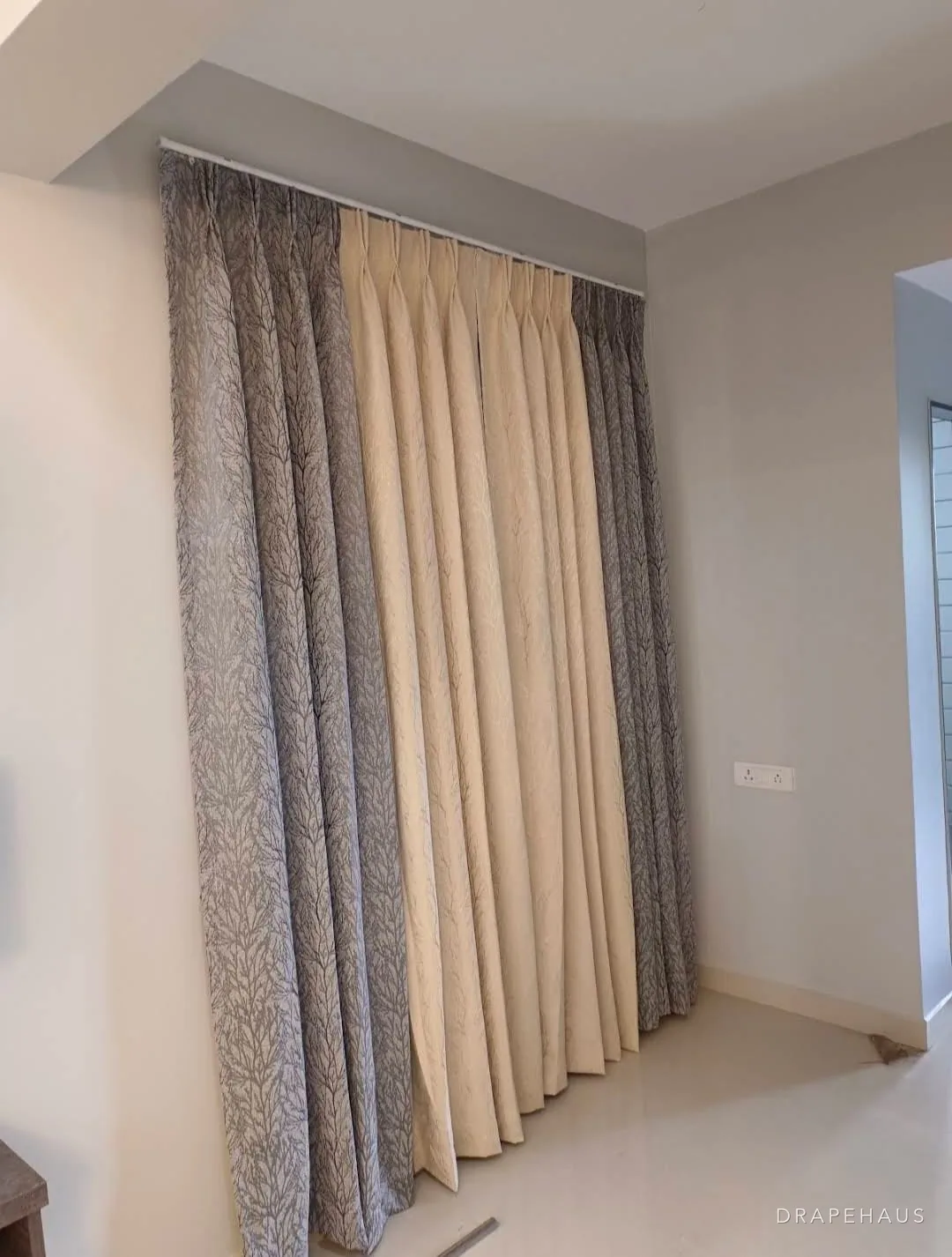
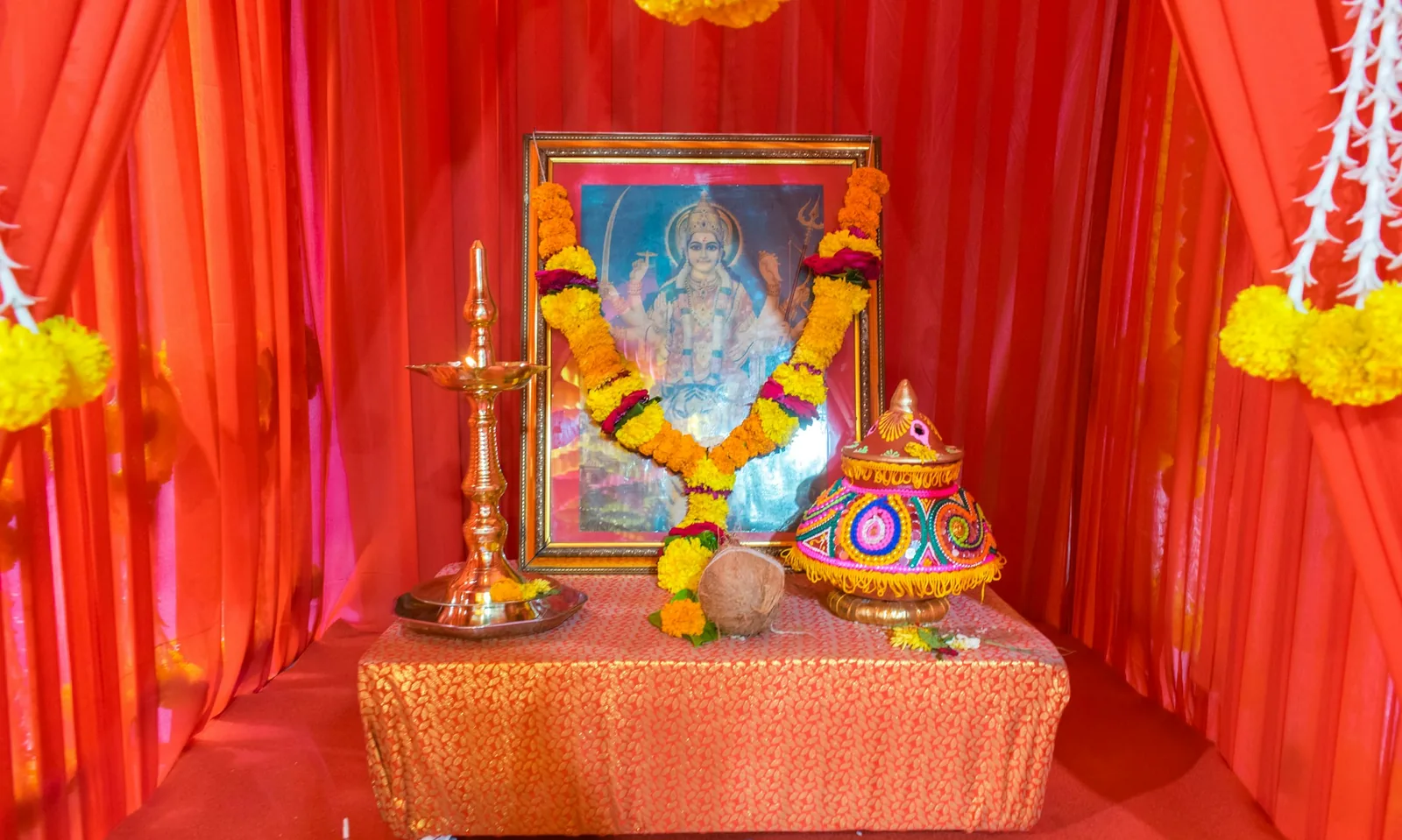
A pooja room door design does three things: it marks the shrine as a separate space, it keeps dust and pets out when the room is not in use, and it opens fully for prayer. In many homes, from a small mandir cupboard in a city flat to a devghar in a village house, that door is a curtain or a fabric panel rather than a wooden shutter. Fabric is light, it never swells or sticks in the monsoon, it fits an odd-sized niche, and it can be changed for a festival in minutes.
It is also the only door in the house that hangs beside a naked flame. The Directorate of Fire and Emergency Services of the Government of Goa advises keeping candles and oil lamps away from furniture, curtains and other flammable items, and turning lamps off before going to sleep. Everything in this guide follows from taking that advice seriously while still making a door that looks right.
A note on what this article does not do. Families follow their own customs about the pooja room, from where it faces to when it is closed, and those customs differ between communities and between households. We do not advise on ritual. If your family follows a practice about the door, tell us and we will design the fabric around it. What follows is practical: fabric, fixing, safety, cleaning and the festival calendar in Goa.
Fabric door or wooden door: what each does
Wooden doors suit a pooja room built as a proper room, with a frame, a threshold and space for the leaves to swing. They close firmly, they can be carved or fitted with bells, and they keep out dust best. In a Goan monsoon, though, solid timber doors on a small cupboard often swell and stick, and a closed cupboard with oil, flowers and incense inside it is a place where mould can start. Solid doors also need space to open: a pair of leaves swinging into a narrow hall is often the reason a family looks for another solution.
Fabric doors are the opposite in almost every respect. They need no swing space, they suit niches and alcoves of any size, they let some air move when closed, and they can be drawn fully aside so the whole shrine is visible during prayer. Their weaknesses are that they collect soot and dust, they need washing, and they must be fixed so that they can never reach the lamp. Between the two sit jaali or lattice doors, which let air and the glow of the lamp through, and fabric panels on a frame, which look like a door but lift out for washing.
Many homes use a combination: a wooden or jaali door for the room itself and a light curtain inside it that is drawn for daily prayer, or a curtain in front of a cupboard shrine with the cupboard's own shelves inside. The table below sets out the choices. Whichever you choose, the flame rule in the next section applies to every piece of fabric in the room, including runners, cloth on the altar and garland ties.
| Door | Works well for | Watch out for |
|---|---|---|
| Solid wooden doors | A full room with a frame and swing space | Swelling in the monsoon; closed, stale air inside |
| Jaali or lattice doors | Air and lamp glow with a sense of enclosure | Dust in the pattern; still needs swing space |
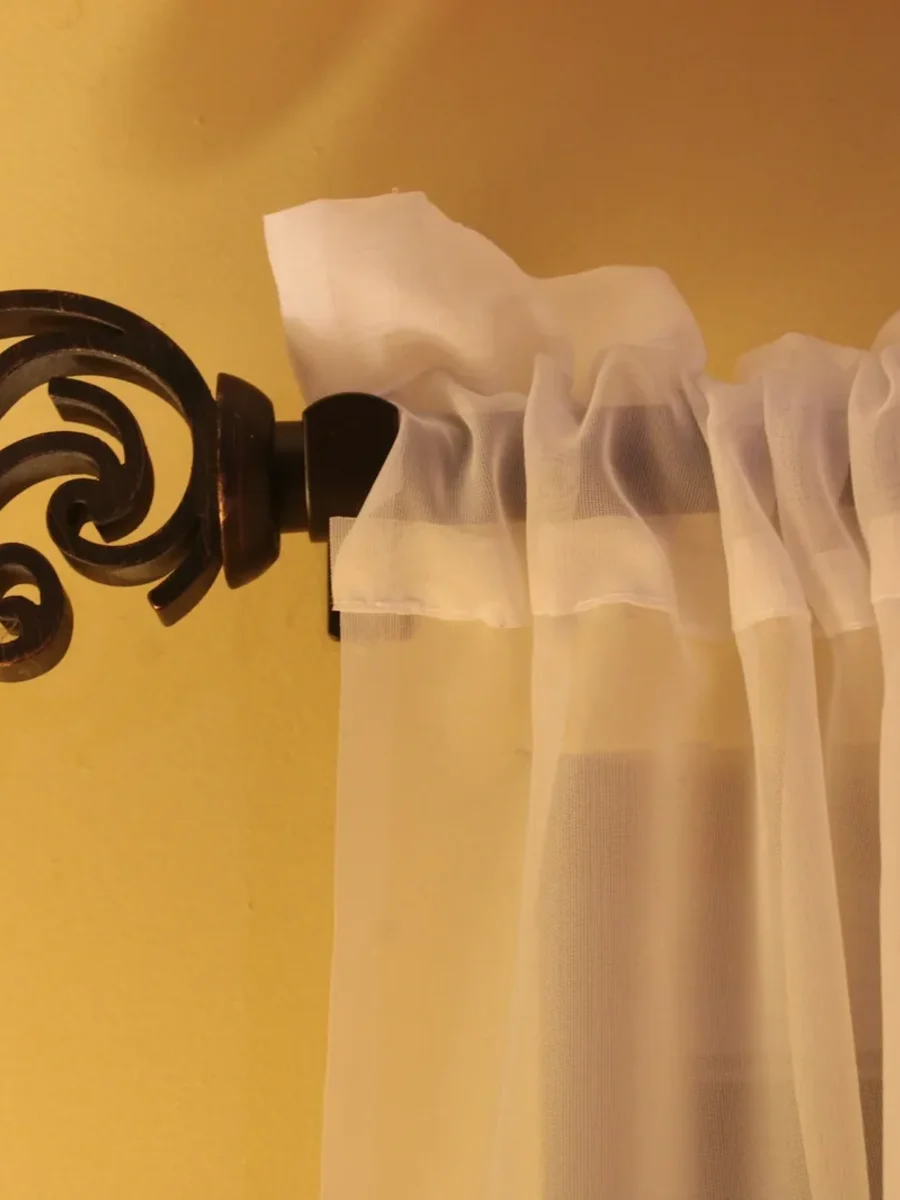
| Curtain on a rod or track | Niches, cupboards, rented flats, odd sizes | Must be fixed so it cannot reach the flame |
| Fabric panel on a frame | A tidy door look that lifts out to wash | Frame needs a dry, sound wall to fix to |
Keeping fabric clear of diyas and samai lamps
Fire services everywhere say the same thing in slightly different words. The Goa Directorate of Fire and Emergency Services asks households to keep burning candles, mosquito coils and oil lamps out of children's reach and away from curtains and furniture. The London Fire Brigade names diya lamps used in worship among the flames that should never be left unattended, and asks for them to sit in heat-resistant holders on a stable surface. The US Fire Administration gives a measurable minimum: keep candles at least 12 inches, about 30 cm, from anything that burns.
Treat that 30 cm as a floor, not a target, because a curtain moves. A ceiling fan, a breeze from a window or someone brushing past can swing the bottom of a curtain well beyond where it hangs at rest. The practical test is simple: hang the curtain, close it fully, then push its lower edge towards the lamp as far as it will go. Wherever it reaches, the lamp must be well beyond that point. If the shrine is shallow and the curtain can reach the ledge, the curtain needs to move, not the lamp: fix it further forward, shorten it so it stops above the ledge, or hold it back on a fixed holdback rather than a loose tie.
Heat rises, so nothing made of fabric should hang directly above a flame, including a pelmet, a valance, a cloth torana or a canopy. Keep the lamp below solid material such as stone, metal or a tiled ledge. For long-burning lamps, an enclosed glass or metal lamp is safer than an open wick. Where a family is comfortable with it, the London Fire Brigade suggests flameless electric lights as a safer alternative to candles and tea lights, and some households use an electric lamp as the steady light with a real flame lit only during prayer.
Two Goa-specific points. During monsoon power cuts the instinct is to light more lamps, but the US Fire Administration advises using torches, not candles, when the power goes. And during Diwali the Goa fire service asks residents of buildings not to keep combustibles on balconies, because flying crackers have caused serious fires; a pooja corner on an enclosed balcony is worth thinking about with that in mind.
Close the curtain and push its hem towards the lamp: the flame must sit well beyond the furthest point the fabric can reach.
Planning something like this?
We visit homes across North and South Goa, measure on site, and bring samples to see in your own light.
Choosing fabric and colour for a prayer space
Fibres behave very differently in a flame, and a simple identification guide published for home sewers shows how. Cotton burns with a steady yellow flame, linen is slow to ignite, rayon (viscose) burns rapidly, and polyester, acrylic and nylon melt and burn, with polyester and nylon dripping melted fibre. Silk burns slowly and tends to self-extinguish, and wool self-extinguishes when taken from the flame. That is a description of how fibres burn in a test, not a fire rating, but it is a fair guide to what to avoid near a lamp: thin viscose sheers, synthetic nets and loose, fluffy weaves are the poorest choices.
For a curtain that hangs near a lamp, the sensible choices are a closely woven cotton or linen of medium weight, which hangs straight and moves less in a draught, or a fabric sold as flame retardant. Flame-retardant fabrics are either made from fibres that resist burning or treated with a finish. Ask for the test documentation, and check the care instructions, because some treatments are affected by washing. No fabric makes it safe to leave a flame unattended.
Colour is a family decision, and many households choose particular colours for reasons of their own. On the practical side, a pale cream or white shows soot, oil and turmeric marks quickly, which some families prefer because it shows when the curtain needs washing. Mid-tones such as saffron, marigold, deep red, maroon or a soft green hide light marks between washes. Metallic zari borders look festive, but metal threads can tarnish in Goa's humid air, so keep them for a festival set that is stored dry. Plain cloth or a small woven motif suits a shrine better than a large print, which competes with the images inside.
Rods, tracks, holdbacks and fixings for small openings
Pooja room openings are often small and irregular: a niche in a wall, a cupboard with a frame, an alcove under the stairs, or a doorway narrower than any standard curtain. That is where made-to-measure fabric helps, because the curtain can be cut to the exact width and drop, with enough fullness to look generous when closed and a small enough stack to clear the opening when open.
For a niche or cupboard with a frame, a slim rod or a short track fixed just above the opening and a little wider than it lets the curtain clear the sides when drawn. Where there is no room for brackets, a rod fixed inside the recess works well, and in a rented flat a tension rod inside the frame avoids drilling at all; our guide to no-drill rentals covers the options. For a full doorway, a ceiling or wall track gives the smoothest draw, and a single panel that stacks to one side keeps the opening clear for an aarti plate.
Holdbacks matter more here than in any other room. A loose fabric tie lets the curtain slip forward; a fixed metal holdback or a hook on the wall holds it in one place, away from the lamp, every time. Brass and other solid metals look right in a shrine and do not mind incense smoke. Near the coast, choose solid brass or stainless fittings rather than plated steel, which rusts in salt air. Our curtain rods page shows the finishes we fit, and types of curtain rods explains which suits which opening.
Festive fabric for Ganesh Chaturthi and Diwali
Goa's two great household festivals fall at opposite ends of the weather. Ganesh Chaturthi comes in late August or September, inside the monsoon. Goa Tourism describes it as an annual homecoming for many Goans, with homes decorated well in advance and a length of celebration that varies from household to household, from a day and a half to 21 days. Diwali follows in October or November, after the rains, when Goa Tourism notes homes aglow with diyas and Narkasur effigies paraded through the streets and burnt at dawn.
For fabric, that means two different plans. For Ganesh Chaturthi, anything new must be made and fitted well before the festival, and anything washed must be dry before it goes up, which in August can take days. Our Ganesh Chaturthi guide sets out the timing, including the room where the idol is installed. Remember that many more lamps and much more fabric will be in the house for those days, so walk round with the flame test in mind: decorations, cloth backdrops and temporary canopies all need the same clearance as the curtain.
For Diwali, the dry weather makes it the easiest time of year to wash, change and hang fabric. Some families keep a second, festive set of pooja curtains, perhaps a richer colour or a zari border, which goes up for the festival season and is then washed, dried in the October sun and stored. Our Diwali guide covers the wider house refresh and the October rush for fitting. If you want a festive set made, ask in the monsoon rather than the week before.
Washing out soot, oil and incense marks
Lamp soot and incense smoke settle on fabric as a fine, slightly oily film, and the inside face of the curtain and the area above the lamp collect most of it. Deal with soot dry first. Take the curtain down, shake it outdoors, and brush or vacuum it gently with a soft brush attachment before it touches water; wetting loose soot first tends to spread it into a grey stain. Oil splashes and ghee marks should be blotted, never rubbed, then treated with a little mild liquid detergent worked in gently before the main wash.
Wash according to the care label, usually in cool or lukewarm water with a mild detergent, and rinse well. Dry in shade or indirect light rather than strong sun, which fades dyed cotton, particularly the saffron and red shades many families choose. Iron while very slightly damp if the cloth needs a crisp hang. Wax drips from candles come off more easily once hardened: lift what you can, then place the fabric between sheets of absorbent paper and press with a warm iron to draw out the rest.
In the monsoon, drying is the hard part. The Smithsonian's conservation guidance advises using fans to move air around damp textiles, and points out that soiled fabric supports mildew at lower humidity than clean fabric. So never rehang a pooja curtain that is still slightly damp, and never fold one away dirty. If a curtain is washed in August for the festival, allow several days indoors with fans, or plan to wash it in a dry spell earlier in the month.
Keeping a closed shrine fresh through the monsoon
A pooja cupboard combines several things mould likes: still air, oil, flowers, food offerings and a wall that may be an outside one. The Smithsonian notes that stagnant air above about 80% relative humidity supports mould on cotton and linen, and Goa's monsoon mornings sit between 87 and 91% according to the India Meteorological Department. A fabric door helps here, because it lets some air through where a sealed wooden door does not.
Simple habits make the biggest difference. Leave the curtain open for a while after the morning prayer, so the shrine airs. Clear old flowers and offerings promptly during the rains. Keep the curtain hem off the floor and away from the ledge where water from washing vessels might sit. If the shrine is against an outside wall, a small gap behind any fixed cloth backdrop lets the wall breathe.
Check the fabric once a week in July and August, especially the back face and the hem. Small grey or black spots are the start of mildew; take the curtain down, brush it outdoors and wash it before it spreads. A second curtain for the monsoon months, perhaps a lighter cotton or blend, means one can always be clean and dry while the other is washed.