 Drape Haus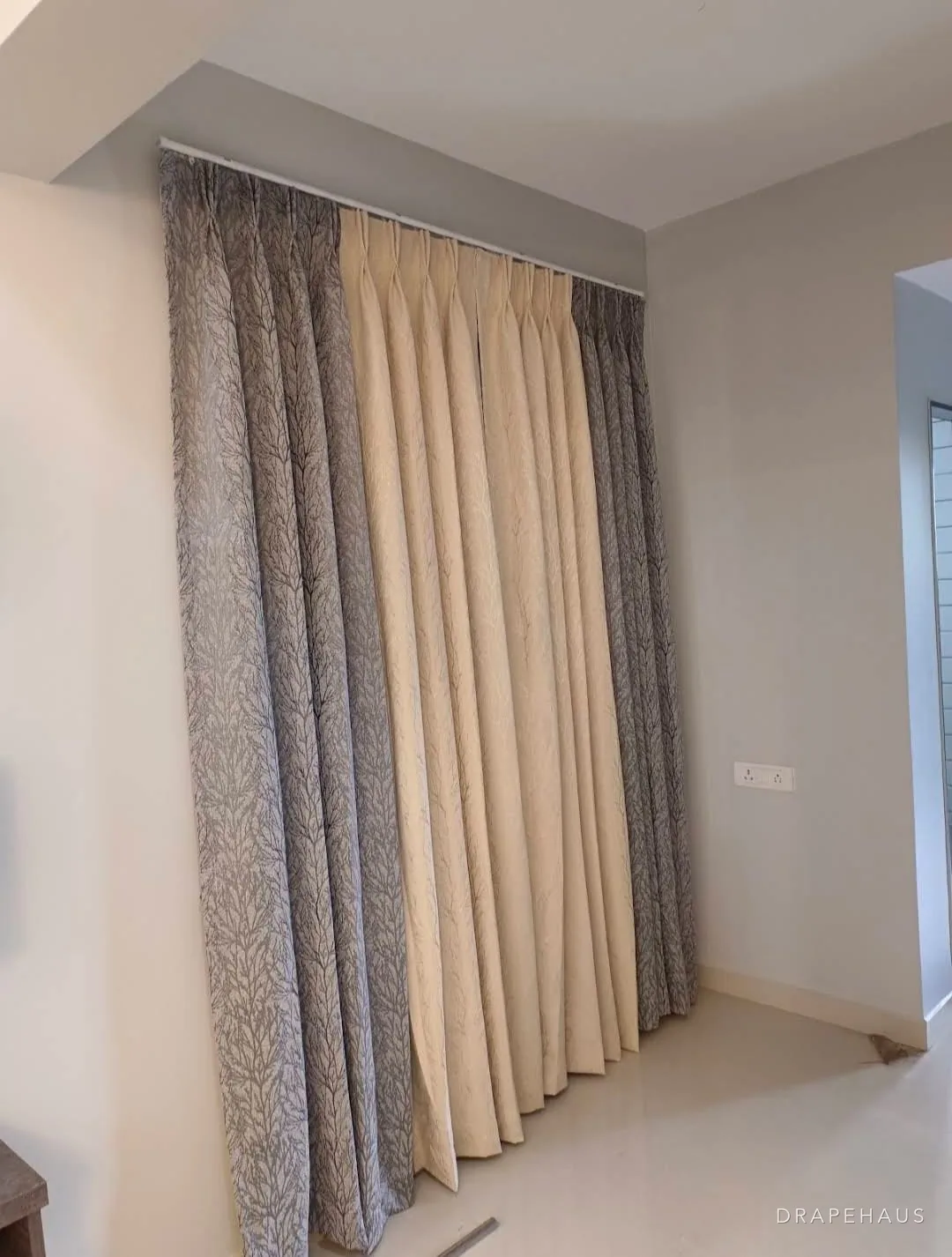
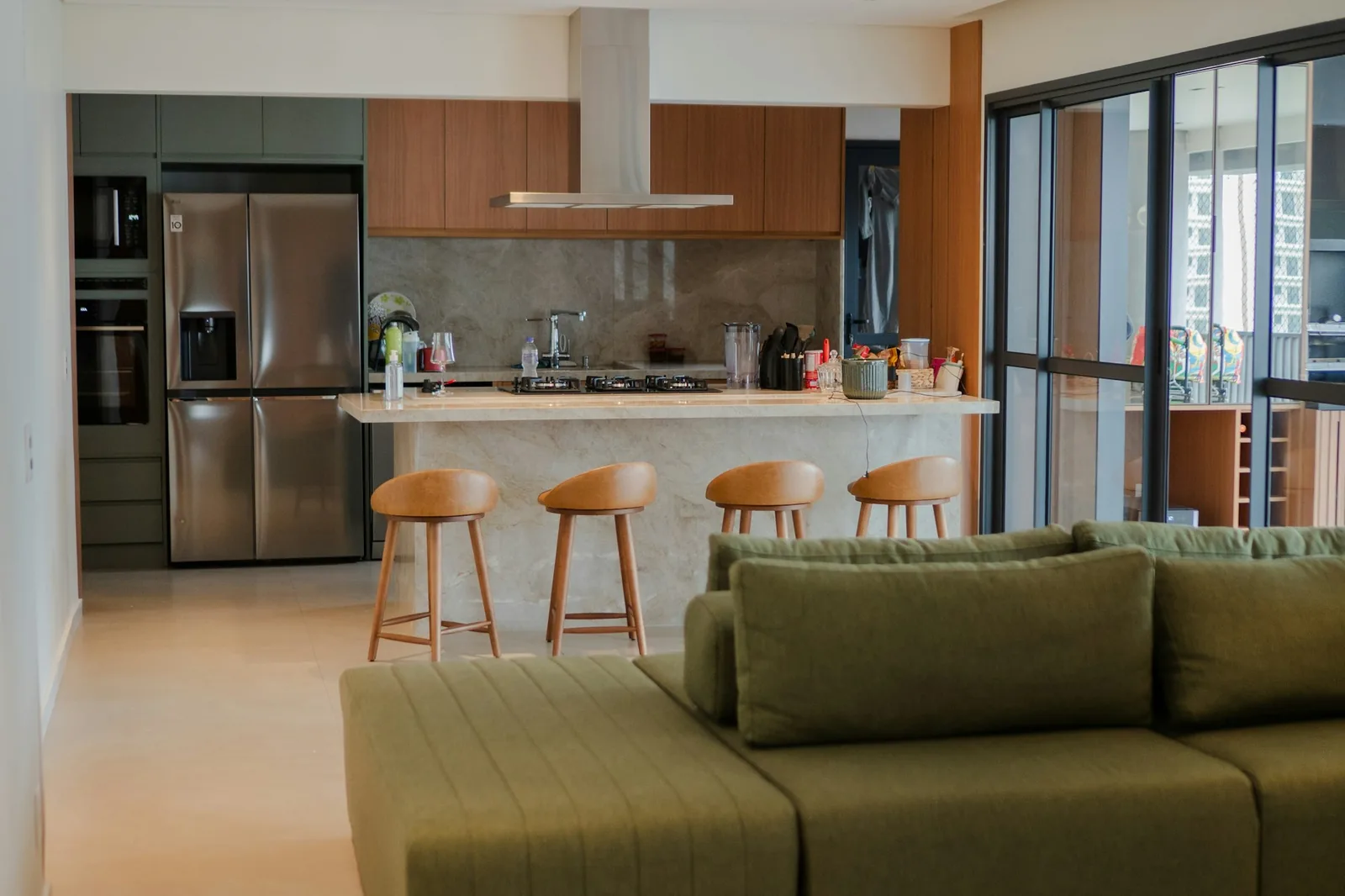
Good open kitchen design starts with the air, not the cabinets. An open kitchen shares one volume of air with the dining table, the sofa, the curtains and the rug, so every tadka, every fish fry and every pot of rice on the boil reaches them. Plan how the smoke and steam leave the room first, keep loose fabric out of their path, and choose washable textiles for the living side. Do that and an open plan gives you what people want from it: light from two sides, a cook who is part of the conversation, and a flat that feels bigger than its floor area.
Goa adds two pressures. Monsoon air already sits at 87–91% relative humidity on most mornings from June to September, according to the India Meteorological Department, and cooking steam goes on top of that. And many flats and villas here are designed to be lived in with the windows open, so the breeze that clears the kitchen can just as easily carry its smoke across the sofa.
A word on what we do. Drape Haus does not design or build kitchens, fit chimneys or put up glass partitions; your kitchen maker, carpenter and electrician do that. We make the blinds, curtains, upholstery, rugs and fabric dividers that sit around an open kitchen, and this guide is about getting those right, together with the kitchen decisions that affect them.
Plan the ventilation before you knock down the wall
The single most important decision in an open kitchen is a ducted hood, the appliance most people in India call a chimney, that actually takes air outside. The Home Ventilating Institute, a North American trade body that certifies ventilation products, puts it bluntly: non-ducted recirculating hoods provide no actual ventilation. They filter some grease, but the heat, moisture and much of the smell stay in the room, and in an open kitchen that room includes your sofa. If the duct cannot reach an outside wall, think hard before opening the kitchen up.
Sizing gives a useful reference point, though it is not an Indian rule. HVI recommends 100 cubic feet per minute (cfm) for every foot of hood width against a wall, with a minimum of 40, and one and a half times that over an island. Converted, 100 cfm is about 170 m³/h. So a hood over a 60 cm hob, roughly two feet, would be rated at about 200 cfm, or 340 m³/h; a 90 cm hob, about three feet, at about 300 cfm, or 510 m³/h; and the same 90 cm hob on an island at about 450 cfm, or 765 m³/h. HVI also points to multi-speed hoods, which run quietly for a simmer and turn up for frying.
Goa's building regulations already anticipate the open plan. The Goa Land Development and Building Construction Regulations, 2010, in the consolidated text to September 2018, allow a dwelling's kitchen either as a separate room of at least 7 m² and 2 m wide, or as part of another room with a designated cooking area of at least 3 m², over and above that room's own area, with light and ventilation next to it. A separate kitchen must also have a window of at least one tenth of its floor area. Later amendments exist, so ask your architect to confirm the current text before you plan around these figures.
If the hood cannot be ducted outside, the smoke has nowhere to go but your fabrics. Solve that before anything else.
Where the smoke goes, and what it lands on
Not all cooking is equal for a hood. Researchers at Lawrence Berkeley National Laboratory measured how much of the pollution from cooking four different hoods actually captured. Pan-frying on a back burner at medium heat, the hoods mostly caught more than 80% of the particles. Stir-frying in a wok on a front burner at high heat was a different story: on the low fan setting, they captured only 3–11% of the fine particles; on high, 16–70%. Indian cooking leans heavily on the second kind: high-heat tempering, frying and roasting masala in a kadai.
Two habits follow, and neither costs anything. Cook the smoky dishes on the back burners where you can, and switch the hood to high before the oil goes in, not after the room is already hazy. The particles and grease that escape the hood rise, spread and settle on whatever is near: the top of the curtain nearest the hob, the back of the sofa, the cushions, the ceiling-fan blades. Over months that film is what turns pale fabric yellow-grey and gives a room its stale smell.
So the layout of the living side matters. Keep the sofa, the main curtains and the best rug out of the direct line between the hob and the nearest open window or door, because that is the route the escaping plume takes when the breeze blows through. A table, a hard-backed dining chair or a counter in that line is easy to wipe; a linen sofa is not. Where the plan allows, put the seating on the far side of the dining table, so the table acts as a buffer.
Planning something like this?
We visit homes across North and South Goa, measure on site, and bring samples to see in your own light.
The window beside the hob: blinds, not curtains
Most open kitchens still have a working window, often right beside or behind the cooktop. Fire services are clear about fabric there: the London Fire Brigade's cooking advice is to keep tea towels and cloths away from the cooker and hob, and a curtain is the largest cloth in any kitchen. A breeze through an open sash can lift a loose curtain towards a burner in a moment, so that window should have a blind fitted close to the glass, or nothing at all.
The best choices are hard, wipeable surfaces: PVC and faux-wood blinds, aluminium venetians, or a roller blind in a coated, moisture-resistant fabric. Fit them inside the recess where the tap and window handles allow, and put the control on the side away from the cooktop. Our kitchen blinds guide covers the recess, grilles and cleaning in detail.
The same fire advice says to clean the cooker hood and extractor regularly, because accumulated fat and grease can ignite. That matters twice over in an open kitchen, where a neglected filter also means more grease escaping into the living room. A filter cleaned on schedule protects the curtains across the room as well as the cook.
Zoning the living side with fabric, rugs and the sofa
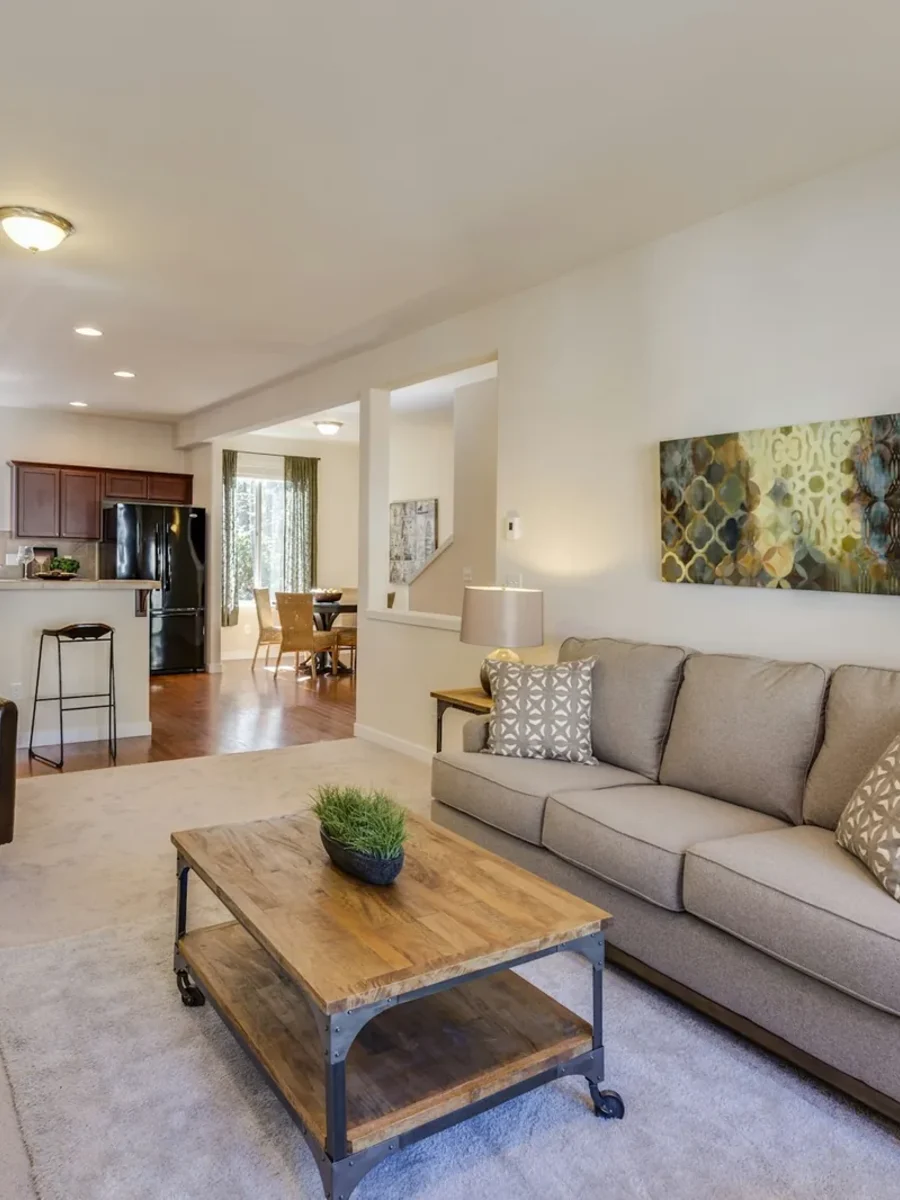
An open plan still needs edges, or it reads as one long room with a stove at one end. The simplest edge is the sofa itself. Turned with its back to the kitchen and floated a little away from the counter, it says where the sitting room begins, and the person on it faces away from the washing-up. Leave a clear walkway behind it; an interior-design guide from the University of Arkansas suggests at least 30 inches, about 76 cm, for a traffic route.
A rug under the seating group does the same job on the floor, and the same guide suggests dividing large rooms with area rugs and furniture groupings. Size it to the sofa and chairs, stop it well short of the kitchen, and choose a flat weave that can be lifted and washed. Our dhurries and flatweaves suit this edge, because a rug next to an open kitchen will see crumbs, splashes and dragged chairs.
Some households want to close the kitchen off now and then: when frying fish, when guests arrive, or to keep the air conditioning in the living room. Glass screens and sliding doors are carpentry and glazing work, and give the most complete separation. A lighter alternative is a full-height fabric divider on a ceiling curtain track along the boundary, drawn across when needed and stacked against the wall the rest of the time. It will not stop smell the way a door does, and it will take some of the grease itself, so make it a washable polyester sheer or a light cotton blend, hang it well away from the hob, and plan to wash it often.
- Sofa back to the kitchen, with a clear walkway behind it
- A washable flat-weave rug that stops short of the cooking zone
- A dining table between hob and seating as a buffer
- A ceiling-track sheer to close the kitchen off when needed
- Pendant lights over the counter or table to mark the change of zone
Fabrics, rugs and cushions that survive an open kitchen
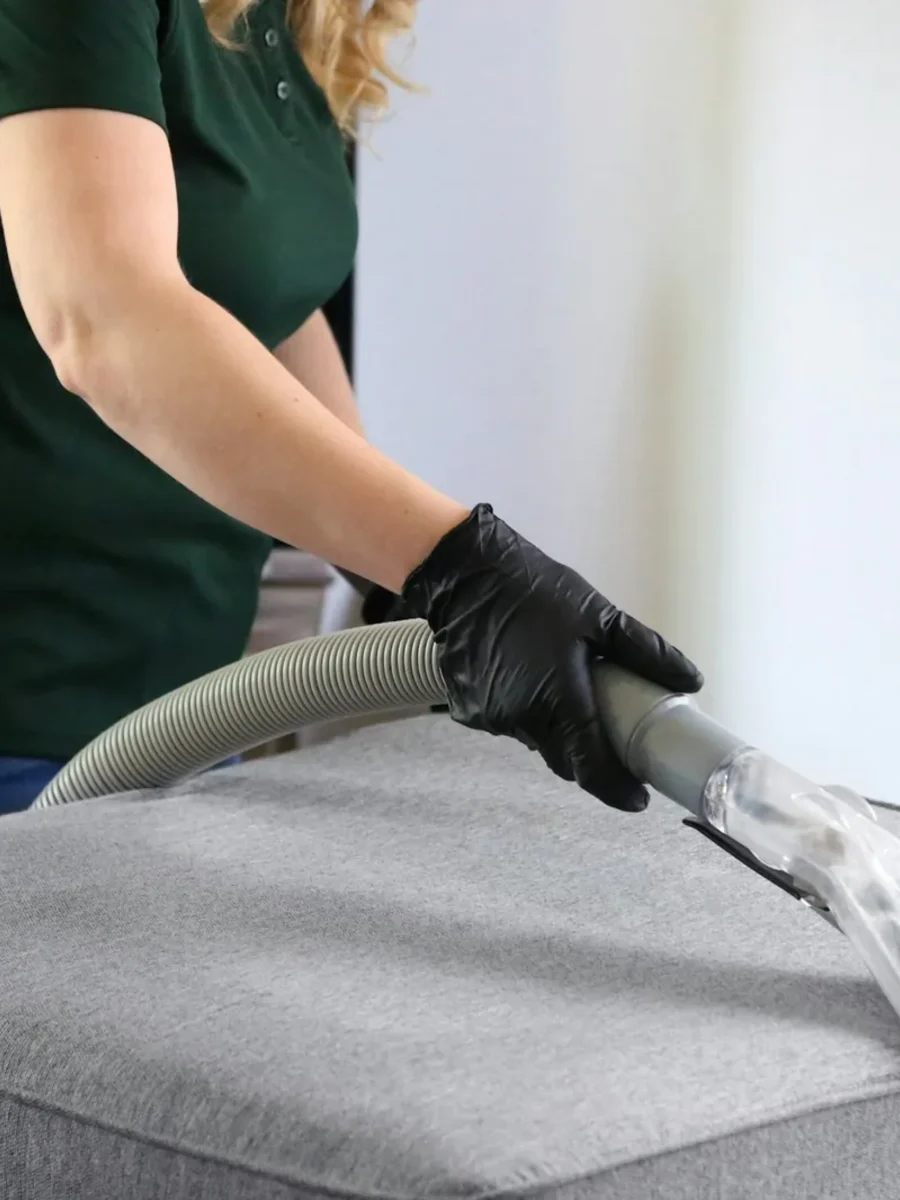
On the living side, judge every textile on one test: can it be cleaned properly, and how? Removable covers are not the same as washable ones. Upholstery fabrics carry cleaning codes, and the industry definitions summarised by the Association for Contract Textiles say that for the common W code (water-based cleaner) and S code (solvent only), cushion covers should not be removed and laundered or dry-cleaned. If you want covers that go in the machine, ask for a fabric that is sold for that, pre-shrunk, and made up as a loose cover.
Grease also feeds mould. The Canadian Conservation Institute notes that mould will grow even on synthetic fibres such as polyester if they are soiled, and that cotton and linen are particularly vulnerable. A cushion near an open kitchen carries a thin film of cooking oil; add a Goan monsoon and it becomes the first thing in the room to smell musty. Regular washing is the cure, which is why easy washing ranks above looks here.
| Item | Better choice | Avoid | Why |
|---|---|---|---|
| Sofa | Tight-weave polyester blend, or a washable loose cover | Pale linen, velvet, chenille | Smooth, tight weaves are easier to clean without damage |
| Cushions | Zipped covers in a washable fabric | Dry-clean-only, beaded or tasselled covers | They sit nearest the plume and need washing most |
| Rug | Cotton or synthetic flatweave | Deep pile, shaggy, silk or viscose | Crumbs and splashes shake or wash out of a flatweave |
| Living-side curtains | Washable sheers or unlined cottons on a track | Heavy lined drapes that only dry-clean | A curtain you can wash every few months stays fresh |
| Divider | Polyester sheer on a ceiling track | Anything near the hob | Takes some smoke itself, so it must wash easily |
Noise from the hood, the mixer and the dishwasher
Open plans are louder than closed ones, and the sound has nowhere soft to go. Tiled floors, plaster, glass and stone counters reflect almost everything. Standard acoustic data, as tabulated by Georgia State University's HyperPhysics from a physics textbook, puts the absorption of poured concrete at 0.02 and heavy plate glass at 0.03 at 1,000 Hz, which means they reflect 97–98% of the sound that hits them. Medium velour drapery absorbs 0.7, unoccupied upholstered seating 0.7 and heavy carpet on concrete 0.4 at the same frequency.
That is why soft furnishings change how an open kitchen sounds. A sofa, a rug under it, full-length curtains on the living-room windows and a fabric-covered panel on one wall all take some of the clatter and the hood's drone out of the conversation. Thin sheers absorb far less than a heavy drape, so if quiet matters, line the main living-room curtains. Our acoustic panels can add more on a wall well away from the cooking. The quietest hood is still one sized properly and run at a lower speed for longer, rather than an undersized one on full blast.
Hard surfaces reflect almost all sound; fabric absorbs a large share. In an open plan, the sofa, rug and curtains are part of the acoustics.
One palette from the cabinets to the cushions
Open kitchens look calmest when the two halves share a colour story. The University of Kentucky's extension guide to wall coverings notes that related colours and patterns in adjoining spaces give a feeling of space and continuity, and an open plan is the extreme case of adjoining spaces. Take one colour from the kitchen, the cabinet fronts, the backsplash or the counter, and repeat it in the cushions, a rug border or a curtain trim on the living side.
Practical colour helps here too. A mid-tone or small pattern on the sofa and cushions hides the faint grey that cooking leaves between washes; pure white and very pale linen show it within weeks. If you love a pale sofa, use a washable loose cover and keep a second set for the monsoon. Wallpaper belongs only on the walls that never see steam, which our guide to kitchen wallpaper maps out zone by zone.
Open kitchens through the Goan monsoon
Cooking adds water to the air. The US Environmental Protection Agency's advice on damp homes is to vent stoves to the outside where possible, because combustion appliances produce water vapour and raise humidity unless vented, and to keep indoor humidity below 60%. In a Goan monsoon, with the windows shut against driven rain, an open kitchen without a ducted hood pushes the whole living room towards the conditions in which fabrics grow mould.
Run the hood for a while after cooking, not just during it, and keep the living-side textiles moving: open the curtains on dry spells, stand sofa cushions on end to air, and lift the rug every week or two. If the flat is closed for the season, take the cushions, divider and loose covers off, wash and dry them fully, and store them in breathable cotton bags. Our guide to reducing humidity in a room covers the rest of the room.