 Drape Haus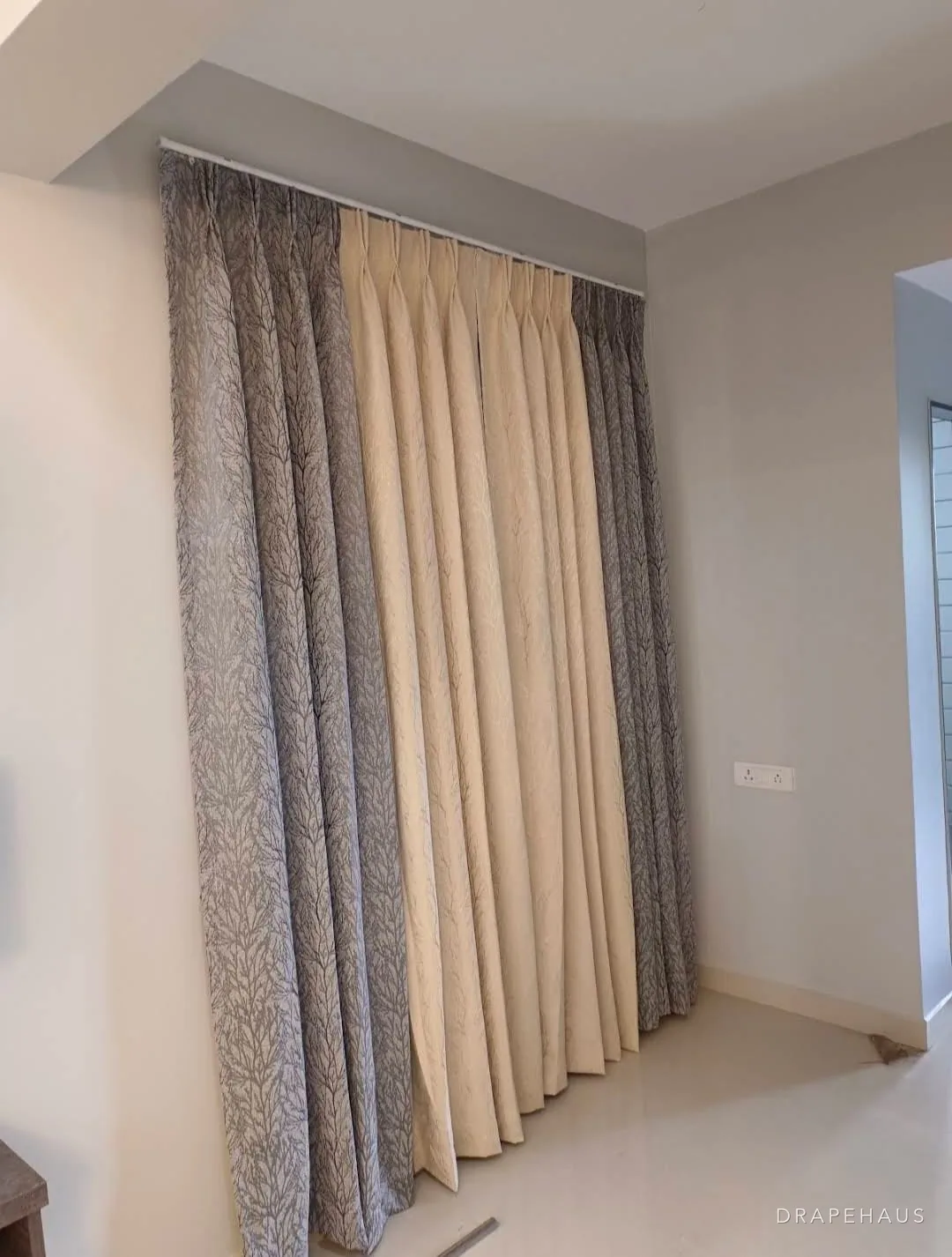
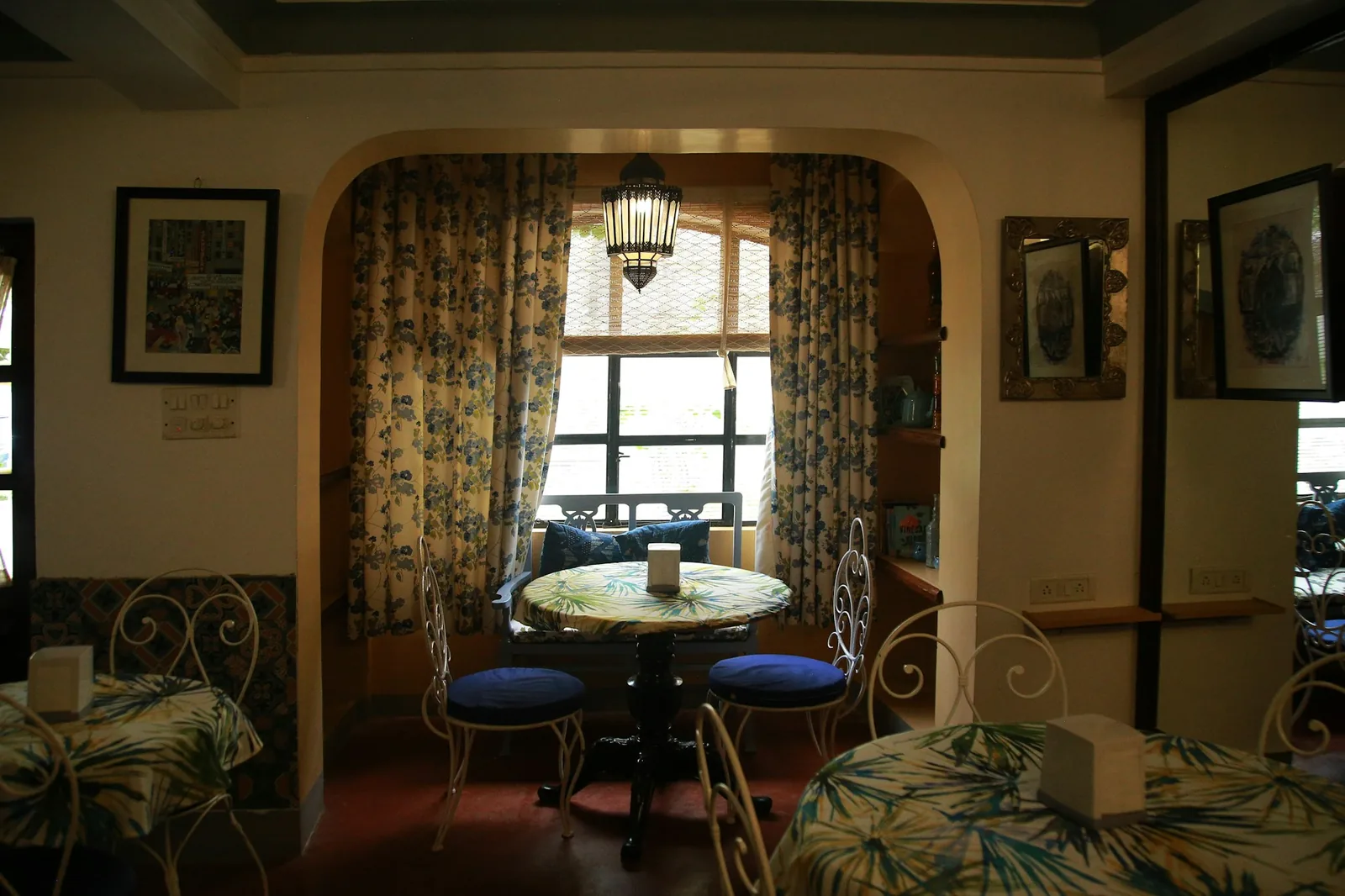
Good home decor in Goa starts from the old houses, not the beach. The interiors that feel most Goan are built on a few things: lime-white walls, red oxide floors, dark carved timber, tall windows with soft light, crisp cotton and lace, a brass lamp and a few blue-and-white tiles. None of that needs a heritage house. A two-bedroom flat in Panjim or a new villa in Assagao can carry it, as long as the choices are made for the climate as well as the look.
The trap is the shortcut. Anchors, rope, fishing-net wall hangings and shell-encrusted mirrors say 'beach holiday', not Goa, and plastic or heavy synthetic decor fights a climate where humidity sits near 90% for four months. Thick fabrics in particular hold damp and are the first thing to smell in August.
This guide takes the elements one at a time: colour, textiles, furniture, windows and objects, then what to avoid and how to scale the ideas to a flat or a villa. Where something is a fact about Goan craft or history, we say where it comes from; where it is decorating advice, it is ours.
A Goan colour palette, inside and out
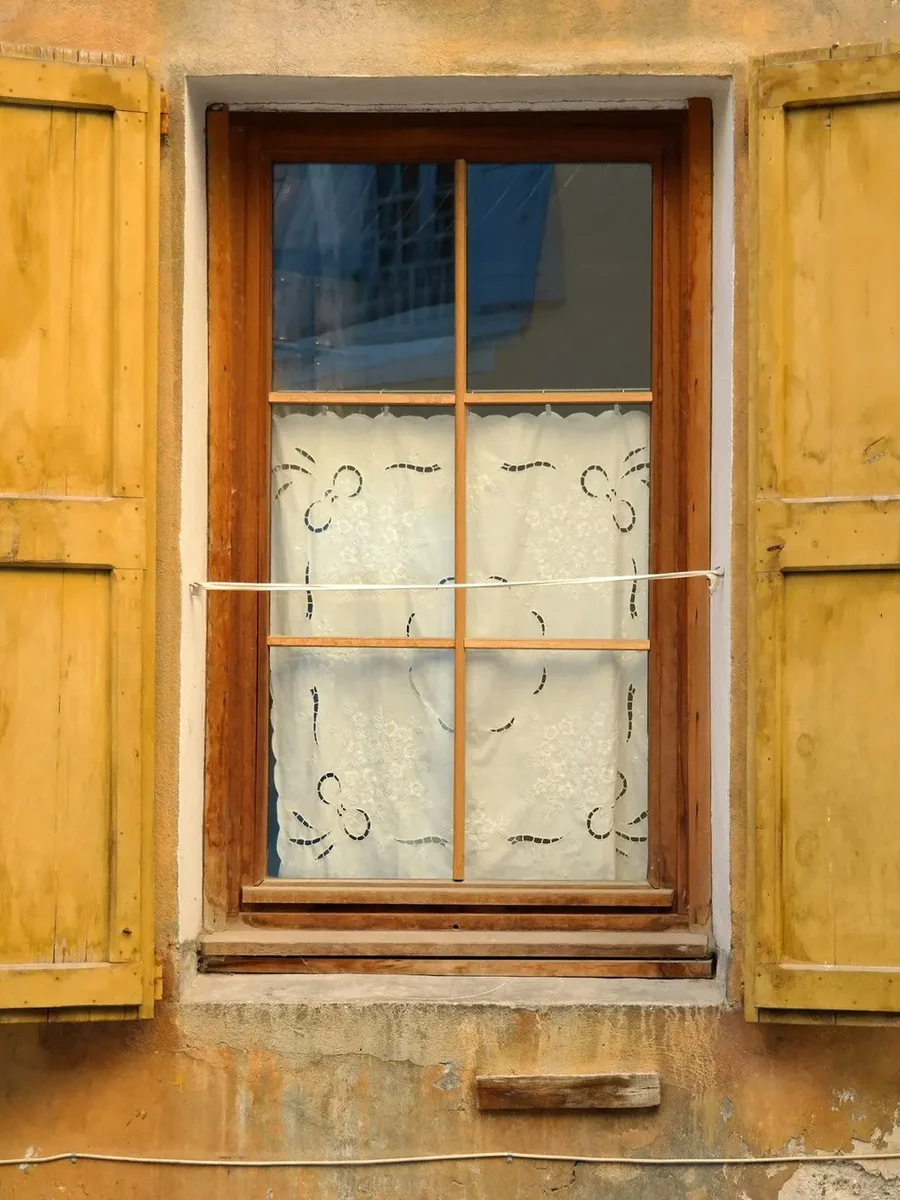
Goan facades are famous for colour, and there is a historical reason. Under Portuguese rule, as accounts of Goan houses record, a private house could not be painted white: white was reserved for churches and chapels, and an owner could be fined for leaving a house unpainted. The result is the yellows, ochres, blues, pinks and greens that line village roads, usually with white picking out the window surrounds, pilasters and cornices.
Inside, the old houses were calmer. Walls were lime plaster, often white or a pale wash, which made the most of the light from shuttered windows. Colour came from the floor, the furniture and the textiles. That is a useful model for a modern interior: keep walls light and let a small number of strong colours do the work.
Use the table below as a starting point. If your walls are old laterite and lime, choose limewash or a breathable mineral paint rather than plastic emulsion; our article on laterite houses explains why. In a modern flat, any good interior paint will do, but a flat, chalky finish reads closer to lime than a sheen does.
| Colour | Seen on | Where it works indoors |
|---|---|---|
| Lime white | Window surrounds, chapels, interior walls | Most walls and ceilings; the base for everything else |
| Indigo and cobalt blue | Facades, azulejo tiles | One feature wall, cushions, a painted cupboard, tiles |
| Ochre and turmeric yellow | Village facades | A hall or dining wall that catches west light |
| Rose and coral pink | Town and village facades | Bedrooms, a reading corner, textiles |
| Deep bottle green | Shutters, doors, facades | Woodwork, a sofa, a pair of chairs |
| Oxide red | Floors, kaavi wall art | Floors and rugs; checked textiles |
Textiles that read as Goan
The most distinctively Goan textile is the kunbi sari, the checked cotton worn by women of the Kunbi community. A newspaper report on its revival describes the traditional cloth as a checked sari in red, white and black with a double-weave dobby edge, distinctive and instantly recognisable; it had disappeared from Goan weaving for more than a century before a revival project began in 2010. Bold red-and-white checks of this kind make excellent cushion covers, table runners and bedspreads, and they tie a room to Goa more directly than any seashell. Buy from Goan handloom weavers where you can.
Lace and crochet are the other Goan signature. A 2022 survey of Goan handicrafts in the Journal of Asian Arts, Culture and Literature notes that crochet and embroidery hold an important place in Goan households and were introduced during the Portuguese period by the nuns of the Santa Monica convent, producing tablecloths, bedspreads, pillow and cushion covers. A crochet runner on a sideboard or a lace-edged pillowcase does more for a room than a new piece of furniture.
For everything else, choose crisp, breathable cottons and linens in plain colours. They wash well, dry quickly in a fan's breeze and soften with age, which suits the look. Our cushions and soft furnishings can be made up in your own handloom fabric or in performance cottons that cope better with sea air. Keep velvet and heavy chenille for an air-conditioned room, if at all.
Planning something like this?
We visit homes across North and South Goa, measure on site, and bring samples to see in your own light.
Furniture cues: dark timber, cane and a long chair
Old Goan interiors are furnished in dark, carved hardwood. The same 2022 handicrafts survey notes that woodcarving came into prominence in Goa during the Portuguese period, with rosewood and teak furniture carved in floral, animal and figurative designs. One good old piece, a carved side table, a chest or a long bench, anchors a room in a way that new furniture cannot, and a restorer can usually bring back a tired finish without stripping its age.
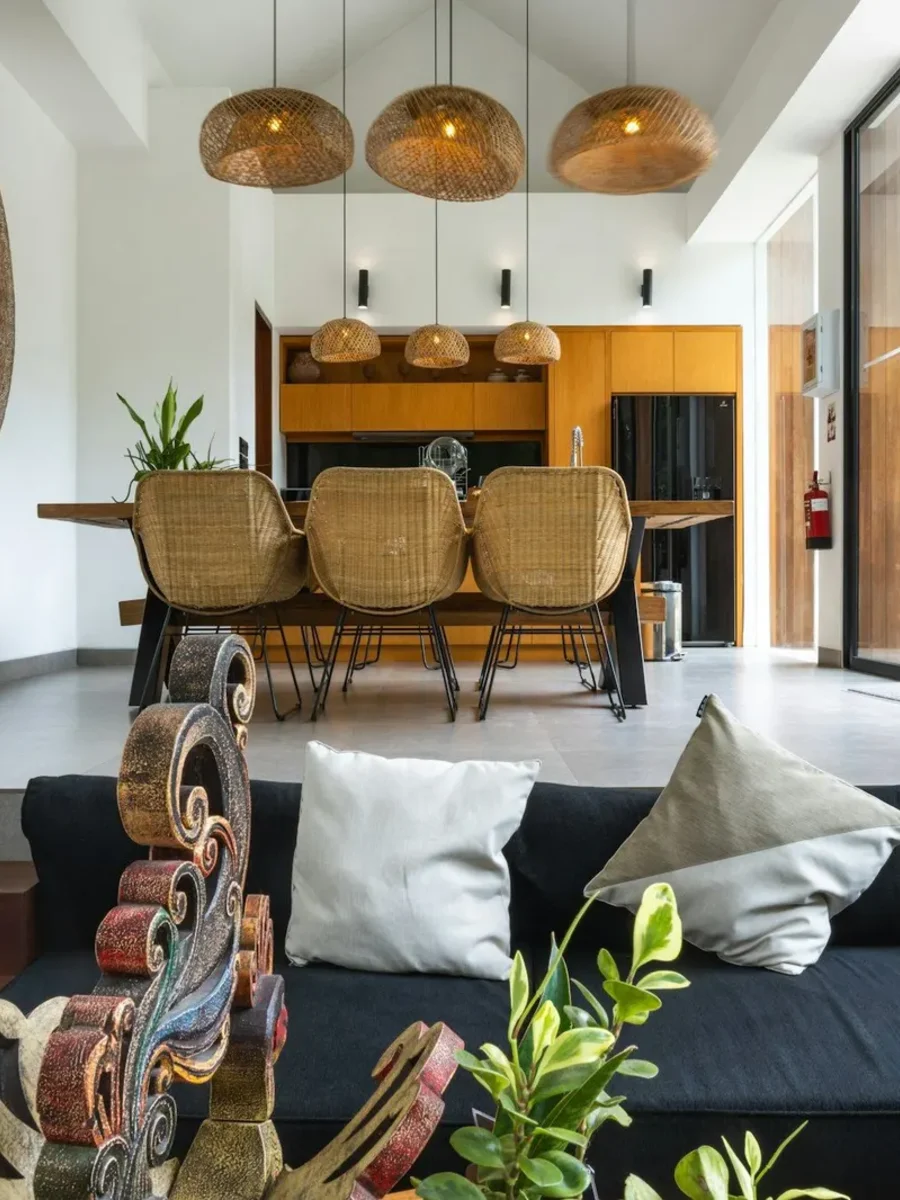
Cane and woven seats are the lighter partner. Cane-backed chairs and settees are cool to sit on in the heat and let air pass, which matters in a climate this humid. A long, reclining planter's chair on a balcony or balcão is about as relaxed a seat as a Goan home can have. Mix dark timber with cane rather than filling a room with either.
For the sofa, keep the frame simple and let fabric and cushions carry the Goan reference. A custom sofa in a plain linen-look fabric, with kunbi-check and white crochet cushions, sits well beside carved timber. Keep wooden pieces a little off external walls, because monsoon damp and mould collect behind anything pushed hard against the plaster.
Windows: tall sheers and chik blinds, not heavy drapes
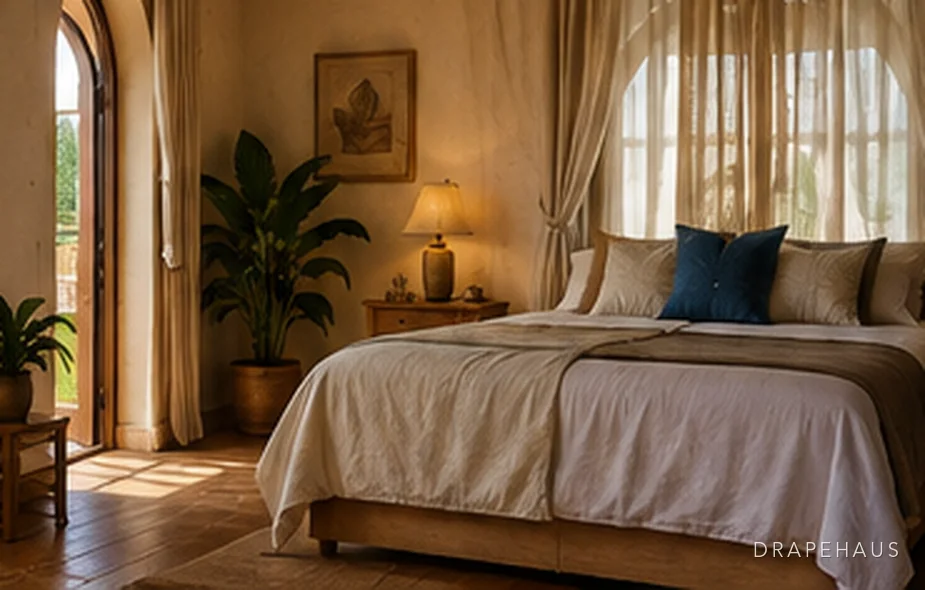
The old houses filtered light rather than blocking it. Their windows were glazed with translucent oyster shell, which softens daylight and gives privacy without glare, as our article on oyster-shell windows describes. A modern interior can borrow the effect with a full-height sheer: a white or ivory voile, or a light linen, hung from as close to the ceiling as possible. Tall sheers make ordinary flat ceilings feel higher and give that diffused, pearly light without any heritage glazing.
Where you need shade, use natural blinds. Bamboo and reed blinds, the chiks hung on verandahs across India, filter the strong west light, let air through and look right against lime and timber. The handicrafts survey lists chicks among the items Goan bamboo craftsmen make, alongside baskets and mats. Our bamboo and chik blinds are made to each opening, and work outside on a balcony as well as inside.
Avoid heavy, interlined drapes unless the room is air-conditioned and kept closed through the rains. In an ordinary Goan room they hold moisture, block the breeze and grow mould along the hem. If a bedroom needs darkness, pair a sheer with a lined curtain or a blackout roller behind it, and choose linen curtains or cotton for the face fabric.
Objects that add a sense of place
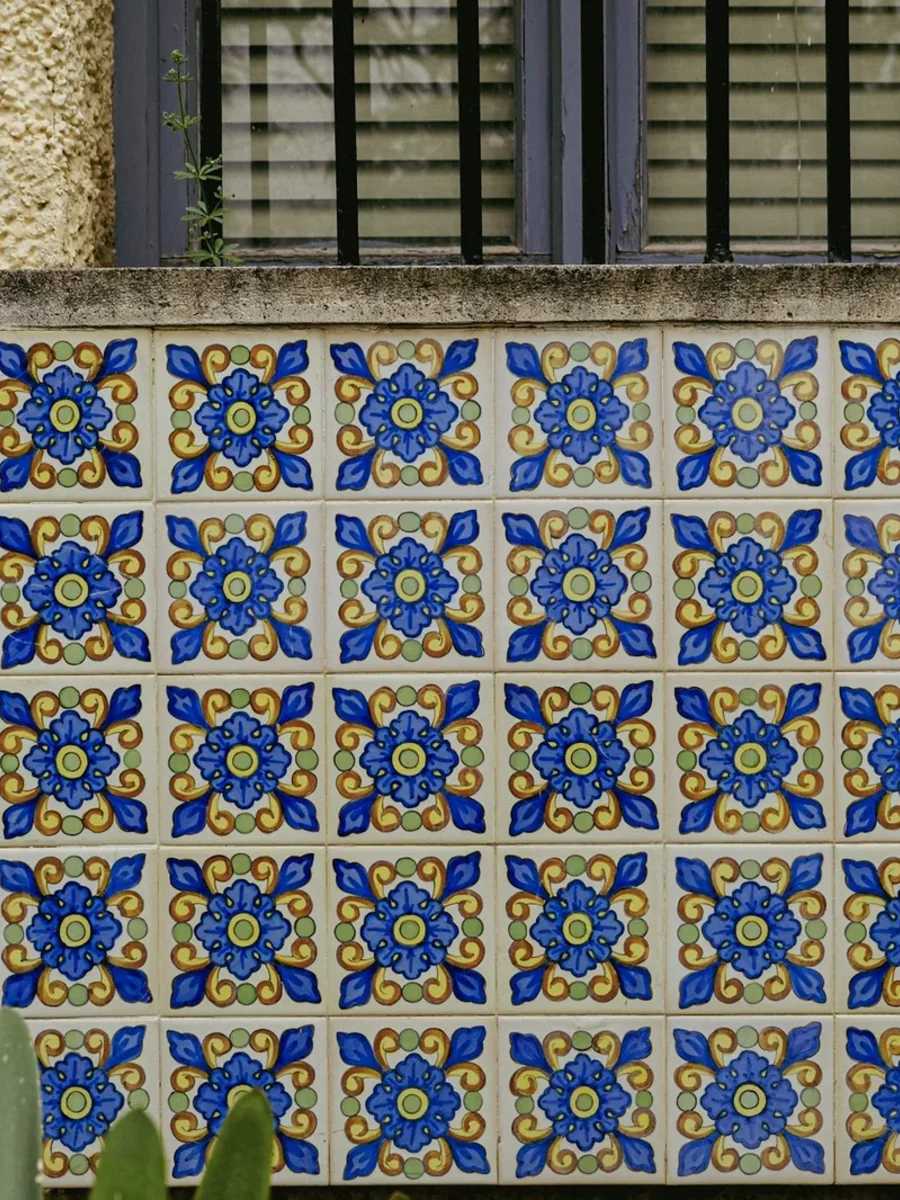
Azulejos are the obvious one, and they have real history here. A Goan newspaper's account of the tradition notes that Portuguese tilework reached Goa in Augustinian buildings, including the churches of Nossa Senhora da Graça and Santa Monica in Old Goa, and that the large panels at Panjim's Institute Menezes Braganza were designed by the artist Jorge Colaço in 1934 and inaugurated in 1937. Today, hand-painted blue-and-white tiles are made in Goa as nameplates, panels and single decorative pieces. A small panel set into a kitchen splashback, a row of single tiles above a doorway, or a framed tile on a shelf brings the reference indoors.
Brass is the second. Goan brassworkers make the samai, which the handicrafts survey describes as a tree-like oil lamp with flower motifs, along with candle stands and bells. A samai on a console or at the end of a corridor is beautiful lit or unlit. Polish it lightly and accept some patina in sea air.
Terracotta and family history complete the picture. Goan potters still make red terracotta pots, planters and hanging pots, and a group of them on a balcony or a stair landing is more Goan than any amount of driftwood. Old family photographs, in plain dark frames, hung in a group in the hall, are what you find in so many old Goan houses. They cost nothing and say more about the home than anything bought.
What to avoid
Avoid the beach-shop vocabulary: anchors, ships' wheels, rope, nautical stripes, fishing nets on walls and shells glued to everything. Goa does have a long tradition of shell craft, which the handicrafts survey traces to the Portuguese period, when shells adorned doors and windows, but a little goes a long way. One mother-of-pearl lamp or a shell-inlaid box is a reference; a room full of shells is a theme.
Avoid materials that suffer in humidity. In Goa, morning humidity runs at 87–91% from June to September, according to the India Meteorological Department. Thick pile rugs left down on a cool floor, heavy velvet curtains, foam-filled cushions without removable covers, and wall hangings made of untreated fibre all hold moisture and smell by August. Plastic decor does not rot, but it yellows in the sun and looks out of place against lime and timber.
Avoid copying a heritage house wholesale into a flat. A balcão, imitation shell windows and a carved altar niche in a fourth-floor apartment look like a stage set. Borrow the colours, the textiles, the light and a few genuine objects, and let the flat be a flat.
If a fabric would be miserable to wash in July, it does not belong in a Goan room that is not air-conditioned.
Scaling the ideas: a Panjim flat or a new villa
In a flat, work with the shell rather than against it. Paint most walls a warm lime white and give one wall a strong colour from the palette above. Hang full-height sheers on a ceiling track to lift the ceiling. Put one carved timber piece in the living room, a cane chair by the window, kunbi-check cushions on a plain sofa and a group of family photographs in the hall. Add a small azulejo panel in the kitchen and a samai on the console. That is a Goan interior, and it fits in sixty square metres.
In a new villa, the same elements work at a larger scale, with two cautions. Double-height rooms and long glass walls need window treatments sized to them; our article on villa living-room design covers the proportions. And new villas are usually more sealed and air-conditioned than old houses, which allows heavier fabrics in some rooms, but the same rule applies to anything that will be closed up for the monsoon: choose what can be washed or stored.
Whichever you have, the order is the same: walls and light first, then large textiles, then furniture, then objects. If you would like help with the soft furnishings, we can visit, bring fabrics to see in your own light and quote for the whole house; book a home visit.