 Drape Haus
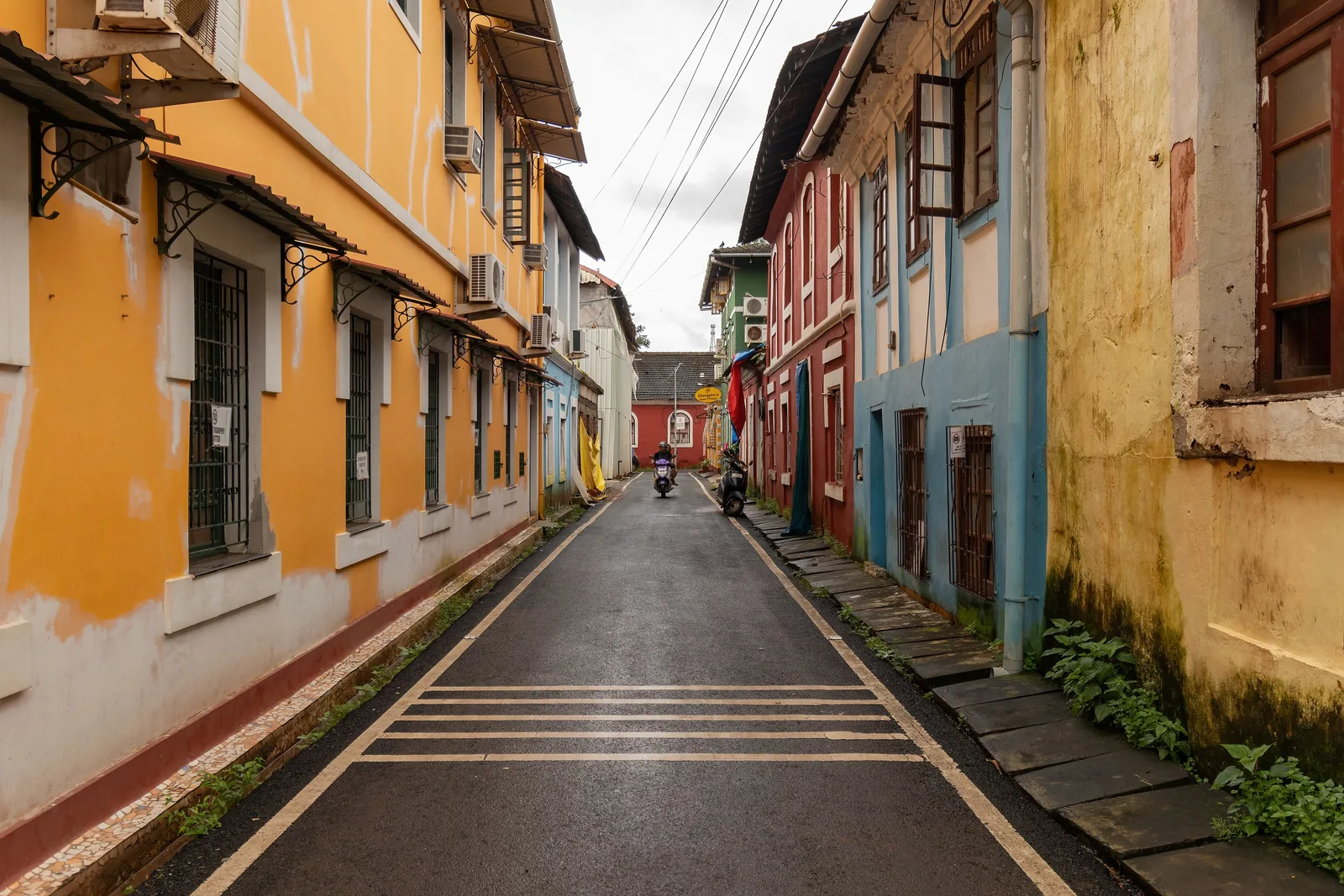
Old Goan houses survive all over the state, but not evenly. They cluster where families prospered in the 18th and 19th centuries and where later development has been gentler: the Salcete villages around Margao, the older quarters of Panaji, and a string of river villages in Bardez and Tiswadi. The Government of Goa's information department notes that Indo-Portuguese mansions still stand in many villages, though in some most of them are now dilapidated.
Almost all of them are private homes. That shapes how you see them. A handful are shown to visitors by their families or have been restored and opened; everything else is seen from the road, which is where the most important parts of a Goan house were designed to be seen anyway: the plinth, the balcão, the rhythm of windows and the colour.
This guide goes place by place, with what can be verified about each, what to look for when you get there, and how to behave on lanes where people live. We give no opening hours or fees, because they change. Check locally before you travel.
Chandor: the great houses on the square
If you see only one village, see Chandor, east of Margao in Salcete. Local histories identify it with Chandrapur, an early Kadamba capital, and its square is dominated by Braganza House, which the Government of Goa describes as a 17th-century mansion occupying one whole side of the square, now two family residences behind a shared entrance. Both wings are shown to visitors by the families.
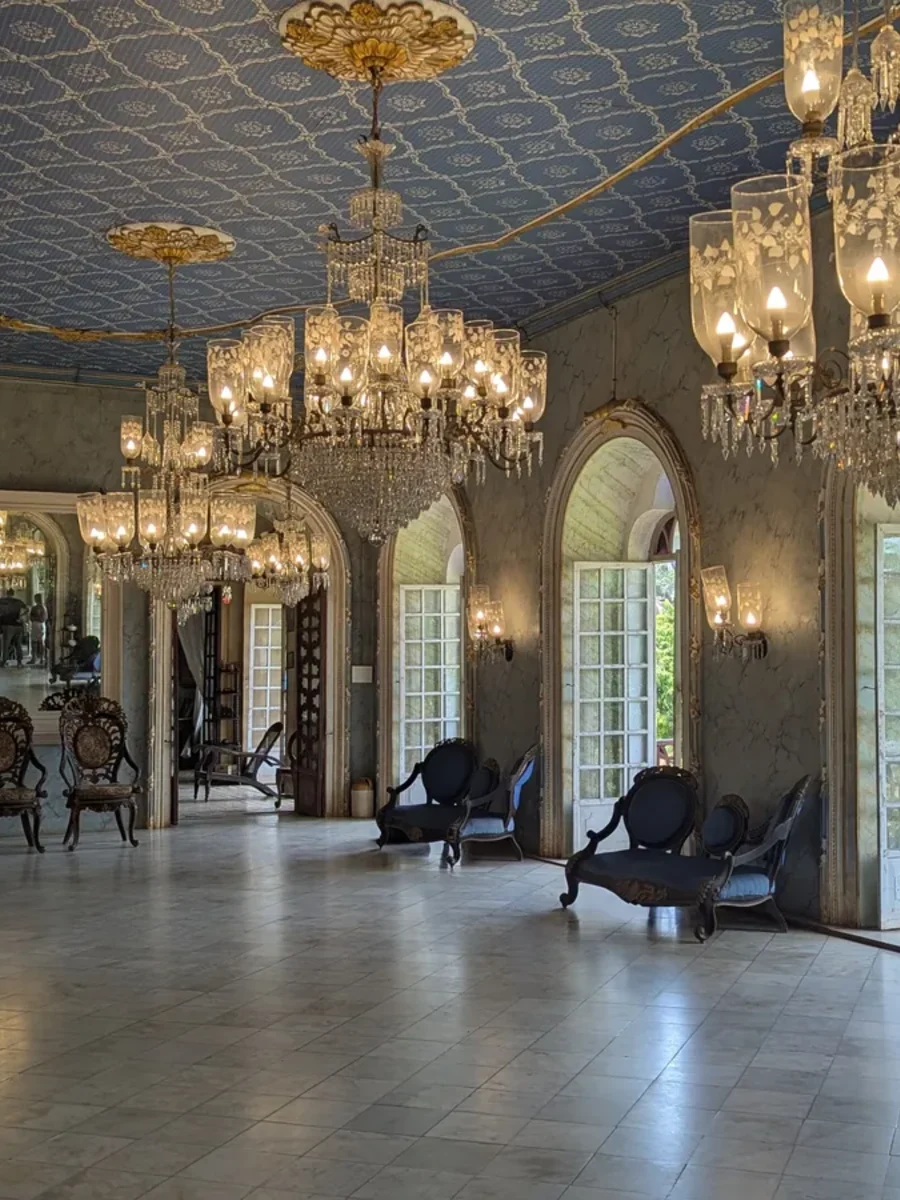
A short walk away is the Fernandes house, known as Voddlem Ghor or Casa Grande. Local accounts describe a house older than its Portuguese-style front, built around a central courtyard, with a ballroom and a hidden basement and passage that the family shows to visitors. Seen together, the two houses show the two faces of Goan domestic architecture: the long, outward-facing front and the inward courtyard behind it.
Start at the church of Our Lady of Bethlehem near the square, then walk the roads leading out towards the fields. The smaller houses here repay attention: balcões with built-in seats, pilastered fronts, coloured walls with white trim, and a few houses clearly empty and slowly giving way, which is part of the honest picture of heritage in Goa.
Loutolim and Quepem: Salcete's other mansions and a restored palácio
Loutolim, north-east of Margao, is the other Salcete village most associated with large family houses. Its church of Salvador do Mundo was built by the Jesuits in 1586, and the lanes around it hold a dense scatter of old houses, several of them substantial. Some have been opened as private house museums or put to other uses over the years; because these arrangements change and several are now businesses, we do not list them here. Ask locally which are receiving visitors.
Quepem, south-east of Margao and outside the old Portuguese core, has one of the few restored mansions regularly shown to visitors. The Palácio do Deão was built in 1787 by Father José Paulo de Almeida, a senior churchman, and later served as a retreat for the colony's viceroys. It has been restored to an approximation of how it looked in his day, and guided tours of around half an hour have been offered. Check current arrangements before you go.
Between them, these places make a good day. The roads linking Margao, Loutolim, Chandor and Quepem pass through paddy and small settlements where houses of every size line the road, and a slow drive with stops is often as rewarding as the named houses.
Planning something like this?
We visit homes across North and South Goa, measure on site, and bring samples to see in your own light.
Panaji: Fontainhas and the other precincts
Fontainhas is the city's most visited old quarter, set between the Altinho hill and the Ourem creek. Its name is usually explained as "little fountains", after the springs at the foot of the hill, and its growth as a residential quarter is traced to the late 18th century, when António João de Sequeira, a Goan who had made money in Mozambique, held the land. The small chapel of St Sebastian was built in 1818 and holds a crucifix with open eyes that came from Old Goa.
Fontainhas is not the only old quarter in Panaji. A 2014 heritage listing study carried out for the state's Town and Country Planning Department identified eight heritage precincts: São Tomé, Fontainhas, Mala, Portais, the central business district, Altinho, Campal and Ribandar, documenting roughly 900 buildings in four grades. São Tomé adjoins Fontainhas and is easily walked with it.
Ribandar, east of the city on the road to Old Goa, is the odd one out in that list: a riverside settlement rather than a planned town quarter, with old houses strung along the main road and the lanes behind it. It makes a natural stop on the way to the churches of Old Goa, and a useful contrast, because it shows the village house and the town house within a few kilometres of each other. As everywhere in this guide, the houses are private and are seen from the road.
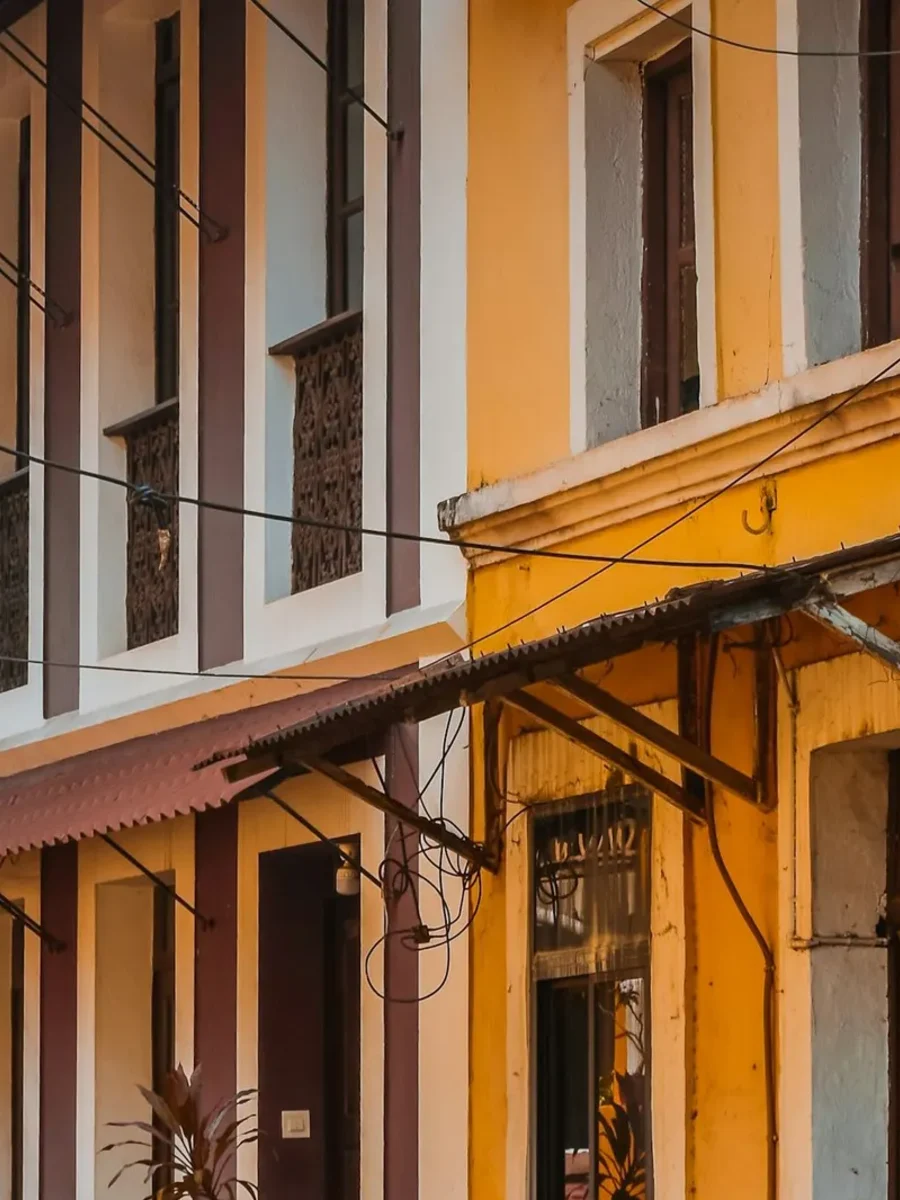
The houses here are town houses rather than country mansions: narrower, often two storeys, set directly on the lane, with projecting balconies and, often, tiled name plates. The government's information department notes that Fontainhas has been declared a cultural quarter. It is not, whatever some travel writing says, a UNESCO World Heritage Site; Goa's World Heritage listing, inscribed in 1986, is the churches and convents of Old Goa.
Fontainhas is a Panaji heritage precinct and a declared cultural quarter, not a UNESCO site. People live in every house.
Divar, Aldona and the northern villages
North of Panaji the old houses are spread through river villages rather than gathered round one square. Divar island, in the Mandovi, is reached by ferry from Old Goa, Ribandar and Naroa, and holds three villages: Piedade, São Matias (Malar) and Naroa. Its narrow roads, churches and old houses, seen with very little through traffic, give a good sense of a Goan village before the main roads arrived.
Aldona, in Bardez, sits on the Mapusa river. Its church of St Thomas, built in 1596 on a plateau above the river, is the anchor for a walk; the wards around it and along the river road hold many old houses, some beautifully kept and some empty. Siolim, further north near the Chapora river, and the neighbouring Bardez villages have similar stretches of old houses between newer buildings.
We have deliberately not named individual houses in these villages. Most are private homes with no arrangement for visitors, and several of the better-known ones are now run as businesses. The pleasure of these villages lies in walking or cycling slowly and reading houses from the road, which needs nobody's permission.
Where to go, at a glance
The table sums up the places above. "Shown to visitors" means a house that has, in recent years, been opened by its owners or managers in some form; it does not guarantee that it is open on a given day. Everything else is for looking at from public roads.
If you have one day, pair Chandor with Loutolim in the south, or Fontainhas with Divar in the centre. Two days lets you add Quepem and a slow drive through Bardez. Go early in the morning in the dry season for the best light and the quietest lanes. In the heaviest monsoon weeks, low roads can flood and river crossings can be affected by the weather.
| Place | Taluka | What you see | Inside? |
|---|---|---|---|
| Chandor | Salcete | Braganza House, Fernandes house, village lanes | Both houses shown to visitors; check locally |
| Loutolim | Salcete | Cluster of family houses around the 1586 church | Some open as house museums; ask locally |
| Quepem | Quepem | Palácio do Deão (1787), restored | Guided tours have been offered; check first |
| Fontainhas and São Tomé | Tiswadi (Panaji) | Town houses, balconies, 1818 chapel | From the street only |
| Divar island | Tiswadi | Quiet village houses and churches | From the road only |
| Aldona, Siolim | Bardez | River villages, houses among fields | From the road only |
What to look for on an old Goan house
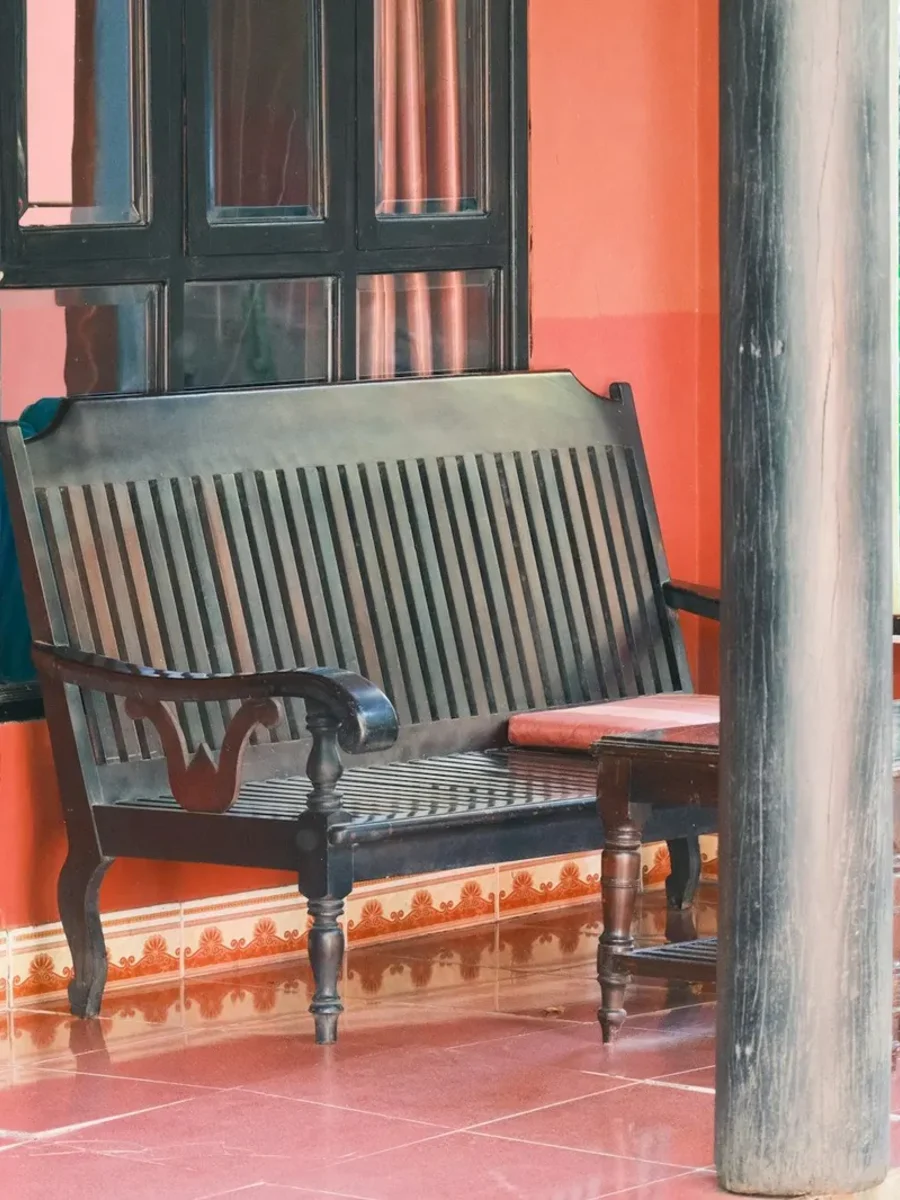
Read a house from the bottom up. The plinth lifts it above wet ground, and steps rise from the road to the balcão, the covered porch with built-in seats. The front door sits behind it, with windows lined up either side in a regular rhythm. Above, deep eaves throw water clear of the walls, and the roof is pitched and tiled.
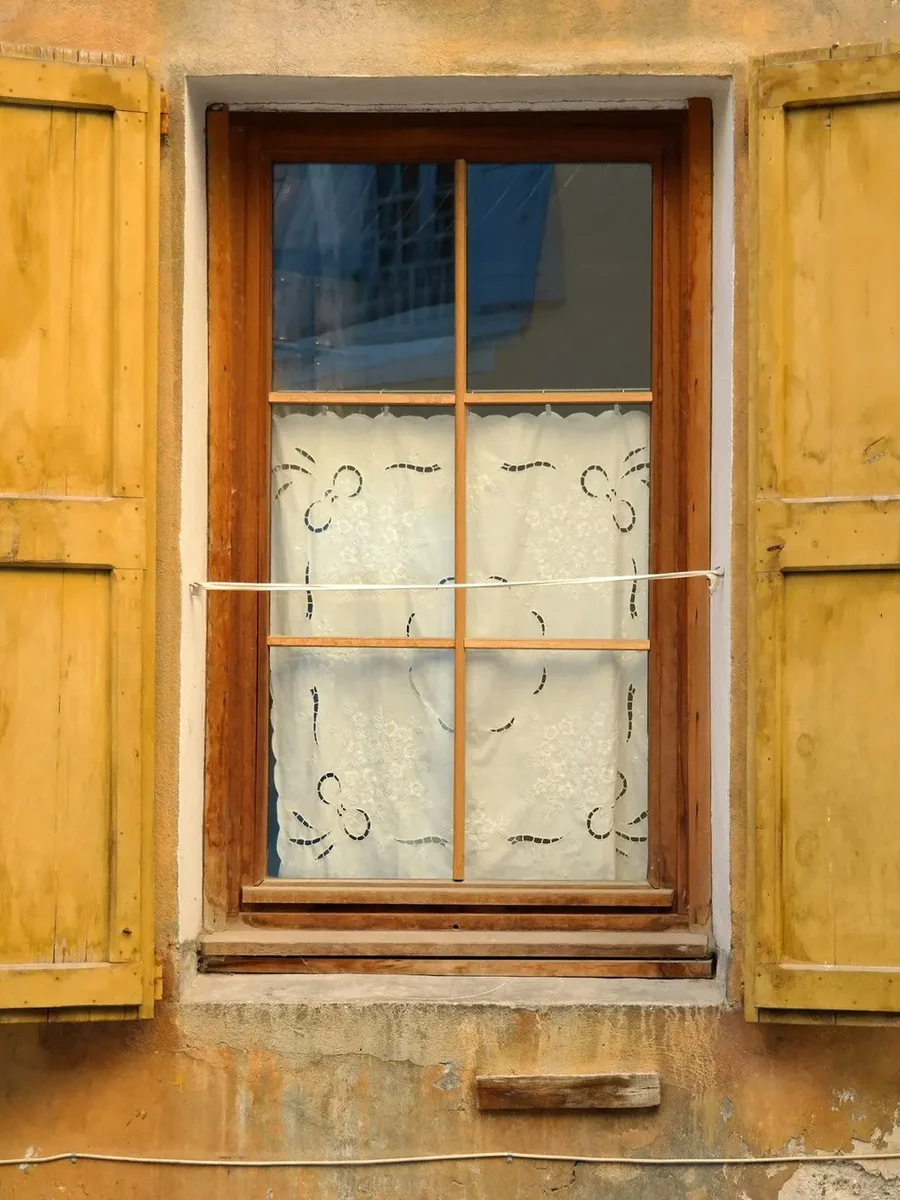
Then look at the details. Pilasters, cornices and window surrounds picked out in white against a coloured wall are the signature of the Portuguese-era front. Small square panes in timber frames may be oyster shell rather than glass; look closely and you will see a pearly translucence instead of clear glass. Through a side gate you may glimpse an inner court, the older way of planning a Goan house. Our pieces on the Goan balcão and oyster-shell windows go deeper into those two features.
- Plinth height and the number of steps to the door
- Balcão: built-in seats, columns, whether it is open or enclosed
- Window rhythm, shutters, and shell or glass panes
- Pilasters, cornices and white trim against the wall colour
- Roof pitch, eaves depth and the state of the tiles
- Side courtyards or an inner court glimpsed through a gate
Etiquette on lanes where people live
Every street in this guide is someone's street. Walk on the road or lane, not up the steps; the balcão is part of the house, even when it faces the road. Do not open gates, sit on built-in seats or lean on old plaster and shutters. Ask before photographing people, and do not photograph through open doors or windows.
If a house is shown to visitors, behave as a guest. Follow the person showing you round, keep children close, ask before taking photographs inside, and accept that some rooms are private. Contributions from visitors help to keep some of these houses standing; give in that spirit. And if you own an old house yourself, our guide to dressing a Portuguese heritage house is a good next step. When you are ready, we can measure and quote for curtains that suit the house and its climate.