 Drape Haus
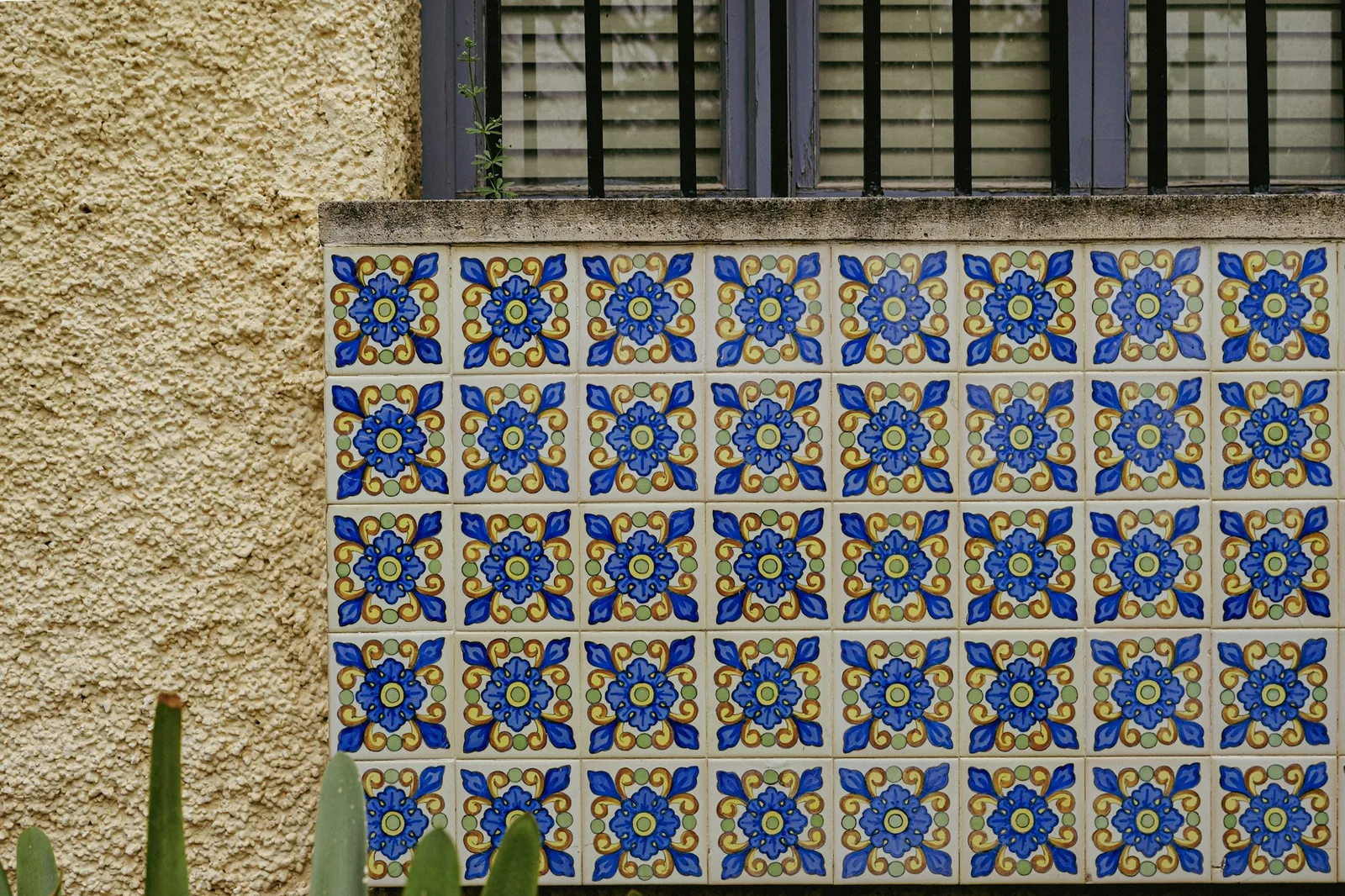
A house name plate in Goa is more than an address. Goan houses have names, and those names are written on blue-and-white tiles, painted on gate pillars, cut into stone or set above the door. They record a family, a saint, a place, a blessing or a meaning private to the household, and people refer to the house by that name for generations.
That makes choosing one a pleasant and slightly serious decision. The name has to be right, the plate has to last in salt air and monsoon rain, and it has to be fixed to a gate pillar or porch wall of laterite and lime plaster without cracking the tile or damaging the wall.
This guide covers the custom, the azulejo tiles most Goan plates are made from, how to word a name, how tile, brass, wood and stone compare outdoors in Goa, and how to place, fix and light a plate. It ends at the porch, which is where we come in.
The Goan custom of naming houses
Goa names its houses. As one Goan feature on the subject puts it, a home here is not simply a number on a road: it may carry a family surname, a saint, a flower, a Portuguese word, a personal name, a religious reference or a title whose meaning only the family knows. Some families choose saints or names expressing gratitude and blessing; others choose names rooted in Hindu traditions. Names appear on blue-and-white ceramic tiles, painted on gateposts, engraved in stone or displayed above entrances.
The name becomes part of the family's vocabulary. A family that has moved away may still identify itself with the ancestral house through the name on its gate, and the name turns up in letters, invitations and directions. That is worth remembering when naming a new house or renaming an old one: in a village, the old name may live on in conversation whatever the new plate says.
In practice, names also do a practical job. Village roads and lanes in Goa are often loosely numbered, and a clearly named, well-lit gate is how deliveries, guests and taxis find a house. A good plate is legible from the road, not just attractive close up.
Azulejo name tiles: where they come from
The blue-and-white tiles that most Goan name plates are painted on belong to the azulejo tradition. A Goan newspaper's account of it traces azulejos to Islamic art brought to Iberia by the Moors and to the majolica technique brought to Portugal by Italian and Flemish artisans in the sixteenth century, and notes that the tradition reached Goa through Portuguese building, particularly the Augustinian churches of Nossa Senhora da Graça and Santa Monica in Old Goa. Goa's best-known modern panels are at the Institute Menezes Braganza in Panjim, designed by the artist Jorge Colaço in 1934 and inaugurated in 1937.
Today, as the same account notes, azulejos in Goa are made mostly as nameplates, souvenirs and decorative pieces. The Asia InCH craft encyclopedia, published by the Craft Revival Trust, describes the process: a clay tile body is fired at about 1,200 °C, glazed and painted with ceramic colours, and fired again at around 1,200 °C to fuse the pigments with the tile. It records blue and yellow as the favoured traditional combination, with floral patterns and religious scenes, though all colours and many themes are now painted. The newspaper describes a Goan tile painter using both high-temperature colours, fired at over 1,000 °C, and low-temperature colours fired at 750–810 °C.
For an outdoor plate, ask the maker which colours and firing they use. Colours fused into the glaze at high temperature are the safer choice for a plate that will face sun and rain every day. A plate is usually painted across several tiles, so ask also for a spare tile or two in case one is ever cracked.
Planning something like this?
We visit homes across North and South Goa, measure on site, and bring samples to see in your own light.
Wording: names, saints, dates and languages
Start with what the house is to the family. A surname is the most common choice and the most useful for visitors. A saint's name, or a name that expresses gratitude or blessing, is common in Catholic and Hindu families alike. A flower, a tree that stands in the garden or a place the family came from all work well. A year of building or of the family's arrival can sit beneath the name, but check it; a wrong date on an old house is worse than none.
Language is part of the character. Portuguese words such as 'Casa' (house) appear on many older plates, and Portuguese carries accents, ã, ç, é, that a painter needs to get right. Konkani, written in Devanagari or in Roman script, roots a name firmly in Goa. Some families use two lines: the name in one language and a short blessing or the family name in another. Before the tile is fired, have someone who reads the language check every letter, because a misspelling cannot be painted out.
Keep it short enough to read from the lane. A name of one to three words, with the house number or the lane name in smaller letters underneath, usually works better than a long inscription. If the plate is to sit on a gate pillar, measure the pillar face first; the plate should fit within it with a clear margin of plaster all round.
- Family name: '(Surname) House', 'Casa (Surname)' or its Konkani equivalent.
- Saint or blessing: the family's patron saint, or a name expressing thanks.
- Place or nature: the village of origin, a tree in the garden, a flower.
- Date: the year of building or of the family's arrival, if known for certain.
- Practical line: the house number and lane, in smaller letters below.
Tile, brass, wood or stone in salt air
Goa's coast is hard on outdoor materials: strong sun for eight months, four months of heavy rain and, near the sea, salt in the air all year. Each material for a name plate handles that differently. The table compares them in practical terms; it reflects general trade experience rather than tested figures, and a well-made, well-fixed plate in any of them will outlast a poor one in another.
Glazed ceramic is the traditional Goan choice for good reason. A fired glaze does not rust, rot or fade the way paint does, and a tile can be wiped clean. Its weaknesses are impact, which can crack a tile, and the fixing, because water getting behind a tile can loosen it over time. Brass looks handsome and is very durable, but it tarnishes quickly near the sea and needs regular polishing or a protective lacquer that itself wears in time. Carved hardwood is warm and traditional on doors and porches, but outdoors it needs oiling or varnish renewed regularly and should sit under the eaves, not on an exposed pillar. Engraved stone, including laterite, is the most permanent of all, but the letters can be hard to read unless they are painted in.
| Material | Strengths | Weaknesses | Best placed |
|---|---|---|---|
| Glazed ceramic tile (azulejo) | Colour fused in glaze; easy to clean; traditional | Can crack on impact; fixing must keep water out | Gate pillar or porch wall |
| Brass | Durable; classic on doors | Tarnishes fast in sea air; needs polishing or lacquer | Under cover, beside the front door |
| Carved hardwood | Warm; can be carved in relief | Needs regular oiling; weathers in sun and rain | Under the eaves or on the porch |
| Engraved stone or laterite | Most permanent; matches the wall | Letters hard to read unless painted | Set into a pillar or wall face |
| Painted lettering on plaster | Simple; easy to repaint | Fades and peels; renewed with the wall paint | Pillars of a lime-washed house |
Fixing a plate to laterite and lime plaster
Old Goan pillars and walls are laterite under lime plaster, and both are softer than the tile you are fixing to them. The aim is a fixing that holds the plate securely, keeps water from getting behind it and does no lasting harm to the wall. That is a job for a careful mason or carpenter; what follows is what to ask for.
Use non-corroding fixings. Conservation guidance from Northern Ireland's Department for Communities says fixings in masonry should be non-ferrous, set in resin, with suitable mortar to the joints. Ordinary steel screws rust in Goa's air, stain the plaster and can crack a tile as the rust swells; stainless steel or brass screws, in plugs or resin set into sound masonry behind the plaster, are the safer choice. Drill through the tile only with a tile bit and without hammer action, and drill the wall slowly, because laterite crumbles at the edge of a hole.
Think about the bedding. On a modern cement-rendered pillar, a tile can be bedded in an exterior tile adhesive in the usual way. On an old lime-plastered wall, a hard cement bed is a poor neighbour for the same reason cement pointing is, as the Society for the Protection of Ancient Buildings explains: it pushes moisture and decay into the softer material around it. A lime-based mortar, or mechanical fixings with the tile mounted on a backing board, respects the wall better. Never fix over kaavi work or decorative plaster. Whatever the method, seal the top edge so rain cannot run down behind the plate, and leave the bottom edge able to drain.
Stainless or brass fixings, no hard cement on old lime, and a top edge that sheds rain: those three keep a name tile on a Goan wall for decades.
Placement and lighting by the gate or balcão
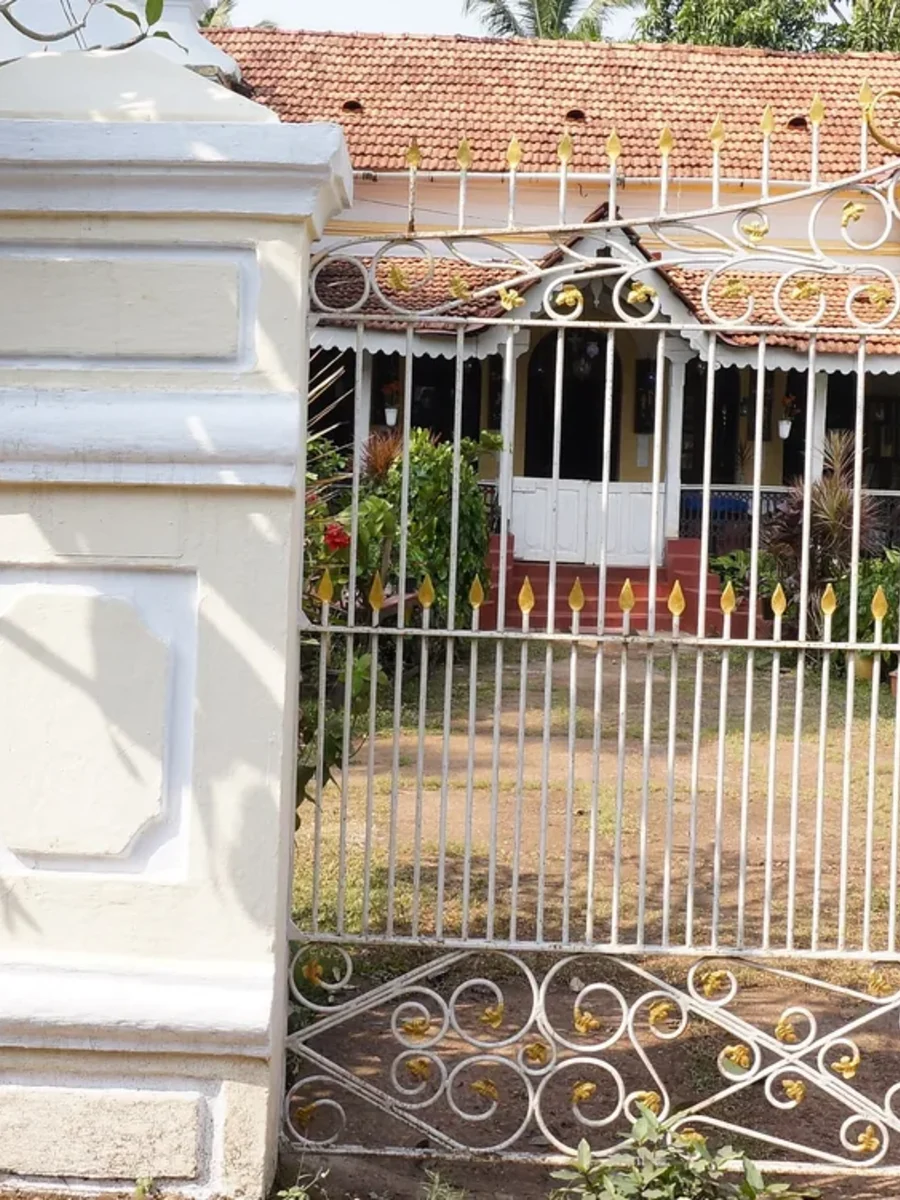
Put the plate where someone looking for the house will see it. For most Goan houses that is the gate pillar facing the road, at about eye height, on the side of the gate a visitor approaches from. If the wall is low and the house is visible, a second plate on the front of the balcão or beside the door repeats the name for those who have already come in. Gates in Goa must open inward under the state's building regulations, so make sure the plate is not on a pillar face the open gate will hide.
Light it. A name that cannot be read after dark does not do its practical job. A small, shielded downlight above the plate, or a lamp on top of the pillar, is better than an uplight that glares in the eyes of people walking past. Choose a fitting made for outdoor use, with stainless or powder-coated parts, and a warm light that shows the blue and white of a tile without turning it cold. A solar fitting avoids running cable through a laterite pillar, though its panel needs a sunny spot.
Frame the entrance as a whole. A tile plate, a pair of terracotta pots, a lamp and a well-painted gate make a small piece of architecture. Our article on Goan compound walls and gates covers the wall and gate themselves, and the Goan balcão the porch beyond.
Carrying the name indoors
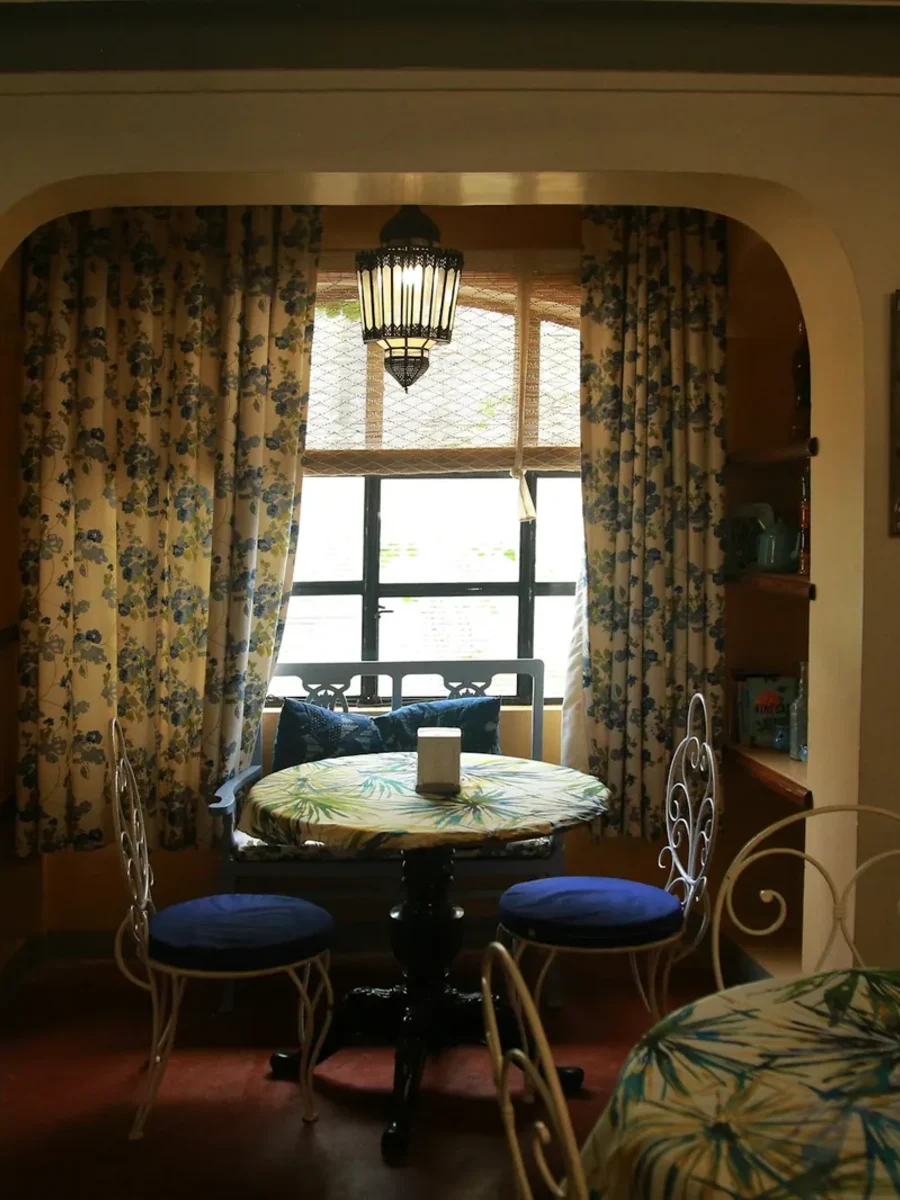
The plate at the gate sets a tone the house can pick up. The blue of an azulejo tile can return in a set of cushions on the porch seats, in a kitchen splashback or in a painted cupboard. A family name on the gate pairs well with family photographs in the hall. None of it needs to match exactly; it is the repetition of a colour or a material that makes a house feel considered.
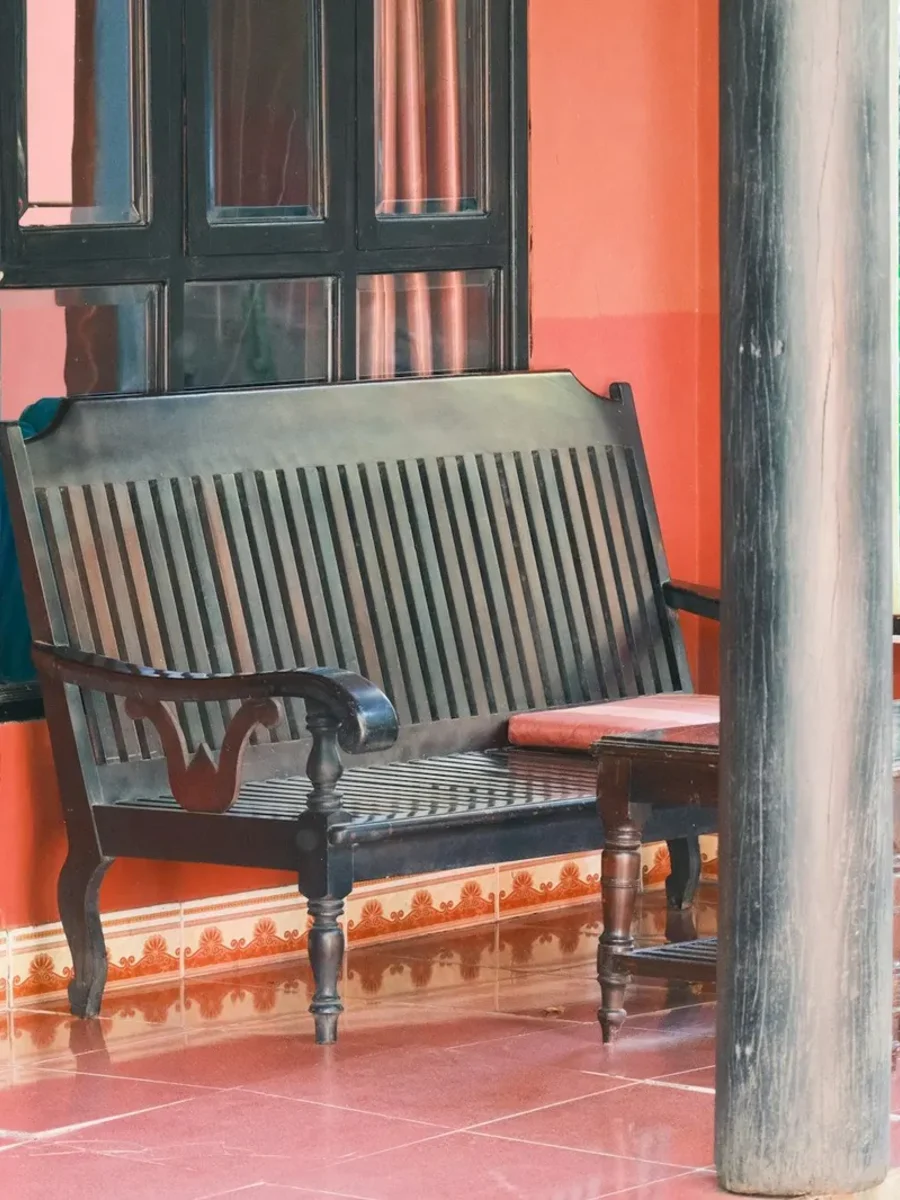
The porch is where the outside and inside meet, and it is where soft furnishings do the most. Weather-resistant cushions on the built-in seats, an outdoor blind against the afternoon sun, and simple, washable curtains at the door all frame the entrance as much as the plate does. Our outdoor upholstery and outdoor blinds are made for Goan sun and rain, and our Goan home decor ideas carry the same thinking through the rest of the house. When you are ready to plan the entrance and porch, we can visit and quote; book a home visit.