 Drapehaus
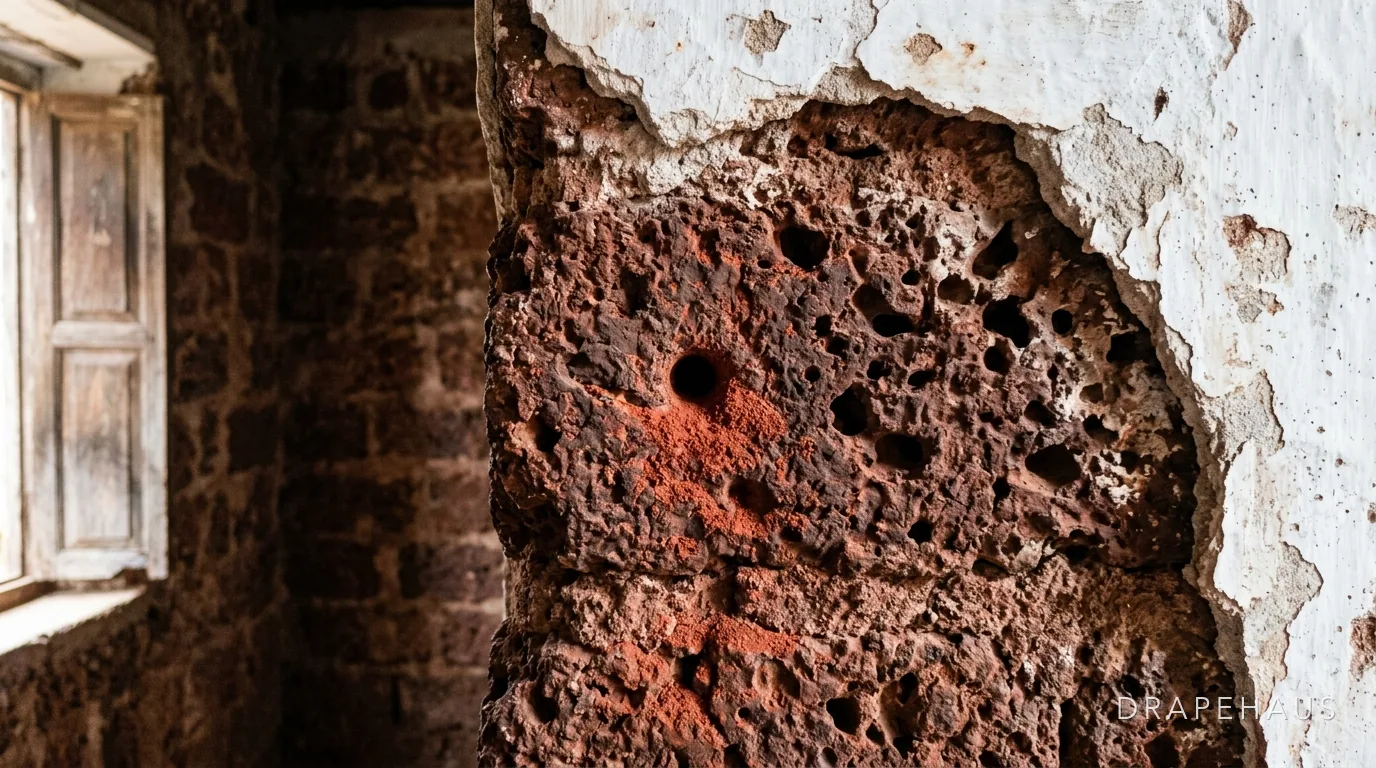
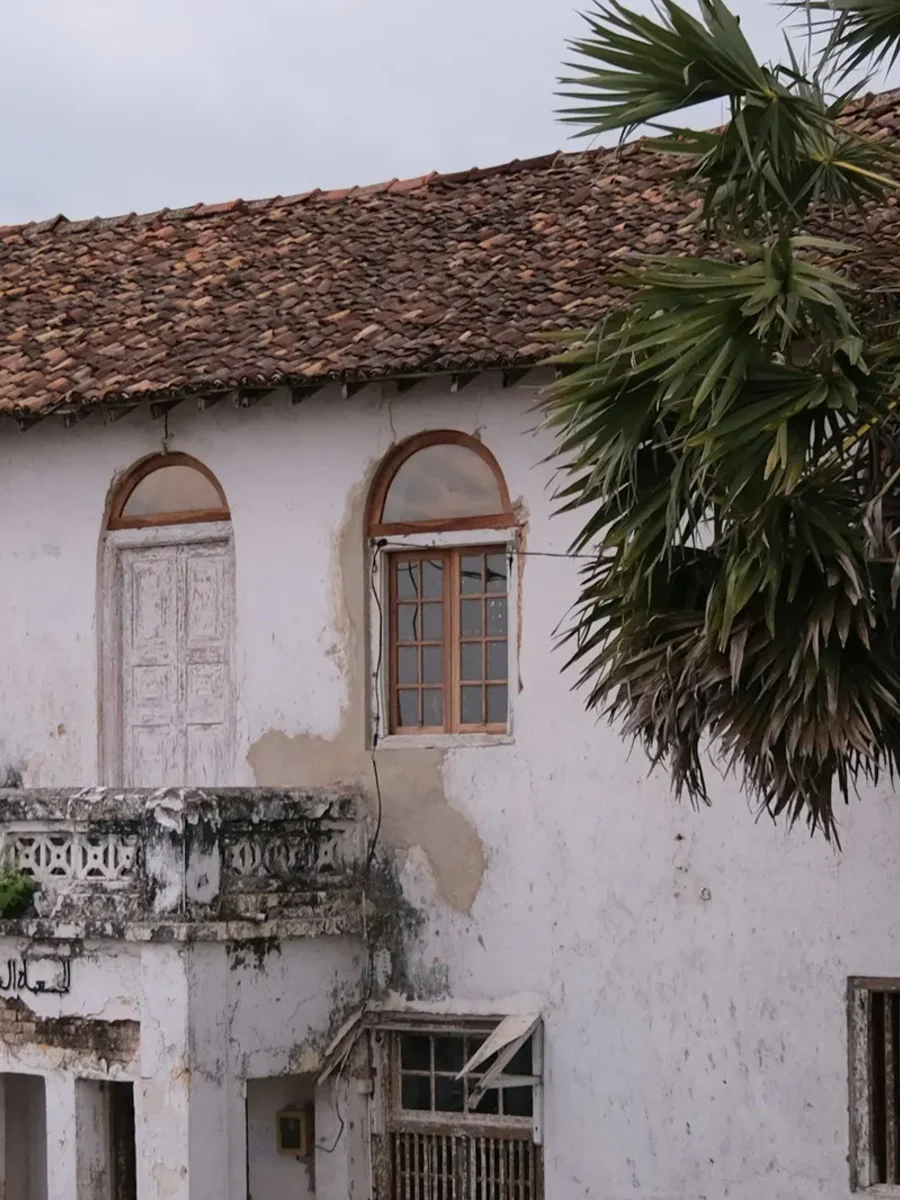
A laterite house is the default old house in Goa. The rusty-red stone is everywhere: in village houses, compound walls, churches and forts, and in the core of the great monuments of Old Goa. Most people who own an old Goan house own a laterite stone house, whether or not they have ever seen the stone under the plaster.
Laterite behaves very differently from the concrete and brick that most builders and most household advice assume. It is porous, it takes up water and gives it back, and it was designed to be finished in lime, which does the same. When that system is left alone, the walls get wet in the monsoon and dry out afterwards. When it is sealed in cement or plastic paint, the water stays in, and laterite walls go damp from the inside.
This article explains what laterite is, why Goa built with it, why cement plaster traps damp, and how to live with a laterite wall day to day — including how to hang things on it. For the detail of curtain fixings, see our guide to fixing into laterite and old walls.
What laterite is
Laterite is a rock formed by the long, intense weathering of other rocks under hot, wet conditions with alternating dry seasons. As rainfall leaches away the more soluble minerals, the less soluble ones — chiefly iron and aluminium oxides and hydroxides, with clay minerals such as kaolinite — are left concentrated. The iron gives the stone its reddish-brown to dark red colour; cavities in it are often lined with yellow or white.
Along the Western Ghats, laterites formed on different parent rocks in different places: over Deccan basalts in Maharashtra, over gneisses and metasediments in Goa and parts of Karnataka, and over granulites in Kerala. The name itself comes from building. The Scottish physician and geologist Francis Buchanan-Hamilton described the material in southern India in 1807 and named it from the Latin later, meaning brick, after watching it being cut into blocks for construction.
Laterite construction in Goa
What made laterite the building stone of the Konkan is an unusual combination. When freshly dug and still moist it can be cut into regular blocks with simple tools; exposed to air, it gradually hardens as the moisture in it evaporates. Researchers writing in the journal Geoheritage in 2023 describe it as a natural stone that, despite a porosity unusual in a building stone, hardens on exposure and was therefore used widely for temples, forts, convents, cathedrals and ordinary homes across Maharashtra, Goa, Karnataka and Kerala.
Goa's own monuments show how durable it can be. The Churches and Convents of Goa, the state's UNESCO World Heritage Site, are built with laterite as their core material, and in 2024 the International Union of Geological Sciences designated Western Ghats laterite a Global Heritage Stone Resource. In houses, laterite replaced earlier mud walls and was usually plastered and painted, not left bare.
Planning something like this?
We visit homes across North and South Goa, measure on site, and bring samples to see in your own light.
Why a laterite wall needs to breathe
Porosity is the key to how a laterite house works. The stone holds water in its pores and in the network of cavities through it. In the monsoon, when Goa receives most of its roughly 3,370 mm of annual rain and humidity stays near 90%, the outer part of a wall takes on moisture. In the dry months that follow, the same moisture evaporates out again, through the stone and through a lime finish that is itself permeable.
Conservation bodies describe this as breathability. The Society for the Protection of Ancient Buildings defines breathable materials as ones permeable enough for absorbed and surface moisture to evaporate during ordinary drying conditions, and notes that many traditional materials also buffer moisture, taking it up from humid air and releasing it when the air dries. A laterite wall in lime plaster is exactly that kind of wall.
Thickness helps too. Old laterite walls are deep, so there is a large volume of stone to take up moisture before any reaches the inner face, and a large surface from which it can evaporate once the rains end. The same mass evens out the day's heat, which is part of why old Goan rooms stay comfortable with the windows open. None of this works if the wall is sealed, which is why the finish matters as much as the stone.
A laterite wall will always take on some water in the monsoon. The question is whether it is allowed to dry out again.
Why cement plaster makes laterite walls damp
Cement render is rigid and much less permeable than lime. On a soft, slightly moving laterite wall, it develops fine cracks, and those cracks draw rainwater in. Because the render is far less permeable than the stone behind it, the water cannot evaporate back out through the face. It moves the other way, into the wall and towards the inside of the house.
The result is the pattern many owners of old Goan houses know well: damp patches and flaking paint on internal walls, white salt bloom where moisture evaporates on the inside face, blown plaster, and mould behind furniture. SPAB warns that impervious cement renders on old buildings restrict evaporation and can cause or accelerate serious decay. Plastic emulsion paints and waterproof coatings do the same thing on a smaller scale.
The fix is usually to remove the cement or coating, let the wall dry, and replaster and finish in lime. That is conservation work for a specialist contractor under an architect's guidance, and it is covered as part of our guide to restoring an old Portuguese house. Do it in the dry season, and expect the wall to take a season or more to dry out fully; replastering too soon simply traps the moisture again.
Living with a laterite house day to day
Day to day, a laterite house asks for a few habits. Keep rainwater off the walls: clear gutters and downpipes before the monsoon, and make sure the ground slopes away from the plinth. Finish walls in limewash or breathable mineral paint rather than plastic emulsion. Keep air moving through rooms, and run a dehumidifier in any room that has to stay closed through the wet months. Check the walls each year after the monsoon: a patch that stays dark into November, or salt that keeps returning in the same place, points to a source of water that needs finding.
Inside, give the walls room to breathe. Large wardrobes, bookcases and upholstered pieces against an external wall stop air moving over the surface and are where mould shows first; set them a hand's width off the wall. Curtains on external walls should hang clear of the plaster, with breathable linings rather than coated ones. Our guide to fungus on walls covers what to do when mould does appear.
Hanging curtains and rails on laterite
Laterite is a good wall and a poor fixing. It is inconsistent in density, it crumbles at the edge of a drilled hole, and in older houses it may be bedded in mud rather than cement mortar. A standard expanding plastic plug has nothing firm to grip, and under the repeated sideways pull of a curtain being drawn every day it works loose and takes a piece of wall with it.
What works is resin anchors into sound stone, more brackets than the span strictly needs to spread the load, or fixing into the hardwood window frame or the ceiling instead of the wall. Decorative plaster and kaavi work should never be drilled. Our challenge guide to laterite and old walls sets out the options in detail, and our curtain hardware is chosen with these walls in mind.