 Drapehaus
Drapehaus
Preparing the room
Drapehaus
Preparing the room
Blinds
Split-bamboo chiks are the traditional answer to a Goan veranda in the afternoon: they cut the glare and the heat, let the breeze straight through and roll up out of the way when the sun moves round.
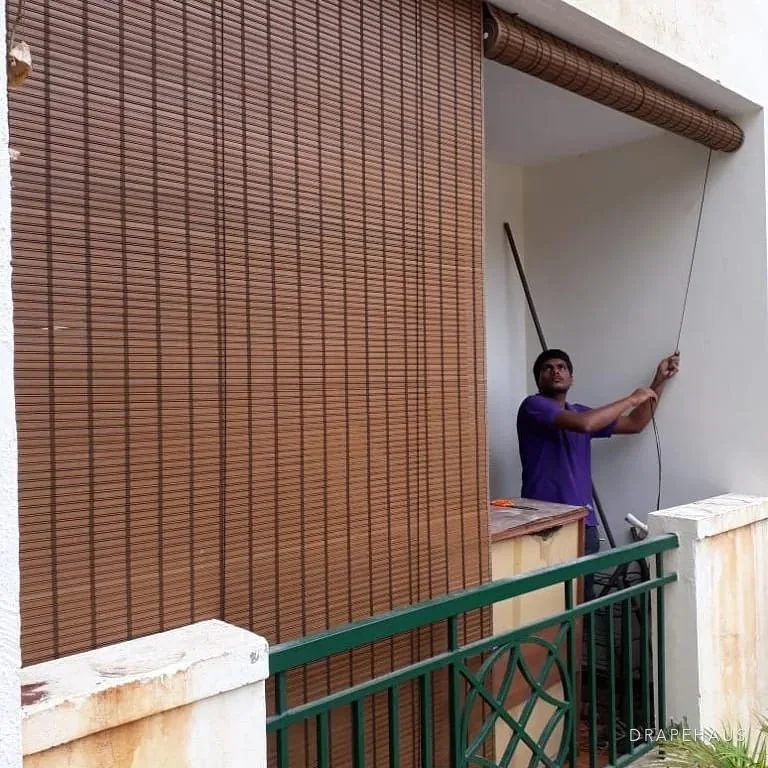
Bamboo chik · Midday
Treatment
Time of day
Split bamboo: you see out but not in by day, and the breeze still moves. At night, lamps on, the view reverses.
In short
By the Drapehaus studio · How we write
Is it right for you?
A chik is a screen of thin split-bamboo strips bound together with cord, hung from a beam or eave and rolled up by hand. Its real value is where it hangs. Outside the opening, it intercepts the sun before it reaches the wall, the window or the veranda floor, so the heat never gets into the fabric of the house. That is a different job from an indoor blind, which can only stop sun that has already passed through the glass.
Our guide to natural weaves covers their lifespan, the case for taking them down in the monsoon and their limits on privacy. This page is about specifying them well: which weave to choose, how to hang and secure a chik against wind, how to roll it, and where an indoor bamboo blind is the better use of the material.
Chiks are the wrong choice where a screen must stay up year-round in driving rain, where real night-time privacy is needed, or where a sealed, air-conditioned room is the goal. For a veranda that must stay shaded through the wet months, an outdoor roller in a coated mesh is the more durable option.
The details
Hung outside the opening, a chik stops the sun before it reaches the wall or the glass, which keeps a veranda or balcão usable through the hottest part of the day. From inside you can still see out; from outside, the shade gives privacy.
Bamboo is a natural material and a consumable one. Exposed chiks weather in a few seasons, so we set them up to roll and tie away, and to come down before the heaviest monsoon weather.
Your options
Natural blinds divide into outdoor chiks, which shade openings from outside, and indoor woven blinds, which bring the texture inside. Each has its own construction.
Swipe for all 6 →
The honest view
Stops heat outside the wall
Exterior shading is far more effective than any interior blind. US Department of Energy research found exterior shades cut dangerous-heat hours by about 55 per cent, against roughly 18 per cent for interior rollers.
Keeps the breeze
The open weave lets onshore air pass straight through, so a veranda stays cool and ventilated rather than sealed off.
Day privacy with a view out
In daylight, you see out from the shaded side while people outside see mostly the bright face of the blind.
Belongs in the architecture
Chiks have shaded Indian verandas for generations. On a traditional house, they look right in a way no manufactured fabric does.
A seasonal material
Rain and sun wear bamboo and its cords. Outdoor chiks need rolling in rain, taking down in heavy weather and replacing periodically.
Night-time privacy is poor
Lit from inside after dark, the blind becomes see-through. Add curtains or a lined layer where privacy at night matters.
Manual and hands-on
Traditional chiks roll up by hand with ropes. They are simple and robust but not suited to motorising or to high openings out of reach.
Side by side
For a veranda or sit-out, the realistic alternatives are an outdoor roller in coated mesh, a fixed canvas awning and a PVC imitation chik.
| Bamboo chik | Outdoor mesh roller | Canvas awning | PVC chik | |
|---|---|---|---|---|
| Breeze | Passes freely | Passes, reduced | Unaffected | Passes freely |
| Monsoon durability | Low if left up | High | Retract in storms | High |
| Look | Natural, traditional | Technical | Architectural | Imitation |
| Operation | Hand-rolled | Crank or motor | Crank or motor | Hand-rolled |
| Rain protection | Little | Some splash | Good, overhead | Little |
| Replacement cycle | Every few seasons outside | Many years | Canvas renewal | Several years |
Swipe to compare →
Many verandas combine them: chiks on the sheltered sides for dry-season shade, an outdoor roller on the weather side.
Rather see it in your own room?
We bring samples to the house, measure every window, and specify for the light and exposure you actually have.
Room by room
The classic use. Hang chiks under the eave on the sun side, with tie-downs so they do not swing in the afternoon breeze.
A chik at the street side shades the seating and gives daytime privacy from the lane while keeping the house open.
Driving rain and full sun wear chiks within a season or two. An outdoor mesh roller is more durable here.
An indoor bamboo or grass Roman gives warm filtered light and lasts many years out of the weather.
Choose a lined bamboo Roman so the room is private at night; unlined weaves become see-through once lamps are on.
Steam and splashing mildew natural fibre quickly. Use faux-wood or PVC instead.
Guests love the look. Plan who rolls them up in rain and who takes them down before the monsoon.
In depth — tap a heading to read
A chik is light, but on a veranda it acts like a sail. The mean onshore wind in coastal Goa is strongest in July, and afternoon breezes in the dry season are enough to lift an unsecured chik and bang it against pillars and railings. We fix chiks to the beam or rafter under the eave with stainless hooks or eyes, and add tie-down points at the base so the bottom bar can be secured to the floor, the parapet or the railing.
The rolling ropes should be synthetic rather than jute or cotton, which rot within a season outdoors. A simple cleat on a pillar holds the rolled blind at any height. On a wide veranda, a row of narrower chiks is easier to roll and tie than one long one, and lets each bay be shaded separately as the sun moves round.
Sun falling on glass or a wall turns to heat the moment it is absorbed. An indoor blind catches that heat inside the room; it can reflect some back, but much of it stays. A chik outside the opening catches the sun before it reaches the wall or window, so the heat is shed into the moving air of the veranda instead.
That is why a chik on the west side of a veranda makes such a difference in the afternoon, and why the same bamboo hung inside the window does far less for heat. The US Department of Energy notes that external shading on west-facing windows can reduce solar heat gain by as much as 77 per cent. Indoors, bamboo is chosen for light and texture; outdoors, it is chosen for heat.
Hang the chik a little clear of the wall or window so air can move behind it and carry the heat away.
Out of the rain and direct sun, bamboo and natural weaves last many years. Indoors, they are usually made up as Roman blinds or rollers on a proper headrail, with a chain or cord control, so they operate like any other blind. Matchstick bamboo gives a fine, refined texture; woven grasses give a softer, more textile one.
The weave is open, so indoor natural blinds give filtered light and daytime privacy but become see-through at night. A privacy or blackout lining sewn behind the weave solves that while leaving the face untouched. In a room that stays closed and humid through the monsoon, choose a synthetic lining and keep the room aired, because natural fibres absorb moisture and can spot.
On a heritage house, chiks are one of the few window treatments that look as though they have always been there. They suit the proportions of deep verandas and balcões, and they let the house breathe in the way it was designed to. Fabric borders in a muted colour give a finished look without drawing attention.
In a rental, the question is who manages them. Chiks should be rolled up in rain and taken down before the heaviest monsoon weather, and someone has to do it. We label each chik by position, set up hooks that make removal a quick job, and recommend keeping a dry, ventilated place to store them flat or loosely rolled, off the floor.
Living with it
Brush off dust and cobwebs with a soft broom or vacuum brush. Avoid soaking bamboo, which swells it and weakens the binding.
Roll and tie chiks whenever rain is expected. Repeated wetting and drying is what wears them most.
Unhook exposed chiks before the heavy rains arrive and store them dry. Sheltered ones under a deep eave can often stay up, rolled.
Store flat or loosely rolled, off the floor in a dry, ventilated place. Shake them out and check for insects before rehanging.
When rolling ropes fray or tie-downs weaken, replace them promptly. A blind that falls in the wind is often ruined by the fall.
Avoid these
A loose chik swings and bangs in the breeze and tears at its binding. Fit tie-down points at the base.
They rot in a season. Use synthetic rolling ropes and ties.
Inside, they do little for heat. Hang them outside the opening to stop the sun before it reaches the wall.
It becomes see-through at night. Choose a lined bamboo Roman.
It is heavy to roll and shades every bay at once. Use one chik per bay.
Checklist
More in blinds
Blinds do what curtains cannot: tight light control in a shallow recess, a clean line on a busy window, and genuine blackout when they run in side channels.
Our work
From the Journal
All articlesOur process
One team from the first visit to the last bracket, so nothing is lost between the person who specified it and the person who fits it.
FAQ
A few seasons in an exposed position — they are a natural, consumable material. Rolling them up in rain and taking them down for the heaviest monsoon extends their life.
Yes. Indoors, bamboo blinds last much longer and give a warm, natural filtered light.
Yes, when hung outside the opening. They stop sun before it reaches the wall and floor, and the heat is carried away by the breeze through the weave. Hung inside the glass, the same blind does much less for heat.
Fix tie-down points at the base, on the floor, parapet or railing, and secure the bottom bar when the chik is lowered. Hang each bay separately, and roll and tie the blinds up in strong wind or rain.
Indoor bamboo Romans and rollers can, because they run on a proper headrail like any fabric blind. Traditional outdoor chiks are hand-rolled with ropes and are not suited to motors; for a motorised veranda, an outdoor mesh roller is the practical choice.
A chik is the traditional outdoor screen of split-bamboo strips bound with cord and rolled by hand. Bamboo blinds is a broader term that includes indoor Romans and rollers made from finer matchstick bamboo on a proper headrail.
Under a deep eave, rolled up and tied, sometimes. On an exposed veranda, no: driving rain rots the cords and splits the bamboo. Take them down and store them dry, and they will last several more seasons.
Next step
A good chik depends on where the sun falls, where the wind comes from and what the eave can hold. We visit, watch how light moves across the veranda, measure each bay and check fixing and tie-down points. We bring chik and natural-weave samples so you can see their shade in your own afternoon light, then make, hang and secure the blinds, and advise on taking them down before the rains. Book a home visit, and we will walk the veranda with you.