 Drapehaus
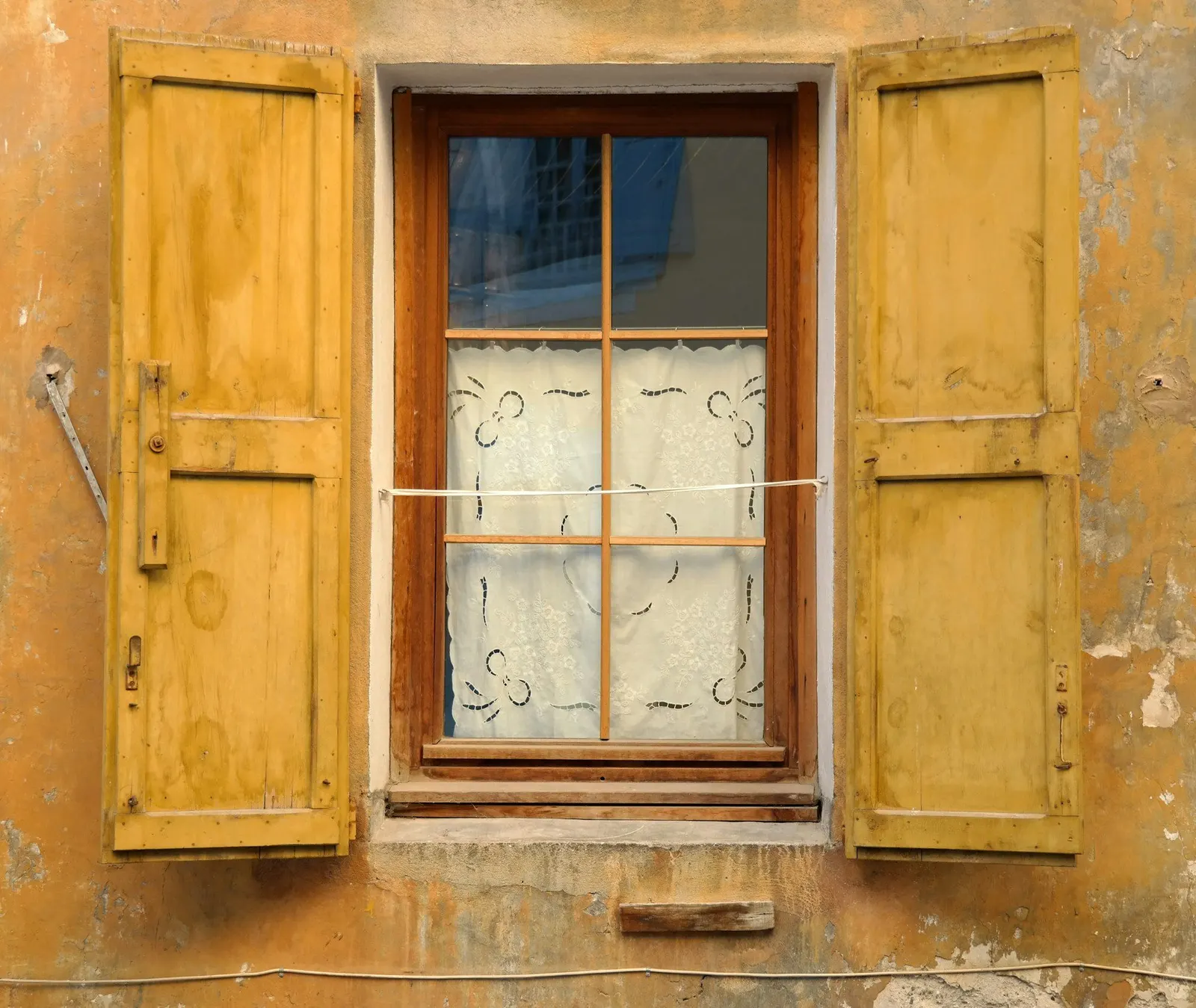
Oyster shell windows are the most distinctive thing about an old Goan house, and the least understood. The small, pale, almost pearly panes set in a timber lattice are not frosted glass. They are thin pieces cut from the shell of the windowpane oyster, Placuna placenta, known in Goa as carepa or karepa, and for centuries they were a common way of glazing a window in Goa.
They do something glass does not. The shell is translucent, not transparent, so light passes through it but a view does not. The room behind gets a soft, even, faintly warm light with no glare and no hard shadow, and the family inside gets privacy without closing the shutters. That quality is the reason the rooms of old Goan houses feel the way they do.
This article explains what the panes are, how they handle light, how to look after and repair them, and how to dress a window that has them. For the wider question of curtains and shutters in these houses, see our guide to the Portuguese heritage house.
What oyster shell windows are
The windowpane oyster is a flat, thin, rounded bivalve that lives in shallow, brackish coastal water on muddy or sandy bottoms. In Goa it was found in bays such as Chicalim and Nauxim, in the Zuari estuary. Its shell grows over four to five years to around 150 mm across, and as it matures it turns from muddy brown to a translucent white.
To make a window, the flat part of the shell was cut into small squares, rectangles or lozenges and slid into grooves in a timber frame, traditionally teak, to form a lattice. The panes were set by carpenters; in Goa the Chari community of traditional carpenters is associated with the work. The result is a window that can be opened like any other, but whose glazing is a grid of small, pale shell tiles.
Local names vary: carepa and karepa are common, and the Living Waters Museum records the Konkani name calva chi karpa. Whatever the name, the material is the same, and it is not something that can be matched from a hardware shop. Some houses have shell in every window; others kept it only in the rooms that face the street, where privacy mattered most, and glazed the rest. It is worth checking each window separately.
How light passes through a carepa pane
The shell has two different faces. The outer side is silvery white with a dull finish; the inner side is smooth, glossy and nacreous. Because the shell is translucent rather than clear, light passing through it is diffused: it leaves the other side spread in many directions rather than as a single beam. That is why the panes glow rather than shine, and why there is no bright patch of sunlight thrown on the floor.
In a hot, bright climate this is extremely useful. The room gets enough daylight to live in without glare, and the light is even across the room rather than concentrated near the window. Because the panes are not transparent, nobody on the street can see in, even with the shutters open, which is part of why they suited houses built close to the road.
Carepa panes already do the job of a sheer. Adding one behind them usually just makes the room dim.
Planning something like this?
We visit homes across North and South Goa, measure on site, and bring samples to see in your own light.
Why oyster shell windows matter
Surviving shell windows are a finite resource. The windowpane oyster is now protected in India and harvesting is restricted, and the craft of making the windows has largely disappeared. The Dastkari Haat Samiti notes that people renovating old houses now tend to keep every usable shell window and add glazed ones, because the skilled people to make new shell windows are no longer there.
That makes every original panel part of the house's irreplaceable fabric, in the same way as its carved timber or its tiles. When shell windows are lost and replaced with clear glass, the house loses its characteristic light, gains glare, and loses privacy; the room behind often ends up needing curtains or blinds it never used to need. Our field guide to Goan architecture puts the shell window alongside the other elements of the old house.
Telling shell from glass is usually straightforward once you know what to look for. Shell panes are small, slightly irregular in size and thickness, milky rather than clear, with a faint pearly sheen on the inner face, and nothing can be seen through them. Frosted or obscured glass is uniform from pane to pane and usually larger. Replacement glass in an old lattice is common, and a single window can hold both, so look at each pane rather than each window.
Care and repair of window pane oyster panels
Shell is thin and brittle, and a broken pane cannot be mended — it can only be replaced with another piece of shell. Treat the panels gently. Clean them dry or with a barely damp soft cloth, never with a pressure washer, abrasive pads or strong chemical cleaners, and do not scrape paint splashes off with a blade; ask a restorer.
Many problems start in the frame. The timber lattice swells in the monsoon and shrinks in the dry season, and a frame that has warped, rotted or been painted solid will crack the shells it holds. Keep the timber sound and lightly finished, keep the window operating so it is not forced, and have a carpenter ease sticking casements rather than forcing them. Check for termites as part of any timber work.
Where panes are missing, the practical options are salvaged shell from another window, a small reversible glass infill, or consolidating what remains. Whatever is chosen, it should be possible to reverse later. Record which panels are original before any work starts, and keep any loose or broken pieces; even fragments can help a restorer match size and thickness when salvaged shell becomes available. The same principles appear in our wider guide to restoring an old Portuguese house.
Dressing oyster shell windows without hiding them
The first rule is not to cover what the panes already do. During the day, a shell window generally wants nothing in front of it. If the room needs a curtain for evening privacy, warmth of atmosphere or darkness, hang it so that it draws fully clear of the window in daylight, stacking on the wall beside the frame rather than over it. A plain linen or cotton in a warm, light tone suits the glow of the panes; a heavy, dark fabric fights it even when drawn back.
That means placing the hardware outside the frame: a pole or track fixed above and wider than the opening, into sound masonry or the ceiling rather than into the shell window's own timber. Hang it forward enough that the internal shutters, if the house has them, can still swing closed. Our guide to fixing into laterite and old walls covers the fixings.
Where a shell window has already been reglazed with clear glass, a light sheer gives back some of the diffusion that was lost, and here our sheer curtains are genuinely useful. Check which you have before specifying anything; it changes the answer completely. Where only some panes survive, a sheer can be used on the glazed windows of a room and left off the shell ones, so the light across the room evens out.