 Drapehaus
Drapehaus
Preparing the room
Drapehaus
Preparing the room
Sofas
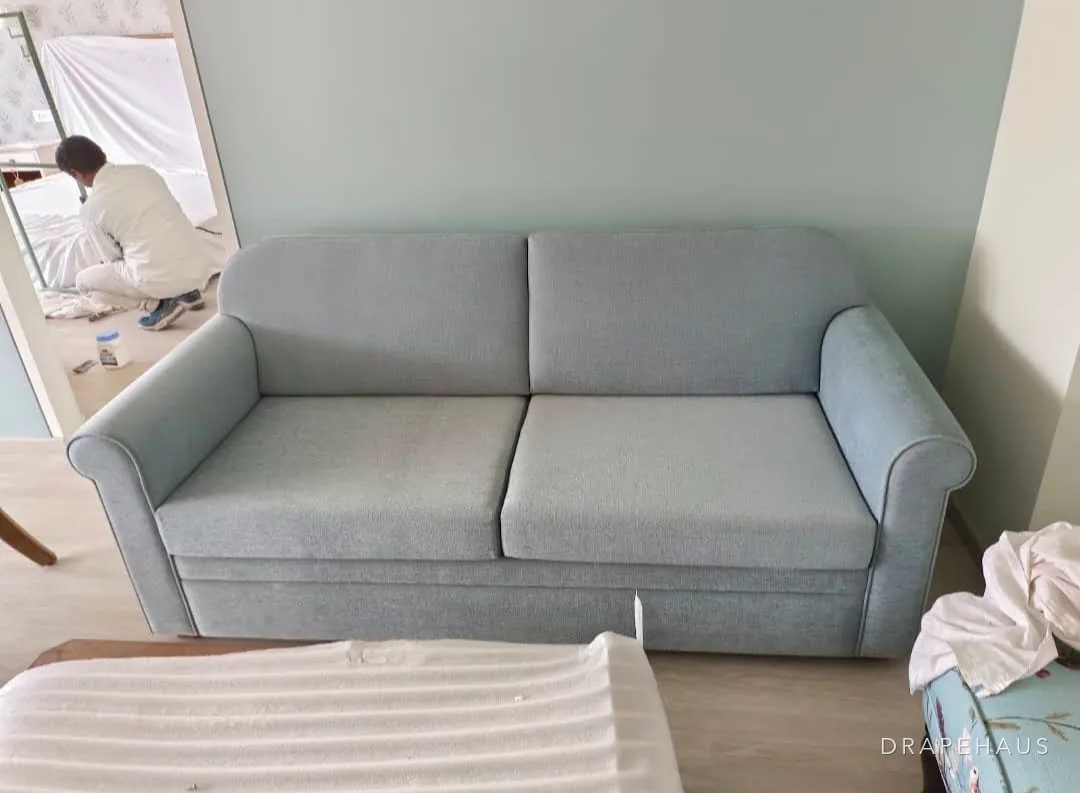
A sofa built to your room's dimensions, your preferred depth and seat height, and covered in a fabric chosen for how the room is used — from a formal drawing room to a homestay lounge.
Durability scale (Martindale rubs, BS 2543)
15k
20k
25k
30k
40k
Who uses it
Where it lives
How it is used
Durability to ask for
30,000+ rubs
Severe domestic / general contract
Removable covers
Yes
zipped, washable, and a spare set
Fibres that suit
Avoid: Anything you cannot clean in place, on a piece used every day. Rub count is one number among several — weave, colour-fastness and how a fabric handles humidity matter as much. We bring samples to see in your room.
In short
By the Drapehaus studio · How we write
Is it right for you?
A custom sofa is specified in layers, from the inside out. The frame comes first, then the suspension that sits across it, then the foam and fill that make the seat, and finally the fabric and how it is fitted. Each layer is a separate decision, and the comfort and lifespan of the finished sofa depend on all of them rather than on the cover you see.
It suits anyone who wants a sofa to last decades rather than a few seasons, and anyone whose room, body or habits do not fit the average a factory designs for. Tall households, people who sit with their feet up, and rooms with fixed features all benefit.
If you mainly want a particular look quickly and are happy with standard proportions, a good stock sofa is a reasonable choice. The case for bespoke is strongest when fit, comfort or climate performance matter more than speed.
The details
Making to size means the sofa fills an alcove exactly, runs the full length of a window or sits at the right scale in a high-ceilinged heritage room. We build hardwood frames and specify foam and webbing for comfort and for the climate.
Fabric is chosen by rub count for the use, and near the sea we lean towards performance fabrics and removable covers that can be washed after the monsoon.
Your options
These are the choices we talk through at the visit. None of them shows once the sofa is covered, which is exactly why they are worth understanding.
Swipe for all 6 →
The honest view
Seat ergonomics set to the sitter
Height, depth and back angle are chosen for the people who use the sofa, so feet rest flat, knees sit at a comfortable angle and the lower back is supported.
Frame you can reupholster
A properly built hardwood frame outlives its first cover. When the fabric wears, the sofa can be stripped, re-webbed and recovered rather than replaced.
Specified for humidity
Timber, foam, fill and fabric are chosen knowing the sofa will face monsoon humidity and, in many houses, weeks of closure each year.
Any shape the room needs
Curved backs for a bay, a sofa that runs the full width of a window, or a low back that keeps a view clear are all possible.
Longer to arrive
The frame is built and upholstered after you approve the design, so a custom sofa typically takes several weeks. Stock sofas can be delivered much sooner.
More decisions
Frame, suspension, foam, fill, fabric, legs and cover style are all yours to decide. We simplify the choices, but they still take time.
Fit is personal
A sofa tuned to a very tall owner may feel deep to a guest. For shared rooms we steer towards the middle and use cushions to adjust.
Side by side
The realistic choices are a new custom sofa, a ready-made stock sofa, or reupholstering one you already own. This is how they compare on the points that matter over time.
| Custom sofa | Stock sofa | Reupholstered sofa | |
|---|---|---|---|
| Fit to room | Exact | Nearest standard size | As existing |
| Seat ergonomics | Set to you | Designed for an average | Can be adjusted |
| Frame quality | Specified and known | Often unknown | Depends on original |
| Climate specification | Chosen for humidity | Rarely considered | New fill and fabric |
| Time to arrive | Several weeks | Quickest | A few weeks |
| Access planning | Designed around route | Fixed dimensions | Already in the room |
Swipe to compare →
If the frame of your current sofa is sound, reupholstery can be the better route. We check the frame at the visit.
Rather see it in your own room?
We bring samples to the house, measure every window, and specify for the light and exposure you actually have.
Room by room
The sofa used most deserves the best frame and the most careful ergonomics. Set seat height and depth for the household, and choose a fabric of at least heavy domestic rating.
A long, generous sofa with a slightly taller back can be scaled to a room that would dwarf a catalogue piece. Proportion matters more than length here.
A window seat sofa or a bench-style sofa at the foot of the bed can be made to the exact width of the recess or the bed.
A firmer, shallower seat with a more upright back suits reading and laptop work. Custom depth makes the difference between a sofa you can work on and one you sink into.
Only with outdoor fabric, quick-draining open-cell foam and a frame that tolerates wetting. Upholstered pieces on an open verandah need to come in for the monsoon.
A compact custom sofa fills an awkward corner. Keep dimensions moderate so it suits most guests, and choose removable covers.
In depth — tap a heading to read
Comfort starts with three dimensions. Seat height decides whether your feet rest flat on the floor with your knees roughly level with your hips. Too low, and getting up becomes an effort, which matters for older family members. Too high, and shorter people sit with their feet dangling.
Seat depth is the distance from the front edge to the back cushion. It should support most of the thigh without pressing into the back of the knee. Deep seats suit tall people and those who sit cross-legged; shallower seats suit upright sitting and shorter frames. Loose back cushions can be made thicker or thinner to adjust effective depth after the frame is built.
Back height and pitch complete the picture. A higher back supports the head for reading and dozing, while a lower back keeps sightlines open across a room or towards a view. We usually ask you to sit on a sofa you find comfortable and measure it, which is more reliable than choosing from numbers alone.
Measure a sofa you already like. It is the best starting point for any bespoke design.
Foam is described in two ways that people often confuse. Density is how much material is packed into a given volume, and it predicts durability: denser foam resists breaking down and keeps its height for longer. Firmness is how hard the foam feels when you sit on it, and it is a matter of preference.
A soft seat does not have to mean a short-lived one. A high-density foam can be made in a softer grade, then wrapped in fibre for a gentler top layer. What shortens a sofa's life is low-density foam, which feels fine at first and then hollows where people usually sit.
For seat cushions we specify high-density foam in the firmness you choose, and for back cushions either foam or loose fibre depending on the look you want. We bring samples so you can press and sit, rather than choosing from a description.
Timber moves with moisture. A frame built from wood that was not properly dried will keep drying in the room, shrinking and loosening its joints. Kiln-dried hardwood has already reached a stable moisture content, so its joints stay tight when monsoon humidity rises and falls. Glued and screwed or dowelled joints, reinforced with corner blocks, hold far better than stapled ones.
Termites and borers are part of life in coastal Goa. We treat frame timber and any board before it is covered, and we prefer naturally durable hardwoods. Legs and plinths that sit on stone or tiled floors are sealed so they do not wick moisture up from a freshly mopped floor.
For the suspension, the choice between webbing and serpentine springs is mostly about feel and weight of use. Springs suit a heavily used family sofa; webbing suits slimmer designs. Both are sound when properly fitted.
Choose fabric by use first. A family sofa used every evening should be heavy domestic at 25,000 Martindale rubs or more, and a homestay lounge should be treated as contract seating, at 30,000 to 40,000. Then choose by fibre: near the sea, polyester, solution-dyed acrylic and performance blends resist damp and fading better than untreated cotton or linen.
Removable covers change how a sofa is looked after. Loose cushion covers with concealed zips can be taken off and washed or dry-cleaned. Fully loose covers, which slip over the whole frame, can be removed entirely and are well suited to rentals and houses with children. Fixed upholstery looks crisper and more tailored but must be cleaned in place.
For washable covers, ask for the fabric to be pre-shrunk or washed before it is cut, so the covers still fit after cleaning.
We measure the room and then everything the sofa must pass on its way in: gates, front door, internal doors, stair width and headroom, and the turn at every landing. The frame is then designed so each piece passes the narrowest point.
If a one-piece sofa cannot make the turn, we build it with bolt-on arms, removable legs or a back that detaches and refixes in the room. These joints are designed into the frame from the start, not improvised on delivery day, so the sofa is just as rigid once reassembled.
Living with it
Turn seat cushions and swap them between positions every few weeks so foam wears evenly. Plump fibre-filled backs daily.
Grit, sand and salt collect where the seat meets the back and the arms. Remove them with a crevice tool before they abrade the fabric.
Follow the fabric's cleaning code. Wash loose covers on a gentle cycle, and refit them slightly damp so they ease back into shape.
In the monsoon, leave a small gap between the sofa back and an external laterite wall so air can circulate and condensation does not reach the fabric.
Fine powder beneath the sofa can indicate borers. Report it early so the frame can be inspected and treated.
Avoid these
A deep sofa looks relaxed in pictures but may not suit the people using it. Sit on real sofas and measure the ones you like.
Firmness is feel; density is lifespan. Ask what density the seat foam is, not only how firm it feels.
An untreated frame can be hollowed by borers without any sign on the outside. Confirm the frame timber is treated before it is covered.
Light-coloured fixed upholstery is hard to keep clean in a busy house. Choose a mid-tone or specify removable covers.
Checklist
More in sofas
Seating made to size, which matters in Goan houses where rooms are rarely the proportions furniture is manufactured for.
Our work
From the Journal
All articlesOur process
One team from the first visit to the last bracket, so nothing is lost between the person who specified it and the person who fits it.
FAQ
It depends on the design and fabric. We give a timeline with the quote once the size and fabric are agreed.
One rated for the use — a high rub count for daily family seating — and, near the coast, a performance or blended fabric that resists damp and fading.
It is worth it when the room, the people or the climate do not suit a standard sofa. You get a frame you know is sound, seat dimensions set to your household, and materials chosen for humidity. If a stock sofa already fits your room and your body well, the case is weaker.
Kiln-dried hardwood with glued and screwed or dowelled joints and corner blocks. The timber should be treated against termites and borers, which matters in a humid coastal climate. Avoid frames of untreated softwood or thin board held together mainly with staples, which loosen and creak.
Neither is simply better. Serpentine springs give a firmer, more resilient seat that holds up to heavy daily use. Elastic webbing gives a lighter, slightly softer feel and suits slimmer designs. Both last well when they are properly fitted and tensioned on a sound frame.
Seat cushions should use high-density foam, because density decides how long the cushion keeps its shape. Firmness is a separate choice, so a high-density foam can still feel soft. We bring samples to the visit so you can compare grades by sitting rather than by specification.
The one that supports most of your thigh without pressing into the back of your knee. Taller people prefer deeper seats and shorter people shallower ones. The simplest way to decide is to measure a sofa you already find comfortable and use it as the starting point.
Next step
We visit, measure the room and the route in, and ask how the sofa will be used and by whom. We bring foam samples to sit on and fabric swatches to see in the room's own light, then agree the frame, suspension, fill, dimensions and covers with you. We build and upholster the sofa, deliver it and place it. Book a home visit and we will design it around your room.