 Drape Haus
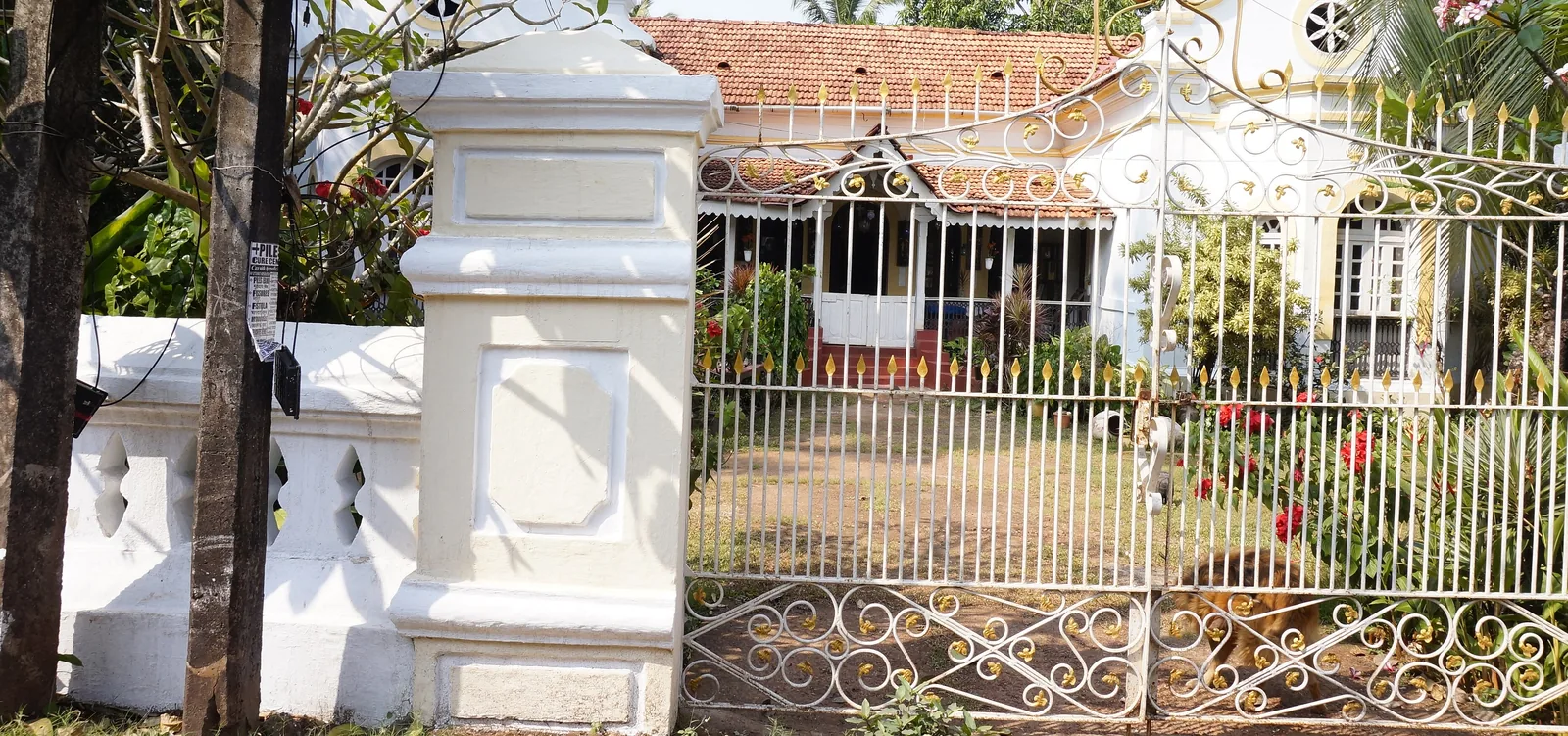
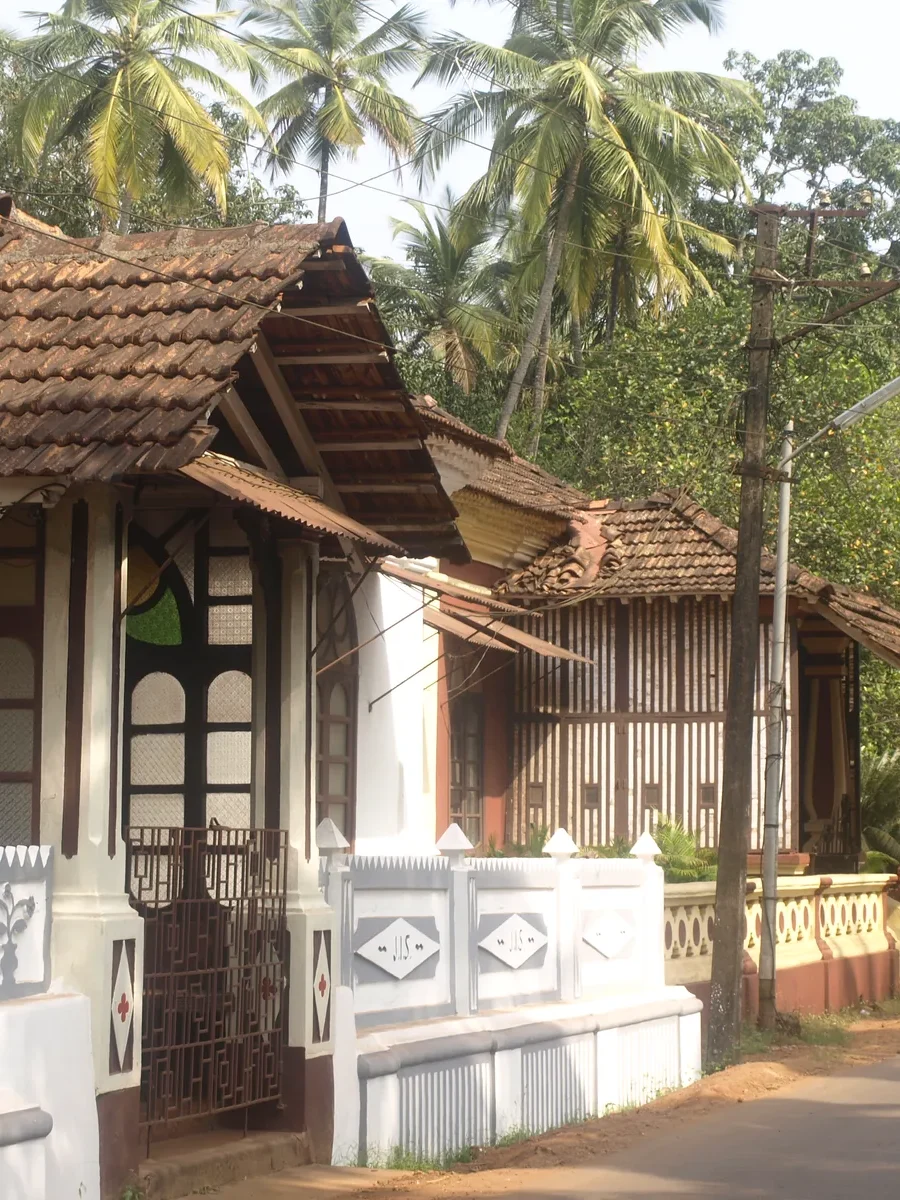
A Goan house is usually seen first over its compound wall: a run of red laterite, a pair of pillars, a gate, and behind them the porch and the tiled roof. Good compound wall design in Goa keeps that relationship. The wall marks the boundary without hiding the house, the pillars announce the entrance, and the gate is open enough to see through.
This guide covers the traditional laterite wall and how it was built, what Goa's building regulations say about height and gates, the gate types that suit Goan houses, why lime pointing outlasts cement on laterite, how to clean the black and green staining that every wall acquires in the monsoon, and how to plant alongside a wall without damaging it.
We should say plainly that Drape Haus does not build walls or gates. We make outdoor fabrics, awnings and cushions for porches and gardens. The advice here is drawn from Goa's regulations and from conservation guidance on masonry walls, and anything structural belongs with an experienced mason or engineer.
How the traditional laterite wall was built
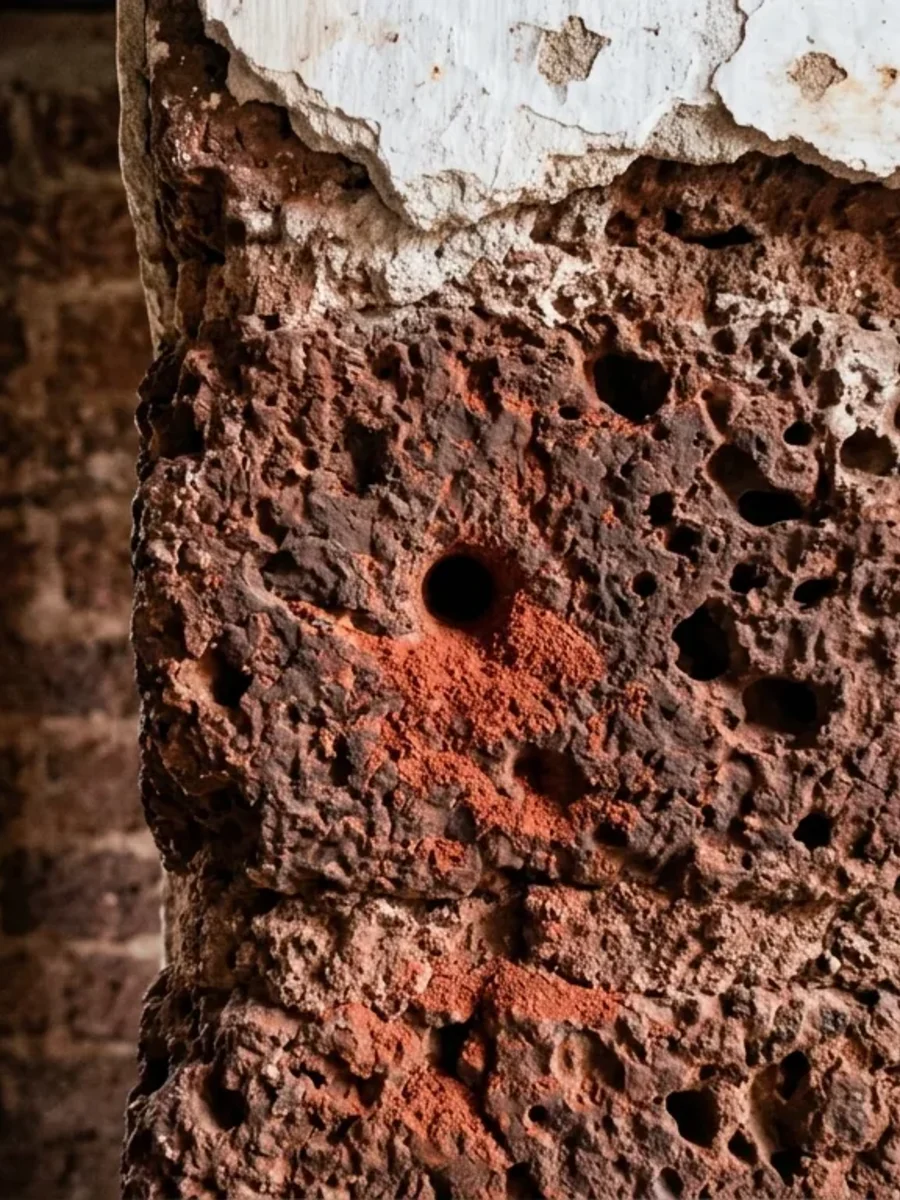
Laterite was the natural material. It is cut from the ground in blocks, hardens as it dries in the air, and is found across much of Goa. One Goan architect's account describes traditional Goan construction as laterite rubble or stone foundations laid in mud mortar, with laterite masonry above, and mortars made from local mud with additives such as fermented jaggery and soaked harda seeds. Compound walls followed the same logic as house walls, on a smaller scale.
A typical old wall is thick for its height, laid in roughly coursed blocks and either left as bare stone or plastered and limewashed to match the house. Its top is the most important part. Historic Environment Scotland's Engine Shed guidance on boundary walls calls the cope the secret to the stability of a slender wall: it throws rainwater away from the core. In Goa that cope may be a row of shaped laterite, a sloped lime capping or a line of tiles. Where it has been lost or cracked, rain runs straight into the heart of the wall.
The gate is marked by a pair of pillars, usually taller and heavier than the wall itself, often plastered and painted, and sometimes topped with a ball, an urn or a small cap. Many have a niche, a cross or a name tile set into them. They carry the weight of the gate and they take most of the knocks, so they are usually the first part of a wall to need repair.
What Goa's building rules say
Compound walls are regulated in Goa. The Goa Land Development and Building Construction Regulations, 2010, in the consolidated version published with amendments up to September 2018, define a compound wall as a wall enclosing a property, including its gates, of any material, and set out the rules in Regulation 11. Permission for a wall and gates may be sought on its own or with a building application, with detailed drawings at a scale of 1 cm to 1 m.
The key limits are set out in the table. Two are often overlooked. Gates must open inwards unless they are recessed into the plot far enough not to swing beyond the wall line. And no barbed-wire fence or cactus hedge is permitted along a boundary facing a public road. In conservation areas the rules ask for the colour scheme of external elevations, including compound walls, and suggest using traditional elements such as pillars and compound walls to integrate new work with the streetscape.
Regulations change and local bodies interpret them. Treat the table as a starting point and confirm the current position with your panchayat or municipality and the Town and Country Planning Department before you build or raise a wall.
| Rule | What it says |
|---|---|
| Boundary not facing a street | Up to 1.80 m high |
| Boundary facing a street | Up to 1.50 m high, of closed type only up to 90 cm |
| At street junctions | No higher than 1.00 m above the road crown for 9.0 m from the corner, both sides |
| Gates | Open inwards only, unless recessed so they do not project beyond the wall line |
| Public road boundaries | No barbed-wire fence or cactus hedge |
| Application | Detailed drawings of wall and gates at 1 cm to 1 m |
Planning something like this?
We visit homes across North and South Goa, measure on site, and bring samples to see in your own light.
Gates: wrought iron, timber and pillared entrances
The commonest Goan gate is painted iron: a pair of leaves in bars or scrollwork, hung between plastered pillars, painted black, green, white or the colour of the house's woodwork. It suits the regulation's requirement for an open wall above 90 cm on the street side, it lets the house be seen, and it lets air move into the garden. Timber gates, solid or boarded, are more private and more rustic, and suit village houses and farm compounds. A small pedestrian gate beside a wider vehicle gate is a sensible arrangement where cars need access.
Salt air is the enemy of iron. On a coastal plot, rust starts at joints, hinges and the bottom rail where water sits. Keep paint unbroken, treat rust as soon as it appears and repaint every few years. Where iron is set into masonry, rust matters doubly: the Engine Shed guidance warns that corroding ironwork on walls should be dealt with promptly to prevent expansion damage to the stonework. Conservation guidance from Northern Ireland's Department for Communities says fixings in masonry should be non-ferrous, set in resin, with suitable mortar to the joints. For new hinge pins and gate fixings in laterite, stainless steel or bronze is the safer choice.
Timber gates need hardwood, a sloping or capped top rail to shed rain, a gap above the ground so the bottom does not sit in wet soil, and oil or paint renewed before the monsoon. A gate that opens inward, as the rules require, also needs a clear swing inside the plot: check that steps, planting or a parked car will not be in the way.
Lime pointing versus cement on laterite
Many old laterite walls in Goa have been repointed in cement at some point, often with hard, grey, projecting ribbons of mortar. It looks tidy for a few years and then causes the problem it was meant to solve. The Society for the Protection of Ancient Buildings explains why: traditional lime mortar is more permeable than the brick or stone it binds and protects the masonry by eroding preferentially, while cement pointing makes the stone itself the most permeable part of the wall, so the stone takes the wetting and decays faster. On soft, porous laterite, that shows as crumbling block edges beside sound cement joints.
SPAB also advises restraint. Repointing is only needed where mortar has weathered back to a depth equal to the joint width or is very loose; soft mortar alone is not a reason. Old cement should only be removed if a trial shows it can come out without damaging the stone. When repointing, joints are raked out to about twice their width and cleaned. The Engine Shed's guidance on lime mortar repairs adds that hand tools should be used rather than power cutters, and that fresh lime work needs protecting from fast drying with damp hessian or sheeting in warm or windy weather.
In Goa that means timing. Lime work wants neither the monsoon nor the hottest, driest weeks of April and May. The months after the rains, when the wall has dried but the sun is gentler, are usually best. Ask any mason for a trial panel first, so you can see the colour and texture of the mortar against the laterite before the whole wall is done.
Lime pointing is meant to wear out before the stone does. Cement makes the stone wear out first.
Cleaning algae and black staining after the rains
Every Goan wall comes out of the monsoon green or black. Goa receives about 91% of its annual rain between June and September, according to the India Meteorological Department, and a wall in shade or near trees stays wet for weeks at a time. Algae, moss and the black crusts that follow are mostly a cosmetic problem on sound stone, but moss holds water against the wall, and roots in joints do real damage.
Be gentle. The US National Park Service's Preservation Brief on cleaning historic masonry recommends starting with very low water pressure, 100 psi or below, even a garden hose, and rising only as needed and generally no higher than 300 to 400 psi, scrubbing with natural or synthetic bristle brushes and never metal ones, which abrade the surface and leave particles that stain. A household pressure washer used close up will cut into soft laterite and lime and open the surface to faster regrowth. The US General Services Administration's procedures add a test patch first, no larger than about 15 cm square, and leaving any biocide on for at least 24 hours before scraping growth off with a wooden scraper.
Do not seal the wall afterwards. The same Preservation Brief says water-repellent coatings are generally not recommended as a way to prevent biological growth on historic masonry, and that some may encourage it; regular gentle cleaning is the traditional and effective answer. Clean in a dry spell after the rains, and repeat lightly each year rather than heavily once a decade.
Planting along a wall without trapping damp
A planted strip along a compound wall softens it and gives privacy, but it is also a common cause of wall damage. The Engine Shed guidance on boundary walls is clear that roots can quickly cause damage, that plant growth in open joints should be removed straight away by hand with all its roots, and that open joints should be repointed so it cannot return. Ivy and creepers should be cut through near the ground and left to die back before being pulled off, so they do not tear out the mortar.
In Goa the same principles apply with more vigour, because everything grows faster. Keep beds a little away from the wall rather than piling soil against it; raised soil holds water against the base and gives termites and roots a way in. Plant climbers on a trellis or wires set a few centimetres off the wall face rather than letting them grip the stone. Keep large trees, especially those with spreading surface roots, well back from the line of the wall, and trim shrubs so air can move along it.
Watch the drainage too. A wall that sits at the bottom of a slope or alongside a paved drive can act as a dam in heavy rain. Weep holes at the base, a gravel strip along the foot and a clear path for surface water to escape all help the wall dry out after each downpour.
Modern adaptations, and precast walls
Many new compound walls in Goa are built of concrete block or precast concrete panels slotted between posts. Precast walls go up quickly and need little skilled labour, which is why they are popular for large plots and long boundaries. Their weakness is character: a grey panel wall reads as industrial beside a lime-washed house. If you choose one for a long rear or side boundary, consider plastering and painting it, or planting in front of it, and keep the street frontage traditional.
On the street side, the rules already push towards a Goan answer: a solid base up to 90 cm, then something open above. A low laterite or plastered wall topped with simple iron railings, or with open pillars and panels between them, meets that and looks right. Laterite cladding on a block core gives the colour of stone, though it cannot behave like a solid laterite wall, and its joints still want a permeable mortar. Keep the pillars generous, give them a proper cap, and paint them the house colour with white edges, as so many old houses do.
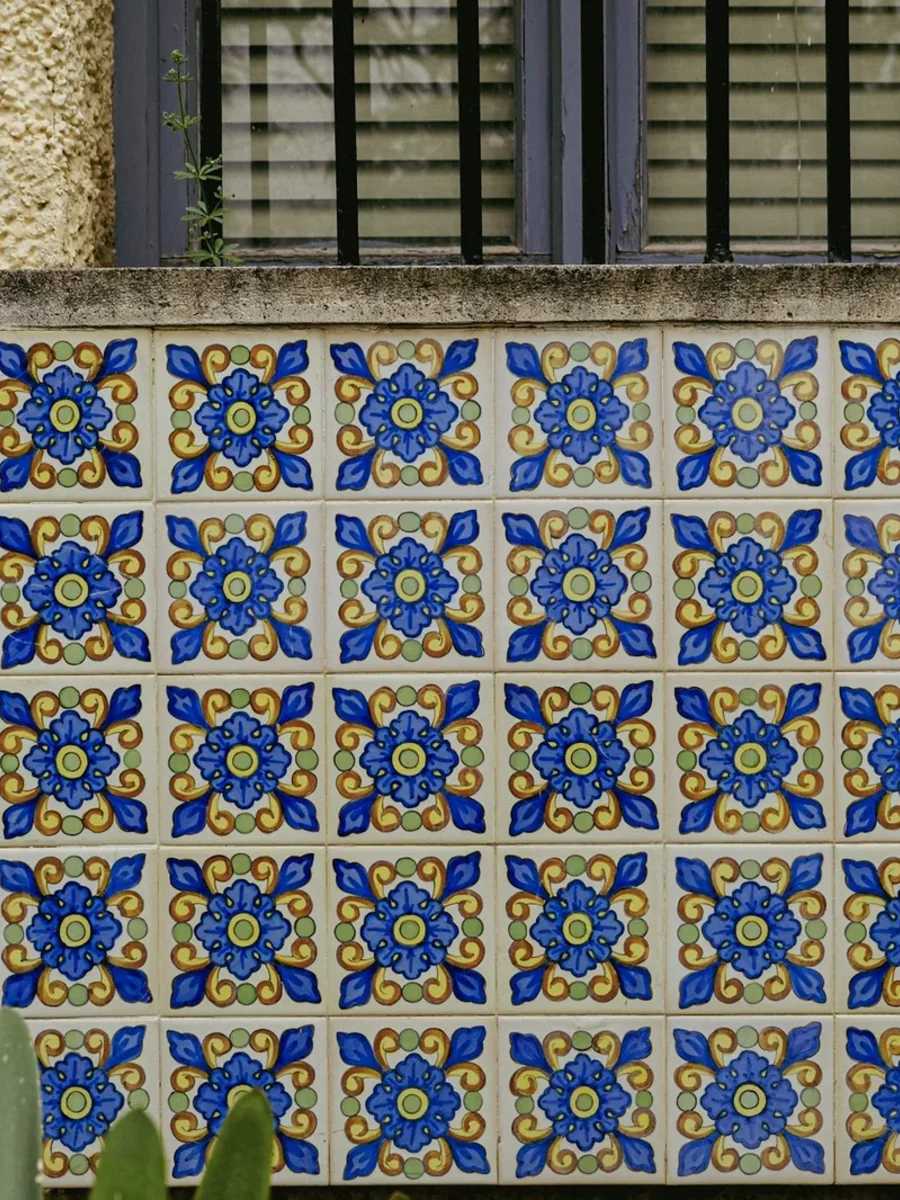
The entrance is also where a house names itself. A name tile on the pillar, a light above it and a planted pot either side make the gate a small piece of architecture. Our article on Goan house name plates looks at tiles and plaques, and the Goan balcão at the porch beyond.
Where soft furnishings come in
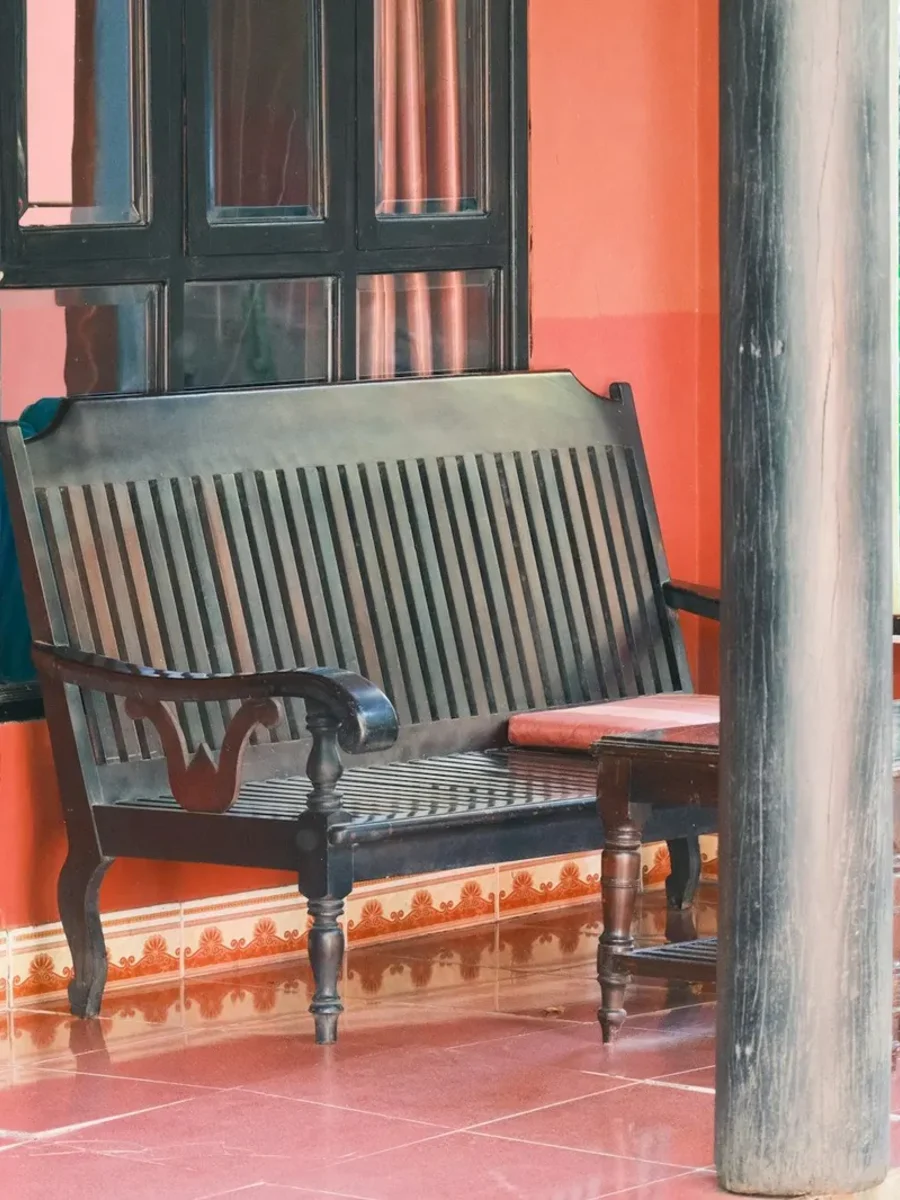
Once the wall and gate are sorted, the space just inside them becomes usable. The porch seats, a verandah or a gate-side sit-out can take weatherproof cushions, an awning or outdoor blinds that keep the afternoon sun off without closing in the view. Our awnings and outdoor shade and outdoor blinds are made for coastal sun and salt air, and outdoor upholstery uses fabrics that dry quickly after rain.
If you are restoring the wall as part of a larger project on an old house, our article on laterite houses explains the material in more depth, and our guide to salt-air damage covers what the sea does to fabrics and metal alike. When you are ready to furnish the porch or verandah, we can visit and quote; get in touch.