 Drape Haus
The best blinds ideas for a living room start with the windows a curtain handles badly. The window behind the sofa, the one beside the television, the narrow opening next to a built-in unit, the deep laterite reveal in an old house and the high clerestory nobody can reach: these are blind windows. The wide openings onto the balcony or garden usually stay with curtains, and the two can be planned as one scheme.
From there the choice is about what each window has to do. A roller blind in a solar-screen fabric cuts glare and heat while keeping the view, and suits a clean, modern room. A Roman blind brings the softness of fabric to a short window over a sofa or window seat. Wooden or faux-wood slats add warmth and let you steer the light; in a humid Goan room, faux wood is the safer slat. Zebra blinds give fine daytime control but are not a night-time privacy answer on their own.
Below are those ideas in detail, a comparison for wide sliding doors, how to pair blinds with dress curtains, and three Goan living rooms worked through window by window. You can try each blind type on a window in our blinds simulator before asking for samples.
Where a blind beats a curtain in a living room
Curtains need two things a living room cannot always spare: wall space beside the window for the open curtains to stack, and clear floor below for them to fall. Take either away and a curtain struggles. A blind lives within the width of the window and lifts up rather than sideways, so it works where furniture is pushed close to the glass, where a window sits in a corner with no wall beside it, or where a console or a radio cabinet stands under the sill. Our living room blinds page sets out the types we fit most often in Goan sitting rooms.
Blinds are also better at fine control. The US Department of Energy's guidance notes that slatted blinds can be adjusted to control glare, light and solar heat gain in a way plain shades cannot, and that roller and Roman shades are most effective for privacy, room darkening and blocking sunlight, while adding little insulation. For a living room that is used for reading in the morning, guests at lunch and films in the evening, that adjustability is the point.
There is a Goan reason too. The Building America Solution Center, run for the US Department of Energy, points out that vertical window attachments cannot be bypassed by sunlight whatever its angle, which makes them very useful on east- and west-facing windows that roof eaves cannot shade. Goan houses have generous eaves, but a low afternoon sun on a west wall gets under any overhang. A blind in that window does the work the eaves cannot.
| Window | Usual blind idea | Why |
|---|---|---|
| Behind a sofa | Roman or roller, mounted above the frame | Lifts clear of the cushions; nothing to trap behind the sofa back |
| Beside or opposite the television | Solar-screen roller or zebra | Cuts reflections on the screen without closing off the room |
| Deep laterite reveal in an older house | Roller or Roman inside the reveal | Sits flush, keeps the deep sill usable, leaves shutters free |
| Window seat or bay | Roman blind | Soft fabric with no curtains to tuck behind cushions |
| High clerestory or fanlight | Motorised roller | Otherwise it is never adjusted |
| West-facing glass with a view | Solar-screen roller, darker fabric | Cuts glare and heat while keeping the view |
Roller blinds for a clean, modern living room: sunscreen or blackout
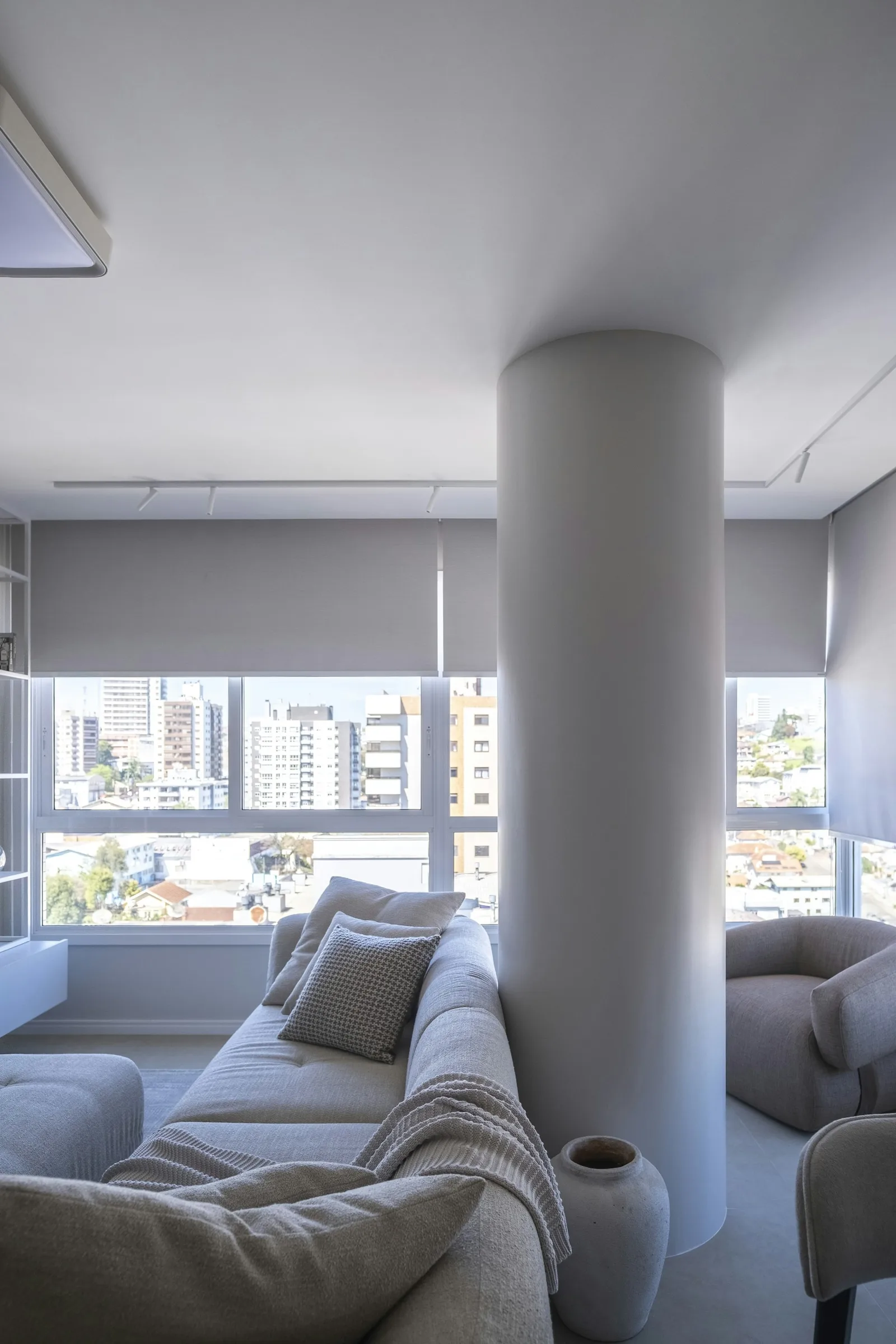
A roller blind is one flat panel of fabric on a tube, and the fabric decides what it does. For a living room the most useful family is the solar-screen or sunscreen fabric: an open weave, usually polyester or a coated yarn, that lets you see out while cutting glare and much of the sun's heat. The Building America Solution Center describes view-preserving interior solar screens as reducing glare and solar heat gain while maintaining the view outside, which is exactly what a sea-facing or garden-facing room needs at four in the afternoon.
Sunscreen fabrics are described by their openness factor, the share of the weave that is open. As the US Department of Energy puts it, greater openness reduces the protection against glare and solar heat gain but increases visibility and light; a lower openness blocks more sun and more of the view. Colour matters as much. A darker screen fabric generally gives the clearer view out, because a dark weave reflects less light back into your eyes, while a pale one glows and blurs the view but reflects more heat. Many people choose a darker screen for the view window and a paler one for a window that is all glare and no view. Our roller blinds page explains how we specify openness for each window.
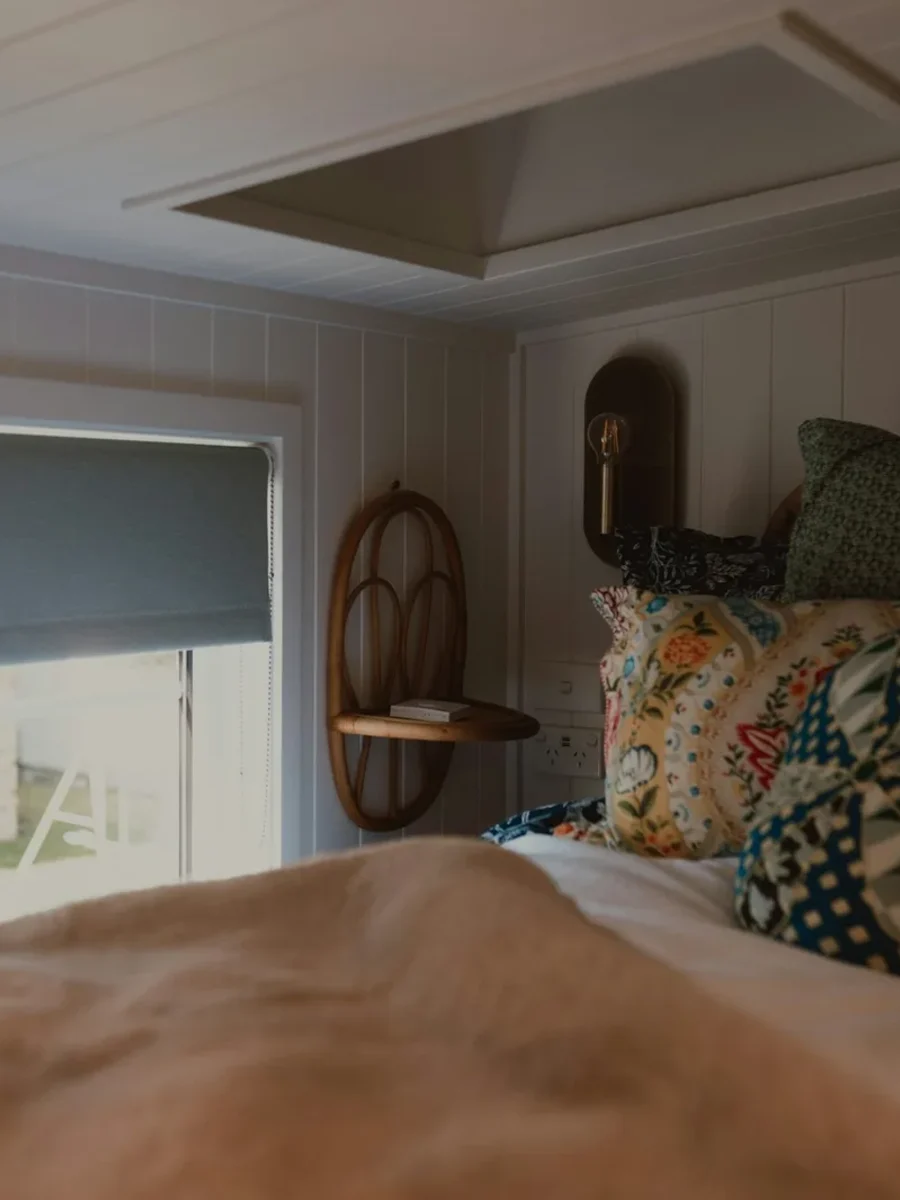
Blackout rollers have a place in a living room too, mainly where the room doubles as a place to watch films or where a television wall faces a bright window. On their own they are a little stark in a sitting room; behind a pair of curtains, where the curtains provide the softness, they work well. In a humid house, choose polyester or coated fabrics over natural ones for rollers: a roller fabric spends months tightly wound on its tube, and natural fibres held there in monsoon air are where mildew spots begin.
For a view window, a darker sunscreen fabric usually gives the clearer view out; a paler one reflects more heat but glows.
Planning something like this?
We visit homes across North and South Goa, measure on site, and bring samples to see in your own light.
Roman blinds for short windows above sofas and window seats
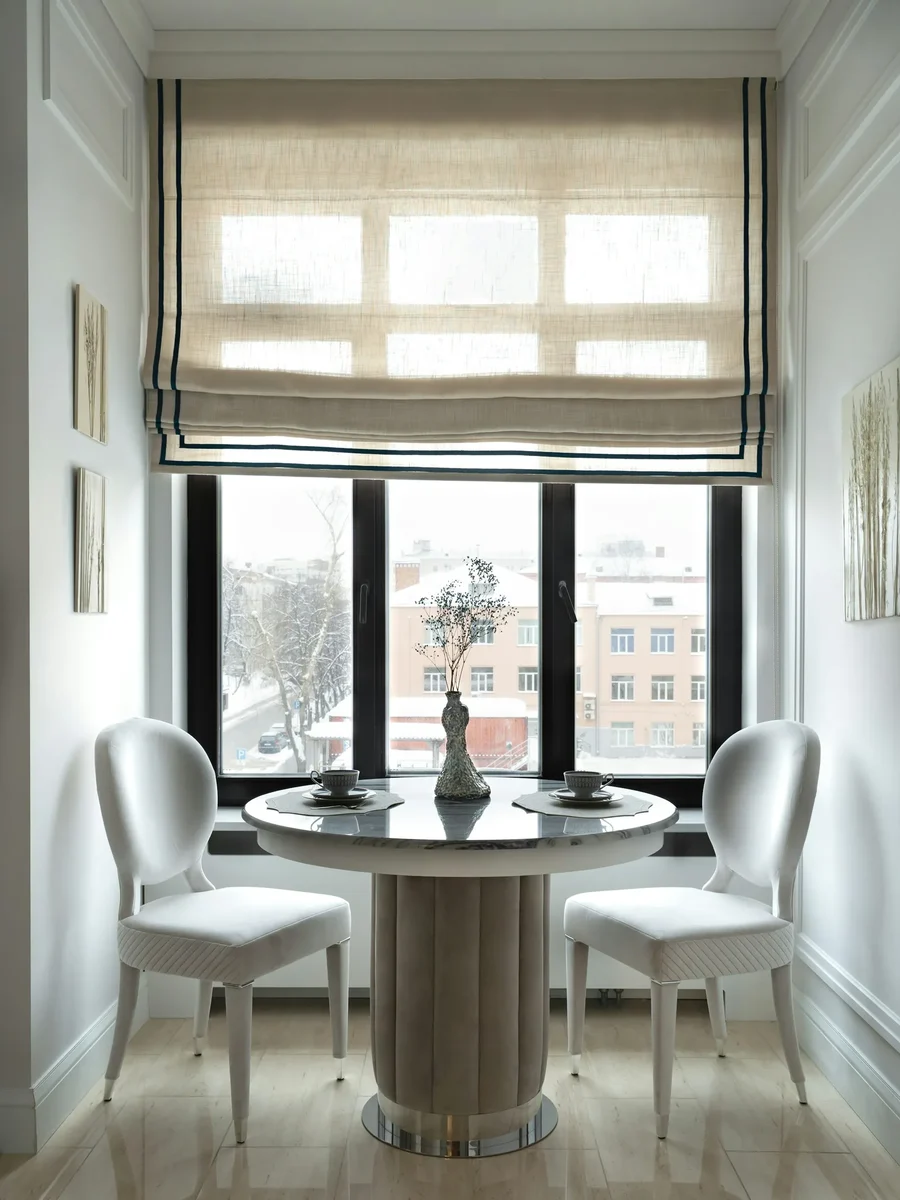
A Roman blind gives the colour and texture of a curtain in the space of a blind. Lowered, it is a flat, tailored panel; raised, it folds into neat pleats at the top of the window. That makes it the natural choice for the short window above a sofa, a window seat with cushions, a kitchen-side window off an open-plan living room, or a pair of narrow windows either side of a chimney breast or a built-in cupboard.
The Roman blind's quiet advantage in a living room is that it can share a fabric with the room's curtains or cushions. Put the main curtains in a plain linen and the Roman blinds on the short windows in the same linen, and the room reads as one scheme even though the windows are dressed differently. Or reverse it: a patterned Roman on one small window, picking a colour from the rug, against plain curtains elsewhere.
Two practical points matter in Goa. First, mount the blind on the wall above the frame where you can, so the folded stack sits on the wall and not across the top of the glass. Second, Roman blinds are traditionally cord-operated, and the US Consumer Product Safety Commission is clear that the safest option where young children are present is to go cordless. A chain with a tensioner fixed to the wall, a cordless mechanism or a motor all solve it. In the monsoon, raise Roman blinds fully on dry days so the folds can air; damp held in pleats is where marks begin. See our Roman blinds for linings and mechanisms.
Wooden and faux-wood blinds, and why faux wood copes better with humidity
Slatted blinds bring character that fabric cannot: the line of the slats, the warmth of timber against a lime-washed wall, the way light comes through in bands. They also do something clever with daylight. The US Department of Energy notes that horizontal slats can be angled to reflect direct sunlight onto a light-coloured ceiling, which diffuses it without much glare. Many Goan living rooms have white or pale ceilings, so tilting the slats upwards on a sunny morning fills the room with soft, indirect light while keeping the sun off the sofa.
Real timber, though, responds to the air around it. The US Forest Products Laboratory's Wood Handbook explains that wood exchanges moisture with the air depending on its humidity and temperature, and that below a certain moisture level it swells as it gains moisture and shrinks as it loses it, which can lead to warping and splitting. Its own table puts the figures plainly: at about 27°C, wood in balance with 50% relative humidity holds about 9% moisture, and wood in balance with 90% humidity holds about 20%. Goan monsoon mornings average 87 to 91% humidity, by the India Meteorological Department's figures. Coatings slow that exchange, the Handbook says, but do not prevent it.
So the honest answer is to place real wood with care. In an air-conditioned living room that stays closed and dry, well-finished timber slats are fine. On a window that stands open through the rains, catches driven rain on the sill or sits close to the sea, choose faux wood or PVC slats instead, which look very similar from across a room and are unaffected by damp. A University of Kentucky extension guide on window treatments lists moisture as a factor that must be considered for wood blinds and not a factor for vinyl and aluminium. Our PVC and faux-wood blinds are what we usually fit on monsoon-side windows.
Zebra blinds for adjustable daytime light, and their limits at night
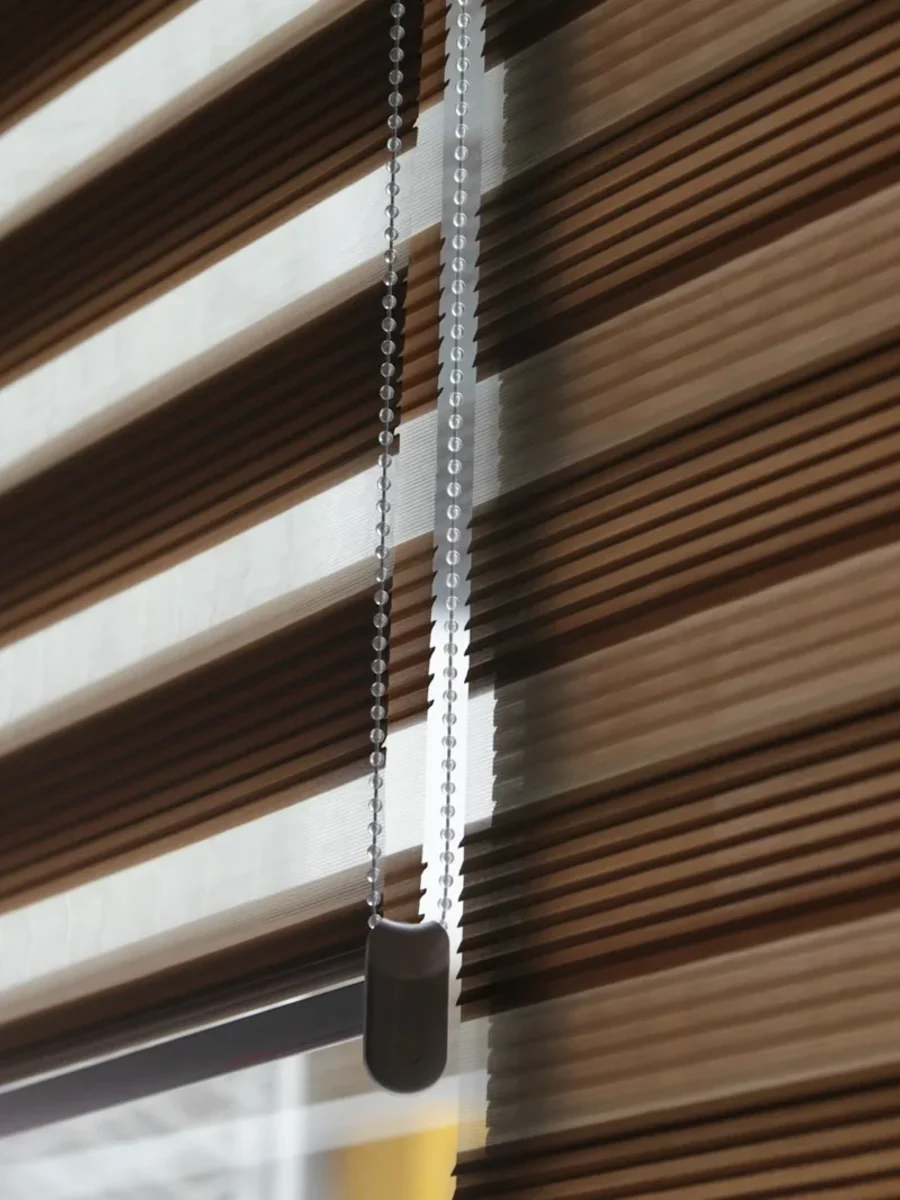
Zebra blinds, also sold as day-and-night or combi blinds, are a roller blind made from a loop of fabric with alternating sheer and solid bands. Turn the chain and the two faces slide past each other: sheer bands aligned for light and a softened view, solid bands over the sheer ones to close the window. For a living room that changes use through the day, it is an easy way to move between bright, filtered and dim without raising the blind, and polyester zebra fabrics dry quickly after a humid spell.
Their limit is the evening. By day, the outside is brighter than the room, so passers-by see mostly reflection and solid bands. After dark, with lamps on inside, the balance reverses: in the open position the sheer bands show the room clearly, and even closed, the overlapping layers glow and can show silhouettes. A ground-floor living room on a lane, or a flat facing another block, needs either a dim-out zebra fabric, a curtain for the evening, or acceptance that the blind will be fully closed at night.
Zebra blinds are also not blackout, so they are not the answer for a television wall facing a bright window if you watch films by day. They are a strong idea for the window beside the screen where you want to trim glare in steps, and for flats where the living room faces a busy road and daytime privacy matters more than night. Our article on what zebra blinds are covers how they work and how to look after them, and the zebra blinds page shows the fabrics.
Wide balcony sliding doors: vertical blinds, panel blinds or curtains
The wide aluminium sliding door onto a balcony is the most common living-room opening in Goan flats, and the hardest to dress with a blind. A horizontal blind three metres wide is heavy to raise, and when it is down it blocks the door. So the realistic options are blinds that move sideways, or curtains.
Vertical blinds draw to one side like a curtain and their vanes rotate to control light while keeping a view. They suit a door used many times a day and they shed dust well. Their weakness in a Goan living room is the breeze: with the door open, loose vanes swing and knock, which is why weighted vanes with a connecting chain at the bottom are worth having. Panel blinds, sometimes called panel glides, are wide flat fabric panels that slide on a multi-channel track and stack behind one another; they look crisp and architectural, but the stack is as wide as one panel, which takes a share of the glass. Curtains on a track, particularly a ripple-fold heading, stack narrowly beyond the opening when the track is extended past the frame, leaving the door completely clear.
For most Goan living rooms we lean towards curtains on the sliding door, perhaps with a sheer, and blinds on the smaller windows. Verticals are the strong choice where the door is in constant use, there is no wall beside it for a curtain to stack, or the room has an office-like modern look. Whichever you choose, check the walking route: a University of Arkansas furniture-arrangement guide suggests at least 76 cm (30 inches) for a traffic route and 91 cm (36 inches) at doorways, and the stacked blind or curtain must sit outside that width, not in it.
| Option | Open position | Light control | In a Goan breeze | Best for |
|---|---|---|---|---|
| Vertical blinds | Stack to one side, narrow | Vanes rotate; good | Vanes can swing; weights and chain help | Busy doors, no wall to stack a curtain |
| Panel blinds | Panels stack behind one another | Open or closed panels | Steady; panels are wide and flat | Crisp, modern rooms with wall-to-wall glass |
| Curtains, ripple-fold track | Stack clear of the opening if the track runs past the frame | Open, closed, or sheer layer | Sheers can billow; weighted hems help | Most living rooms, softness and evening privacy |
| Roller or zebra per door panel | Rolled up on each fixed or sliding pane | Good | Fixed to the frame, so steady | Doors where each pane can carry its own blind |
Pairing blinds with dress curtains for warmth and layered light
The most comfortable living rooms often use both on the same window: a blind inside the reveal that does the daily work, and a pair of curtains outside it that softens the room and closes for the evening. The University of Kentucky's guide notes that many designers now combine blinds or shades with fabric side panels and curtains, and suggests that where a blind does the work and the curtains do not need to close, stationary side panels save on hardware and fabric.
That is a useful decision to make deliberately. If the blind gives you all the light control and privacy you need, the curtains can be dress curtains: fixed panels, narrower than a working pair, framing the window and adding colour and texture. If you want the curtains to close at night, for privacy or warmth in an air-conditioned room, they need a full working track and enough fullness to cover the window. The US Department of Energy reports that 75% of home window coverings stay in the same position every day, so be honest about which layer you will actually move.
Plan the projection. The curtain track has to sit far enough forward that the curtain clears the blind's headrail, the chain and the handle of the window, so measure the depth of the blind as fitted before fixing the curtain brackets. Keep the two in conversation: a plain blind under patterned curtains, or a textured Roman in the same tone as plain curtains, looks considered; two patterns on one window rarely does.
- Blind does the work, curtains frame: stationary side panels, narrow and fixed
- Blind for daytime glare, curtains for evening privacy: a full working track
- Blackout roller for films, sheer curtain for daytime softness
- Solar-screen roller on the view window, lined curtains drawn at dusk
Three Goan living rooms, worked through
A two-bedroom flat with a west-facing balcony. The living room has a 2.4 m sliding door to the balcony and a 90 cm window beside the television. The sliding door gets curtains on a track that runs past the frame, a sheer for the afternoon and a lined curtain for the evening. The window by the television gets a solar-screen roller in a darker fabric, lowered from about four o'clock to stop reflections on the screen while keeping the sky in view. One blind, one pair of layered curtains, and the room is usable at every hour.
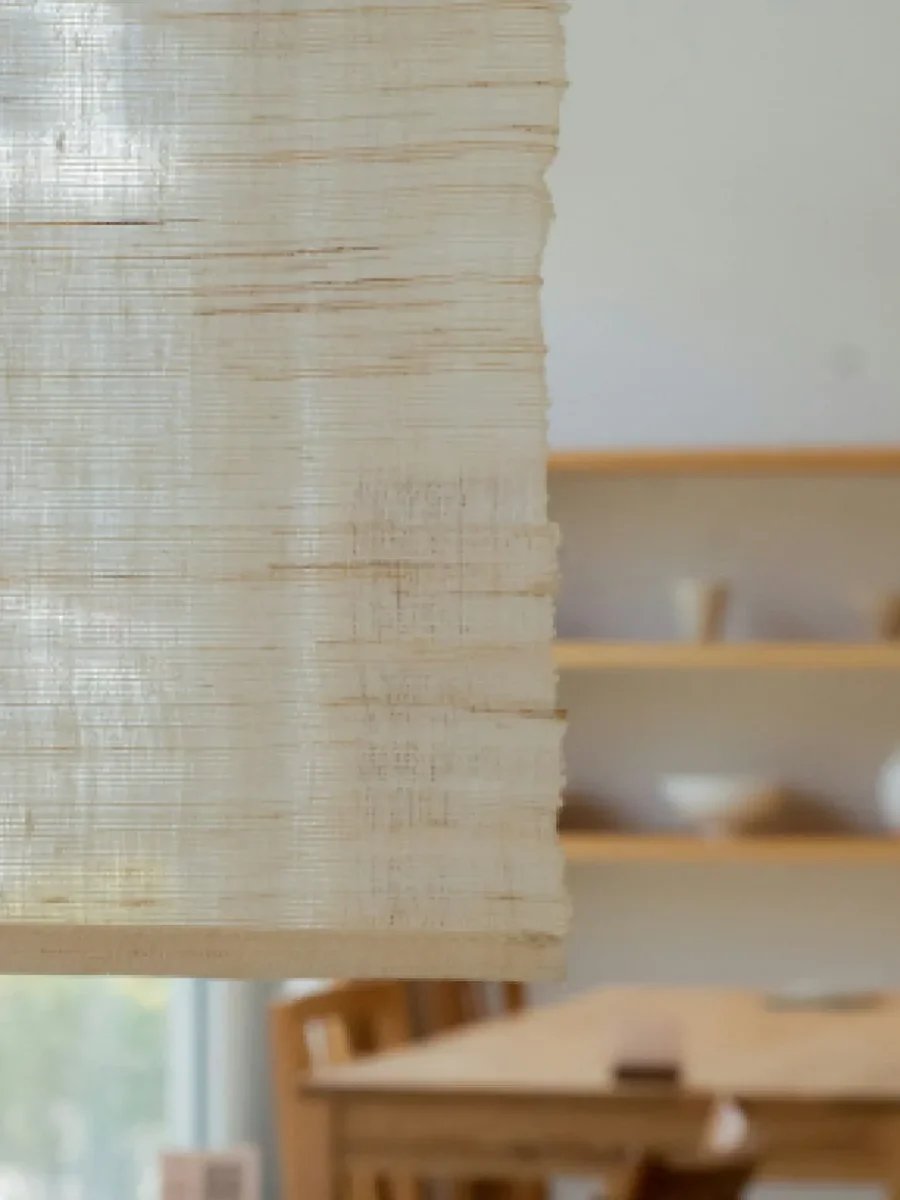
A sala in an older house with deep laterite reveals. Tall windows with timber shutters that fold back into thick walls, a red oxide floor, dark teak furniture. Here the reveals do half the work. Roman blinds in a natural linen-look fabric fit inside each reveal, just in front of the folded shutters, and give daytime privacy from the road without hiding the shutters. Because the room is open to the air all year, the fabric is a polyester blend rather than pure linen, and the blinds are raised fully on dry monsoon days. Curtains are optional; if the owners want them, simple dress panels outside the reveals frame the windows.
A villa living room with clerestory windows above wide glass. The main glass wall faces the garden and has motorised curtains. Above it, a band of fixed clerestory windows lets in hard sun in the late afternoon. Nobody will climb up to adjust those blinds, which is why the Energy Department's observation about coverings left in one position matters here. Motorised rollers in a solar-screen fabric, set to lower on a schedule, solve it. Our motorised blinds page covers wired and battery options, and the Building America Solution Center recommends pre-wiring windows for motorised shading during construction where you can.