 Drapehaus
Drapehaus
Preparing the room
Drapehaus
Preparing the room
Blinds
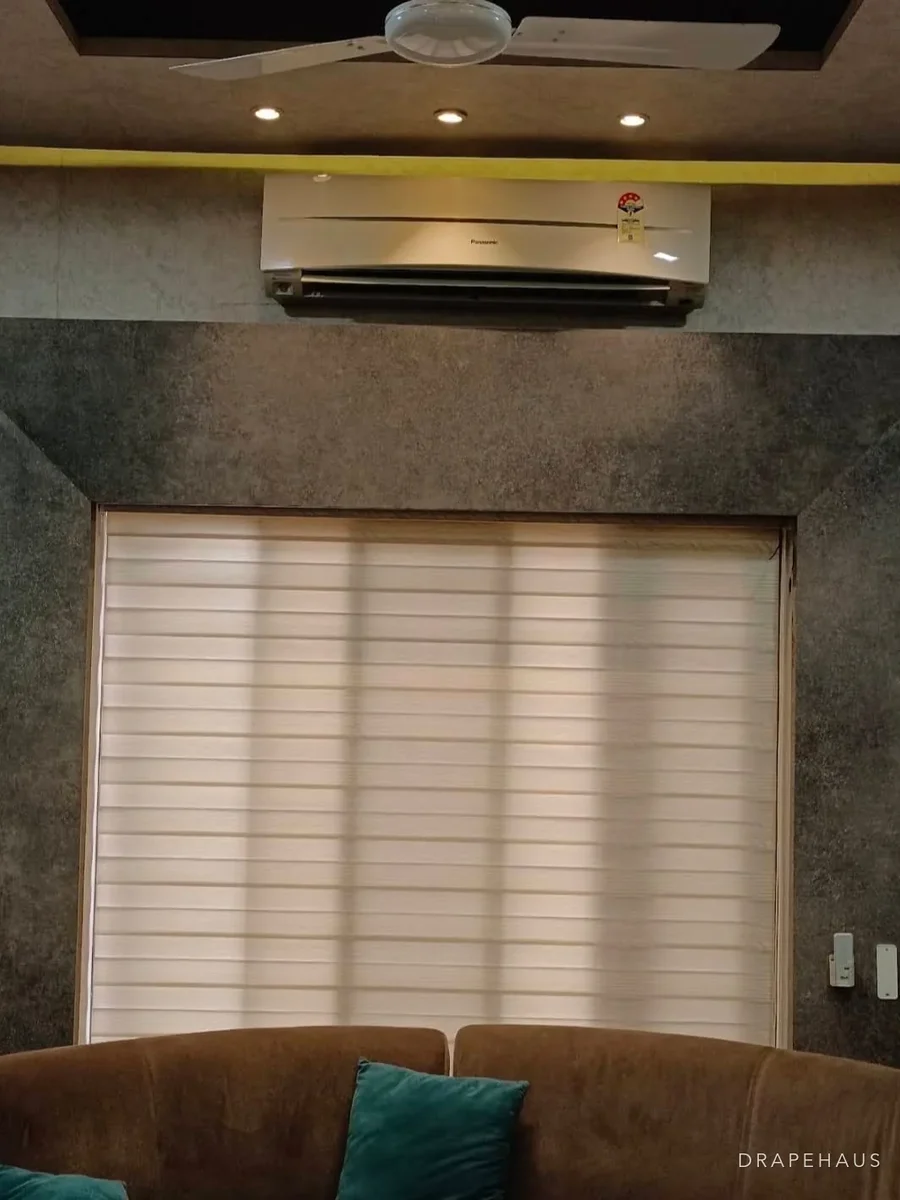
Alternating sheer and solid bands that slide past one another, so a single blind moves from open and bright to fully closed with every step in between. They are one of the most asked-for blinds in modern Goan apartments.
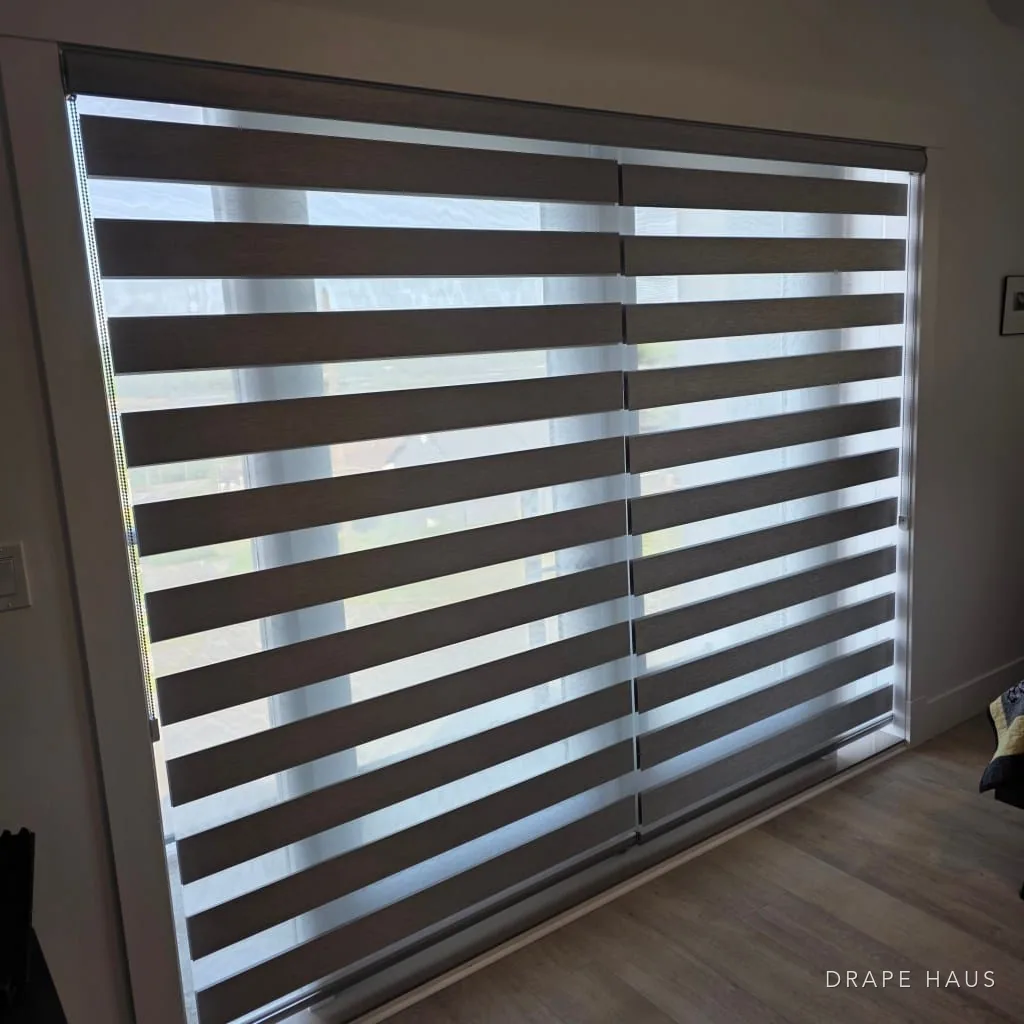
Zebra · Midday
Treatment
Time of day
Alternating sheer and solid bands: slide them into line for light and a filtered view, offset them for privacy.
In short
By the Drapehaus studio · How we write
Is it right for you?
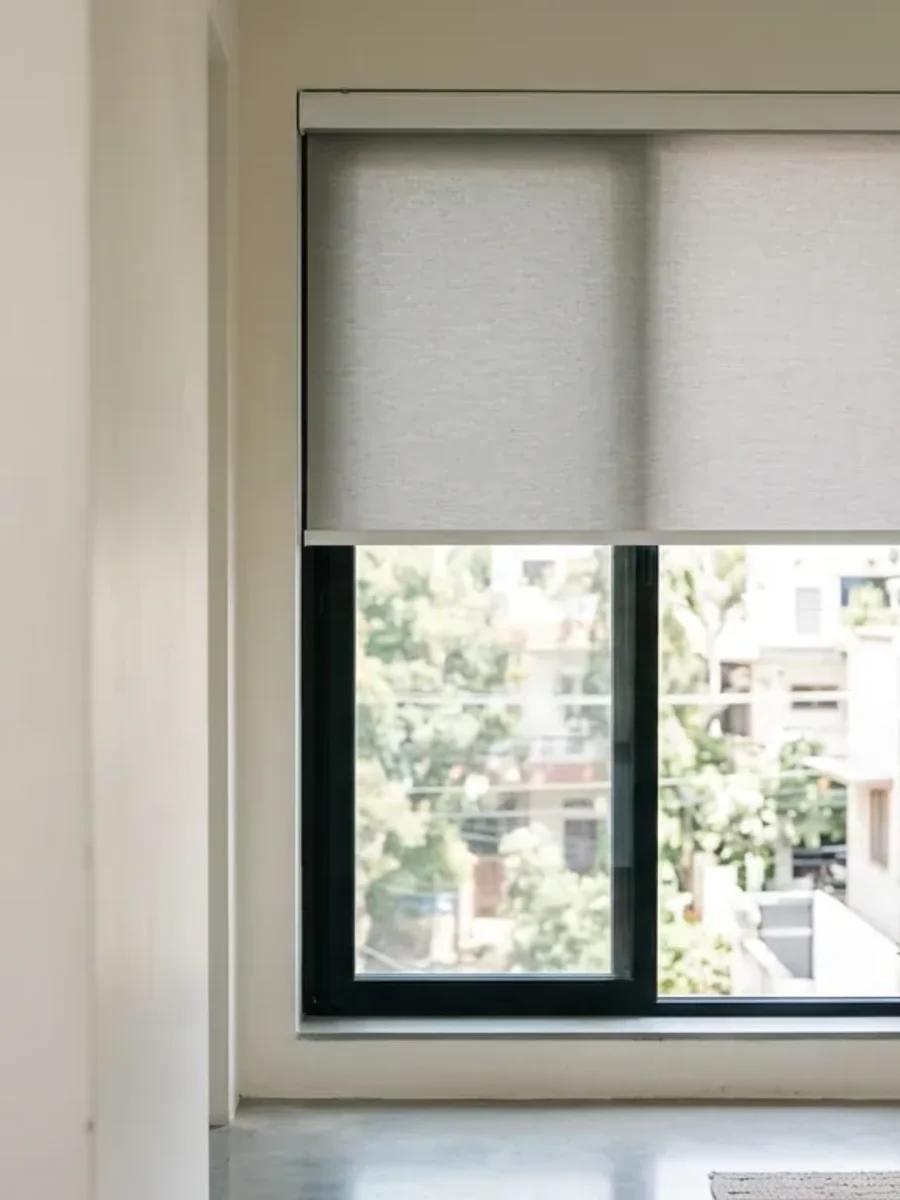
A zebra blind is a roller blind with a double layer. One continuous loop of fabric, printed or woven with alternating sheer and solid bands, runs down the front and back of the blind. Turning the chain slides the two faces past each other. When the sheer bands line up, you look through two layers of voile; when a solid band sits over a sheer one, the view closes. That is why they are also sold as day and night blinds or dual blinds.
They suit rooms where the light changes through the day and you want to answer it without raising or lowering the whole blind: a living room with a screen, a study facing west, an apartment with a large window onto the street. They give a clean, contemporary line that sits well with flush plaster and aluminium frames.
They are not the right choice for a bedroom that must be truly dark, for a bathroom where the fabric will be splashed, or for a room used mostly at night with the lights on, where the sheer bands give away more than people expect. They also look out of place in some heritage rooms, where a Roman blind or timber Venetian is kinder to the architecture.
The details
Aligned, the sheer bands let light through; offset, the solid bands close the gaps. It is a finer control than a roller blind gives, without the tilting slats of a Venetian — and the fabric wipes clean and copes well with humidity.
On a wide opening we split the run into two or three blinds so each is light to operate and can be set independently, and we fit inside the reveal where the depth allows for the cleanest finish.
Your options
The mechanism is much the same from one zebra blind to the next. What changes the result is the fabric, the band proportions and how the top of the blind is finished.
Swipe for all 6 →
The honest view
Fine control without lifting
Glare can be cut, softened or let in with a small turn of the chain. You do not have to raise the whole blind to let light in, so the room keeps its privacy in the lower half.
Synthetic fabric that tolerates humidity
Most zebra fabrics are polyester, which absorbs very little water. They keep their shape and resist mildew far better than cotton or linen blinds through a coastal monsoon.
Neat in a shallow recess
The headrail is compact and the blind rolls up tightly, so it fits reveals where a Roman blind would not stack neatly and a Venetian would clash with handles.
Clean look when half-open
Unlike a Venetian, there are no tilted slats catching dust at odd angles. A zebra blind at its filtering position still looks orderly and flat.
Not true blackout
Even with dim-out bands, light passes the sides and faintly through the rows. For a bedroom that must be dark, a blackout roller in side channels is better.
Night-time privacy
With lights on inside and dark outside, the sheer bands can let passers-by see in even in the filtering position. Close fully, or add a curtain, in rooms used at night.
Band alignment on split blinds
When a wide window is split, each blind must be made from the same fabric batch and set to the same drop, or the stripes will not line up across the joins.
Side by side
The realistic alternatives in a living room are a plain roller, a timber or aluminium Venetian and sheer curtains. Here is how they compare.
| Zebra blind | Solar roller | Venetian | Sheer curtains | |
|---|---|---|---|---|
| Adjust light without raising | Yes, via bands | No | Yes, by tilting | No, draw only |
| View when filtering | Striped, partial | Soft, through weave | Slatted | Soft, hazy |
| Darkest position | Room-darkening | Depends on fabric | Dim | Light-filtering only |
| Humidity tolerance | High | High | Timber low, others high | Fibre-dependent |
| Dust collection | Low, flat fabric | Low | High, every slat | Moderate |
| Look | Modern, graphic | Minimal | Architectural | Soft, relaxed |
Swipe to compare →
A zebra blind behind a pair of sheer or lined curtains combines fine daytime control with softness and night privacy.
Rather see it in your own room?
We bring samples to the house, measure every window, and specify for the light and exposure you actually have.
Room by room
The classic use. Set the bands to filter afternoon glare off a screen while keeping the room bright, and close them fully for privacy in the evening, ideally with curtains in front.
Fine adjustment through the day keeps glare off a monitor without plunging the room into dimness. Choose a textured band so the stripes do not strobe on video calls.
Workable only if you do not need darkness. For sleep, add blackout curtains or choose a blackout roller in side channels instead.
Polyester bands tolerate humidity, but grease settles on the sheer rows. Keep them away from the hob and choose a pale, wipeable fabric.
Steam and splashing mark the voile bands. Faux-wood or a PVC roller is the more durable answer in a wet room.
Easy for guests to understand and hard to damage. Pair with blackout curtains, since guests expect a dark room for a late morning.
Fine with a chain tensioner or motor. Dim-out bands help for naps, but do not expect a dark room at midday.
In depth — tap a heading to read
A zebra blind carries twice the fabric of a roller, so the roll is fatter when raised. Inside a recess, that bulk has to clear window handles, stays and any grille on the inside face. We measure depth at the handle as well as at the frame, and if the handle projects, we move the blind forward onto the face of the reveal or specify a cassette that sits proud of it.
The drop matters more than on a roller. The bands must finish in a sensible position when the blind is fully down, so the bottom rail does not stop halfway through a voile row. On a pair of windows in the same wall, we set both blinds to the same drop so their bands align across the room when set to filter.
Where windows sit side by side, ask for the blinds to be made from one fabric batch. Band spacing can vary slightly between batches.
In a living room, a zebra blind does its best work in the afternoon. With the bands offset, it cuts direct glare on a screen or a polished floor while letting diffused light through the rows. With the bands aligned, you keep the view of the garden with a slight softening.
Two limitations are worth knowing. First, the blind does little for heat on a west-facing wall; it controls glare, not solar gain. A solar roller or exterior shading does more for that. Second, at night with lamps on, the voile rows become windows in reverse. In rooms overlooked from a lane or a neighbour, plan for curtains or close the blind fully after dark.
Polyester zebra fabric copes well with humidity, but the voile rows are the weak point near the sea. Salt and fine dust settle in the open weave and, because salt draws moisture from the air, those rows can hold a faint dampness that dulls the fabric and, in a closed room, spots it.
A cassette headrail keeps the rolled fabric covered, which helps a great deal in a house left closed for weeks. We also specify stainless or coated brackets and a plastic or stainless chain rather than a plated metal one, which will mark the fabric with rust in its first monsoon near the water.
The fiddly part of a manual zebra blind is stopping at exactly the right point. A continuous chain with a clutch holds the position securely; a spring-assisted cordless version is tidier but less precise. For a single window, a good chain is usually the better choice.
Motorisation makes more sense on zebra blinds than almost any other type, because the motor can be programmed with the aligned and offset positions and return to them exactly. On a wide opening split into three blinds, one control moving all three to the same filtering position is a genuine improvement in daily use.
Contrast is what makes zebra blinds look busy. A white voile band against a charcoal solid is striking in a showroom and restless on a large window. Tonal combinations - ivory on ivory, sand on sand - give the same control with a calmer, more textile appearance.
Match the band to the size of the window. A narrow band suits a large glazed wall because the stripe dissolves at a distance; a wide band suits a small window where you want the view to open clearly. In an older house with limewashed walls, a textured, off-white fabric almost always sits better than a bright white or a strong colour.
Living with it
Set the blind to its open position so both layers are visible, then brush or vacuum gently with a soft attachment. This reaches the back face as well as the front.
Dab marks with a cloth and mild soapy water, then blot dry. Soaking or machine washing distorts the bands and can separate the coating on dim-out fabric.
Wipe the voile rows lightly with a damp cloth every few weeks in sea-facing rooms, before the salt draws in enough moisture to dull the fabric.
On dry days, raise the blind fully for an hour to let air reach the rolled fabric and the glass behind it.
If the blind starts slipping or the bands drift out of register, have the clutch adjusted rather than winding it harder.
Avoid these
They darken a room, but they do not black it out. For a bedroom, pair them with blackout curtains or choose a blackout roller.
The voile rows are see-through from outside after dark. In overlooked rooms, add curtains or close the blind fully in the evening.
Strong stripes dominate a large opening. Choose tonal colours or narrower bands on wide glazing.
The double roll is bulkier than a roller. Measure the handle projection, not just the frame, before choosing an inside mount.
Different fabric batches or drops leave bands misaligned across a split window. Order them together and set one drop.
Checklist
More in blinds
Blinds do what curtains cannot: tight light control in a shallow recess, a clean line on a busy window, and genuine blackout when they run in side channels.
Our work
Our process
One team from the first visit to the last bracket, so nothing is lost between the person who specified it and the person who fits it.
FAQ
Most give strong room-darkening rather than total blackout, because light passes the edges and between bands. For true blackout a blackout roller in side channels is better.
Yes, but we usually split a wide opening into two or three blinds. Each is lighter to operate and can be set to a different position.
They are one of the best options. They let you filter afternoon glare while keeping the room bright and part of the view, then close fully in the evening. In an overlooked room, add curtains for night privacy, because the sheer rows are visible from outside once the lights are on.
A roller blind is one sheet of fabric that goes up and down. A zebra blind is a double layer of banded fabric, so it can filter light without being raised. Rollers offer true blackout in side channels and more solar fabric choices; zebras offer finer daytime control.
Partly, when they are in the filtering position and the room is lit. The voile rows are sheer from both sides. Close the blind fully so solid bands cover the sheer ones, or add curtains in rooms that face a lane or a neighbour.
Polyester zebra fabric resists mildew well, but dust and salt in the sheer rows can hold moisture in a closed room. Keep them clean, give the room some airflow during the monsoon, and choose a cassette headrail if the house is shut for long periods.
Set the bands to the open position, vacuum gently with a soft brush attachment, and spot-clean marks with a damp cloth and mild soap. Do not soak or machine wash them; it distorts the bands and damages any dim-out coating.
Next step
Band scale and colour look very different in a showroom and in your own room at four in the afternoon. We visit, measure each recess including handle depth and drop, and bring zebra fabrics to hang against the window so you can see how they filter your light. We then specify the fabric, headrail and mechanism, make the blinds to those measurements and fit them. Book a home visit, and we will bring the samples to you.