 Drape Haus
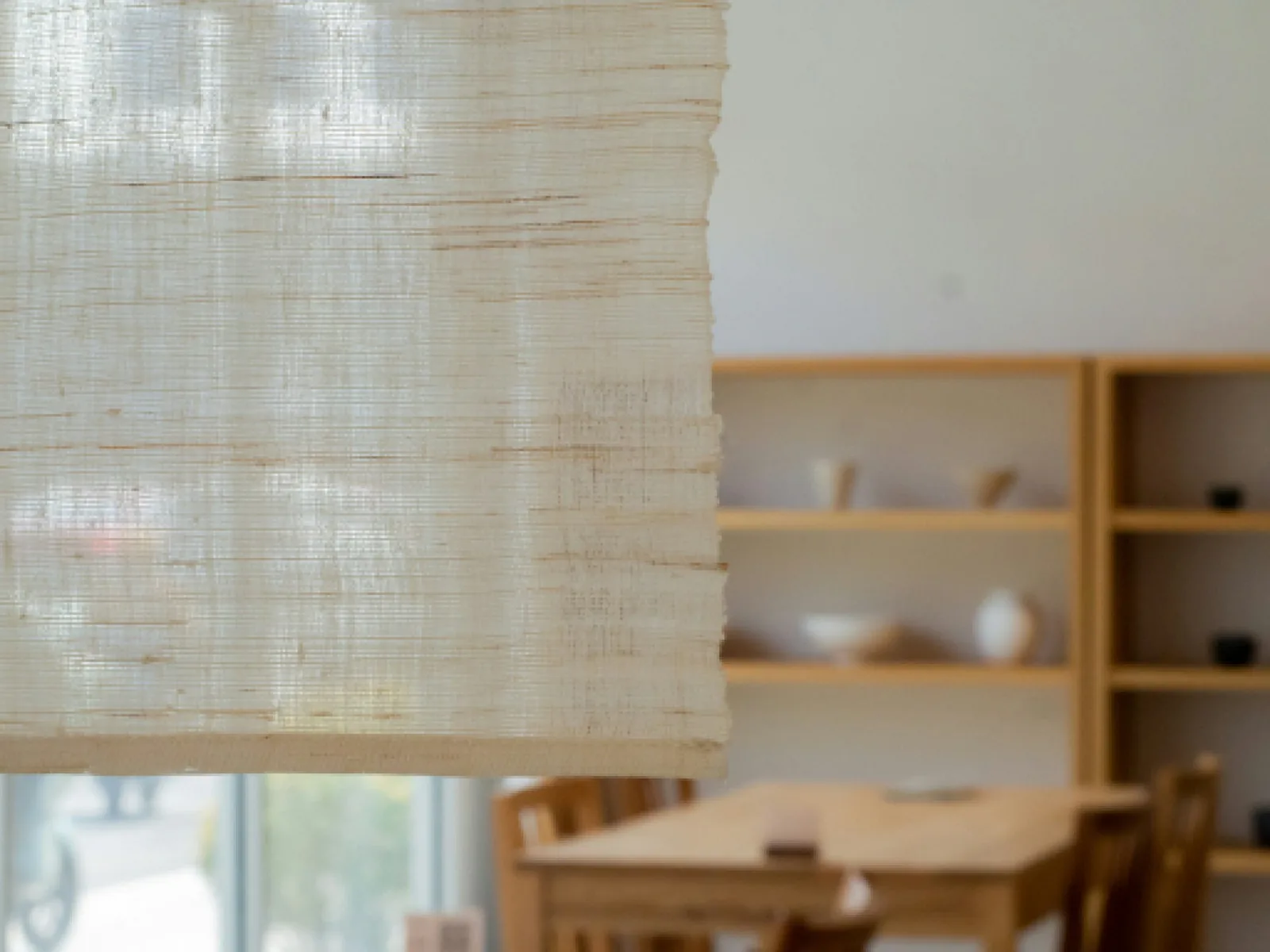
Roman blinds are fabric blinds that lift in horizontal folds. Lowered, a Roman blind hangs as a flat, tailored panel of fabric covering the window. Raised, it gathers into a neat stack of pleats at the top. Sometimes called Roman curtains or, in American usage, Roman shades, they give the colour and softness of a curtain while needing no wall space either side of the window.
That makes them the natural choice for windows where curtains do not fit: over a kitchen counter or a desk, on a window seat, between cupboards, or in a narrow bay. They are made like curtains, with a face fabric, a lining and sometimes an interlining, so the fabric and lining choices matter just as much, especially in a climate where morning humidity sits close to 90 per cent through the monsoon.
This explainer covers how a Roman blind works, the three main styles, the lift mechanisms and their safety, linings and fabrics for humid rooms, where they work and where they do not, and how to clean one properly. To see one move, try our Roman blind simulator; to see what we make, visit our Roman blinds page.
How do Roman blinds work?
A Roman blind has a simple anatomy. The face fabric is backed by a lining, and across the back, at regular intervals, run horizontal pockets or tapes holding thin rods, often called battens or dowels. Small rings are sewn to each pocket in vertical lines, usually two to four lines depending on the width. Lift cords are tied off at the bottom bar, run up through every ring in their line, and pass into a headrail at the top, where they are gathered by the operating mechanism.
When the mechanism draws the cords up, the bottom bar rises first and meets the rod above it, then both rise to meet the next, and so on. The fabric between each pair of rods folds outward into a pleat, so the blind stacks in even layers. When the cords are released, gravity and the bottom bar's weight let the folds drop out again and the blind falls flat. The spacing of the rods is calculated from the drop, so that the stack is tidy and the lowest fold sits evenly when the blind is part-raised.
This is why a Roman blind behaves differently from a roller blind. A roller winds a single sheet of fabric round a tube; a Roman folds a sewn, lined panel. The roller is slimmer at the top and more resistant to damp, while the Roman is softer, more decorative and better at bringing pattern and texture to a window. Both have a place, and many rooms use one of each.
Flat, hobbled and relaxed Roman blind styles
The style of a Roman blind is mostly about what happens to the fabric between the rods. In a flat Roman, the panel is cut to the exact drop, so it hangs perfectly smooth when lowered and folds into crisp pleats when raised. It is the most tailored look and shows a plain weave or a pattern equally well, which is why it is the one most people picture.
A hobbled Roman, also called a waterfall or cascade Roman, uses extra fabric between the rods, so soft overlapping folds remain even when the blind is fully down. The effect is fuller and more traditional, and it suits heavier linens and heritage rooms where a perfectly flat panel would look too modern. It uses more fabric and makes a deeper stack, so it needs a little more height above the window.
A relaxed Roman leaves out the rods in the lower part of the blind, so when it is raised the bottom edge falls into a gentle curve, like a smile. It looks casual and works with lighter fabrics in bedrooms and living rooms. The trade-off is precision: the sides do not close as neatly and the curve takes a little light at the bottom, so it is less suited to rooms that need full privacy or darkness.
| Style | When lowered | When raised | Suits |
|---|---|---|---|
| Flat | Smooth, flat panel | Crisp, even pleats | Most rooms; patterns and plains |
| Hobbled (waterfall, cascade) | Soft overlapping folds | Deep, full stack | Heritage rooms, heavier linens |
| Relaxed | Flat, with a slight curve at the hem | Curved, informal swag | Bedrooms, light fabrics |
Planning something like this?
We visit homes across North and South Goa, measure on site, and bring samples to see in your own light.
Mechanisms: cords, cord locks, chains and motors
There are three common ways to raise a Roman blind. The traditional method is a cord and cleat: the lift cords gather at one side of the headrail into a single pull cord, which is wound round a cleat on the wall to hold the blind. A cord lock does the same job inside the headrail, gripping the cords when the pull cord is let go at an angle. Both are simple and suit small, light blinds. A side chain with a clutch, by contrast, turns a shaft in the headrail that winds the lift cords onto small spools; it is smoother on heavier blinds and holds any position securely. A motor in the headrail does the same at the press of a button.
Safety is the reason the choice matters. In December 2009 the US Consumer Product Safety Commission and the window covering industry announced a recall to repair all Roman shades and roll-up blinds, after reports of five deaths and sixteen near strangulations in Roman shades since 2006. The Commission explained that a child could put their neck between an exposed inner cord and the fabric on the back of the blind. Modern Roman blinds are built with that in mind, with cord shrouds or covered rings on the back and cord stops near the headrail.
The Commission's own advice is plain: cordless window coverings are the only way to eliminate the strangulation hazard, and other measures, such as shortening pull cords, fitting cord stops and anchoring continuous loops to the wall, reduce it but do not remove it. In any room where young children sleep or play, choose a cordless design or a motor, or at the very least a chain anchored to the wall with a tensioner, and keep beds and furniture away from the window.
In children's rooms, choose cordless or motorised Roman blinds; anchored chains are the minimum.
Linings for Roman blinds: standard, blackout and thermal
The lining does more work on a Roman blind than on a curtain, because it is sewn to the face along every rod pocket and shapes every fold. A standard lining, usually a cotton or polyester blend, gives the blind body, protects the face fabric from sun and adds privacy. A blackout lining has a dense coated or woven layer that stops light passing through the fabric. A thermal lining, or a soft interlining between face and lining, adds bulk, a fuller fold and some insulation against hot glass.
In Goa, the lining is also where mildew starts. The India Meteorological Department records relative humidity across the state of 87 to 91 per cent in the mornings from June to September. The Smithsonian's Museum Conservation Institute notes that stagnant air above 80 per cent will support mould on cotton and linen, while polyester and nylon absorb little moisture, and that dirt and residues let mildew grow at lower humidity still. A thick cotton interlining in a closed, unventilated room is therefore a real risk; a breathable polyester-rich lining in a room with airflow is far less of one.
Blackout linings bring one more detail. Each rod pocket is stitched through the layers, and light can show through the needle holes along each fold. Good workrooms either stitch the pockets to the lining only or hang a separate blackout layer behind. Our guide to blackout linings explains the different types, and our guide to monsoon damp and mildew covers keeping rooms dry enough for any lined fabric.
Choosing fabric: which weights fold crisply, which sag, and which fade
Medium-weight fabrics make the best Roman blinds. A firm cotton, a linen blend or a medium polyester holds a crisp fold and hangs flat. Very light fabrics, such as a fine voile, look limp and show every rod line unless they are lined. Very heavy fabrics, such as thick velvet or chenille, fold into a deep, bulky stack and add weight to the cords and headrail. Loose, open weaves can sag between rods over time, especially in humid air, and stretchy fabrics never sit square.
Pattern needs planning, because the folds cut it into horizontal strips when the blind is raised. A good maker centres the motif across the width and sets the fold spacing so the design reads well raised as well as lowered. Large-scale patterns often work better on curtains; small repeats, stripes and textured plains are kinder to Roman blinds.
Colour matters on sunny windows. The Canadian Conservation Institute explains that light fades colours, that the damage builds up with exposure, intensity multiplied by time, and that ultraviolet usually causes less than half of the fading. In plain terms, a saturated colour on a west-facing window will fade however much UV is filtered, and the fold edges that catch the most light will go first. Because the lining faces the glass, it takes the direct sun and shields the face fabric, which is one more reason to line a Roman blind on a bright window. Choose paler, more forgiving colours for windows that take hard afternoon sun, as our guide to fading and sun damage explains.
Where Roman blinds work, and where they don't
Roman blinds are at their best where a curtain would be in the way. Over a desk or a kitchen counter, on a window seat, in a bay between built-in cupboards, or on a narrow window beside a door, they give softness without a stack of fabric beside the glass. They suit bedrooms well with a blackout lining, especially fixed above and outside the recess with an overlap, and they look particularly at home in dining rooms, where they can match chair upholstery.
They are a poor choice where they will get wet. In a bathroom, steam and splashing mark the face and spot the lining; in a kitchen, a blind beside the hob gathers grease and is a fire risk. Near a sink, an unlined synthetic Roman is workable, but a PVC roller or a faux-wood blind is more practical. Very wide windows are another limit: a single Roman across a wide opening becomes heavy and its folds wander, so it is better split into two or three matched blinds.
Closed houses deserve a mention. A Roman blind left lowered against damp glass for months can wick condensation into its bottom fold. If a house will be shut through the monsoon, choose synthetic fabrics and breathable linings, raise the blinds before leaving, and include them in any mid-season check. Our guide to the closed-house season covers the rest of the house.
Caring for Roman blinds, including taking them apart to clean
Routine care is simple. Lower the blind fully every few weeks and vacuum both sides with a soft upholstery brush, working along the folds, because dust held in the pleats holds moisture too. Blot small marks with a barely damp cloth and a little mild soap, without rubbing, and let the blind dry fully lowered. On dry mornings in the monsoon, raise it so air can reach the glass behind.
A full clean means taking the blind apart, never putting it in a machine whole. Take the blind down from its headrail or fixing, untie or unhook the lift cords from the bottom bar, pull them out through the rings, and slide each rod and the bottom bar out of its pocket. Photograph the cord routing first. The face fabric and lining can then go for dry cleaning, which is the usual recommendation for lined Roman blinds because face and lining can shrink at different rates. Only wash at home if the care labels of both layers allow it.
When the fabric comes back, check that it is still square and the same drop before re-threading the rods, and re-tie the cords so the bottom bar hangs level. If that sounds fiddly, it is, and many owners prefer to have it done professionally. We do this, and refabric old Roman blinds, as part of our Roman blinds work. For a step-by-step routine for other fabric blinds, see our guide on how to clean blinds.