 Drape Haus
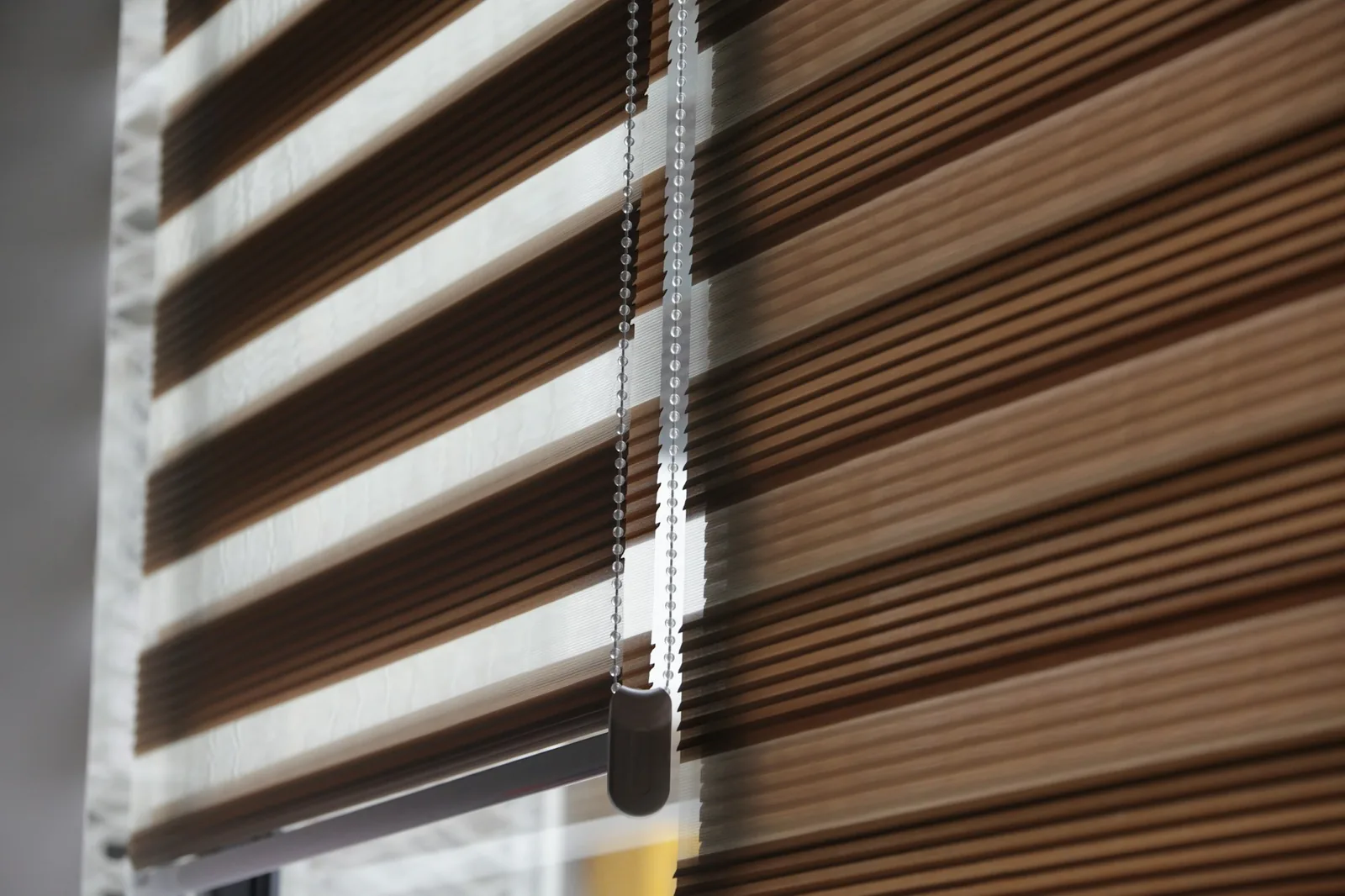
Zebra blinds are roller blinds made from a double layer of striped fabric. A single continuous loop of material, woven or printed with alternating sheer and solid horizontal bands, passes down the front of the blind, round the bottom rail and back up behind. Turning the chain moves the two faces past each other. When the sheer bands line up, light and a softened view come through; when the solid bands cover the sheer ones, the window closes. They are also sold as day-and-night, dual or combi blinds.
That one idea gives a degree of control a plain roller blind cannot, without the tilting slats of a Venetian. It is also why zebra blinds have particular limits: they are never fully dark, the sheer bands behave differently at night, and the stripes have to stay in register to look right.
This guide explains how zebra blinds work, their real pros and cons, what neighbours can and cannot see, how fabrics behave in Goan sun and humidity, and how to care for them. You can slide the bands yourself in our zebra blind simulator, and see the blinds we make on our zebra blinds page.
How zebra blinds work: two layers, three positions
Picture a long loop of striped fabric hanging from a roller, with both ends fixed to the roller and a weighted bottom rail sitting inside the bottom of the loop. The front face and the back face are the same fabric, so they carry the same bands. Because the loop runs round the bottom rail, turning the roller shifts the front face down and the back face up by the same amount, and their stripes slide relative to each other.
That gives three useful states. In the open position, sheer band sits over sheer band and solid over solid, so you look through two thin layers of voile with the solid bands as horizontal stripes across the view. In the closed position, each solid band covers a sheer band on the other face, so the window reads as a nearly continuous panel. Between the two, the overlap varies and the light dims in steps. Keep turning past the closed position and the whole blind rolls up to the headrail like any roller blind, leaving the glass clear.
Most zebra blinds are worked by a continuous chain with a clutch that holds the position, and some by a spring-assisted cordless mechanism or a tubular motor inside the roller. A motor can be programmed to stop at exactly the open and closed band positions, which removes the one fiddly part of manual use: stopping at the right point.
The benefits of zebra blinds
The main benefit is fine, adjustable light control without lifting the blind. In a living room facing the afternoon sun, a small turn of the chain moves from full daylight to softened glare to dim, while the lower half of the window stays covered for privacy. A roller blind can only be up, down or part-way; a zebra blind can be fully down and still let light in.
They also look clean and modern. The headrail is compact, the blind rolls tightly into a small cassette or onto open brackets, and when raised it leaves almost nothing over the glass. That suits flush-plastered apartments with aluminium or uPVC frames, where a bulky stack of fabric would look out of place. And because most zebra fabrics are polyester, which absorbs little moisture, they keep their shape in humid weather and wipe clean more readily than cotton or linen blinds.
Finally, they are easy to live with. Guests understand them at once, children cannot tangle slats, and the flat fabric collects less dust than a Venetian's many horizontal surfaces. For rentals, home offices and living rooms where the light changes through the day, those are real advantages.
- Adjust light without raising the blind
- Compact, tidy roll and headrail
- Polyester fabrics that tolerate humidity
- Flat fabric that is simpler to dust than slats
- Easy to motorise with exact band positions
Planning something like this?
We visit homes across North and South Goa, measure on site, and bring samples to see in your own light.
The drawbacks: not blackout, dust in the sheer bands, and alignment
Zebra blinds are never blackout. Even closed, light passes faintly through the overlapping layers, round the sides of the fabric and over the top of the roller. Dim-out versions with denser solid bands make a room noticeably darker, but not dark enough for anyone who needs a black bedroom at six in the morning. For that, a blackout roller in side channels or a blackout curtain is the honest answer, with the zebra blind used for daytime control.
The sheer bands are the maintenance weak point. Their open weave holds dust, and near the sea it also holds fine salt, which draws moisture from humid air. Polyester itself absorbs little water, but the Smithsonian's Museum Conservation Institute notes that soiling and residues let mildew grow on fabric at lower humidity than clean cloth would allow, and Goa's monsoon mornings average 87 to 91 per cent relative humidity according to the India Meteorological Department. In a closed room through a long monsoon, a dusty voile band can spot. That is one reason to choose a cassette headrail in a sea-facing room and to keep the blinds dusted.
Alignment is the third. The bands only look right when the two faces are square to each other and the blind hangs straight. A clutch that slips, a roller that is not level, or fabric that tracks to one side can push the stripes out of register. On a wide window split into several blinds, each must be made from the same fabric batch and set to the same drop, or the bands will step across the joins. None of this is common with a well-made, well-fitted blind, but it is worth knowing before you buy.
Zebra blinds and privacy at night: what neighbours can see
By day, zebra blinds give good privacy. The outside is brighter than the room, so someone looking in sees mostly reflected daylight and the solid bands, even in the open position. At night the situation reverses. With lamps on inside and darkness outside, every sheer band becomes a lit window. In the open position, a neighbour or someone in the lane can see movement and shapes through those stripes, and often more detail than people expect.
In the closed position, each solid band overlaps a sheer one on the other face, and the view is blocked well enough for most homes. It is not perfect: the overlap is narrow, so a bright room may show faint silhouettes at the band edges, and a gap at the sides of the blind lets light out. The honest rule is to close zebra blinds fully after dark in rooms that are overlooked, or pair them with curtains for night privacy.
This matters most in the kinds of homes common in Goa now: apartments facing each other across a compound, village houses on narrow lanes, and ground-floor rooms close to a road. Our guide to privacy on narrow lanes covers layering for those situations, and a sheer or lined curtain in front of a zebra blind is often the neatest answer.
Zebra blinds are most private by day and least private at night with the lights on. Close them fully after dark.
Zebra blind fabrics, and how fast dark bands fade in Goan sun
Most zebra fabrics are polyester, in three broad families. Standard fabrics pair a crisp voile with a smooth solid band and give a graphic, modern look. Linen-look and textured weaves soften the stripes and sit better beside natural upholstery. Dim-out fabrics have a denser or coated solid band for darker rooms. Within each, the width of the bands changes the character: narrow bands give finer steps and a calmer look on large windows; wide bands give a clearer view when open on smaller ones.
Colour is where sunny windows bite. The Canadian Conservation Institute explains that light fades colours, that the damage is proportional to intensity and builds up over time, and that for many colours ultraviolet causes less than half of the fading, so filtering UV alone does not prevent it. There is no fixed number of months for a given blind, because it depends on the dye, the orientation and how often the blind is down. What is certain is that a charcoal or navy zebra blind on a west-facing window takes strong direct light most afternoons of the dry season, and a dark, saturated dye will show it first. Because the back face sits nearer the glass, it can also fade at a different rate from the front, which shows as a slight colour difference between the layers.
So on windows facing west or the sea, we generally recommend paler, tonal combinations such as ivory on ivory or sand on sand. They fade more gracefully, show less salt bloom and look calmer on a big window. Save dark and high-contrast bands for shaded windows. Our guide to west-facing glare explains which rooms take the hardest light.
Routine care, and signs a zebra blind needs re-aligning
Care is mostly dusting. Set the blind to the open position so both faces are exposed, then brush or vacuum gently with a soft brush attachment, working from top to bottom. Wipe the bottom rail with a damp cloth. Spot-clean marks by dabbing with a cloth and mild soapy water, then blotting dry; never soak a zebra blind or put it in a machine, because the bands distort and any coating can crack. In sea-facing rooms, a light wipe of the sheer rows every few weeks stops salt building up. The full routine is in our guide on how to clean blinds.
Watch for a few signs. If the bands no longer meet cleanly when closed, if one side of the bottom rail hangs lower than the other, if the fabric creeps towards one end of the roller as it winds, or if the chain slips and the blind drifts down on its own, the blind needs adjusting. Usually the cause is a worn or loose clutch, brackets that have moved, or fabric that has been pulled at an angle. A clicking or grinding noise from the headrail is another early warning.
Most of these are adjustments rather than replacements, and the sooner they are seen to, the less the fabric is stressed. Do not keep winding harder against a slipping chain. For safety, the US Consumer Product Safety Commission advises anchoring continuous-loop chains to the wall or floor and notes that cordless products are the only way to remove the hazard entirely, so a motor or a cordless mechanism is the better choice in children's rooms. We service, re-align and refabric zebra blinds as well as making new ones.
- Bands do not meet evenly in the closed position
- Bottom rail hangs out of level
- Fabric creeps to one end as it rolls
- Chain slips or the blind drifts down by itself
- New clicking or grinding at the headrail