 Drape Haus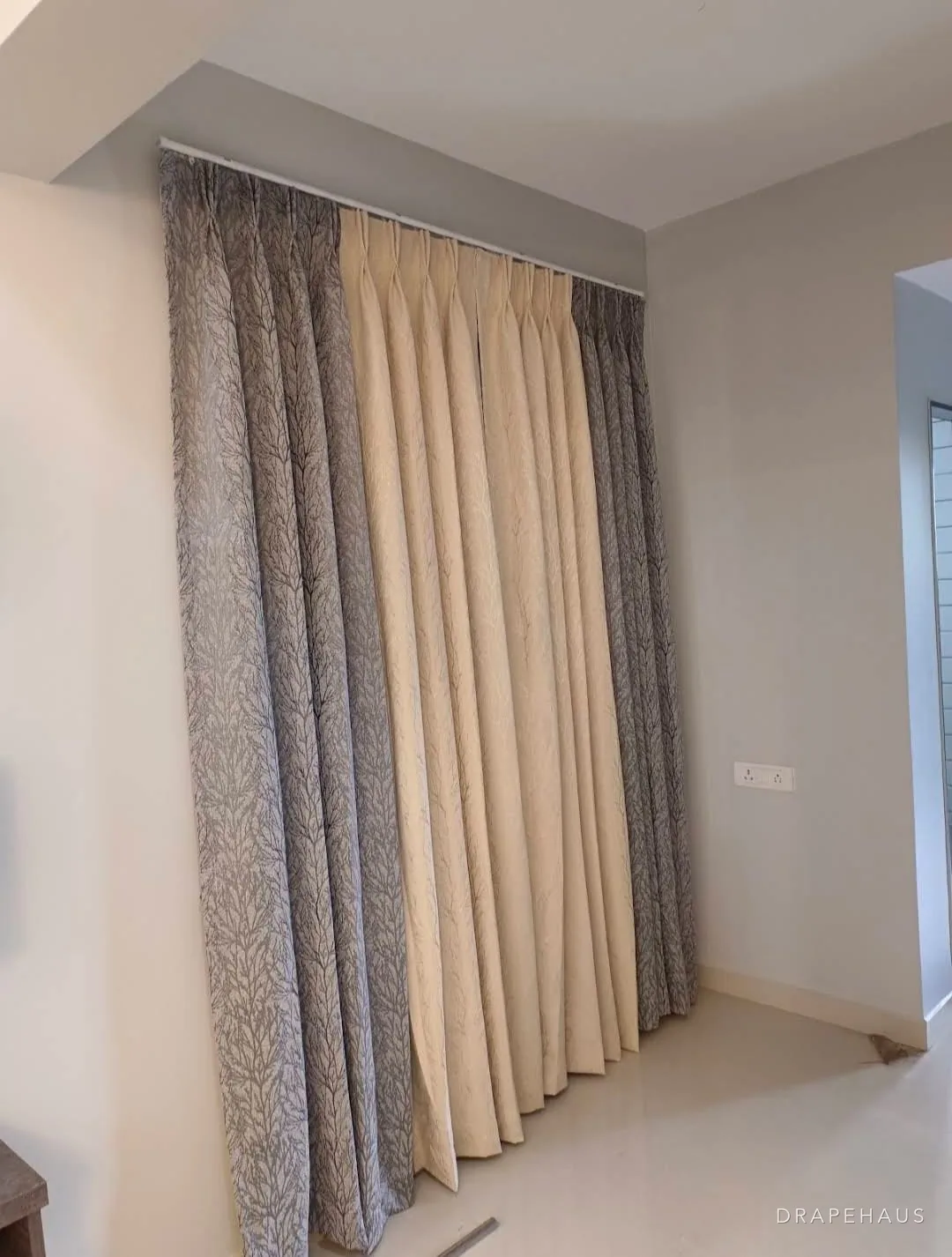
Small bedroom design is mostly arithmetic. In a Goan flat, the second bedroom is often built close to the legal minimum: the state's building regulations set a habitable room at no less than 10 m² of carpet area, no narrower than 2.5 m, and at least 2.80 m from floor to ceiling. Into that space go a bed, a wardrobe, a window and a door, and in many rooms they all want the same wall. The ideas that work are the ones that win back centimetres on the floor and add height on the walls.
This guide works through a typical small room with real numbers: where the bed can go and how much walking space is left, why ceiling-mounted curtains make the room taller, which blinds suit a window behind the bed or a desk, how to keep a wardrobe dry on an outside wall, and why a small bedroom with the door and window shut needs more fresh air than people think.
Every measurement below is either from a published source or shown as a sum you can redo with your own tape measure. Made-to-measure pieces, from a bedroom blind to a headboard, can be sized to whatever your room turns out to be.
How small is a small bedroom? The Goan minimum, in numbers
The Goa Land Development and Building Construction Regulations, 2010, in the consolidated text to September 2018, set the floor for every habitable room: a carpet area of at least 10 m², a width of at least 2.5 m, and a height of at least 2.80 m to the underside of the slab or ceiling. Every habitable room also needs windows or similar openings of at least one tenth of its carpet area, so a 10 m² room may have as little as 1 m² of window, frames included. Later amendments exist, so treat these as the published baseline and confirm the current text with an architect if it matters.
That gives a useful worked example. A room 2.5 m wide and 4.0 m long is exactly 10 m². It is narrow, it may have one small window, and it has a ceiling high enough to use. Those three facts point to most of the ideas that follow: plan the floor in centimetres, treat the small window carefully, and use the height.
| Rule | Minimum | What it means in a small bedroom |
|---|---|---|
| Carpet area | 10.00 m² | For example 2.5 m × 4.0 m, or 3.0 m × 3.35 m |
| Width | 2.50 m | A double bed across the width leaves little or no walking space |
| Height | 2.80 m | Room for full-height curtains and a properly mounted fan |
| Window area | 1/10 of carpet area | As little as 1 m² of window in a 10 m² room |
Fitting the bed: walkways and the wall it goes against
A University of Arkansas interior-design guide gives three clearances worth using as a reference: at least 30 inches (about 76 cm) for a route people walk along, 36 inches (about 91 cm) at doorways so people can pass, and 36 inches or more in front of drawer units so drawers can open and someone can stand at them. They are not Indian rules, but they are a good test of whether a layout will feel cramped.
Now the sums. Say the bed is 150 cm wide; measure your own. In a room 250 cm wide, a bed placed across the width with its head against one long wall leaves 250 − 150 = 100 cm to share between the two sides: 76 cm on one side leaves just 24 cm on the other, not enough to walk. So in a 2.5 m room the bed usually goes with one long side against a wall, and the 76 cm walkway runs down the other side and across the foot. Turn the bed the other way, along the 4 m length, and the head and foot use around 200 cm of that length, leaving the rest for the wardrobe zone.
The wardrobe then needs its own clearance. If it is 60 cm deep, a figure to check against your carpenter's drawing, and has drawers, the Arkansas guide suggests 91 cm in front of it: 60 + 91 = 151 cm of the room's width given to storage and the space to use it. In a 250 cm room that leaves 99 cm, which is why so many small Goan bedrooms put the wardrobe on the short wall at the foot of the bed rather than along the side. Draw it on squared paper before anything is built.
Measure the bed, the wardrobe depth and the door swing before choosing anything. In a 2.5 m room, a few centimetres decide whether a layout works.
Planning something like this?
We visit homes across North and South Goa, measure on site, and bring samples to see in your own light.
Curtains at ceiling height make the room taller
Goa's 2.80 m minimum ceiling is generous, and most small bedrooms waste it. A rod fixed just above a small window draws a horizontal line partway up the wall, and the eye reads the room as only that tall. A track fixed to the ceiling, with the curtain falling to just clear the floor, does the opposite: the fabric runs the full height of the wall and the room reads as tall as it really is.
The sum makes the difference plain. Say the window head is at 2.10 m and a rod sits 15 cm above it, at 2.25 m. A curtain from there to the floor is about 2.24 m long, and above it there are 55 cm of bare wall. Move the track to a 2.80 m ceiling and the curtain is about 2.79 m long: the same window now carries more than half a metre of extra fabric height, and the top of the wall is no longer cut off. A ceiling curtain track also stops light spilling over the top of the curtain, which matters in a bedroom that faces the morning sun.
Two more height tricks cost little. Match the curtain to the wall colour, or just a shade deeper, so the fabric reads as part of the wall rather than a block in front of it. And let the curtain run wider than the window, so it stacks on the wall rather than across the small glass and the room keeps every bit of its daylight.
Blinds for windows behind the bed or the desk
In a narrow room, the window often ends up directly behind the headboard or above a desk. A floor-length curtain there gets trapped behind the bed and never draws properly. That is the place for a blind, fitted inside the window recess or tight above it, so the bed or the desk can sit close to the wall.
For sleep, a blackout roller is the simplest choice, and fitted outside the recess with an overlap at each side it leaks less light round the edges. For a window over a desk, a zebra blind or a light-filtering roller lets you cut glare on a screen while keeping daylight. A roman blind gives a softer, curtain-like look where you want fabric but have no floor space for it. Our blackout blinds cover the darkest options, and the bedroom blinds guide linked above deals with fitting on the aluminium sliding windows found in most Goan flats.
You can have both: a blind on the window behind the bed for darkness, and a ceiling-height curtain on the other wall's window for height and softness. That combination often suits a small room better than trying to make one treatment do everything.
Pale colours, a reflective ceiling and placing a mirror
Colour is the least costly space-maker there is. The University of Kentucky's extension guide notes that light colours and white expand a space so a room appears larger, that dark colours enclose it, that cool colours such as blues and greens seem to move away and can make a small room seem larger, and that light ceilings reflect more light. It also suggests painting woodwork the same colour as the walls to tie them together. In a small Goan bedroom, that means pale walls, a white ceiling, door and window frames in the wall colour, and a light rug.
Pattern follows the same logic. The same guide notes that small designs make a room seem larger and large designs smaller, so a big bold print belongs on a cushion or the bedspread, not across the whole bed wall. Our article on bedroom wall design covers the wall behind the bed in detail.
A mirror doubles the light from a small window, but in Goa there is a catch. Building guidance from the US Department of Energy's Pacific Northwest National Laboratory classes mirrors with vinyl wallpaper as vapour-proof finishes, warns against attaching them to the inside of outside walls in warm, humid climates, and notes that they may be used if mounted on clips or spacers that let air circulate behind them. In an air-conditioned bedroom, mount a large mirror on an inside wall, or on spacers on an outside one, never glued flat.
Storage beds, wall lights and a wardrobe that stays dry
Storage beds and wall-mounted lights both free floor space. A bed with drawers or a lift-up base replaces a chest of drawers, and two wall lights replace two bedside lamps, so bedside tables can shrink to a narrow shelf. In a humid climate, give storage beds the same care as any closed box: put only clean, fully dry linen inside, leave the base open to air on dry days, and check its corners in the monsoon.
The wardrobe is the bigger risk. In many flats it stands on an outside wall, which stays cool and damp through the rains. The US Environmental Protection Agency notes that mould is frequently found on walls in cold corners behind furniture, where condensation forms. Leave a gap of a few centimetres behind a freestanding wardrobe, use ventilated or louvred shutters where you can, and run a dehumidifier or the air conditioner's dry mode with the room closed on the wettest weeks. Our guide to wardrobe design for humidity goes through shutters, board and internal layout.
Fabric in a small room needs the same thinking. The American Lung Association notes that dust mites live in bedding, mattresses, upholstered furniture, carpets and curtains, draw moisture from the air, and are best controlled by keeping humidity below 50%. In a compact bedroom, keep the textiles washable and few: one rug that can be lifted, one set of curtains, bedding washed weekly.
Fresh air and the right fan for a small, stuffy room
Small bedrooms get stuffy fast because there is so little air in them for one or two sleepers. A field study at the Technical University of Denmark measured it in single student rooms: with the window shut, bedroom carbon dioxide averaged 2,585 ppm through the night; with it open, 660 ppm. When the air was fresher, measured sleep quality, next-day concentration and performance on a test of logical thinking all improved. A split air conditioner cools and dries the air it recirculates but does not, by itself, bring fresh air in.
In a Goan flat the answer is usually a window that can stay open safely: a sliding window net so it can be left ajar at night, the bedroom door left open where privacy allows, and, in the monsoon, an hour of open window on dry mornings. Goa's regulations themselves provide for cross-ventilation in at least one habitable room of a dwelling, through windows or ventilators on opposite or adjacent walls, a reminder that air needs a way through, not just a way in.
Fan size matters more in a small room than people expect. ENERGY STAR's guidance, citing the American Lighting Association, suggests blades of 36–42 inches (about 91–107 cm) for rooms of 76–144 sq ft, roughly 7–13.4 m², which covers most small bedrooms, and 29–36 inches for rooms up to 75 sq ft. It advises mounting a fan in the middle of the room, at least 7 feet (2.13 m) above the floor and 18 inches (46 cm) from the walls. In a 2.5 m wide room with a centred fan of 107 cm, the blade tips sit (250 − 107) ÷ 2 ≈ 72 cm from each wall, comfortably clear of a curtain on a ceiling track.
| Room area | Suggested blade span | Typical Goan room |
|---|---|---|
| Up to 7 m² (75 sq ft) | 74–91 cm (29–36 in) | Study or very small bedroom |
| 7–13.4 m² (76–144 sq ft) | 91–107 cm (36–42 in) | Most second bedrooms in flats |
| 13.4–20.9 m² (144–225 sq ft) | 112 cm (44 in) | Main bedroom |
| 20.9–37.2 m² (225–400 sq ft) | 127–137 cm (50–54 in) | Large living room or villa bedroom |