 Drape Haus
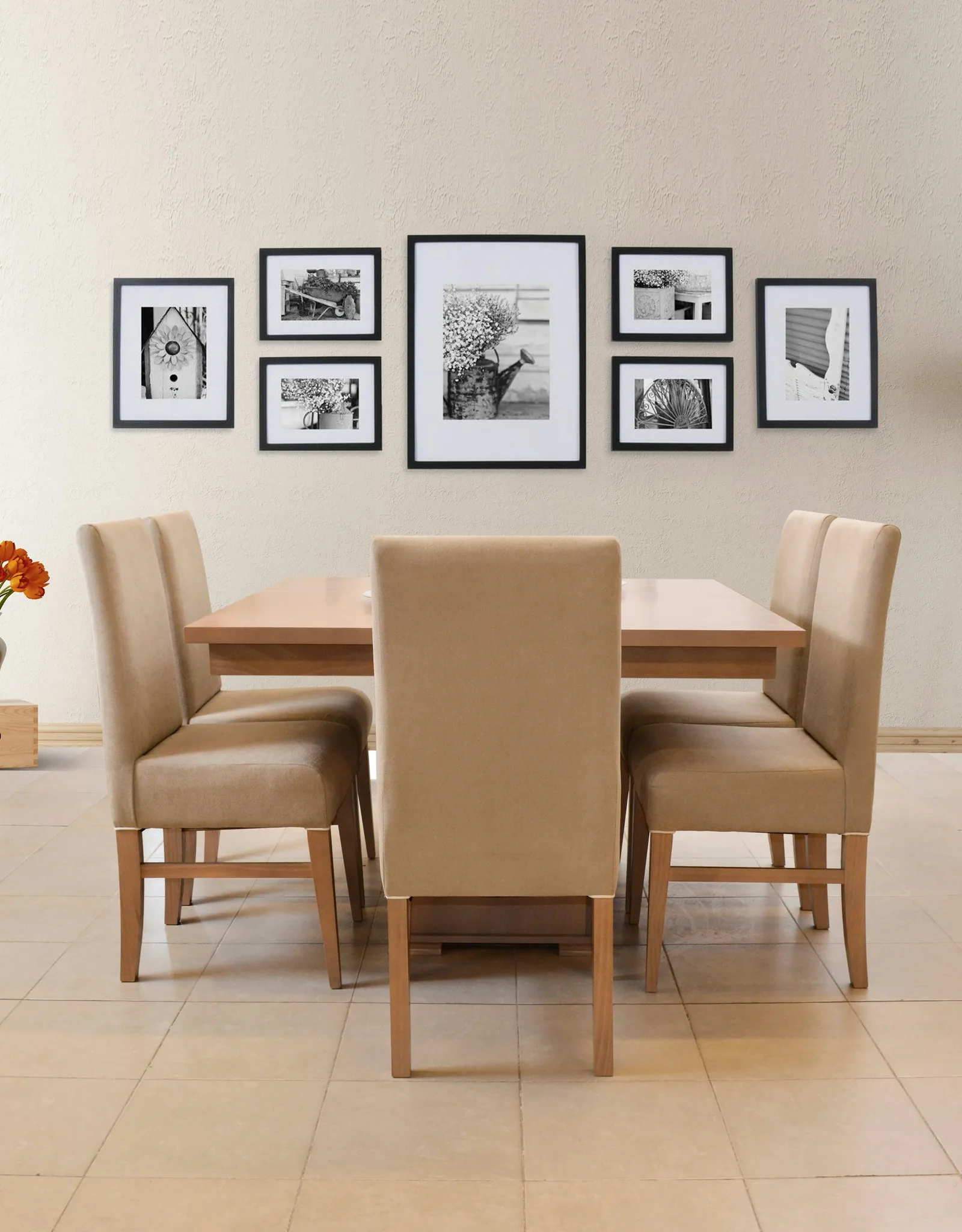
Dining room wall decor has to do two jobs that pull in different directions. It is the backdrop to the longest sitting of the day, looked at from a chair for an hour or more, so it should be worth looking at. And it sits within reach of curry, oil, wine and small hands, so it should forgive a splash. The best ideas manage both.
In Goa there are good traditions to draw on: blue-and-white azulejo tiles, plates on the wall, family photographs, a carved sideboard beneath a mirror. There is also the climate to respect. Walls next to the kitchen collect steam and oily air, monsoon damp finds external walls, and a dining room in a house closed for the season is one of the first to show mould.
This guide works through the main ideas, wallpaper, panelling, plates and tiles, mirrors, paint and lighting, with a practical eye on cleaning. For room-specific product choices, see our dining room wallpaper and dining room wall panels pages.
Start with what the dining wall has to survive
Watch a long family lunch and you will see where the wall takes punishment. Serving spoons flick gravy sideways. Children lean back and put a hand on the wall. Chair backs tap it every time someone stands. Near a kitchen door or serving hatch, steam and oily air drift out with every dish, and over a monsoon that leaves a faint film on everything within a metre or two.
So divide the wall in your head. The band from the floor to just above chair-back height is the working zone, and wants a surface that can be wiped hard. The zone above, at eye level for seated diners, is where decoration belongs: paper, art, plates, tiles or a mirror. The ceiling and the wall above the pendant are mostly about light. Once the zones are clear, most decisions follow.
Check the wall itself too. An external dining-room wall facing the monsoon, or one with a bathroom or sink behind it, needs a moisture check before any wallpaper or panel goes on. Our guide to fungus on walls explains the warning signs, and the best wallpaper for humid walls covers which papers suit which wall.
Wallpaper feature walls that survive the occasional splash
The label tells you how cleanable a wallpaper is. Under the European symbols set out in EN 235, which the German wallpaper industry's institute explains, papers are graded from water-resistant during hanging, where only fresh paste can be dabbed off, through washable and highly washable, to scrub-resistant, where water-soluble dirt can be removed with mild soapy water or a mild scouring agent and a sponge or soft brush, and finally highly scrub-resistant. The American trade uses the same idea: washable means cleanable with a sponge, mild detergent and water, and scrubbable means it withstands a brush. For a dining wall within splash range, choose the scrubbable grades.
Even the toughest grade has limits. The institute notes that highly washable surfaces shift most dirt except oils and fats. Turmeric and oil are the hard ones in an Indian kitchen, so test before you buy: ask for an offcut, smear it with a little curry, leave it an hour, then wipe it as the label allows. Darker and mid-tone patterned papers hide what is left far better than pale plains.
Placement does the rest. Paper the wall diners face rather than the wall behind their chairs, and keep it off the wall beside the kitchen door. University of Kentucky extension guidance suggests that dining rooms, which are not occupied for long stretches, can take more outstanding patterns than living rooms. In a Goan house where Sunday lunch lasts the afternoon, that is worth tempering: a bold botanical on the wall facing the window often works better than one surrounding the table on every side.
Planning something like this?
We visit homes across North and South Goa, measure on site, and bring samples to see in your own light.
Panelling and wainscoting at chair height
A chair rail is exactly what its name says: a moulding fixed at the height where chair backs strike the wall, so they hit wood instead of plaster. Panelling below it, often called wainscoting or a dado, protects the whole working zone. University of Kentucky guidance suggests wallpaper above chair-rail moulding as one way to give a dining room special impact, which also lets you use a more delicate paper, since nothing touches it.
Set the rail by your own chairs, not by a rule. Pull a chair back from the table as someone would to stand up, and mark where its top rail meets the wall; the chair rail should sit at or a little above that mark. Dining chairs vary a lot, from low cane chairs to high-backed upholstered ones, so measure the ones you have or are buying. If the chairs will change, err higher.
The panel material follows the wall. Painted timber or MDF suits a dry, air-conditioned dining room and gives the crispest classic look. Beside a kitchen, or on a wall that may take damp, PVC or WPC panels wipe clean and do not swell. Applied moulding boxes painted the same colour as the wall give the look of panelling with very little thickness. Our wall moulding page shows the profiles, and the dining room wall panels page covers which wall to panel.
Plates, azulejo tiles and family art in the Goan tradition
Blue-and-white tiles belong in a Goan dining room. The Asia InCH craft encyclopedia, published by the Craft Revival Trust, records that glazed, painted azulejo tiles can be seen across old churches and homes in Goa, that they were introduced in Portuguese times, and that their production continues today. Old tiles can be seen at the Menezes Braganza hall in Panjim, painted by Jorge Colaço. The craft encyclopedia describes the process: a clay tile is fired at about 1,200 °C, glazed and painted with ceramic colours, then fired again at about 1,200 °C to fuse the pigment with the tile.
That firing is what makes tiles so practical in a dining room. The colour sits in a fused glaze, so a tile panel behind a sideboard or a serving counter wipes clean like any glazed surface, and it does not fade in sun. A single panel of a few tiles framed in timber, a band at chair-rail height, or a splashback behind a buffet all bring the tradition in without turning the room into a kitchen. Our article on Goan home decor ideas looks at the wider palette, and the one on Goan house name plates at how tiles are painted and fixed.
Plates on the wall are the other old habit, and an easy one to do well. Lay the plates out on the floor first, or cut paper templates and tape them up, until the group looks balanced; an odd number around a larger central plate is the simplest arrangement. Use plate hangers sized to each plate, with coated claws that do not scratch the rim, and fix into the masonry with proper plugs rather than relying on a nail in lime plaster. Family photographs and paper art need more care: keep them out of direct sun, away from the kitchen door, and off external walls in the monsoon, and leave a little air gap behind each frame so damp does not settle against the back.
Mirrors that double the light in a narrow dining room
Many Goan dining rooms are long and narrow, a passage between the hall and the kitchen with a table down the middle. A large mirror on one long wall makes the room feel twice as wide and throws window light deep into the room. Place it where it reflects something worth seeing, a window, the garden, the pendant over the table, rather than the kitchen door. A mirror above a sideboard is the classic position, and it puts the glass safely above the splash zone.
Colour can help a narrow room too. University of Kentucky guidance notes that light colours expand space while dark colours enclose it, and that a warm or dark covering on the long walls with a light or cool covering on the short walls tends to square up a long, narrow room. A mirror on a long wall painted a light colour does both jobs at once.
Fix mirrors with air behind them, especially on external walls of air-conditioned rooms. US building guidance from the Pacific Northwest National Laboratory, written for warm, humid climates, lists mirrors with vinyl wallpaper as low-permeability finishes that should not be attached flat to the inside of exterior walls, and allows them where they are mounted with clips or spacers that let air circulate behind. In a Goan dining room that means mirror clips or a framed mirror on hooks, not a sheet of glass glued to the plaster.
Wipeable paints and finishes for walls near the table
Paint sheen is the smallest decision with the biggest effect on cleaning. The US federal painting specification uses the Master Painters Institute's gloss levels, from G1, flat, through velvet, eggshell, satin and semi-gloss, to G7, high gloss, and notes that flat traditionally means G1 or G2, eggshell G3, semi-gloss G5 and gloss G6. As a general rule, the higher the sheen, the easier a paint is to wipe, while lower sheens hide uneven plaster better.
The trade-off is glare and flaws. University of Kentucky guidance notes that a glossy surface produces more glare than a matte one, and on the uneven lime plaster of an older Goan house a semi-gloss wall shows every ripple in raking light. That is why the middle of the scale, eggshell or satin, is the usual choice for dining walls: it wipes, and it is kind to old walls and to the eyes of people sitting under a pendant. Keep semi-gloss for the chair rail, the skirting and the door frames, which take the hardest wear.
Colour matters as much as sheen. Mid-tones and warm earth colours hide a faint splash that a brilliant white shows from across the room. Some matt paints are made to be washed; if you want the look of flat paint, ask specifically for one labelled washable or scrubbable, and test a patch with the same curry smear you used on wallpaper.
| Gloss level | Name | Dining room use |
|---|---|---|
| G1–G2 | Flat or matt, velvet | Ceilings; walls well away from the table, unless labelled washable |
| G3 | Eggshell | Main walls; wipes and forgives uneven plaster |
| G4 | Satin | Walls near the table and the kitchen door |
| G5 | Semi-gloss | Chair rails, skirting, door frames |
| G6–G7 | Gloss, high gloss | Joinery details; shows every flaw on walls |
Pendant and wall lighting that flatters the table and the wall
The pendant belongs to the table, not the room. Centre it over the table even if the table is off-centre in the room, and hang it low enough to make a pool of light over the food but high enough that seated diners can see each other across it. Hold a cardboard disc of the same diameter at different heights while someone sits at the table, and fix the cable when nobody's view is blocked. A dimmer turns the same fitting from bright for a family lunch to soft for a late dinner.
Then light the wall you have decorated. A picture light over a group of plates or a painting, a pair of wall lights either side of a mirror, or a wall washer across wallpaper all make the dining wall part of the evening rather than a dark backdrop. Warm-coloured light flatters food, faces and the blues of azulejo alike. University of Kentucky guidance notes that colours appear darker and brighter on walls than elsewhere, so check paint and paper samples under your dining lights at night as well as in daylight.
Plan the wiring before any panel, tile or paper goes up, so wall lights and switches sit where the design needs them. Keep one lamp on the inverter or on batteries, because monsoon power cuts have a way of arriving during dinner. If you would like samples brought to your dining room and the wall checked for damp on the same visit, book a home visit and we will measure for a written quote.