 Drape Haus
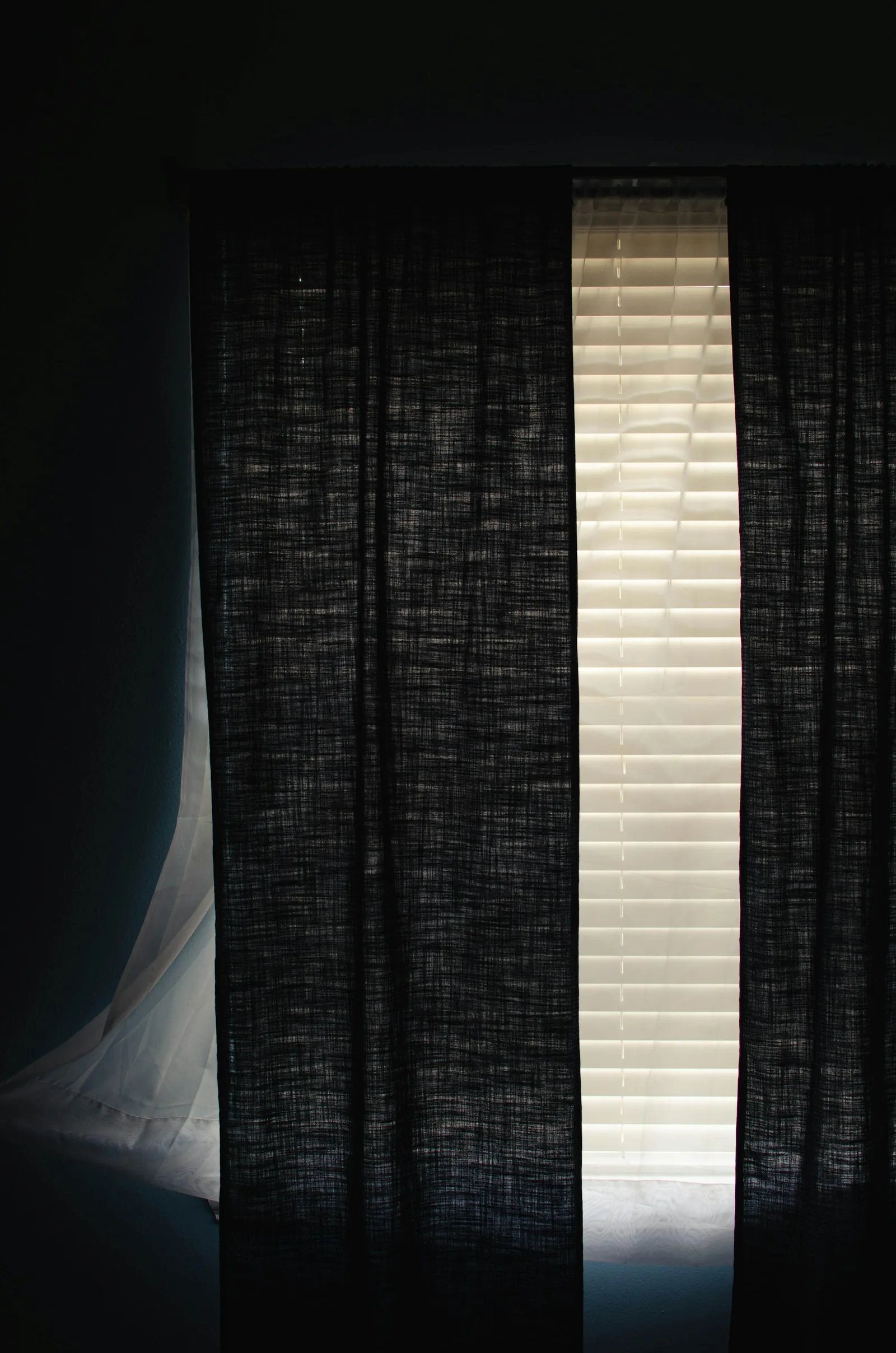
Blackout curtains for a bedroom only make the room dark when the light has nowhere to go round them. The lining itself blocks light almost completely. What lets a bedroom stay grey at dawn is the gap above the rod, the bright strips down each side, the line where the two curtains meet and the glow under the hem. Close those gaps and the same curtain makes a different room.
This matters most to the people who sleep when the sun is up: shift workers coming home after a night duty, parents settling young children in bright evenings, anyone in an east-facing room who wakes at six whether they want to or not. The NHS lists a dark, quiet, cool room among its tips for better sleep, and suggests fully closing curtains and using an eye mask if light is still a problem. Training material for night-shift workers from the US National Institute for Occupational Safety and Health puts it simply: a very dark bedroom facilitates sleep.
Below is how to close each gap, how to choose between blackout fabric and a blackout lining in a humid climate, when to add a blind, and a step-by-step plan for getting a bedroom properly dark. Our blackout curtains page shows the fabrics and linings we make up, and the blackout curtain simulator lets you try them on a photo of your own window.
Who needs a truly dark bedroom, and why
Morning light is a powerful signal to the body. The NIOSH training for nurses on shift work explains that morning light striking the eye sets off a chain of reactions that start the body's daytime alerting processes, and that the blue part of daylight has the strongest effect. For someone trying to sleep at nine in the morning after a night shift, that is the problem. The same material advises a very dark bedroom, and suggests a dim red nightlight and a clear path to the bathroom so that getting up in the dark is safe.
For everyone else, NHS advice is consistent: it lists a room that's too hot or cold and noise among common causes of insomnia, and recommends a dark and quiet bedroom, using curtains, blinds, an eye mask or ear plugs if needed. A blackout curtain is the most comfortable way to do that every night.
Babies are a little different. The NHS suggests teaching a baby that night-time is different from daytime by opening curtains during the day and keeping lights low at night. A blackout curtain still helps with evening bedtimes and early summer dawns, but there is no need to keep a nursery dark all day. Choose a curtain that opens fully and easily, so daytime can be bright.
The five places light gets in
Stand in the bedroom at sunrise with the curtains closed and the lights off. Wait a minute for your eyes to adjust. Every line of light you can see is a gap, and almost every one is at an edge of the curtain, not in the middle of it. The table below lists where they come from and what closes each one.
Through the fabric itself is the fifth route, and the least common with a proper blackout lining. It shows as pinpricks along stitch lines, a faint glow through a worn or cracked coating, or light through eyelet holes. Lock-stitched hems, a lining that is not pierced by the heading tape, and replacing old linings when the coating starts to crack all help.
| Leak | Usual cause | Fix |
|---|---|---|
| Over the top | Rod or track fixed just above the frame | Ceiling-fixed track, or a pelmet or box over the track |
| Down the sides | Curtain ends level with the window frame | Track extended past the frame, curtains returned to the wall |
| Through the centre | Two curtains meeting edge to edge | Overlap arms on the track so the leading edges cross |
| Under the hem | Curtain stops at the sill or well above the floor | Floor-length curtain finished just clear of the floor |
| Through the fabric | Pinholes at stitching, eyelets, worn coating | Lock-stitched hems, a separate lining, renew old linings |
Planning something like this?
We visit homes across North and South Goa, measure on site, and bring samples to see in your own light.
Sides: returns and wrap-around rods
Side leaks are the most common and the easiest to prevent. First, the track or rod should run well past the frame on each side, typically 15 to 20 centimetres or more, so that the closed curtain overlaps the wall rather than ending at the window's edge. This also gives the curtains somewhere to stack when open, so they do not cover the glass by day.
Second, the curtain should turn back to the wall at each end. This is called a return. On a track, the end of the curtain is hooked to a fixing on the wall or to the bracket, so the fabric wraps round the end of the track and closes the gap between curtain and wall. On a pole, a wrap-around or 'return' rod curves back to the wall at each end and does the same job. The US Department of Energy's advice on fitting draperies, written for keeping heat in, describes the same principle: seal the drapery at both sides, even using hook-and-loop or magnetic tape to hold the edges to the wall.
In a bedroom with a wardrobe or a wall close beside the window, there may be no room for a long extension. A curtain that is wider than the window plus a return still works; where even that is impossible, a blind fitted outside the recess behind the curtain takes over at the sides.
Top: pelmets and ceiling tracks
Light over the top is the leak people notice first, because it shines straight onto the ceiling. A rod fixed a few centimetres above the frame always leaves a bright band, since the curtain hangs slightly forward of the wall and light escapes behind it. The two fixes are to take the curtain to the ceiling or to cover the top.
A ceiling curtain track fixed directly to the ceiling leaves nothing above the curtain for light to pass through. It suits most Goan bedrooms, including flats where there is little wall between the top of the window and the ceiling. In a villa with a false ceiling, a recessed pocket can hide the track completely. Where the ceiling is too high or the slab cannot be drilled, a pelmet or a fabric-covered box over a wall-fixed track does the same job and can be painted to match the wall.
The Department of Energy recommends the same for its own reasons: a cornice at the top of a drapery, or placing the drapery against the ceiling. A closed top also stops the warm air behind a sun-facing curtain from spilling into the room, which is why it helps with heat as well as light.
Centre and hem: overlaps and floor clearance
Where two curtains meet in the middle, they rarely meet perfectly. Over time the leading edges drift apart a little, and a vertical line of light appears. On a good track, overlap arms carry the two leading edges past each other so they cross by several centimetres when closed. On a pole, the same effect comes from the last ring on one side sitting beyond the centre. A single curtain that draws one way across the whole window avoids the centre gap altogether, if there is wall space for it to stack on one side.
At the bottom, a curtain that stops at the sill lets light bounce off the sill and onto the ceiling. A floor-length curtain finished about a centimetre above the floor blocks it. Letting the curtain pool on the floor blocks a little more light but collects dust, gets wet when the floor is mopped and, in the monsoon, wicks moisture into the hem, so we do not recommend it in Goa.
There is a balance to keep in humid months. The Building America Solution Center, discussing condensation behind interior shades, suggests leaving the bottom of a shade about a centimetre off the sill to let some air move along the glass. A small gap at the hem does the same for a curtain and costs almost nothing in darkness.
Stop the hem about a centimetre above the floor: dark enough for sleep, clear of mop water and monsoon damp.
Blackout fabric or blackout lining, in a humid house
There are two common ways to make a blackout curtain. One uses a blackout fabric, a single cloth with an opaque coating, often foam, on the back, made up on its own. The other sews a separate blackout lining behind a normal face fabric. Both stop light. They behave differently over years in a humid, sunny climate.
A separate lining has three advantages. You can use any face fabric you like, from linen to velvet. The lining takes the sun, so the face fabric fades far less. And when the coating on a lining eventually ages, which coatings do with years of sun, heat and washing, the lining can be replaced without remaking the curtain. A detachable lining, hooked onto the same track as the curtain, can also be taken off and washed separately.
Coated blackout fabric is lighter and costs less to make up, and it suits rentals and children's rooms where a simple, washable curtain is the goal. Its drawbacks are fewer face fabric choices and the fact that when the coating wears, the whole curtain has to go. In the monsoon, the US Environmental Protection Agency's advice for preventing mould applies to both: keep humidity below about 60%, dry anything damp within 24 to 48 hours, and do not leave fabric pressed against a wet window for days. Our blackout linings guide compares the constructions in detail.
A blackout blind behind the curtain for the darkest room
For the darkest result, combine two layers. A blackout roller blind fitted inside the window recess, close to the glass, blocks most of the light at the window itself. A blackout curtain in front, on a ceiling track with returns, catches what escapes round the blind's edges. Between them, very little light reaches the room.
The blind can be fitted with side channels, slim tracks that hold the fabric's edges, for an even tighter seal, though they suit some window frames better than others. In flats with aluminium sliding windows, check the depth of the recess and the handles before choosing an inside fit. Our blackout blinds and the bedroom blinds page explain the options.
Two layers also make sense for comfort. The blind does the hard work against the sun and can stay down on hot afternoons; the curtain softens the room and handles privacy in the evening. If the curtains are on a high window or need to open and close at set times, a motorised track can close both at dusk and open the curtain a few minutes before your alarm.
How to get a bedroom properly dark, step by step
For a new blackout curtain, or to improve one you already have.
Find the leaks
At sunrise, with the curtains closed and lights off, wait a minute for your eyes to adjust and note every line of light: top, sides, centre, hem or through the fabric.
Raise the track
Fix the track to the ceiling, or as close to it as possible, or add a pelmet over the existing track so no light passes over the top.
Widen it
Extend the track 15 to 20 centimetres or more past each side of the frame, so the closed curtain overlaps the wall.
Add returns and overlaps
Turn each end of the curtain back to the wall and fit overlap arms so the two leading edges cross in the centre.
Set the hem
Make the curtain floor-length and finish it about a centimetre above the floor, not at the sill and not pooling.
Choose the lining
Use a blackout lining, ideally separate from the face fabric so it can be replaced, with lock-stitched hems and no eyelets piercing it.
Add a blind if needed
For shift workers or very bright east-facing rooms, fit a blackout roller blind inside the recess behind the curtain.
Keep it fresh
Draw the curtains fully back on dry mornings in the monsoon, keep the fabric off wet glass and wipe condensation from the frame.