 Drape Haus
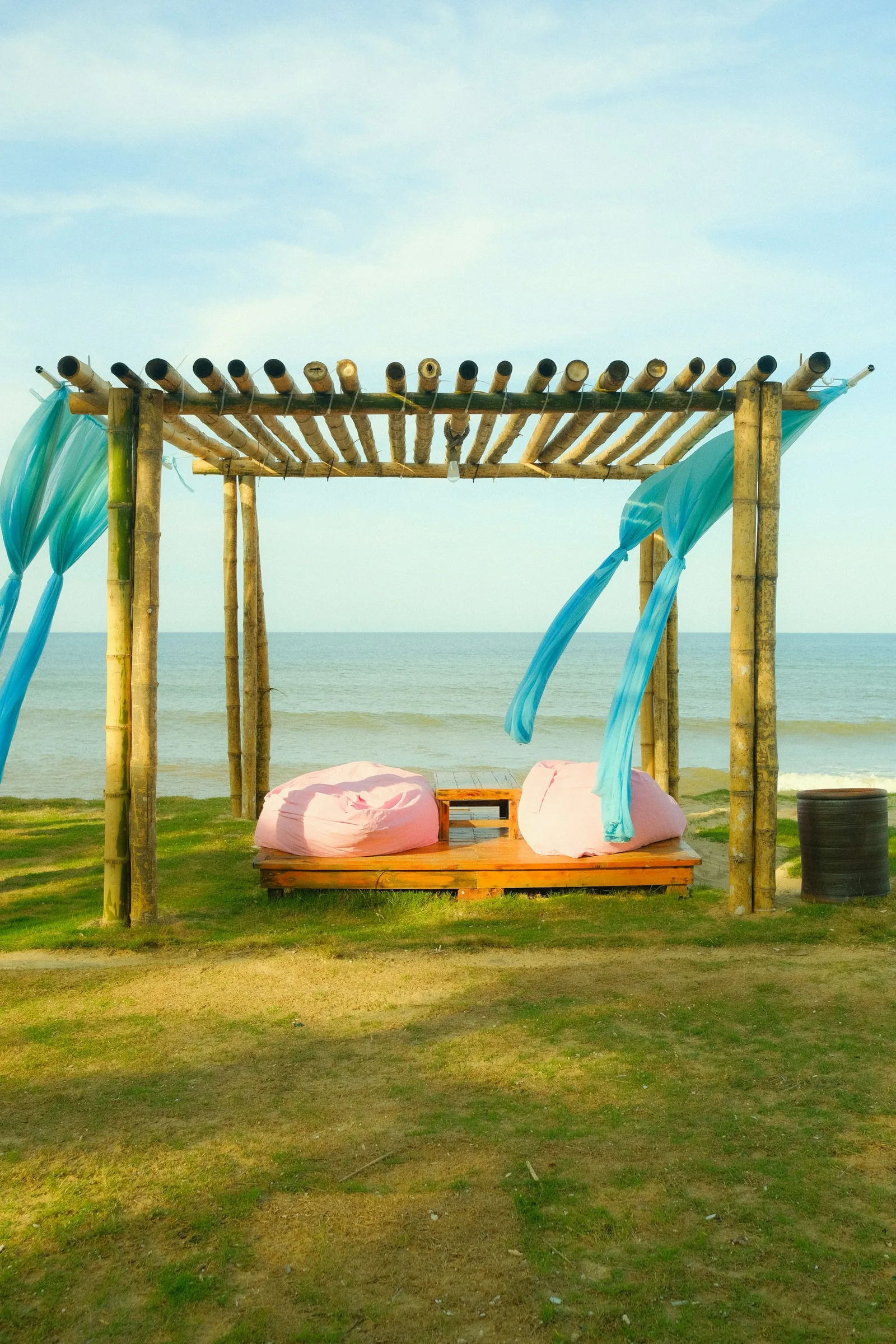
Good pergola design in Goa starts with a plain admission: the open timber or metal frame most people picture gives patterned light, not shade. Beams and rafters break up the sun, but at midday in April and May most of it still reaches the table. Real shade comes from what you put on top: a retractable fabric canopy, a fixed fabric roof, shade sails, slats set closely, or a climbing plant that has had years to grow.
The second admission is about the weather. Goa's monsoon sets in around the first week of June, and the India Meteorological Department records the most thunderstorms in May, June, September and October, sometimes with squalls. A fabric roof that is perfect from November to April has to be designed to come down, or retract, before those months. Planning for that is part of the design, not something to work out in the first storm.
This guide walks through the shade options for a garden, terrace or rooftop pergola, the fabrics behind each, how they behave in wind, and a simple plan for the pre-monsoon take-down. Drape Haus makes and fits the fabric side of this: canopies, blinds, sails and cushions. We do not build or engineer pergola structures, so where the frame or its fixings matter, we say so and point you to the right professional.
What a pergola can and cannot do in a Goan year
A pergola is a frame of posts and beams with an open roof of rafters or slats. Searches in India use the word for several quite different things: a garden or poolside frame over seating, a terrace or rooftop pergola on a flat roof, a pergola projecting from the front of a house, and decorative pergola beams added to an elevation mainly for looks. The shade question is different for each. A garden pergola can be orientated freely. A terrace pergola sits on a waterproofed roof slab, where every post and fixing is a question for the builder. A front pergola is often more about the look of the house than about shade.
Open rafters alone do some useful work. They break up direct sun, carry climbing plants, and give a frame to hang blinds and lighting from. What they do not do is keep rain off, and once a fabric roof is added they change from an open frame into something that catches wind. That shift is why this article spends as much time on wind and the monsoon as on looks.
It helps to decide early which months the pergola must work. For most Goan houses the honest answer is October or November through May, the dry season, with the pergola stripped back to its bare frame for the monsoon. A covered outdoor room that stays usable through the rains is a different project, closer to a roofed verandah, and it belongs with your architect or builder rather than with a fabric canopy.
Decide which months the pergola has to work before choosing the shade. Dry season only and all year are different designs.
Retractable pergola canopies and how they are operated
A retractable canopy is the most flexible answer for a dining or lounging pergola. The fabric runs in guides fixed along or between the pergola beams. Pulled closed, it makes a continuous roof; pushed back, it folds into soft pleats or rolls onto a tube at one end, and the sky is open again. The pleated type is usually called a waterfall or wave canopy, because the fabric hangs in loops between rods when it is drawn. The roll-up type sits in a cassette or under a small cover when retracted.
Operation is either manual, with a cord, pole or hand crank, or motorised, with a remote, a wall switch or a timer. Motors make sense on a large canopy or one above head height. On anything exposed, the most useful accessory is a wind sensor that retracts the canopy automatically when gusts pick up. Battery and solar motors avoid running cables across a terrace, and any motorised canopy should have a manual override for power cuts; our page on motorised window treatments covers the same choices for blinds.
Two design points decide whether a canopy lasts. First, it needs a fall, a slight slope from one end to the other, so that a shower runs off instead of pooling in the fabric. Water collecting in a sag stretches the cloth and loads the frame. Second, the guides must be fixed to a frame that is straight and strong enough to hold the tension. If the pergola is old, out of true or lightly built, have a builder or structural engineer look at it before a canopy is added.
Planning something like this?
We visit homes across North and South Goa, measure on site, and bring samples to see in your own light.
Shade sails: tension, twist and fixing points
A shade sail is a triangle or quadrilateral of fabric stretched between three or more fixing points, on posts, walls or a pergola frame. Sails suit irregular terraces and gardens, they read as light and modern, and they cast generous shade for the material used. They also look simple, and that is where most trouble starts.
A sail stays still in the wind because it is tensioned and curved. Four-cornered sails are usually set with two opposite corners high and two low, giving a saddle twist that stiffens the fabric and sheds rain. A flat, slack sail flaps, pools water and wears quickly at the corners. The US Centers for Disease Control and Prevention, in its shade planning guide for schools, puts it plainly: the structural integrity of a fabric structure depends on its curvature and positioning, structures must be designed for the wind they will meet, and their design and installation should be left to specialists.
That applies with force to fixing points. A tensioned sail pulls hard on every corner, and in a gust that load rises sharply. Fixing into a laterite wall, a parapet, an old timber beam or the edge of a waterproofed terrace slab is a decision for a builder or structural engineer, not for whoever hangs the fabric. The CDC guide also describes a school district that added extra poles after windstorms and now takes its sails down whenever a hurricane is forecast. Goa does not get hurricanes, but its pre-monsoon squalls are reason enough to plan sails that can be released quickly and stored.
Fixed fabric, slats, polycarbonate or plants
Not every pergola needs a moving canopy. A fixed fabric roof, laced or tensioned onto the frame, costs less to make and has fewer parts to fail, but it stays where it is, so it must come off for the monsoon and cannot be pulled back on a cool evening. Closely spaced timber or aluminium slats give permanent, partial shade and no rain protection; angled louvres do better, though fixed ones cannot be adjusted through the day. Neither needs taking down. Remember too that any roof, fabric or slatted, does little against low afternoon sun from the side; on a west-facing terrace, outdoor blinds dropped from the beam on that side do more for the evening table than a denser roof.
Solid roofs sit at the other end of the range. Polycarbonate sheet keeps rain off and lets light through; the CDC notes that polycarbonate panels can let in a great deal of light while blocking up to 99% of ultraviolet radiation. The trade-off is heat: a clear or light-coloured solid roof traps warm air under it unless the sides are open, and a solid roof on a terrace is a building alteration: ask your builder whether it needs approval, and let them build it.
Plants are the slow, cool option. The US Department of Energy notes that a trellis with climbing vines can shade a patio while still letting breezes through, and that shade and evapotranspiration from trees can lower surrounding air temperatures by as much as 6°F, about 3°C. A creeper takes seasons to fill a frame, it drops leaves and flowers, and the DOE cautions against dense foliage hard against the house, where it keeps walls damp. Many good pergolas combine a creeper with a light fabric canopy that can be drawn while it grows.
| Option | Shade | Rain | In the monsoon | Best for |
|---|---|---|---|---|
| Retractable fabric canopy | Full when drawn, none when open | Light showers if it has a fall | Retract; remove on exposed sites | Dining and lounging pergolas used daily |
| Fixed fabric roof | Full, all the time | Light showers if tensioned with a fall | Remove and store | Pergolas used mainly in the afternoon |
| Shade sails | Good, with gaps at the edges | Sheds some if twisted | Release and store | Irregular terraces and gardens |
| Slats or fixed louvres | Partial, changes with the sun | None | Stays up | Low-maintenance frames |
| Polycarbonate sheet | Light and UV control, little heat control | Keeps rain off | Stays up; a building job | Covered walkways and sit-outs |
| Climbing plants | Dappled to dense, after years | Little | Stays | Gardens with patience |
Choosing the fabric: acrylic canvas, coated polyester or shade mesh
Three families of fabric do almost all outdoor shade work. Woven acrylic canvas, normally solution-dyed so the colour runs through the fibre, gives full shade, a soft woven look and good fade resistance; it is the usual material for awnings and retractable canopies. Our guides to outdoor canvas and solution-dyed acrylic cover how it is made and cared for. PVC-coated polyester, either as a solid sheet or as an open mesh, is stiffer and more water-resistant; the mesh version is the one used in many outdoor blinds because it cuts glare while keeping the view.
Knitted polyethylene shade cloth is the material of most shade sails and commercial shade structures. It is light and lets hot air escape through the knit, and it is sold by how much sun it blocks. The CDC guide describes school canopies of polyethylene mesh that block 90% to 95% of the sun's ultraviolet rays while allowing heat to escape. It also gives a useful warning about lighter grades: loosely woven cloth that lets 50% to 80% of the sun through is designed for horticulture, and shade cloth blocking 80% of solar radiation gives roughly the protection of an SPF 6.7 sunscreen, against about SPF 15 for cloth blocking 94%. The CDC treats 94% as the minimum for school play areas.
Colour matters twice. The US Department of Energy advises that an awning fabric should be opaque and tightly woven, and that a light colour reflects more sunlight. Dark fabric under a strong sun gets hot and radiates that heat down onto the people beneath, but it does cut more glare. For a pergola over a dining table, mid to light tones are usually the comfortable middle. Near the sea, every thread, zip and fitting should also be chosen for salt air, as our guide to salt-air damage explains.
- Acrylic canvas: full shade, soft look, sheds light showers when tensioned with a fall; needs drying before it is rolled away
- PVC-coated polyester: water-resistant and easy to wipe; solid for shelter, mesh for view and airflow
- Polyethylene shade cloth: breathable, made for sails; check the stated block rating and choose a high one for seating
Wind, squalls and what fabric does in a storm
IMD's long-term figures for Panjim show modest average winds: about 9.4 km/h in May, rising to 12.8 km/h in July, when the monsoon wind blows from the west and south-west. Averages hide what matters to a canopy, which is the gust. IMD notes that thunderstorms in Goa peak in May, June, September and October, and that monsoon thunderstorms are sometimes accompanied by squalls. A fabric roof extended in one of those can lift, tear at its fixings or load the frame far beyond anything it carries on a still afternoon.
Fabric fails in predictable ways. A slack canopy flogs, snapping back and forth until seams and edges wear through. A flat roof without enough fall fills with rain, and the weight of the pocket stretches the cloth and bends the rails. A sail with a weak corner fixing loses that corner and then whips around the others. Every one of these is avoided in the same way: correct tension, a proper fall, fixings the builder has approved, and a habit of retracting or releasing the fabric before rough weather rather than during it.
For terraces and sea-facing roofs, which take the full force of the wind, a motor with a wind sensor is worth considering, because it retracts the canopy even when nobody is home. Otherwise, make retraction part of the evening routine from mid-May, and never leave a canopy drawn over an empty house. Our awnings and outdoor shade page explains how we specify sensors and retraction on exposed positions.
Retract before the weather turns, not during it. Most fabric damage happens because nobody was there to pull the canopy in.
Taking the fabric down before the monsoon
Because the monsoon usually sets in during the first week of June, aim to have canopies and sails down by the end of May, on a dry, calm day after a few days without rain. Fabric must go into storage completely dry: rolled or folded damp, acrylic and polyester will mildew and stain in a Goan store room within weeks. Brush off leaves and dust, rinse salt off coastal fabric with fresh water, and dry it fully in the sun before packing.
Store fabric loosely rolled on a tube or folded along existing creases, in a breathable cotton bag or wrap rather than sealed plastic, off the floor, in a dry room. Label every piece with its position, especially sails, whose corners are rarely interchangeable. While the fabric is down, it is a good time to check the frame: rust at the brackets, loose bolts, rot at the foot of timber posts, and the condition of the waterproofing around any posts on a terrace.
Rehang after the monsoon has withdrawn, which IMD puts at around the third week of September, and once October's thunderstorms have eased. Owners who are away for the season can hand the whole cycle over: our monsoon take-down and storage service takes fabric down before the rains, cleans and stores it, and puts it back up for the season. If you are planning shade for a new or existing pergola, book a site visit and we will look at the frame, the sun and the wind with you.