 Drape Haus
Porch design in India covers several different spaces, and it is worth being clear which one you have. Most searches mean the covered entrance at the front of a house: the steps, the sheltered area before the main door, and often somewhere to sit. Many also mean a car porch, the roofed parking bay attached to the front of the house. In an old Goan house the porch is the balcão, the raised entrance with its built-in seats, which has its own article in our guide to the Goan balcão.
Whichever it is, a Goan porch has a harder job than most rooms. From November to May it faces strong sun, with west-facing fronts catching the worst of the afternoon. From June to September it takes rain driven by monsoon winds that IMD records blowing mainly from the west and south-west. And it is the part of the house every visitor judges first.
This guide covers the decisions that make a porch work: depth and overhang, roll-down blinds for the monsoon, seating and cushions, lighting that draws fewer insects, floors that stay safe when wet, and how to echo older Goan details on a new house without parody. Drape Haus designs and makes the soft side, blinds, awnings, cushions and nets. The roof, columns and floor are for your architect or builder, and we say where.
Entrance porch, car porch or sit-out: decide what the porch is for
Before any styling, list what the porch must do. An entrance porch needs shelter at the door, room to put down shopping and take off shoes, and a clear, safe path from the gate. A sit-out porch needs depth for chairs, shade at the times you sit, and some privacy from the road. A car porch needs headroom and width for the car and a dry route from the car to the door. Many Goan houses ask one porch to do two or three of these, which is fine, as long as each job has its own space and the seating is not in the line of the front door.
Orientation decides a lot. A porch facing east is pleasant in the afternoon and needs little more than a deep roof. One facing west catches low afternoon sun under the roof for much of the year and, on the coast, the monsoon rain as well; this is the porch that most needs screens. A north- or south-facing porch is easier, but in Goa's monsoon, rain falls at a slant whichever way the house faces.
If the house is old, look closely at what is already there before adding to it. A Goan house front with its pillars, balustrades and seats is part of the character of the street. Our overview of Goan architecture describes the traditional forms, and they are worth reading before you change a facade.
Porch depth and roof overhang for both sun and rain
The roof is the porch. Its depth and how far it overhangs decide how much of the floor stays shaded and dry, and no blind, cushion or tile makes up for a roof that is too shallow. A deeper porch keeps sun off the back wall and the front door for more of the day, and keeps a larger part of the floor dry when rain blows in. The CDC's shade planning guide for schools makes the point for outdoor shelters generally: extend the eaves as far as possible, because if people under a structure can see the sky, they are still exposed to scattered sunlight.
There is no single right depth, because it depends on the height of the roof, the direction the porch faces and how the space will be used; a high roof over a shallow porch lets in far more slanting sun and rain than a low one. Ask your architect to check the sun angles for the afternoon months and the slant of monsoon rain on your particular front. Make sure the roof drains away from the steps and the door, with gutters and downpipes that discharge clear of the path.
On an existing porch that is too shallow, an awning or a fixed fabric valance on the open side extends the shade without rebuilding. The US Department of Energy reports that window awnings can reduce summer solar heat gain by up to 65% on south-facing and 77% on west-facing windows, figures measured for US homes but a fair indication of how much shading the front of a house can do. Awnings need ventilation so hot air is not trapped beneath them, and they need to be retracted for the monsoon. We specify them with that in mind for exposed fronts.
Get the roof right first. Blinds and awnings refine a porch, but they cannot rescue a roof that is too shallow.
Planning something like this?
We visit homes across North and South Goa, measure on site, and bring samples to see in your own light.
Roll-down blinds and screens for driving monsoon rain
The most useful addition to a Goan porch is usually a set of vertical outdoor blinds on the open sides. They drop from the beam or lintel to the floor and close the opening against low sun, slanting rain or the gaze of the lane, then roll up out of sight. Three materials cover most needs: PVC-coated polyester mesh, which cuts glare and heat while keeping the view and the breeze; solution-dyed acrylic canvas, which gives full shade and privacy; and clear PVC, which keeps rain off a seating area without hiding the garden.
Wind is what separates a good porch blind from a bad one. A blind that hangs free becomes a sail in a squall, slaps against pillars and tears at its fixings. Every outdoor blind should be held at the sides, by zip-edged side channels, tensioned cables or a bottom bar that hooks down, chosen by how exposed the opening is. The DOE notes that the openness of a solar screen sets the trade-off: more openness means more view and light, less protection from glare and heat. Our outdoor blinds page explains the options in detail.
Clear rain screens bring one more consideration. In direct sun, a closed PVC screen traps heat, and closed on all sides in the monsoon it can turn a porch into a damp, airless box. Leave a gap or an open side for air, roll screens up when the rain stops, and dry them before rolling. Our article on plastic rain curtains for balconies covers sheet thickness, fixings and ventilation in more depth, and the same rules apply to a porch.
Seating: built-in benches or loose chairs with outdoor cushions
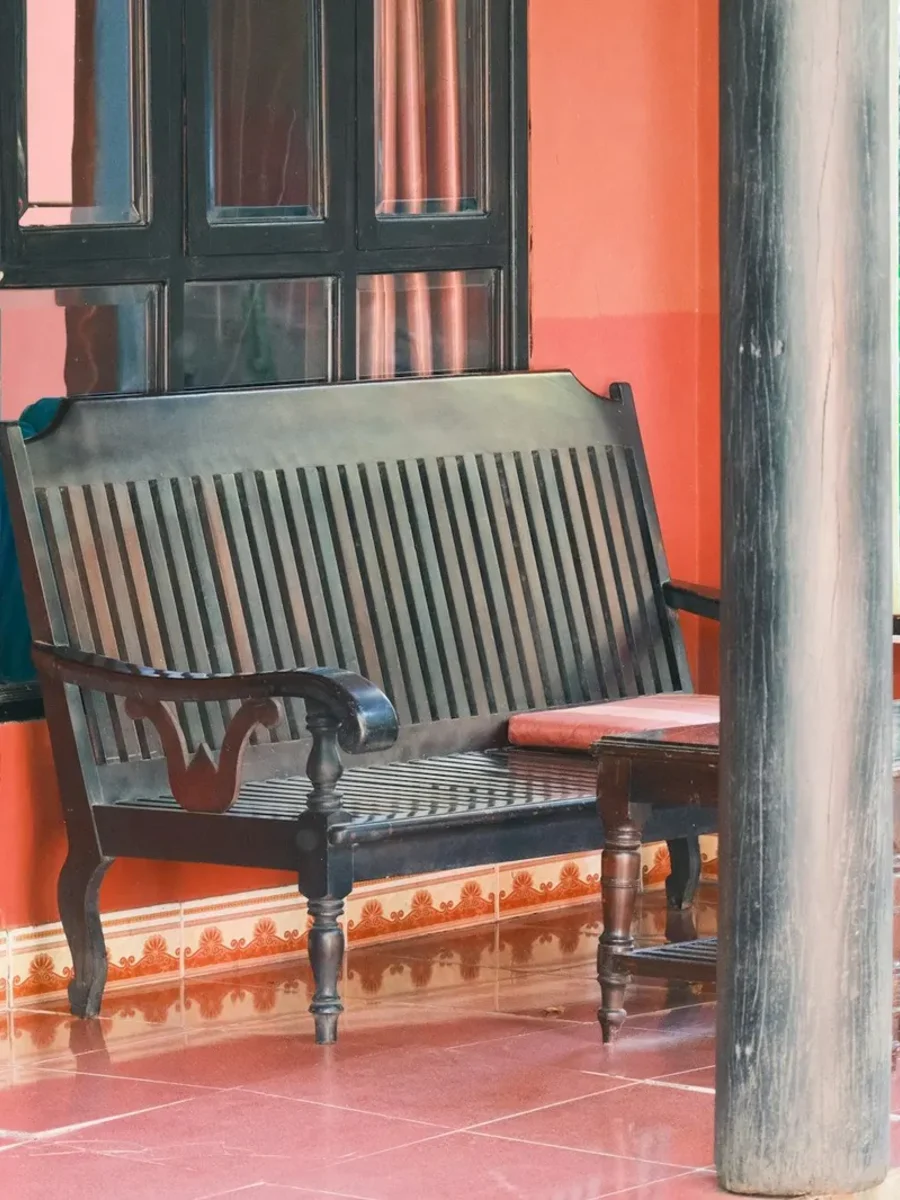
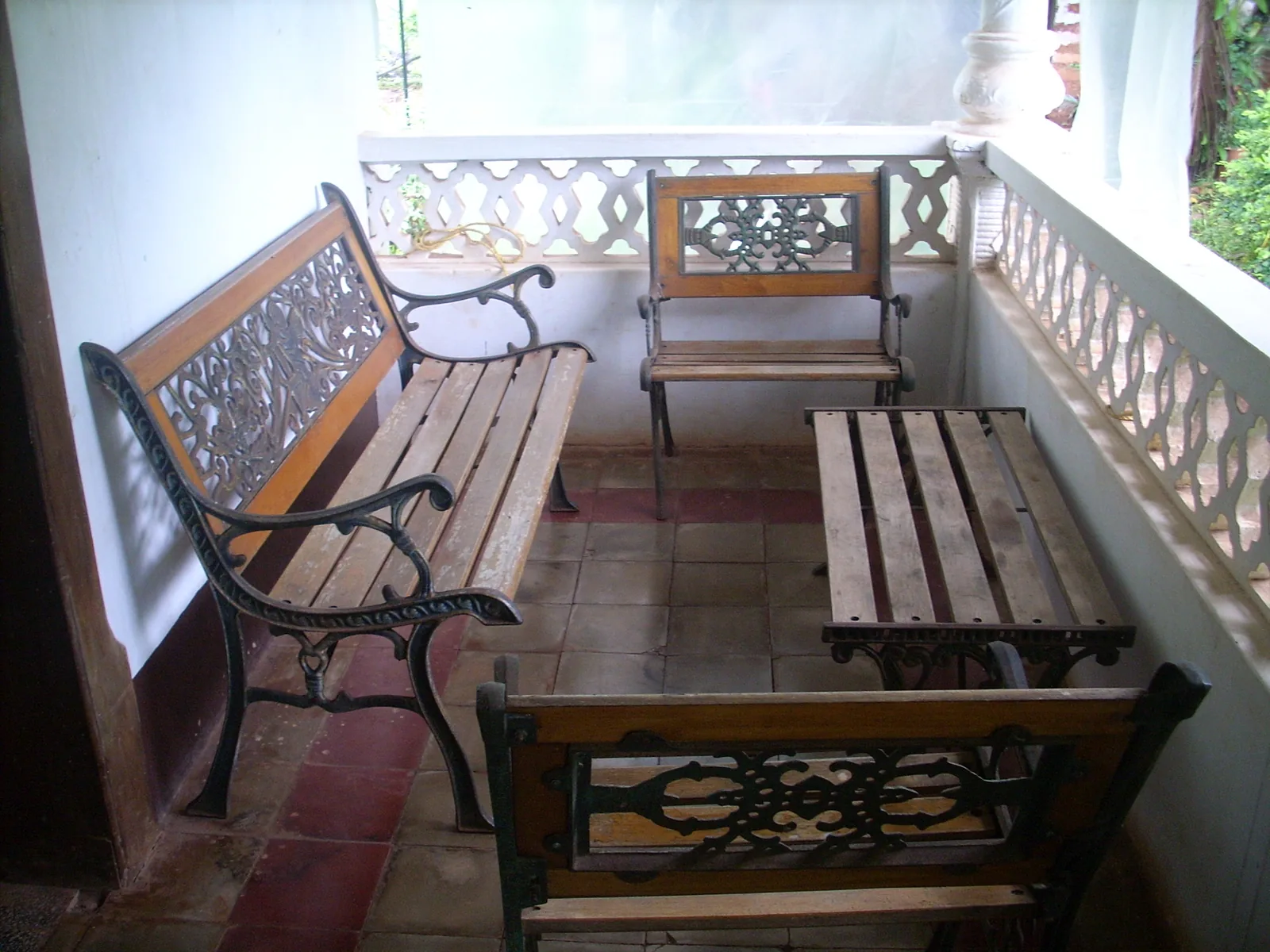
Built-in masonry seats are the Goan tradition, and they suit a porch that faces the weather. They cannot blow over, they do not rot, and they leave nothing to carry indoors in a storm. The cost is flexibility: they fix the layout for good, and bare masonry is hard and cool without cushions. Loose chairs and benches are easier to rearrange for visitors and to move out of the rain, but they need materials that cope with sun and wet, such as powder-coated aluminium, stainless fittings or well-maintained hardwood, and somewhere to go in the monsoon.
Either way, comfort comes from cushions, and on a porch cushions must be made for the outdoors. That means covers in solution-dyed acrylic or a similar outdoor fabric, quick-draining open-cell foam that lets water run through, a breathable base, and zipped covers that come off to wash. Ordinary upholstery foam soaks up rain and stays damp for days in monsoon humidity. Our outdoor and marine upholstery is made to size for built-in benches, swing seats and loungers, and our outdoor sofas are built for covered verandahs and porches.
Plan where cushions go in bad weather. On a deep, sheltered porch, a slim set of seat pads can stay out for most of the year and come in during storms. On an exposed one, keep a box or cupboard inside the front door for them. Before the monsoon, clean and dry everything and store it off the floor in a ventilated room.
Lighting that welcomes guests without drawing insects
A porch light has three jobs: lighting the steps and the edge of any change in level, letting you see who is at the door, and making the house look lived in after dark. In Goa it also attracts every flying insect in the garden, and those insects then gather at the door and come in when it opens. Lamp choice and placement both help.
Research gives some practical guidance. A study in the Philosophical Transactions of the Royal Society B notes that ultraviolet and blue light are usually the most attractive to arthropods, and found that not all white lamps of the same colour temperature are equally attractive: lamps tuned to cut the most attractive wavelengths drew fewer. A field experiment in Ecology and Evolution compared domestic lamps and found that LEDs attracted significantly fewer insects than tungsten filament or compact fluorescent lamps, but found no significant difference between warm-white and cool-white LEDs. Replacing old bulbs with LEDs is therefore the clearest single step.
Placement does the rest. Light the steps with low, shielded fittings rather than one bright lamp beside the door, so insects gather lower down and away from the opening. Keep strong lights off when nobody is using the porch, or put them on a motion sensor. Then stop the insects that do arrive at the door itself: a pleated or sliding screen on the main door lets it stand open on a warm evening. See our mosquito nets for doors for the options that suit a front entrance.
Porch flooring that stays safe when wet
A porch floor is wet for much of the monsoon and dusty or sandy for the rest of the year, and it is the floor guests cross in outdoor shoes. Slipperiness when wet is the property that matters most. Polished stone and glossy tiles that look smart in the showroom can be treacherous on a rainy evening.
The UK Health and Safety Executive's guidance on assessing floors is the clearest reference. It uses the pendulum test, which swings a rubber heel across a wet floor, and classes a pendulum test value of 36 or more as low slip potential, 25 to 35 as moderate and 24 or less as high. Surface roughness gives a quick indication too: for water-wet floors, roughness (Rz) below 10 microns indicates high slip potential and above 20 microns low. The HSE also cautions that manufacturers' figures are usually measured on new, unfitted material, and that grouting, polishing, cleaning and wear can all change how slippery a floor becomes.
So ask for wet slip-resistance data on any porch tile or stone, prefer textured, honed or matt finishes over polished ones, and never seal or polish a porch floor to a shine. A slight fall towards the garden, set by your builder, stops water lying on the surface. A coir or rubber-backed mat at the door catches the wettest footsteps, though it should be lifted and dried regularly in the monsoon or it will rot and harbour mould.
| Measure | High slip potential | Moderate | Low slip potential |
|---|---|---|---|
| Pendulum test value (PTV) | 0–24 | 25–35 | 36 and above |
| Surface roughness Rz, water-wet | Below 10 µm | 10–20 µm | Above 20 µm |
Echoing Goan pillars, balustrades and seats on a new house
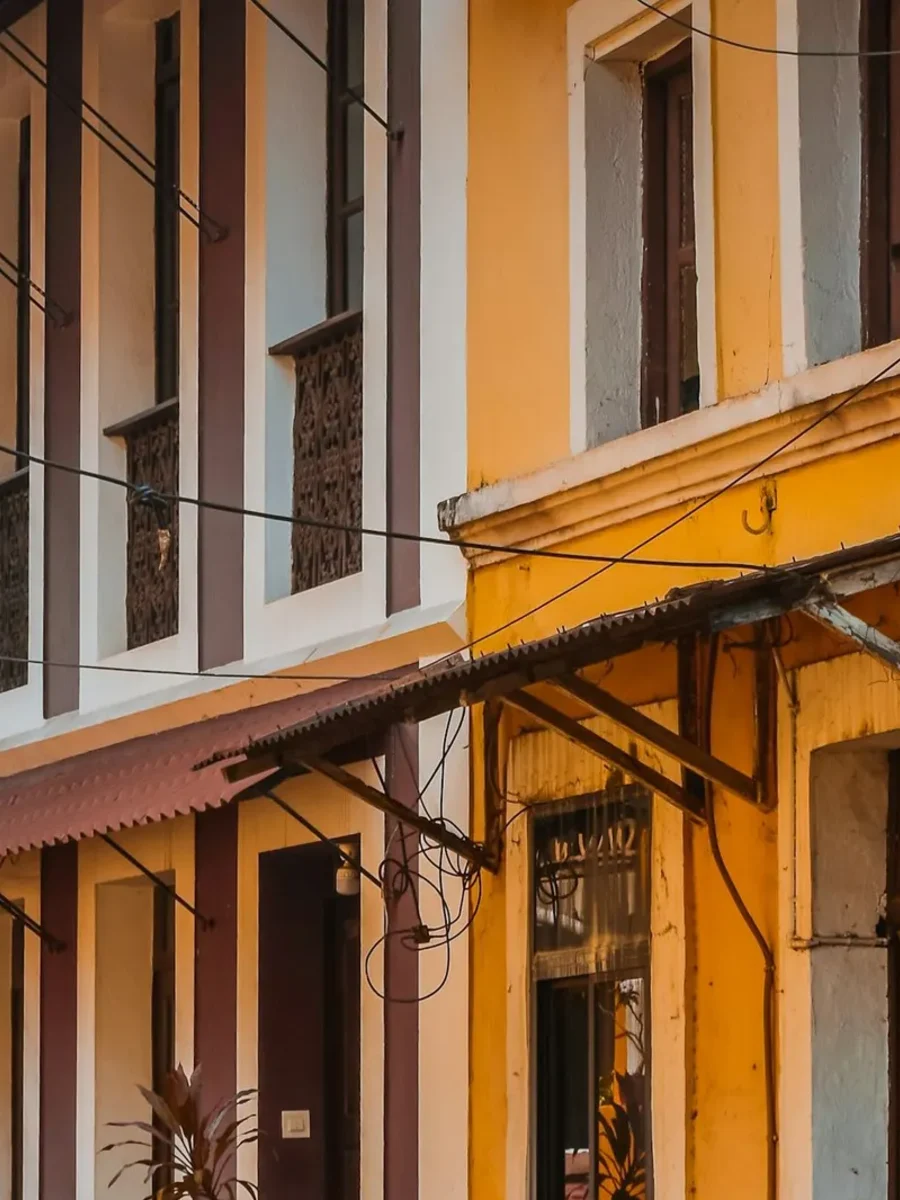
New houses in Goa often borrow from old ones at the front door: a pair of pillars, a low balustrade, built-in seats either side of the entrance, a lime-washed wall in a strong colour with white trim. Done with restraint, these details root a new house in its street. Done as a collection of motifs, they look like a set. The old houses that hold the eye are usually simple in their parts and generous in their proportions.
A few principles help. Keep pillars in scale with the roof they carry, rather than slim columns under a heavy slab. Let the seats be real seats, deep enough to use, rather than a decorative ledge. Choose a palette of two or three colours from the house itself, and let the cushions and blinds pick up one of them rather than adding another. The same restraint works indoors, where a few strong colours carried through from the front of the house usually look better than many.
On an old house, the rule is to add lightly and reversibly. Fix blinds and awnings to the roof timbers or a discreet batten, not into ornamental columns or lime mouldings, and avoid enclosing a traditional porch permanently, which changes both the facade and the way the house breathes. If the house is a heritage property, take advice from someone experienced with conservation before altering the front. Once the structure is settled, we can visit the house to plan blinds, an awning, cushions and door screens together, and our awnings and outdoor shade page shows what that work involves.