 Drape Haus
Drape Haus
Preparing the room
Drape Haus
Preparing the room
Wall Panels
Interlocking panels of rigid PVC that will not rot, swell or interest a termite. They are the practical choice for bathrooms, utility areas, ceilings and rentals — provided the wall behind them is dealt with honestly first.
In short
By the Drape Haus studio · How we write
Is it right for you?
A PVC wall panel is a long, light profile of rigid vinyl, either hollow with internal ribs or filled with a closed-cell foam core, finished with a printed film, a laminate or a plain colour. The panels lock together along a tongue and groove and are fixed to the wall with clips on a frame, with adhesive, or with a combination of the two. Because the material does not take up water and offers nothing for termites to eat, it has become the default wall covering for many wet and difficult rooms in Indian homes.
In Goa those two strengths matter. A monsoon that keeps the air close to saturation for weeks swells timber, softens board and grows mould on emulsion, while termites find their way into anything cellulose that touches a damp wall. PVC simply ignores both. It is also quick to install, light enough for ceilings, and easy to clean, which is why landlords and homestay owners reach for it when a room needs refreshing between seasons.
The honest limits are just as important. PVC moves with heat, so a wall in full afternoon sun can bow if the panels were fitted tight. Thin, glossy sheet panels look like plastic from across a room, and printed wood or marble effects are convincing only from a distance. Most importantly, PVC does not fix a damp wall. It covers it, and a wall that cannot breathe through its face will keep its moisture behind the panel, where you cannot see what it is doing to the plaster.
The details
PVC panels come as long tongue-and-groove strips or wider sheets, in plain, wood-grain, stone and patterned finishes. Water does not harm the panel itself, which is why they are so widely used in Goan bathrooms, balconies and kitchens. They are light, quick to fit and easy to wipe down.
The thing they cannot do is cure a damp wall. A wall that is wet from rising damp, a leaking pipe or rain through laterite stays wet behind PVC, and because the plastic does not breathe, the moisture has nowhere to go. We check the wall with a meter first, and where there is any doubt we fix the panels on a batten frame with a ventilated gap rather than gluing them flat to the plaster.
Quality varies more than the brochures suggest. Thin, hollow panels dent when a chair knocks them, show every bump in the wall and look plasticky up close. Thicker, denser profiles with a good surface film hold a straight line and read far better in a living room. We bring both so you can press a thumb into them before you choose.
PVC also moves with heat. On a wall that takes afternoon sun through glass, panels need room to expand at the ends and edges, or they ripple. Near a stove or a halogen spotlight they should not be used at all.
Your options
Everything sold as a PVC wall panel shares the same polymer, but thickness, core and finish decide how it looks on the wall and how long it stays flat.
Swipe for all 6 →
The honest view
Indifferent to water
PVC does not swell, rot or delaminate when splashed or steamed. In a bathroom, a laundry or a kitchen dado it stays exactly as fitted, season after season.
Nothing for termites
Termites eat cellulose. A PVC panel on a PVC or aluminium frame gives them nothing to feed on, which removes one of the commonest reasons wall linings fail in Goan houses.
Light and quick to fit
A room can be lined with little mess, no wet trades and no drying time, which matters in an occupied home or a rental that must be back in use between guests.
Easy to keep clean
A damp cloth removes most marks. There is no paint to scuff and no grain to trap grime, so it suits hard-used spaces and children's rooms.
Good on ceilings
The weight is low enough to hang overhead on a light frame, and the surface does not sag or stain from humidity the way some boards do.
Moves with heat
PVC expands noticeably when warm. On a wall in direct sun, or behind glass facing west, panels fitted without gaps can bow or open at the joints.
Traps moisture in a damp wall
The panel itself does not rot, but it stops a wet wall drying through its face. Mould and salt then build on the plaster behind, out of sight.
Looks like plastic when done badly
Thin glossy sheets, visible joints and printed timber that repeats every panel give the material its poor reputation. Thickness and finish make all the difference.
Behaviour in fire
PVC does not feed a fire as readily as timber, but when it does burn it gives off dense, harmful smoke. Keep it away from cooking flames, heaters and light fittings that run hot.
Side by side
In a humid room the real choice is usually between PVC, WPC, tiles and a good paint system. Here is how they compare in everyday use.
| PVC panels | WPC panels | Ceramic tiles | Anti-fungal paint | |
|---|---|---|---|---|
| Water resistance | Excellent | Very good | Excellent with sound grout | Moderate |
| Termite risk | None | Very low | None | None |
| Feel and solidity | Light, can sound hollow | Dense, solid | Hard, cold | As the wall |
| Heat movement | High | Moderate | Very low | None |
| Hides an uneven wall | Yes, on a frame | Yes, on a frame | No, needs a true surface | No |
| Ease of change later | Easy to remove | Moderate | Demolition | Repaint |
Swipe to compare →
Where a wall is wet from rising damp or a leak, none of these is the answer until the source is dealt with.
Rather see it in your own room?
We bring samples to the house, measure every window, and specify for the light and exposure you actually have.
Room by room
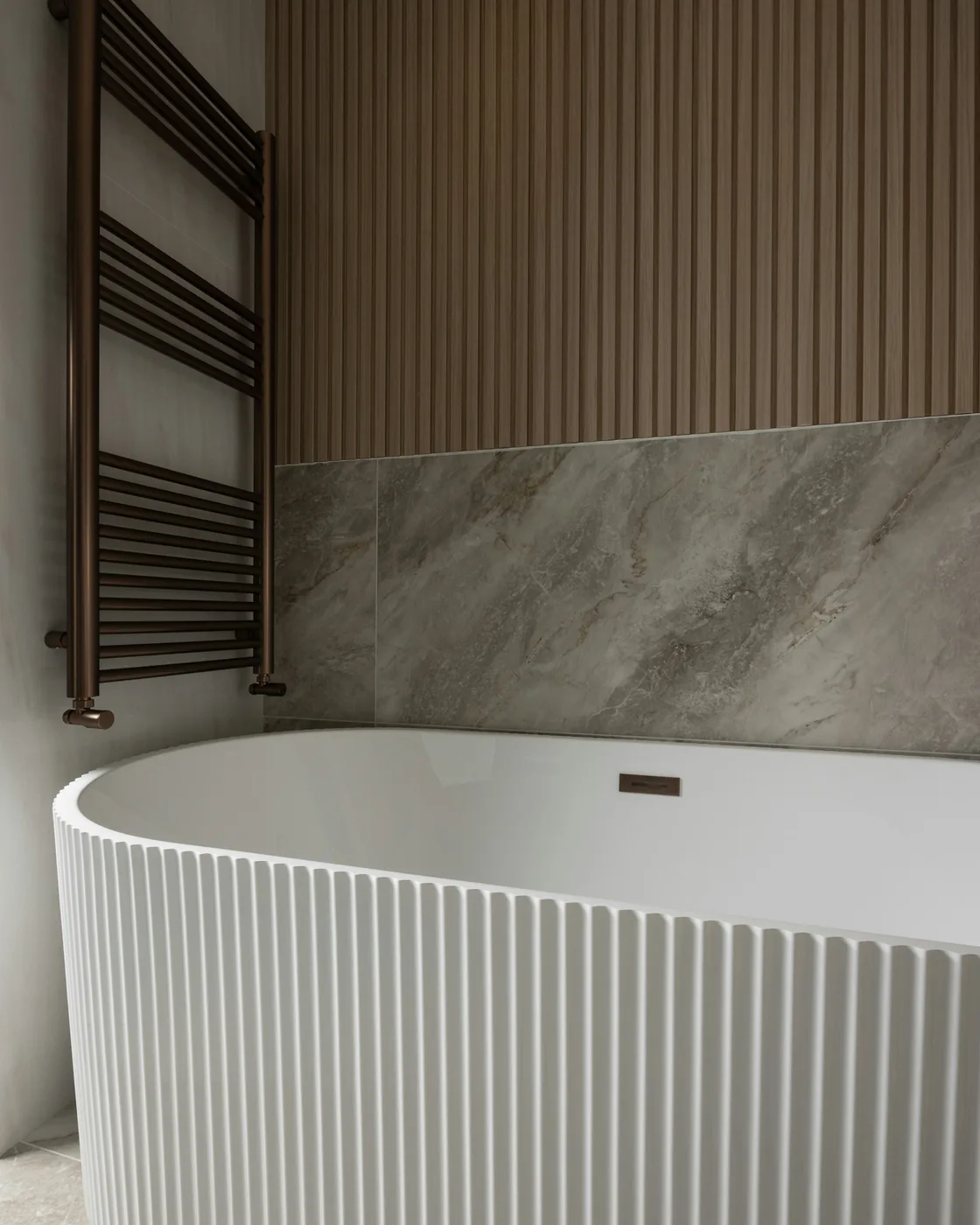
The natural home for PVC. Run it above a tiled splash zone or full height on a dry wall, seal the base with a trim and silicone, and keep a gap behind for air.
Light, unaffected by humidity and easy to fit round lights and exhaust fans. Use a rigid frame so the panels do not sag between fixings.
A quick, clean refresh between seasons that stands up to luggage, wet towels and heavy cleaning. Choose matte, plain finishes that will not date.
Works as a feature wall in a thicker foam-core or fluted panel. Avoid gloss and repeating wood prints on the main wall people see first.
Fine on walls away from the cooking zone. Never behind the hob: heat distorts PVC and a flame will make it smoke.
A west wall behind glass gets hot enough to make panels move. Choose pale colours, leave generous gaps and use clips that let the panel slide.
Only after the cause of the damp is found and treated. Covering a wet wall moves the problem out of sight rather than solving it.
In depth — tap a heading to read
Every PVC job starts with the wall, not the panel. We test the plaster with a moisture meter at several heights, look for salt bloom near the skirting, check for hollow plaster by tapping, and ask where the water goes in the monsoon: which side takes the rain, whether there is a terrace or bathroom above, whether the outside face is cracked. Laterite walls in particular can hold a great deal of water after a heavy season and release it slowly into the room.
If the readings are high, the right first step is to find the cause, whether that is a failed external coat, a leaking pipe, a blocked gutter or rising damp, and give the wall time to dry. Panels fitted over a wet wall look fine for months and then reveal the problem as a smell, black spotting at the joints or plaster crumbling when the panel is eventually removed.
A PVC panel is a finish, not waterproofing. Treat the wall first, then line it.
On a sound, dry, flat wall, panels can be glued directly. On most older walls we prefer a frame: PVC or aluminium battens fixed with plugs, set out level and packed true. A frame bridges the waves in old plaster, gives a cavity for wiring, and leaves a small air space between the wall and the back of the panel. In Goa we avoid untreated timber battens altogether, because they become termite food the first time the wall gets damp.
That air space is worth keeping open. Leaving a small gap at the top and bottom of the lining, hidden by the trims, lets the cavity breathe rather than sealing the wall into a box. In a bathroom the base trim is sealed against splashing, but the cavity can still vent at ceiling level.
PVC grows and shrinks with temperature more than almost any other wall lining. A run of panels across a sunny wall can lengthen enough over a hot afternoon to push against a corner and bow outwards. The answer is simple but often skipped: leave an expansion gap at every end and every abutment, hide it behind a trim, and fix with clips rather than rigid glue across the whole back so the panel can slide.
Colour matters too. Dark panels absorb far more heat than pale ones, and dark laminates on a wall that takes the evening sun are the ones we most often see distorted. Glass in front of the wall makes things worse, so a window wall or a room with a big west-facing sliding door needs paler finishes and extra allowance for movement.
Salt does not attack PVC itself, but it does attack plated steel screws and clips, and rust stains bleed through joints within a season near the sea. We use stainless or plastic fixings in coastal homes. In a house closed for the monsoon, PVC is a forgiving lining because it does not grow mould on its face, though condensation can still collect behind it if the room is sealed tight with no air movement at all.
Fire sense is the other part of a responsible specification. Keep PVC well away from hobs, tandoors, heaters and any light fitting that runs hot, use fittings designed for enclosed ceilings, and do not use it to line escape routes in commercial premises without checking what the local rules require.
Most of what makes PVC look like a stopgap is avoidable. Choose a thicker panel with a matte or textured face, run the joints vertically so they read as a deliberate rhythm, and finish every edge with a matching trim. Plain colours almost always age better than printed timber or marble, whose repeat becomes obvious once you notice it.
Planning the layout also helps. Centre the panels on the wall so the cut pieces at each end are equal, align joints with windows and switches, and mark socket positions before the panel goes up so the cut-outs are neat. Small decisions like these separate a lining that looks built-in from one that looks added later.
Living with it
Wipe with a soft cloth and warm water with a little mild soap. Avoid scouring pads and solvent cleaners, which dull the face and can lift a printed film.
In bathrooms, rinse soap and shampoo off the lower panels so residue does not build up in the joints, where it becomes a home for mould.
After the monsoon, look along the skirting and at corners for staining, lifting or a musty smell, all signs of moisture behind the lining.
If a panel starts to bow, it usually needs its end gap restored or a clip loosened, not more adhesive. Ask for it to be eased before it cracks.
A cracked or dented panel can usually be swapped for a new one without disturbing the rest. Keep a few spare panels from the same batch for this.
Avoid these
The commonest and most costly error. The damp keeps working behind the panel until plaster fails or mould shows through the joints.
With no expansion gap, panels in warm rooms bow or push their joints open. Every run needs room to move.
Untreated timber behind a lining is an invitation to termites. Use PVC or aluminium framing.
High gloss shows every wave and repeated wood grain looks artificial. Matte, plain or fluted finishes read better.
Heat distorts it and flame makes it smoke. Use tile, stone or glass in the cooking zone.
Checklist
More in wall panels
PVC, WPC, wood, fluted, acoustic and marble-effect panels, chosen for the wall they are going on as much as for the look.
Our process
One team from the first visit to the last bracket, so nothing is lost between the person who specified it and the person who fits it.
FAQ
They should not be glued to one. The source of damp needs fixing first; after that we use a batten frame with an air gap so any residual moisture can dry out behind the panels.
Yes, for walls and ceilings outside direct shower spray, and inside it with sealed joints and trims. They are not a substitute for waterproofing the wall beneath.
Thin panels can. Thicker, denser profiles with a matt or textured finish look far more considered. Seeing and handling samples on site is the best way to judge.
Printed finishes can soften over years in strong direct sun. Indoors, away from unshaded glass, they hold their colour well.
The panel is, and it will not swell or rot when wet. The installation is only as good as its trims and sealing at the base and edges, and a PVC lining does not waterproof the wall behind it.
Not until the cause of the damp has been found and treated. A panel over a wet wall hides the moisture, which then works on the plaster unseen. Once the wall is dry, a ventilated frame is the safer method.
No. PVC contains nothing termites eat. Problems arise when untreated timber battens are used behind the panels, so we frame with PVC or aluminium.
Almost always heat. PVC expands when warm, and panels fitted without end gaps on a sunny wall have nowhere to go but outwards. Pale colours, gaps behind trims and clip fixings prevent it.
On walls away from the cooking area, yes. Behind a hob they distort with heat and produce harmful smoke if they catch, so the cooking zone should be tile, stone or glass.
Next step
The panel is the easy part. We visit, test the walls for moisture, note which ones take the sun, and work out how the lining should be framed and finished in your room. Then we bring panel samples in the finishes that suit the space, set out the joints and trims, and fit the job with the right fixings for a coastal house. Book a visit and we will tell you plainly whether PVC is the right answer for that wall.