 Drape Haus
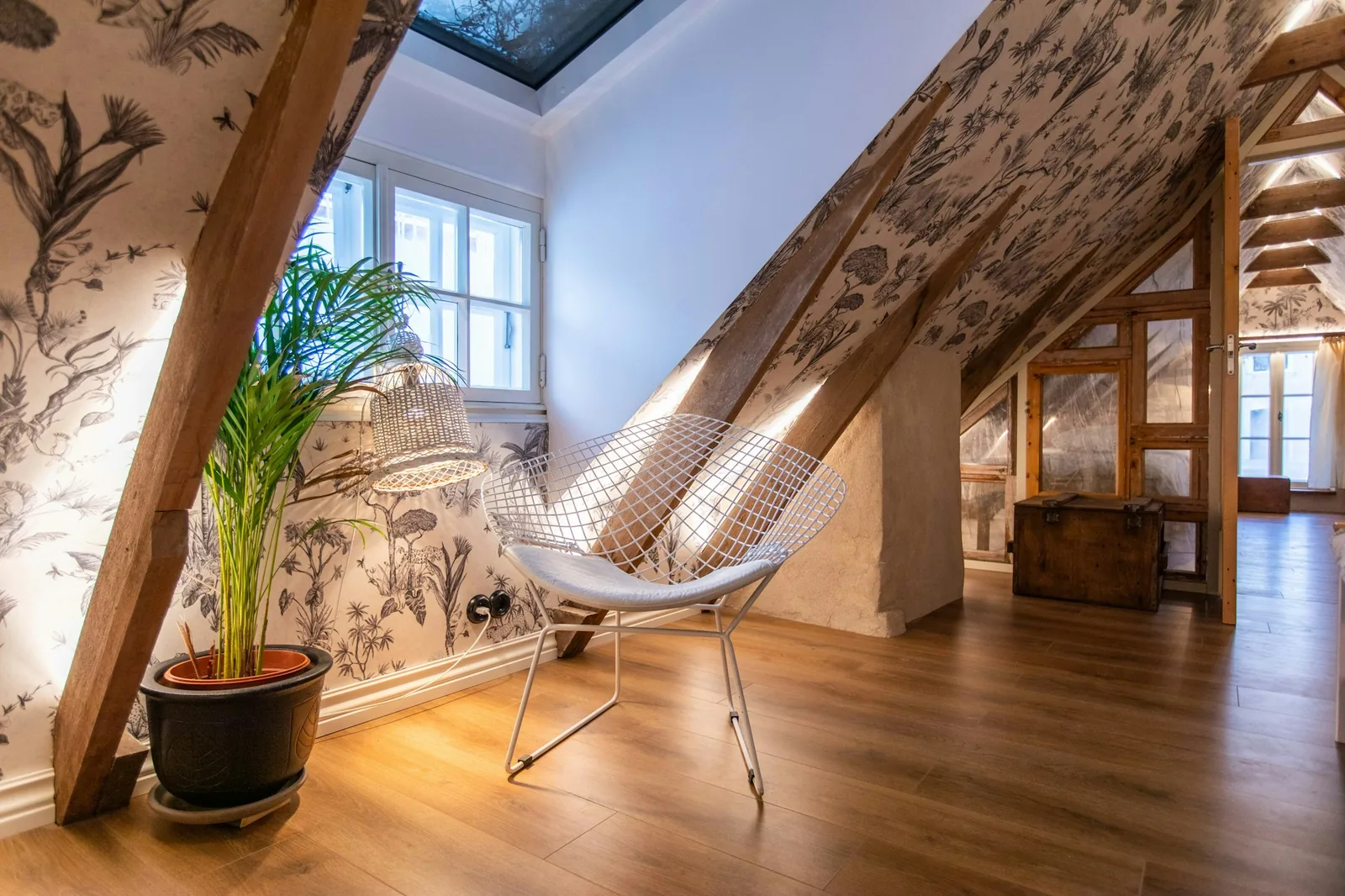
The best wallpaper for a home in Goa is the one that suits the wall it goes on. A paper that would last twenty years in a dry, heated flat can lift, bubble or grow black spots within a monsoon here, and the cause is almost never the design. It is moisture: in the wall, in the room, or trapped between the two by the wrong kind of paper.
So the choice runs in a particular order. First the wall: is it dry, sound and free of salts? Then the room: is it air-conditioned, naturally ventilated, wet or closed for months? Only then the paper: a breathable non-woven for most living rooms and bedrooms, a washable vinyl where water is splashed and wiped, and nothing at all on some walls. Design comes last, and in strong tropical light it has its own rules.
This guide works through that order. It is about choosing well for everyday rooms; if you are considering grasscloth, silk or hand-painted panels, our article on luxury wallpaper for humid homes covers those finer papers in depth.
Check the wall before you choose any wallpaper
Most of what you need to know about a wall can be seen before any meter comes out. Stand back and look along it in raking light from a window. Paint that has bubbled, flaked or gone chalky in a band near the floor points to damp rising from below. A tide mark, a wavy brownish line with paler paint beneath it, shows where water has climbed and dried. White, powdery or crystalline deposits are salts carried out of the masonry by water, and they will push any paper off the wall as they crystallise behind it.
Then touch it. Tap the plaster with a knuckle and listen for hollow patches, which mean plaster that has come away from the wall and will come away further once a wet paste is applied. Press tape firmly onto the paint and pull it off sharply; if paint comes away on the tape, it will come away under the weight of wet wallpaper too. A wall with old distemper or limewash needs that loose surface dealt with before anything is hung.
Finally, measure. A moisture meter used at several heights, especially low down, near window reveals and in corners, tells you whether the wall is drying or holding water. The US federal guide specification for wallcoverings sets a maximum meter reading of five per cent for plaster, concrete and masonry, and requires the source of any moisture to be found and fixed before installation. Meters vary, so the paper maker's own limit is the number to follow; what matters most is a wall that reads evenly, without a wet patch in one spot.
If the wall has grown fungus before, find out why before covering it. A paper hides mould; it does not stop it. Our article on fungus on walls goes through the usual causes, from leaking terraces to condensation behind furniture.
- Flaking or bubbled paint near the floor: damp rising from below
- Wavy brown tide marks: water that has climbed and dried
- White powder or crystals: salts that will push paper off
- Hollow sound when tapped: loose plaster that must be repaired
- Paint lifting on tape: a surface too weak to hold wet paper
Vinyl, vinyl-coated or non-woven: what the labels mean
Shops use these words loosely, so it helps to know what they mean in the trade. The Wallcovering Installers Association defines a non-woven substrate as one made on a paper machine from long-fibre cellulose pulps and textile fibres combined with binders. One maker of these substrates describes them as breathable because of the textile fibres in them, and dimensionally stable, which is why non-woven papers can be hung by pasting the wall and laying the dry paper onto it.
Solid vinyl is different. The same dictionary describes it as a vinyl film laminated to a paper or fabric backing, generally the most durable wallcovering because the face is a solid sheet. Vinyl-coated paper is a paper with a sprayed or coated decorative surface, a lighter-duty product. And on breathability the dictionary is blunt: breathable wallcoverings let water and air pass through, and solid vinyl and foils are not breathable.
The catch is that the two words can appear on one roll. Many papers are a solid vinyl face on a non-woven backing, sold as non-woven because of how they hang. They hang easily and wipe clean, but they do not breathe. Read the construction on the label or the maker's data sheet, not just the name of the collection, and ask whether the face is vinyl.
| Construction | What it is | Breathes? | Wipes clean? | Best placed |
|---|---|---|---|---|
| Non-woven, printed or coated | Cellulose and textile fibres; design printed on | Yes | Lightly | Living rooms, bedrooms, walls that must release moisture |
| Vinyl face on non-woven | Solid vinyl laminated to a non-woven back | No | Yes | Internal walls in kitchens, children's rooms, corridors |
| Paper-backed solid vinyl | Solid vinyl on a paper back | No | Scrubbable | Bathrooms away from the shower, utility rooms |
| Vinyl-coated paper | Paper with a sprayed or coated face | Partly | Lightly | Low-wear rooms; less robust than solid vinyl |
| Traditional paper | Mostly cellulose, often printed | Yes | No | Dry, air-conditioned rooms with steady humidity |
Planning something like this?
We visit homes across North and South Goa, measure on site, and bring samples to see in your own light.
Why vinyl on an air-conditioned wall can fail
This is the failure that catches people out, because it happens in the best-kept rooms. In a hot, humid climate, water vapour moves from the warm, wet air outside towards the cooler, drier air of an air-conditioned room. Normally it passes through the wall and the paint and is carried off by the air conditioner. Put a vinyl wallpaper on the inside of that wall and the vapour meets a barrier where the wall is coolest.
Building scientists have documented the result. The US Department of Energy's Building America Solution Center lists vinyl wallpaper among Class I vapour retarders, at 0.1 perm or less, and advises that no low-permeance finish such as vinyl wallpaper or mirrors should be attached to the inside of walls in warm, humid climates. Writing about the hot and humid south-east of the United States, the engineer Gordon Hart describes vinyl wallpaper on exterior walls as a cause of severe mould: moisture builds up between the vinyl and the wall, where the paper and paste give mould something to feed on. The US EPA's remediation guide names the space behind vinyl wallpaper as a place to expect extensive hidden mould.
In Goa the conditions line up for much of the year. The India Meteorological Department's normals put morning humidity at 87 to 91 per cent from June to September, and a bedroom whose air conditioner runs every night through the rains is exactly the room in that research. The practical rule is simple: on the inside face of an external wall in an air-conditioned room, use a breathable paper or none. Vinyl belongs on internal partitions, where both sides of the wall share the same indoor air.
Vinyl on an outside wall of an air-conditioned room traps moisture where the wall is coolest. Keep vinyl to internal walls.
Adhesives and primers that hold in humid air
A wallpaper is only as good as the layer that holds it. The US federal wallcovering specification asks for a primer and adhesive recommended by the paper's maker, containing a non-mercury mildewcide, and a strippable adhesive with a primer that protects the wall when the paper eventually comes off. In a climate where any film of paste behind a paper is potential food for mould, that is the standard worth asking for.
The primer does three jobs. It seals a porous wall so it does not suck the paste dry before the paper bonds; it evens out the colour behind a thin or pale paper; and it lets the next person strip the wall without taking the plaster with it. Where the wall colour varies, the specification calls for a white pigmented primer so patches do not show through.
Match the paste to the paper. Non-woven papers are hung by pasting the wall, which keeps the paper itself dry and stable. Heavy vinyls want the stronger adhesive their maker specifies. Using a heavy vinyl adhesive on a delicate paper can stain it, and a light paste on a heavy vinyl lets the seams lift. Paste dries more slowly in humid air, so seams need rolling firmly and the room needs gentle air movement while it cures, not a fan blowing directly onto fresh paper.
One last point. If the wall was ever mouldy, cleaning it and treating it before priming matters more than any adhesive. A mildewcide in the paste slows new growth; it does not deal with an existing colony under the paint.
Rooms to avoid, and rooms that suit wallpaper
Some walls should not be papered at all. The US federal specification advises against wallcovering on the interior face of exterior walls because moisture can build up behind it, and notes simply that where mould is a concern, wallcovering should not be used. In a Goan house the first walls to rule out are ground-floor walls with any sign of rising damp, walls under a terrace or bathroom that has leaked, and the monsoon-facing side of a laterite house.
Old lime-plastered walls are a special case. The Society for the Protection of Ancient Buildings explains that traditional materials are vapour permeable and hygroscopic: they take up moisture and let it go. A vinyl seals that surface. On these walls a breathable non-woven, or a limewash instead of paper, is the honest choice; our guide to laterite and old walls explains why.
Most other rooms can take wallpaper with the right paper. The table below is the starting point we use; every wall still gets checked on site.
| Room or wall | Verdict | Paper to choose |
|---|---|---|
| Living room, internal wall | Good | Non-woven; a feature wall or the whole room |
| Bedroom with air conditioning, internal wall | Good | Non-woven or vinyl on non-woven |
| Bedroom with air conditioning, external wall | Caution | Breathable non-woven only, on a dry wall |
| Children's room | Good | Vinyl on non-woven on internal walls, for wiping |
| Bathroom | Caution | Washable vinyl on an internal wall, away from the shower, with an extractor |
| Kitchen | Caution | Washable vinyl away from the hob and sink splash |
| Ground-floor wall with rising damp | Avoid | Cure the damp first; consider paint or panels on battens |
| Lime-plastered heritage wall | Avoid vinyl | Breathable non-woven, or limewash instead |
| Behind wardrobes and beds pushed to the wall | Avoid | Leave painted; the air never moves there |
Designs that age well in bright tropical light
Goan light is strong, and on west-facing walls it is low and direct for hours each afternoon. That fades colour. The Canadian Conservation Institute classes most plant-based colourants and many bright dyes as highly sensitive to light, and notes that ultraviolet weakens paper over time. A printed paper is not a museum object, but the principle holds: saturated brights on a wall that takes direct sun will fade first and fade unevenly, leaving a sharp ghost wherever a picture or cabinet stood.
So choose with the light in mind. Mid-tones and earthy colours, the ochres, greens, terracottas and indigos already at home in Goan interiors, show fading far less than pinks and pale blues. Ask for the light-fastness rating on the label and favour the better grades for sunny walls. Sheers or blinds that cut direct sun at its strongest hours protect a paper as well as the furniture; our guide to fading and sun damage explains how.
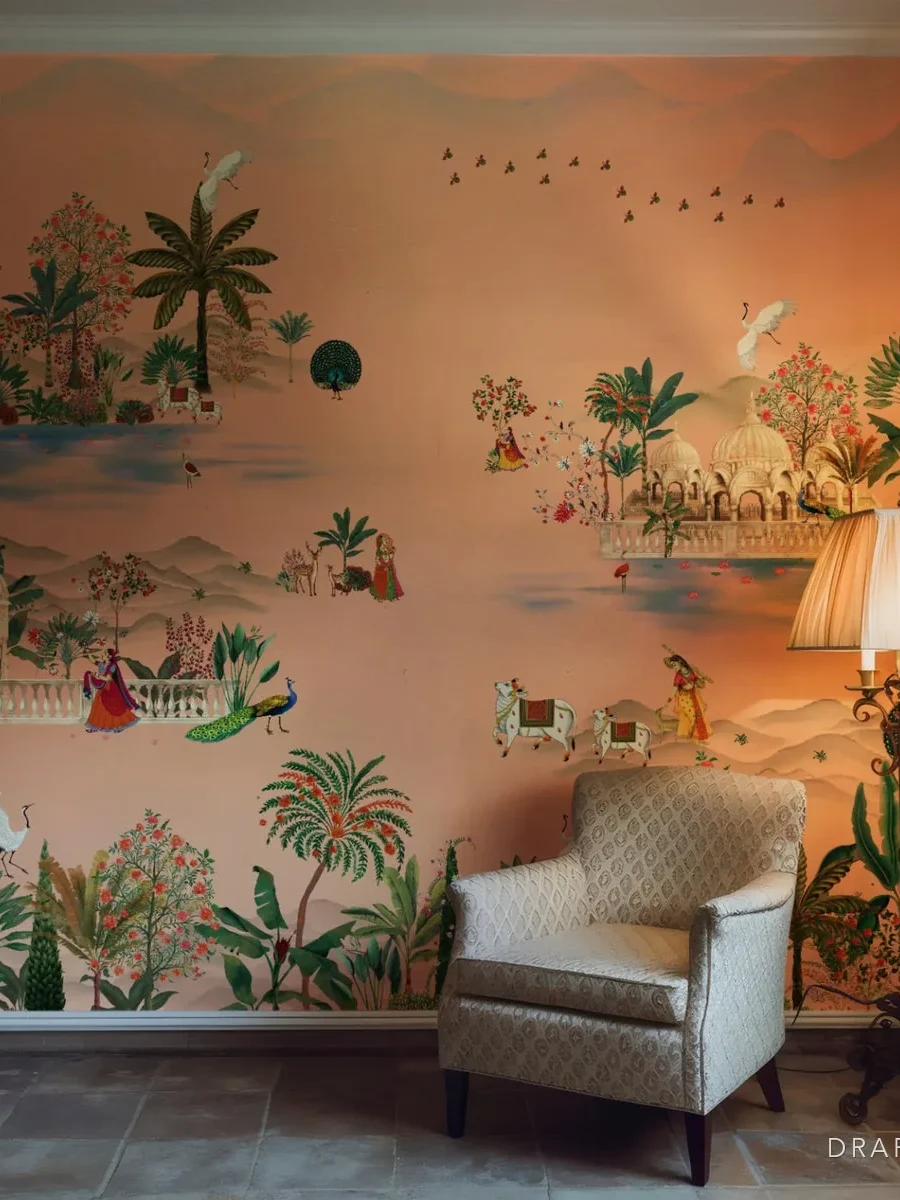
Texture and sheen matter too. Raking light across a glossy paper picks out every undulation in old plaster, while a matt or textured surface forgives it. Scale the pattern to the room: high ceilings in villas and Portuguese houses take a larger repeat than a flat's bedroom, and a small repeat on a very large wall can read as a blur. A pattern repeat also changes how much paper you need, so run your walls through the wallpaper calculator before deciding between two designs.
Finally, decide early whether the paper is a feature or the room. A single wall behind a bed or a sofa makes a strong statement and leaves the other walls to carry the curtains and art. Papering the whole room works best with quiet textures and small repeats. Our bedroom wallpaper page shows how that plays out in one of the rooms where wallpaper is most often wanted.
When to hang wallpaper around the monsoon
Timing is the simplest protection there is. The India Meteorological Department's normals for Goa show humidity at its highest from June to September, with mornings at 87 to 91 per cent. October is still humid, at about 84 per cent in the morning. From November to May, mornings fall to between 71 and 79 per cent and afternoons to between 61 and 71 per cent. Walls follow the air with a lag: they soak up the rains for months and take weeks to dry once the rains stop.
That makes the dry season the time to paper, and late in the year the time to test. Take moisture readings in November or December, after the walls have had a chance to dry, and hang once they read evenly. Avoid hanging in the monsoon unless the room has been dehumidified or air-conditioned for some time and the wall is confirmed dry. New plaster needs longer: the federal specification asks for surfaces to dry for at least 30 days before vinyl goes up.
Order early, and order once. Rolls from the same print batch match each other; a later batch can differ slightly in shade. Keep a spare roll, stored flat in a dry room, and keep the batch label with it. The same specification calls for wallcovering to be stored flat at 30 to 60 per cent relative humidity, which in Goa means an air-conditioned room, not a cupboard on an outside wall.
If you would like the wall checked before you choose, we assess walls and supply and hang home wallpaper across Goa, and specify contract-grade coverings for hotels and offices through our commercial wallpaper service. A home visit starts with a moisture meter, not a sample book.