 Drape Haus
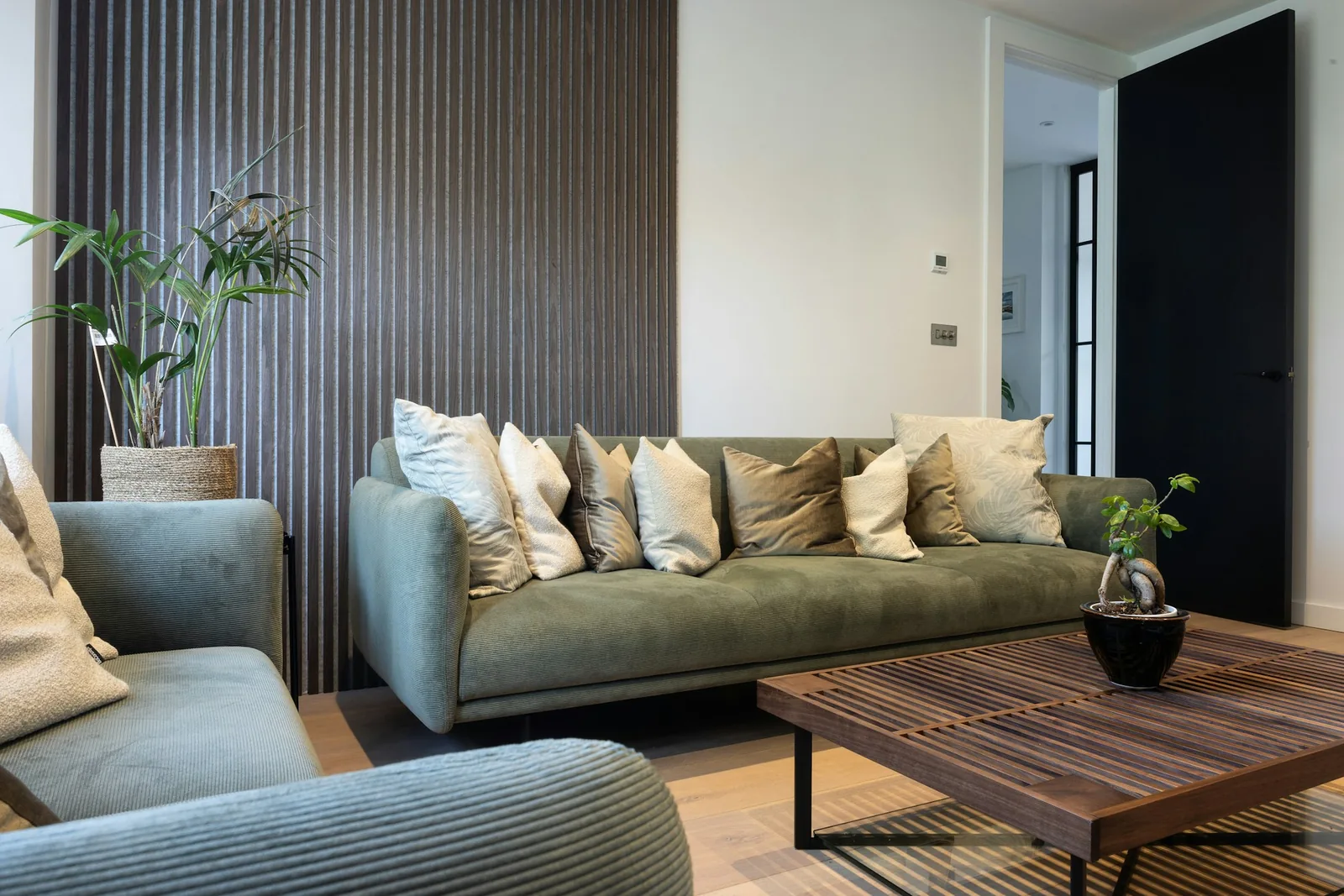
Living room wall design in Goa is a choice between finishes that shrug off humidity and finishes that need a dry wall to survive. PVC and WPC panels, fluted profiles and wall moulding can go on most walls once any seepage has been fixed. Wallpaper, real timber and fabric need a wall that stays dry through the monsoon, which usually means an internal one. The look you want matters, but the wall you have decides what will still look right next October.
The test is the monsoon. The India Meteorological Department records winds that are mostly westerly to south-westerly from June to August, driving rain onto the west and south-west faces of Goan houses, and morning humidity of 87 to 91% across the season. A living room wall that faces that weather can be damp to the touch for weeks, and a wall behind a sofa that never moves gets no air at all.
Below are the main feature-wall ideas, each with where it works and where it fails, followed by the damp checks to do first and the lighting that makes any of them worth looking at in the evening.
Pick the wall, then check it for damp
Most living rooms have one obvious candidate: the wall you face from the main sofa, usually with the television on it, or the wall behind the sofa as seen from the entrance. In a long hall, the end wall often works better than either. Choose one wall. A single strong feature makes a room feel finished; several compete with each other and with the windows.
Then find out whether that wall is internal or external, and which way it faces. An external west or south-west wall is the one most likely to take in rain. Look for the signs: paint that bubbles or flakes near the skirting, a tide mark, a white crystalline bloom of salts on the plaster, a musty smell behind furniture, or black spotting in the corners. The US Environmental Protection Agency notes that mould can hide on the back of drywall, wallpaper and panelling, which is exactly what a feature wall can become if it goes over a wet surface.
A moisture meter gives a better answer than a hand on the plaster. The US federal guide specification for wallcoverings sets a maximum reading of five per cent for plaster and masonry before anything is hung. Readings taken at several heights, including low down and near windows, tell you whether damp is rising, coming in around a frame or spread evenly. A simple extra check is to tape a square of clear plastic tightly to the wall for a couple of days: moisture under the plastic is coming from the wall, moisture on top of it is condensation from the room.
Fix the water first. Every finish in this article hides a damp wall; none of them dries it.
Feature-wall ideas compared
The table sets the main options side by side. The middle column is the one to read twice: it says what the wall needs to be like for each finish to last. If your chosen wall cannot meet that condition, move down the table rather than hoping.
Several of these combine well. Fluted panels on a television wall with wallpaper on the end wall; moulding on a heritage-style wall with a limewash finish; a PVC marble sheet behind the television with plain paint around it. What rarely works is three textures on three walls of the same room.
| Finish | Wall it needs | Upkeep | Fails when |
|---|---|---|---|
| PVC panels and PVC marble sheets | Sound; seepage fixed; can be external | Wipe clean | Glued flat over a wall that is still wet |
| WPC panels | Sound; seepage fixed; can be external | Wipe; dust grooves | Fixed without an air gap on damp masonry |
| Fluted panels (PVC or WPC) | As above | Brush or vacuum the grooves | Grooves left to collect dust and grease |
| Wallpaper | Dry, internal wall preferred | Wipe gently if washable | Damp or salt in the wall; vinyl on an AC room's external wall |
| Real timber cladding | Dry internal wall | Oil or polish; watch for termites | Humidity swings, damp, termites |
| Wall moulding with paint | Any sound wall | Repaint | Fixed into crumbling plaster |
| Fabric or acoustic panels | Dry internal wall | Vacuum; spot clean | Damp wall; direct sun fades fabric |
Planning something like this?
We visit homes across North and South Goa, measure on site, and bring samples to see in your own light.
PVC and WPC feature walls for humid rooms
PVC panels do not take up water, which makes them the safest choice for an external living room wall once the source of any damp has been fixed. They come in plain, wood-look, stone-look and large-format marble-effect sheets; the large sheets have the fewest joints and read most like a solid wall. They are light, quick to fix and wipe clean, which suits a house that is closed for part of the year or a rental that needs to look fresh at every changeover.
WPC, a wood-polymer composite, is firmer and warmer to the touch, with a more convincing timber grain. It resists moisture and termites far better than wood or MDF, and is the usual choice when an owner wants a wooden wall design without the worries of real timber in a humid room. It is heavier than PVC, so fixings and battens matter more.
On older walls, laterite and lime plaster especially, fix either material on battens with a small air gap rather than gluing it to the plaster, so the wall behind can still breathe and dry after the rains. Our guide to laterite and old walls explains why that matters, and the living room wall panels page covers materials and layouts room by room.
Fluted and louvred television walls, and keeping the grooves clean
Fluted panels are the most asked-for living room wall panel at the moment, and with reason. Vertical ribs catch side light, add height to a room with a modest ceiling and hide small irregularities in the wall behind. Louvred panels, with open slats, do a similar job where you want air or light to pass, as a screen between the living and dining areas or in front of an air-conditioner grille.
On a television wall, plan the whole composition before anything is fixed: screen size and height from your own sofa, the set-top box and router, speaker positions and the sockets they need. Leave one removable panel or a service hatch behind the screen. It is easy to plan at the start and saves taking a wall apart when a cable fails. The TV wall panels page shows typical layouts.
The grooves are the maintenance point that nobody mentions in the showroom. In a Goan house they collect fine dust in the dry season and a sticky film in the monsoon, especially in an open-plan room where cooking happens nearby. A soft brush or the brush attachment of a vacuum every couple of weeks keeps them clean; a damp microfibre cloth wrapped over a ruler reaches into deeper flutes. Choose a wider flute if the room is close to a kitchen, because narrow grooves are harder to clean. More on profiles is on our fluted wall panels page.
Wallpaper on dry, sound walls only
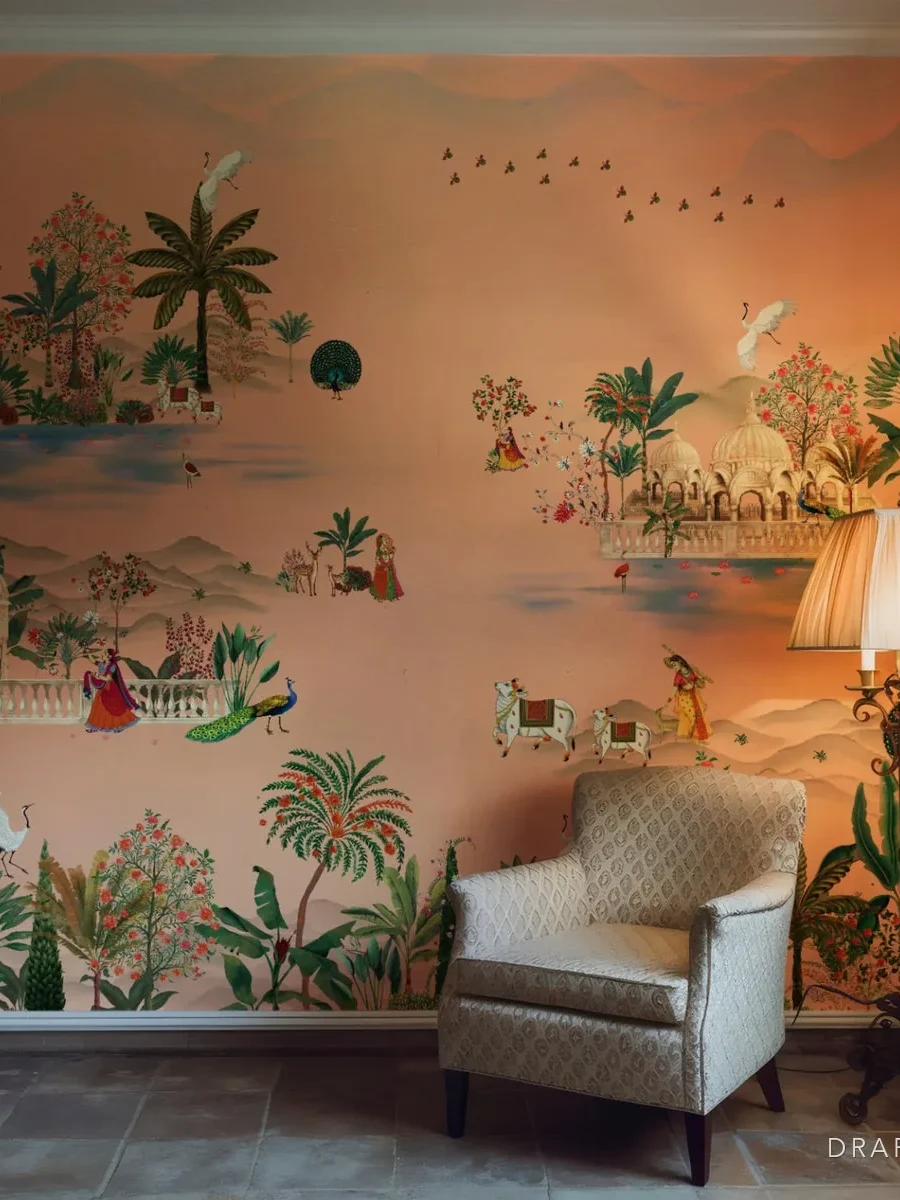
Wallpaper gives a living room more pattern, colour and texture than any panel: a large botanical behind the sofa, a grasscloth effect behind the television, a mural on the end wall of a long hall. It is also the finish most sensitive to the wall behind it. Hang it on an internal wall where you can, after the moisture checks above, in the dry months once the walls have had time to dry out from the rains.
Be careful with vinyl on an external wall in an air-conditioned living room. Building guidance from the US Department of Energy's Pacific Northwest National Laboratory classes vinyl wallpaper as a near vapour-proof layer and warns against placing such layers on the inside of walls in warm, humid climates, because moisture from outside condenses behind them. The US federal wallcovering specification goes further and advises against wallcovering on the interior face of exterior walls at all. On such a wall, a breathable non-woven paper is the safer choice, and panels on battens safer still.
Scale matters on the large walls common in Goan villas. The University of Kentucky's extension guide notes that small, delicate patterns can look lost in large rooms, while large designs make a room appear smaller; a wall broken up by doors and windows suits a smaller pattern. Our living room wallpaper page goes into choosing a wall and a design, and the wallpaper calculator works out the rolls.
Moulding grids for a classic or heritage-inspired room
Applied moulding, thin profiles fixed to the wall in rectangles and then painted, gives a living room the panelled look of an older house without covering the plaster. It suits Portuguese-style villas and new houses built in that idiom, and it costs the wall very little in breathability, because most of the surface stays painted plaster.
Proportion is everything. Work out the grid on paper first: a band of equal panels below a dado height with taller panels above, or a single row of tall panels running floor to cornice. Align the panels with the windows and doors in the same wall, and leave equal margins at corners. Paint the moulding and the wall the same colour for a quiet, tailored look, or pick out the moulding in a slightly lighter shade for more relief.
On old lime plaster, fix moulding with an adhesive suited to the surface and as few mechanical fixings as possible, and never chase cables through original plaster for a feature wall. Our article on heritage villa interiors covers how to work with old walls, and the wall moulding page shows the profiles we fit.
Lighting the feature wall
A feature wall that is not lit in the evening disappears exactly when the living room is used most. Three methods cover nearly every case. A wall washer, a row of ceiling downlights set back from the wall and angled towards it, spreads even light across wallpaper or a painted moulding grid. A grazing light, an LED strip at the top or bottom edge set close to the surface, throws shadows across texture and makes fluted panels and stone-look sheets come alive. A cove or concealed strip behind a floating shelf or a panel edge gives a soft glow without showing the source.
Picture lights still suit a single large artwork or a mirror on a moulded wall. Keep the colour of the light warm in a living room, and put the feature lighting on its own switch, ideally on a dimmer, so it can stay on low when the main lights are off.
Plan the wiring with the panels, not after them. Strip lights need a driver somewhere accessible and a route for the cable, and downlights need ceiling positions measured from the finished wall face. In Goa, where monsoon power cuts are common, a lamp or two on rechargeable batteries keeps the room usable while the feature lights are off. When the wall is decided, a home visit lets us check its moisture, bring samples and measure for a written quote.