 Drape Haus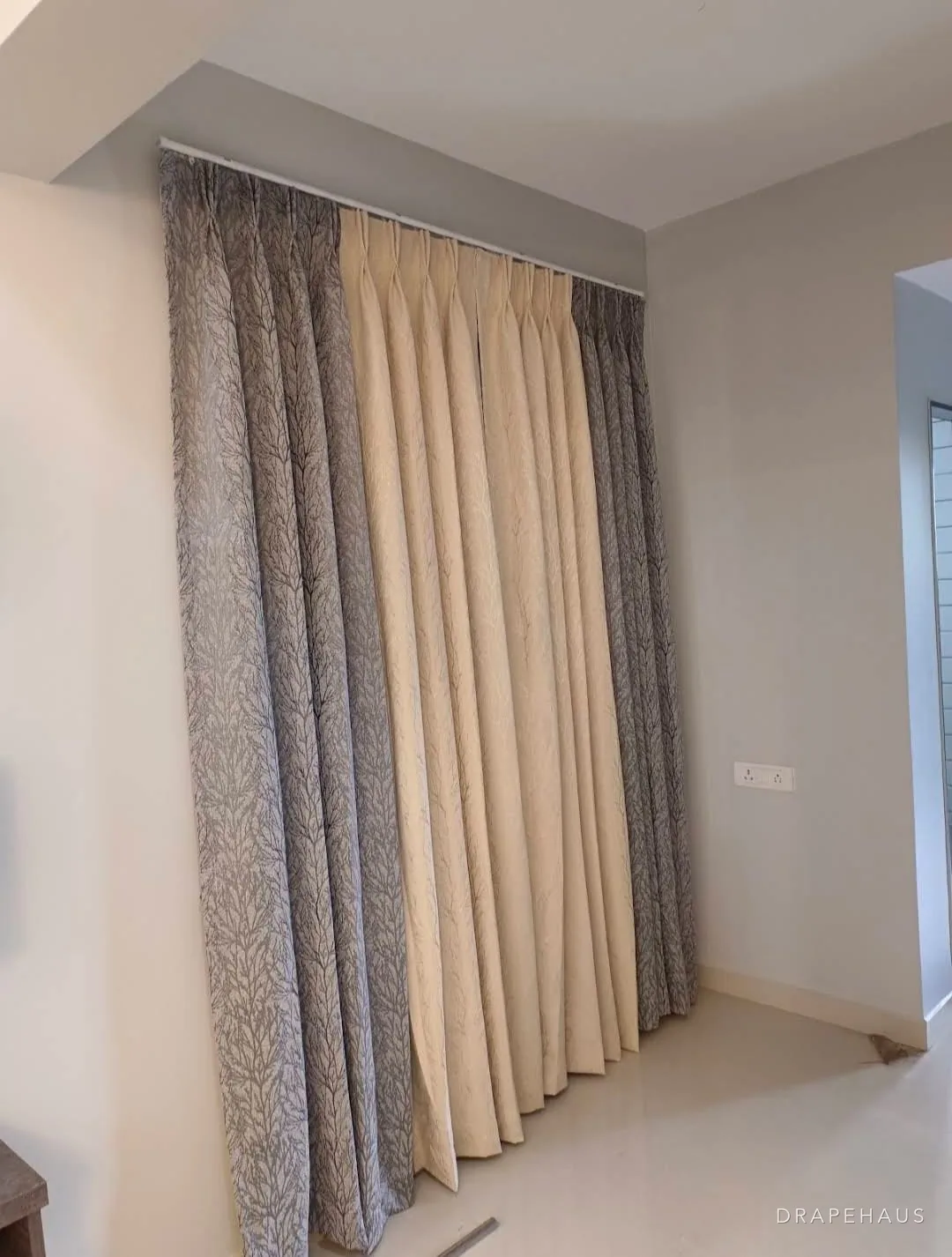
Door curtains are curtains hung across a doorway instead of, or as well as, a door. In a Goan house they solve a particular problem: you want the breeze to move through the house, but you also want privacy, a little separation between rooms, and a door that does not bang shut every time the wind gets up. A length of fabric on a rod or track does all three.
They suit internal doorways most: bedroom doors left open for cross-ventilation, the door to a pooja room, a kitchen opening, the passage to a bathroom, a wardrobe niche. They also work alongside a real door, such as the balcony door or the main door, where a curtain softens the opening and screens the view while the door stands open.
This guide covers where a fabric door helps most, the hardware that fits in or above a door frame, which fabrics hang still in a draught, tiebacks for busy doorways, washable choices for kitchens, and the heavier portière curtains that suit the tall doors of older Goan houses.
Where a door curtain helps in a Goan home
The first reason is air. Goan houses, old and new, rely on cross-ventilation, with windows on one side and doors on the other letting the sea breeze or the evening wind pass through. Close a bedroom door for privacy and the room goes still. Hang a curtain in the doorway instead, leave the door open behind it, and the air keeps moving while the room stays private.
The second is noise and movement. A wooden door left free in a through-draught swings and slams, especially when the monsoon wind gets up. A curtain moves, but quietly. In a home with small children, a door held open with a stop, and a curtain doing the screening, also means fewer fingers caught by a door blowing shut.
The third is softness. Many Goan interiors are hard: tiled or polished floors, plastered walls, high ceilings. A curtain in a doorway adds texture and colour, and frames the view from one room into the next. It can also mark a change of use, such as the line between a living room and a dining area, without building anything.
The usual doorways are the bedroom door, the pooja room, the kitchen, the passage to a bathroom or utility area, a walk-in wardrobe or store, and a staircase landing. Each has a slightly different job, which the sections below go through.
- Bedroom doors left open for cross-ventilation
- Pooja rooms, for privacy and a sense of threshold
- Kitchen and utility openings, to screen the view and the clutter
- Bathroom passages and dressing areas
- Wardrobe niches and storerooms without doors
- Balcony and main doors, layered with the door itself
Rods, tension rods and tracks for doorways
There are three ways to hang a door curtain, and the doorway decides which. A curtain rod on brackets above the door frame is the most common. Fixed above and beyond the frame, it lets the curtain stack clear of the opening when drawn back, which matters in a doorway people walk through. Our guide to types of curtain rods compares materials, and in a coastal house a rod in anodised or powder-coated aluminium or marine-grade stainless will not rust. See our curtain rods for the range we fit.
A tension rod is a sprung or screw-adjusted rod wedged between the two sides of the door frame, inside the opening. It needs no drilling, which makes it popular in rented flats. It works for light curtains in narrow, square doorways. It does not suit heavy fabrics, wide openings or frames whose sides are not parallel, and because the curtain hangs inside the frame it cannot be drawn fully clear of the opening.
A curtain track, fixed to the wall above the door or to the ceiling, is the smoothest option for a curtain drawn many times a day, because gliders run inside the profile instead of rings scraping along a pole. It is the right choice for heavy or lined curtains and for wide openings such as the archway between two rooms. Our curtain tracks are chosen for the weight and the span.
Fixing is the hidden part. In older houses, the wall above a door is often laterite or old lime plaster, and in concrete houses the lintel sits just above the frame. We use resin anchors in laterite and fix into the lintel in concrete, so a curtain that is pulled aside dozens of times a day does not work its brackets loose.
Planning something like this?
We visit homes across North and South Goa, measure on site, and bring samples to see in your own light.
Fabrics that hang still in the breeze
The most common complaint about door curtains is flapping. A light curtain in a doorway with a through-draught billows into the room, wraps round people walking past and catches on door handles. The IMD's climate summary for Goa describes winds strengthening from the west and south-west between June and August, and those are the months when a door curtain is tested.
Weight is the cure. A medium-weight cotton or linen hangs far more steadily than a sheer. A lining adds weight and body, and a deeper hem, or a weighted tape sewn into it, holds the bottom edge down. For a doorway that takes a strong draught, a lined curtain with a weighted hem hangs straight where an unlined one swings. Fullness matters too: a curtain made with generous fullness falls in folds that resist the wind better than a flat panel.
Sheers have a place, in a doorway where the aim is a soft veil rather than privacy, or between two rooms that share light. They need a still doorway, or they will drift. Sheer curtains work well layered in front of a heavier curtain, so the sheer is drawn across by day and the heavier one at night.
Damp is the other climate issue. With morning humidity of 87–91% through the monsoon, according to the IMD, a curtain next to a door that lets in rain can stay damp for days, and natural fibres left damp are more prone to mildew than synthetics.
If a door curtain flaps, add weight before anything else: a lining, a weighted hem or more fullness.
Tiebacks and holdbacks for busy doorways
A door curtain that is always half across the opening gets grabbed, pushed and tripped over. In any doorway used through the day, plan how it will be held open. A holdback is a fixed hook or arm on the wall beside the door; you drape the curtain behind it. A tieback is a band of fabric, rope or leather that wraps round the curtain and hooks to the wall.
Position matters more than style. Set the holdback far enough to the side that the gathered curtain clears the door frame completely, so nobody brushes it as they pass. A height around a third of the way up the curtain, or a little lower, gives a soft curve; in a narrow passage, a higher point keeps the fabric tighter to the wall. For a doorway used constantly, a holdback is quicker than a tieback, because you only drape the fabric behind it.
With small children in the house, avoid long hanging cords and looped tiebacks within reach. In its advice on blinds, the Royal Society for the Prevention of Accidents urges families to check there are no looped cords or chains that a child could put around their neck, and the same care applies to cord tiebacks on curtains. Fabric bands, rigid holdbacks and short tiebacks fixed close to the wall are safer choices.
Washable fabrics for kitchen and utility doors
A curtain in a kitchen doorway takes cooking smells, grease and the odd splash, and needs washing far more often than a bedroom curtain. Choose a fabric that can go in a washing machine without shrinking or losing its shape: a good cotton, a cotton and polyester blend, or a polyester with a linen look. Unlined curtains, or ones with a detachable lining, are easier to wash and dry.
Make it easy to take down. An eyelet curtain on a rod, or a curtain with a simple tab or tape heading, comes down in a minute. Keep the curtain well clear of the hob and any open flame; where a gas stove sits close to the doorway, a short curtain or a blind may be safer than a full-length one.
Dry it fully before rehanging, especially in the monsoon. The US Environmental Protection Agency advises drying damp materials within 24 to 48 hours to prevent mould growth, and a heavy kitchen curtain hung back damp in August will not dry on the rod. A fan, a dry day or a dehumidifier in the room solves it. The same applies to a curtain at a utility or wash-area door, where steam and splashes keep fabric damp.
Portière curtains for tall Goan doors and heritage interiors
A portière is a curtain hung across a doorway or the entrance to a room. The word comes from the French porte, door, and the Online Etymology Dictionary records it in English from 1843. A portière is usually heavier than a window curtain: a lined or interlined fabric, hung full height to cut draughts and divide rooms, and drawn aside on a rod or track.
The style suits older Goan houses well. Their doors are tall, often double-leafed, with a fanlight above, and the rooms are high. A portière hung from a rod above the fanlight, in a heavy linen, cotton velvet or damask, gives a doorway presence and lets the doors stay folded back against the wall. In a sala with a run of doors to the balcão, a matching set of portières ties the room together. Our guide to Goan architecture explains how these houses are planned around through-air and tall openings.
Heavier fabrics bring heavier hardware, and humidity. A full-height velvet or interlined portière needs a sturdy rod or a heavy-duty track, fixed into sound masonry, and in Goa it needs airing through the monsoon so damp does not settle in the folds. Velvet curtains suit a formal room that is lived in all year; in a house closed for the rains, they are worth taking down and storing.
Door curtain ideas, room by room
Bedroom door: a lined cotton or linen curtain on a rod above the frame, drawn across at night with the door left open behind it for air. A holdback keeps it clear by day. In a guest room, it gives visitors privacy without shutting them in a still room.
Pooja room: a richer fabric, a silk or a printed cotton, often in a colour chosen by the household, on a slim rod, short or full-length depending on the opening. Keep it well clear of lamps and diyas, and choose a fabric that cleans easily, because smoke and oil collect on it.
Kitchen: a washable cotton or blend on an eyelet heading, at half or full height, tied back during cooking. Bathroom passage or dressing area: a curtain that tolerates humidity, such as a polyester or blend, with room for air to move behind it.
Balcony door: a curtain inside, layered with a mosquito net for the door, so the door can stand open in the evening with the net closed and the curtain drawn for privacy. Plan the net and the curtain together so the curtain still draws in front of it. Main door: a heavy curtain inside the door screens the view into the house when the door stands open, and a lined fabric cuts draughts. For a whole-house plan, our curtains collection is the place to start, and we measure and fit every doorway as well as every window.