 Drape Haus
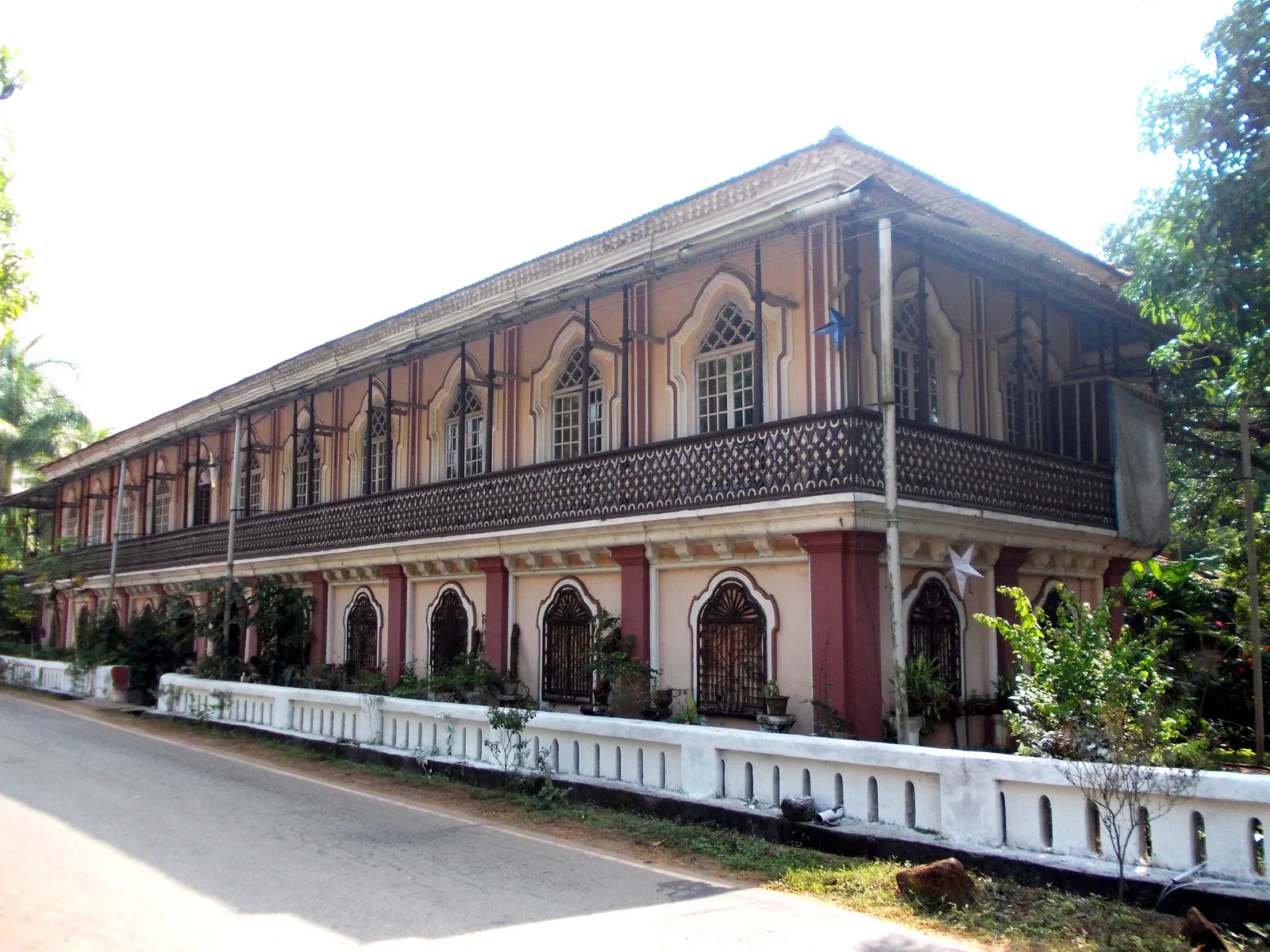
Chandor is a village in Salcete, about nine kilometres east of Margao, on the banks of the Kushavati river. Most people know it for one building, the long Braganza House on the church square, which has its own guide in our article on Braganza House. This piece is about the rest of Chandor: the village as a whole, its older past, the way its houses gather around the square, and what its great houses tell an owner about building and furnishing for Goa.
Chandor is old in a way few Goan villages can match. The Archaeological Survey of India identifies it with ancient Chandrapura, a capital under the Bhojas through to the Kadambas between the 4th and 13th centuries, and a major port. The Portuguese-era houses arrived much later, on top of a settlement that had already been important for centuries.
As everywhere in Goa, nearly all the houses here are private homes. We describe what official and scholarly sources say about them, give no hours or fees, and suggest you check before visiting any house at all.
Before the mansions: Chandrapura on the Kushavati
The ASI's own summary, published in 2025, places Chandor on the Kushavati and calls it ancient Chandrapura, a capital from the Bhoja period to the Kadambas and a major port city, and describes the excavated site in the village as significant. In other words, Chandor was a place of power and trade long before any of its present houses were built.
That history explains something about the village's shape. Chandor was not founded around a Portuguese church; the church arrived in a place that already had a long life, fields and a river. The later houses fitted themselves into that landscape, and the village still feels spread out rather than planned, with roads running from the square towards chapels, fields and the river.
For a visitor, it means two kinds of heritage sit side by side: an archaeological site from the first millennium and great houses of the 18th and 19th centuries. Seeing both in a day gives a far truer picture of Goa than the mansions alone.
The church square and how the village gathers around it
The square is the natural place to begin. The church of Our Lady of Bethlehem, Nossa Senhora de Belém, was built in 1645. Its front collapsed on 14 August 1949 and was rebuilt in a neo-Gothic style, while the nave and sanctuary keep their older Mannerist character; the church was blessed again on 17 December 1950. A cross of intricate design stands in front of it.
Braganza House runs along one side of the square; the Government of Goa describes this huge house as now divided into separate homes with a common entrance. Walk on along the road and you reach the Fernandes house. Other, smaller houses line the roads leading out of the village, and the chapel of Our Lady of Piety stands on a hill above it. Travel writing also tells of a chapel of St Tiago tied to an old village legend.
The square, in other words, is where the village meets, and the houses relate to it in different ways. The grandest front faces it directly across the open ground; others stand along the roads that lead to it, in their own compounds. Reading Chandor is partly reading which families chose to face the church and which chose a quieter plot.
Start at the church square, walk the roads outward, and look at every house from the road unless you have been invited in.
Planning something like this?
We visit homes across North and South Goa, measure on site, and bring samples to see in your own light.
Braganza House as a building: what the architecture shows
Our separate guide to the house covers its families, rooms and collections. Here it is worth looking at the house purely as architecture, through the HPIP inventory of Portuguese-influenced heritage. Its architectural analysis dates the building to the late 18th century and notes that it was heavily altered in the 19th, which makes the earlier design hard to read. It describes the house as two independent dwellings forming one architectural whole.
Several features stand out. Unlike most Goan family houses, which tended to live on the ground floor, Braganza House has its main rooms on an upper floor, a habit of Portuguese manor houses. Inside the entrance, a corridor leads to a large patio largely covered by a porch on big pillars, a sheltered space where people could move about freely in the rain and heat. A single stair divides symmetrically into two, in the Baroque way.
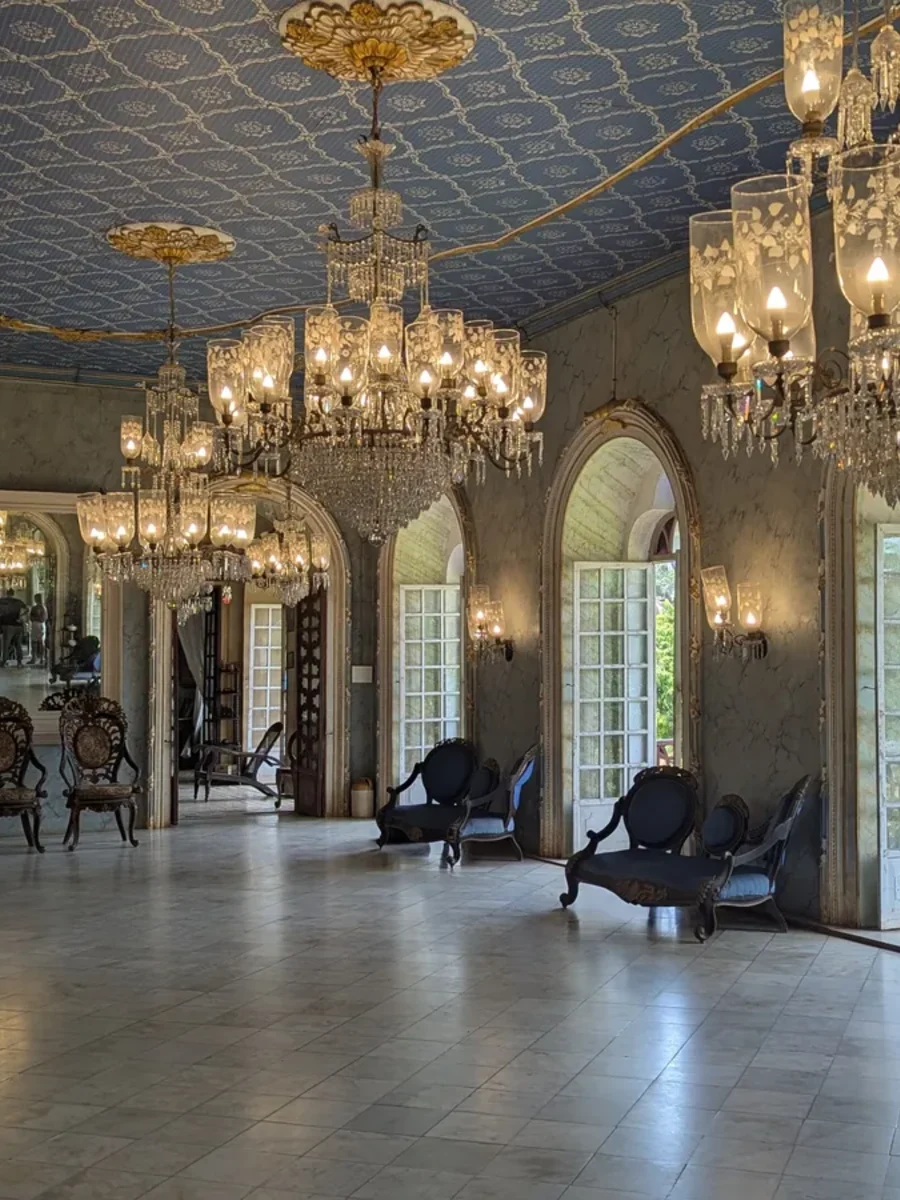
The front has been reworked too. According to HPIP, the 19th-century additions, chiefly a large ballroom, brought a new window design to the facade: the arched heads over the balcony windows are of that period, while the three small brackets under each balcony and the large Tuscan pillars between the windows are 18th-century survivals. Inside, traces of a vasary, the long dining room of Goan tradition, can still be read in two rooms, and some rooms keep pyramidal ceilings with carved and gilded trusses.
One detail matters for anyone who furnishes old houses. HPIP notes faint wall paintings that reproduce fabric patterns and suggests that the main halls were once lined with silk, which, being poorly suited to humidity, was gradually replaced by paint. The textiles of a Goan mansion were always fighting the climate.
The Fernandes house: an older plan behind a 19th-century front
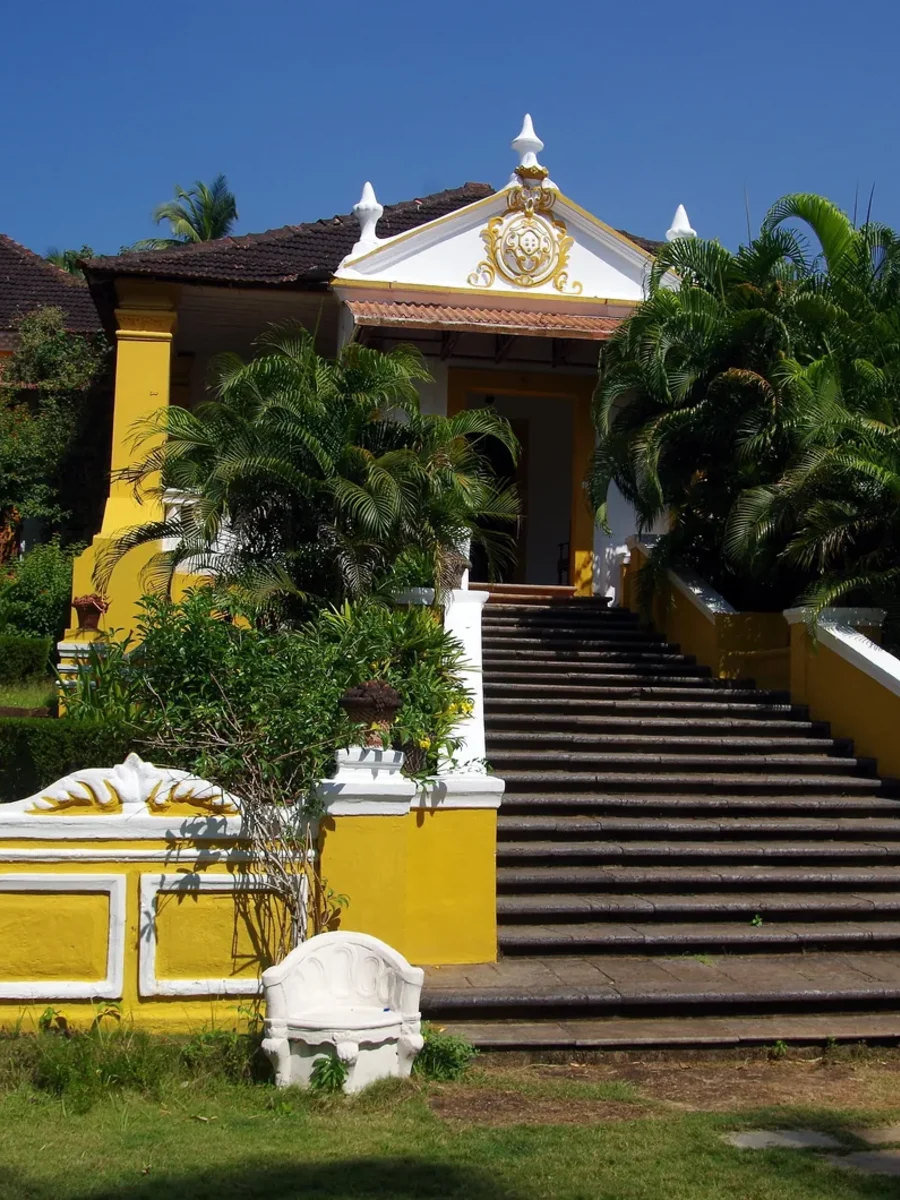
The Fernandes house, also known locally as Voddlem Ghor, is the other great house in the village that has been shown to visitors by its family. The Government of Goa calls it one of the oldest remaining palácios in Goa, with an original house showing Hindu influence built some 500 years ago, and a portion in Portuguese style built by the Fernandes family in 1821. A salon on the first floor is used for receiving guests.
The government page also singles out that the house was arranged so that its occupants could escape in case of attack, and travel writing adds broad verandas, French windows and a ballroom. Our piece on the oldest house in Goa looks at how far the 500-year claim can be taken, and why house dates in Salcete are so often disputed.
For anyone learning to read Goan houses, the pairing with Braganza House is the lesson. One house presents a long, formal front to the square with its main rooms upstairs; the other carries a much older core, shaped by Hindu building tradition, behind a front added in the 19th century. Our guide to Portuguese house plans in Goa explains how these plans work room by room.
The smaller houses, and what to look for
Away from the two named houses, Chandor's roads are lined with ordinary village homes, and they repay a slow walk. The Government of Goa's description of the state's mansions applies to them in miniature: walls and pillars of red laterite and local wood, roofs of terracotta tiles, and inside, objects gathered from around the world alongside furniture carved by local craftsmen.
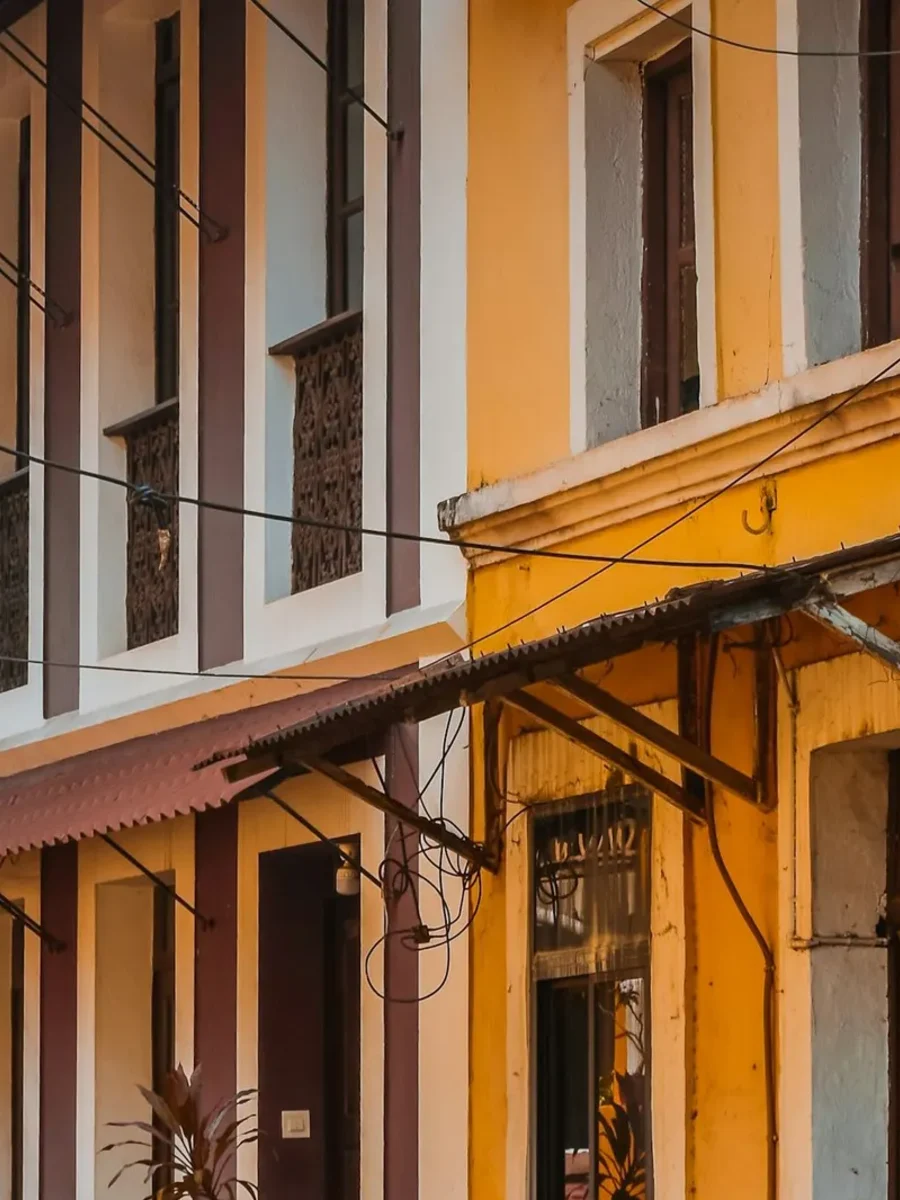
Look at how each house meets the road: whether it sits on a raised plinth, how many steps lead up, and whether there is a balcão with built-in seats, open or enclosed. Look at the windows, because small square panes with a soft, pearly translucence rather than clear glass are oyster shell. Look for an inner courtyard glimpsed through a side gate, the older way of bringing light into a deep house. Our guides to the Goan balcão and oyster-shell windows explain both features.
Some houses are beautifully kept, others are clearly empty and slowly failing, and a few are being restored. All of that is the honest state of heritage in a Goan village, where large houses need constant upkeep and families are often spread far from home.
- Plinth height and the steps up from the road
- Balcão seats, columns, and whether the porch is open or enclosed
- Shell or glass panes, and whether the shutters still work
- Laterite showing through worn lime plaster
- Roof pitch, eaves depth and the state of the tiles
- A courtyard or yard glimpsed from the road
The village calendar, and when houses open
Chandor's biggest day is 6 January, the feast of Our Lady of Bethlehem, which is celebrated with the Epiphany and the visit of the Three Kings. Each year three boys are chosen to play the kings. In 2025, Gomantak Times described them dressing in regal clothes, gathering at the chapel of Our Lady of Piety on the hill, and riding on horseback to the church, keeping a long tradition. It is a village occasion first, and visitors should treat it as one.
Travel writing also mentions Mussol Khell, a folk performance tied to community gatherings, and growing interest from villagers and the state in heritage walks and community-based stays. Those plans are still developing, so check what is happening when you go.
There is no published calendar for when houses are open. The Government of Goa's advice for heritage mansions is that most can be visited only by special request or appointment, made with the owner or through the nearest tourist office, well in advance, and that a small donation towards upkeep is customary. Assume nothing is open until you have confirmed it, and expect that a house may be closed for a family event or repairs.
Furnishing lessons from Chandor's great rooms
The silk walls are the first lesson. If the halls of a Chandor mansion were once lined with fabric that the humidity defeated, the conclusion for a modern owner is not to avoid textiles but to make them removable. Curtains that can be taken down and stored for a closed monsoon, cushion covers that come off for washing, and rugs that roll up all keep fabric in a Goan house without asking it to survive the wet months fixed to a wall.
The covered patio is the second. A porch on pillars that lets people move about in the rain is a good model for a modern verandah or balcão: cushions in outdoor-grade fabric that dries quickly, brought indoors in the heaviest weeks. Our outdoor and marine upholstery is made for exactly that kind of use.
The third is scale and timber. Tall balcony windows set between pillars look best with light curtains hung inside the frame line, so the shutters still close and the window keeps its proportion. The Government of Goa describes much of Braganza House's furniture as 18th-century seeso wood, lacquered or inlaid with mother of pearl; chairs of that kind are worth recovering rather than replacing. Our reupholstery service works on old frames with the care they need, and our field guide to Goan furniture helps identify what you have.