 Drape Haus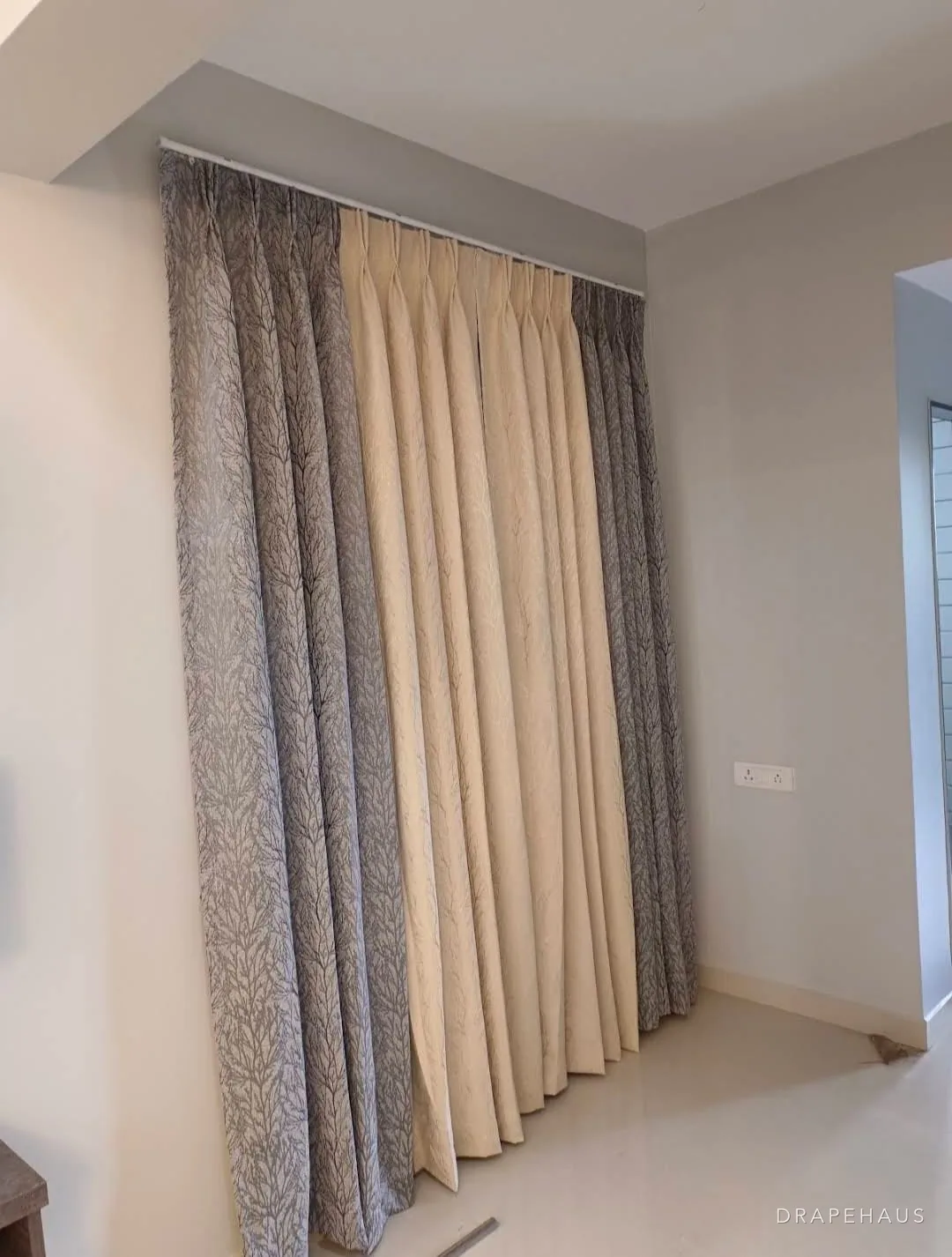
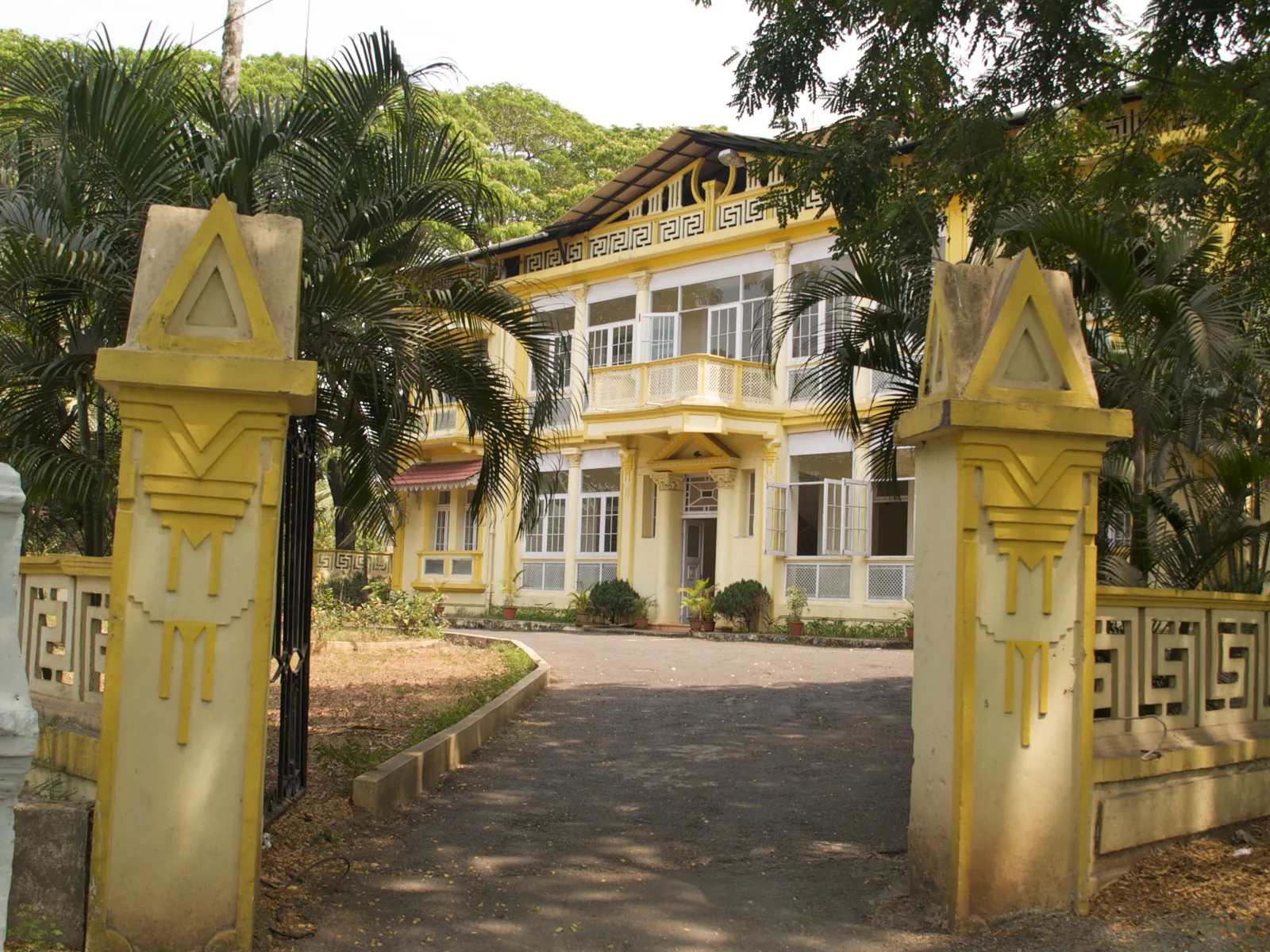
Goa's art deco buildings are hiding in plain sight. Most date from the 1940s and 1950s, the last years before Liberation in 1961, and they sit between two better-known layers: the colour-washed Portuguese-era houses of the 18th and 19th centuries, and the concrete that followed. In Panjim, Margao, Mapusa and some Salcete villages you will find rounded corners, thin concrete sunshades, sunburst grilles and terrazzo floors, often on buildings people walk past without a second look.
Many of them are houses, and many more are hybrids: an older Goan house with a deco gate and grilles, or a deco front on a traditional plan. They are younger than the mansions and not usually thought of as heritage, which puts them at particular risk of demolition. They also have their own restoration problems, because they are built of early reinforced concrete and steel rather than laterite and lime.
This guide covers where Goa's art deco buildings are, how to recognise the style on a house, what the interiors of the period were like, the main restoration issues, and how to furnish and dress the windows of a deco-era house without turning it into a period set. For the older houses, start with our field guide to Goan architecture.
Goa's overlooked modern layer
Art deco takes its name from the 1925 International Exhibition of Modern Decorative and Industrial Arts in Paris. It reached India through Bombay, which was building in the style by the 1930s, and from there it reached Goa. A 2025 Scroll article identifies the Praça do Comércio on Panjim's main square, designed in the 1930s by the engineer Luís Bismarck Dias (1894–1949), as one of Goa's earliest art deco buildings, and notes that most of the state's deco buildings date from the 1940s and 1950s.
A 2019 Business Standard report on Goa's deco heritage explains part of the story. By the early 1950s many buildings in Panjim needed redevelopment, and with no architecture school of its own Goa brought in architects from Bombay, then in the grip of art deco. The report quotes the Goa Heritage Action Group's estimate that Panaji alone has more than 50 buildings of art deco importance, and records that the style also reached Margao, Mapusa and rural pockets.
The same report makes the point that matters most to house owners. A hybrid style emerged, in which Indo-Portuguese homes took on art deco details and the reverse, and deco gates and grilles went on being used for decades after the style itself had faded. Terrazzo flooring, it notes, was first popularised in Goa during the deco period. So a house need not be a pure deco design to have deco elements worth keeping.
How to recognise art deco on a Goan house
Deco in Goa is usually restrained: a few strong lines and one or two motifs, applied to a plain, rendered concrete or masonry building. Art Deco Mumbai, the trust that documents the Bombay buildings, lists the elements to look for, and most of them appear in Goa. Its glossary describes eyebrows, or chajjas, as cantilevered projections over windows and balconies that act as weather shades, often with their edges picked out in a darker colour, and grilles in metal, concrete or wood with geometric or tropical designs on balconies, windows, stairwells and gates.
A 2008 survey of Goan deco on the Goan Architecture blog adds local habits. Buildings of the period, it notes, often have curved corners at road bends and junctions. The rising sun appears again and again in window grilles, and in one Margao grille the sun is shown with clouds across its face. Railings carry a lightning-flash motif. In the Assolna–Velim–Cuncolim villages of Salcete, it describes houses built by villagers after long stints on the shipping lines and in the Middle East, with chevrons and steps on their façades.
- Rounded corners, especially where a building meets a road junction
- Eyebrows: thin concrete sunshades over windows, sometimes running the full width of the front
- Sunburst, chevron, zigzag and stepped motifs in grilles, gates, parapets and plaster
- Ship-deck railings, portholes and other nautical details on balconies
- Long horizontal bands or lines across the front, often in a contrasting colour
- Terrazzo or marble-chip floors, sometimes laid in geometric patterns
- Metal-framed windows with slim glazing bars
One deco grille or gate can be the most valuable thing on a plain house front. Keep it, repair it and paint it before replacing anything else.
Planning something like this?
We visit homes across North and South Goa, measure on site, and bring samples to see in your own light.
Where to see art deco in Goa
Panjim has the best-documented examples. The Praça do Comércio faces the Church of Our Lady of the Immaculate Conception on the main square. Scroll describes its long colonnade, which gives shelter from sun and rain, a roofline stepped like a Mesopotamian ziggurat, zigzag and chevron friezes, and wooden sunburst grilles of which only a handful survive on its more than 120 windows. The building is government-owned; one section was demolished in November 2022, and the rest remains vulnerable. Unusually, it uses local laterite in its non-load-bearing parts.
A short walk away, at the corner of Rua Cunha Rivara and M. G. Road, stands Damodar Niwas, built in November 1952 by the businessman Damodar Mangalji. The Navhind Times describes its curved balconies with high, narrow railings like a ship's deck, a central tower like an observation deck, and tall vertical windows, and records that Goa's first lift was installed in it. For houses, the Business Standard report points to the mostly residential Dada Vaidya Road, where it notes a house with stripes on its front reminiscent of car bumpers and another with distinctly deco window grilles.
In Margao, the Goan Architecture survey singles out the Comunidade building of Salcete beside the Municipal Garden, with tall, slender columns at its entrance and a rising-sun motif in a window, and curved buildings along the same garden. In Mapusa it notes the staircase railing of the Municipal Council, with its marble-chip floor still in place. The Salcete villages of Assolna, Velim and Cuncolim hold houses of the type described above. Almost every deco house in Goa is a private home or a working building, so look from the street and do not photograph people or interiors without asking.
Inside a deco-era house
Art deco changed interiors as much as façades. Art Deco Mumbai describes how, in the new apartments of 1920s–40s Bombay, designers, furniture makers and suppliers began to offer complete schemes that integrated flooring, lighting, furniture, fabrics and wall treatments, setting new standards for interiors. Its glossary illustrates yellow and grey terrazzo set in a chevron pattern, the kind of floor that announced a modern home.
Few Goan interiors of the period are documented. The Business Standard report credits the deco years with bringing terrazzo floors to Goa, and the 2008 survey photographed marble-chip flooring still in place at Mapusa. When you survey a house of this age, look first at the floors, including borders, coloured panels and metal divider strips, then at anything built in: niches, curved plaster corners, cabinets, ceiling roses, original light fittings and switches, and plain flush or panelled doors. Record them before any work starts.
Treat these survivals as the starting point for any scheme. A terrazzo floor or a set of original grilles carries more character than anything that can be added, and it gives you the colours to work from. Our article on Goan furniture traditions covers the older pieces many families mix with deco-era furniture.
Restoration: steel windows, terrazzo and concrete
Deco buildings fail differently from laterite houses. The US National Park Service's Preservation Brief on historic concrete explains the main mechanism: steel reinforcement rusts, rust takes up more space than the steel it replaces, and the expansion cracks and spalls the concrete around it. Rust staining often appears before spalling. Corrosion is accelerated when carbonation reaches the steel, and by chlorides from sea spray or from seawater or unwashed beach sand used in the original mix. In a coastal climate, the parts to watch are the thin ones: eyebrows, balcony slabs and parapets, where there is little concrete over the steel.
Metal windows suffer from the same enemy. The Park Service's brief on historic steel windows names moisture as the primary cause of corrosion, and advises making the building weathertight before anything else: cracked masonry, leaking gutters, air-conditioner condensate and poorly ventilated rooms all feed rust. It recommends repair over replacement where possible, removing light rust by hand, priming bare metal immediately with a rust-inhibiting primer, and never burning off old paint, which may contain lead.
Terrazzo rewards patience. The US General Services Administration's terrazzo repair specification calls for pH-neutral cleaners, matching aggregate and matrix colour in any patch, keeping original divider strips wherever possible, and trying each repair on a sample first. Avoid harsh household cleaners on old terrazzo until a restorer has tested the floor. These are US conservation documents, useful here as a reference rather than as Indian rules, and all of this is specialist work for engineers and restorers. We make and fit soft furnishings; the guidance is to help you ask the right questions, not a specification.
| Problem | Usual cause | First step |
|---|---|---|
| Cracked or spalling sunshades and balconies | Corroding reinforcement, often with thin cover | Engineer's assessment before any patching |
| Rust stains on concrete | Steel corroding beneath the surface | Investigate early; staining often precedes spalling |
| Stiff, rusting steel windows | Moisture from leaks, condensate or poor ventilation | Make the building weathertight, then repair |
| Dull, stained terrazzo | Wear, old coatings, harsh cleaners | Test pH-neutral cleaning on a small area |
| Cracked terrazzo | Movement in the slab beneath | Match aggregate and matrix; keep divider strips |
Furniture and fabrics without pastiche
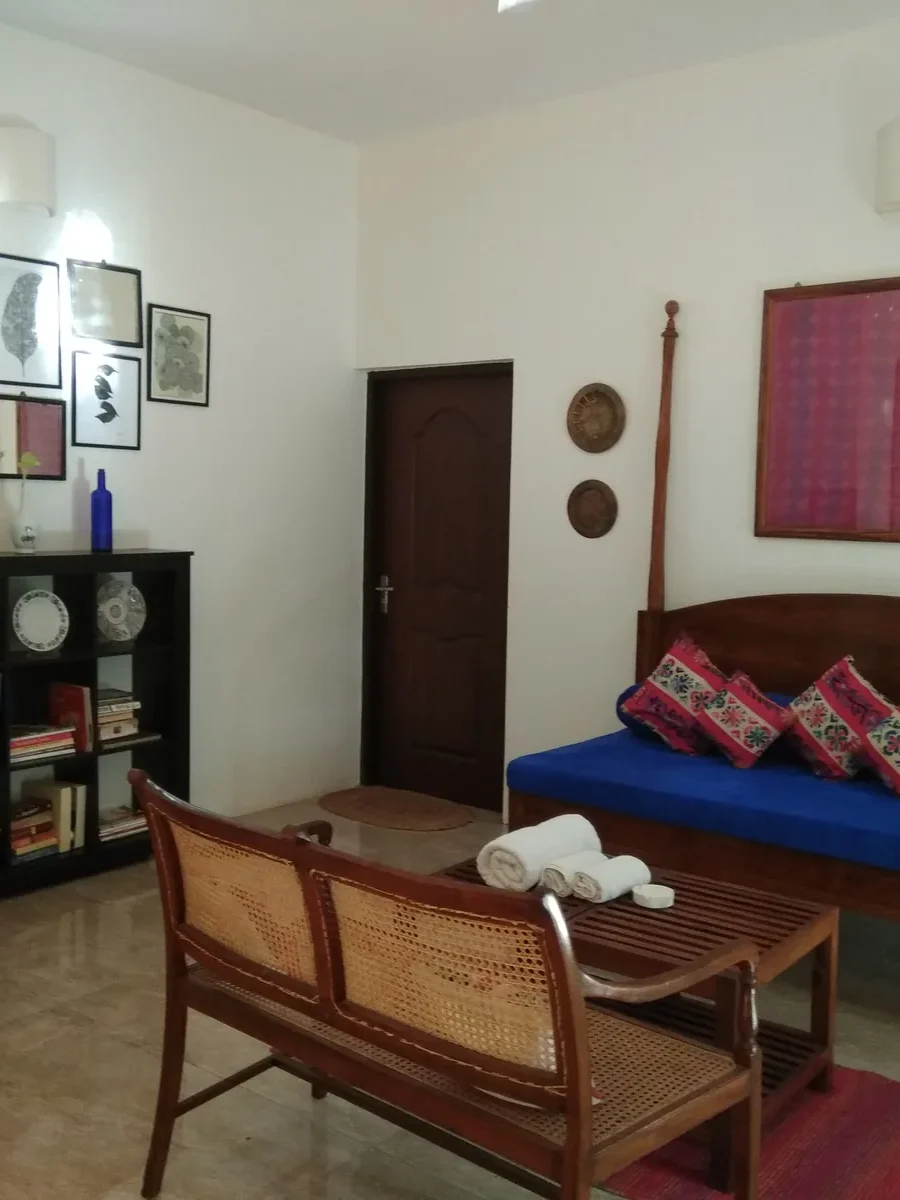
A deco-era house does not need deco furniture. It needs pieces that respect its lines: long, low shapes, rounded arms and corners, solid timber or simple upholstery, and a sense of order. A custom sofa made with a clean, curved arm and a plain fabric will sit better against a terrazzo floor than a reproduction club chair. Older Goan pieces, cane and rosewood, mix well too, because many families furnished these houses with what they already had.
Use pattern sparingly and geometrically. If the floor or the grilles already have a strong motif, keep fabrics plain or textured and let one element, a rug or a cushion, echo it. Velvets and heavy weaves can look right in a deco room but hold moisture in Goa's monsoon; keep them to rooms that are air-conditioned or well ventilated, and choose easy-clean grades where they will be used hard. Linen and cotton in strong, flat colours suit the period and the climate.
Rugs on terrazzo need an underlay that will not stain or stick, and they should be lifted and dried if the floor is damp in the rains. Lighting matters: warm, indirect light from wall fittings, uplighters and table lamps shows off curved ceilings and terrazzo far better than rows of downlights.
Dressing slim steel windows and curved corners
Deco windows are often wide, with slim metal frames and little or no timber reveal to fix into. Do not drill into old steel frames to hang a blind; fix to the concrete or masonry above the opening, or to the ceiling. A ceiling curtain track fixed across the full width lets curtains stack clear of the glass and keeps the thin frames visible, which is often what makes the façade. Where an eyebrow already shades the window, a light linen or a sheer is usually enough by day.
Curved corners and bay-like windows are where made-to-measure tracks earn their keep. A track can be bent to follow the curve, so curtains run round it in one sweep; ripple-fold curtains give the even, modern folds that suit the period better than heavy pinch pleats. For bedrooms, a blackout layer can run on a second track behind.
If you prefer blinds, choose ones that sit outside the frame rather than inside a shallow reveal: roller blinds in a plain fabric, or Roman blinds for a softer look, mounted above the opening and wide enough to cover the frame. Try combinations in the curtain simulator, and when you are ready we can measure the windows and quote; get in touch.