 Drape Haus
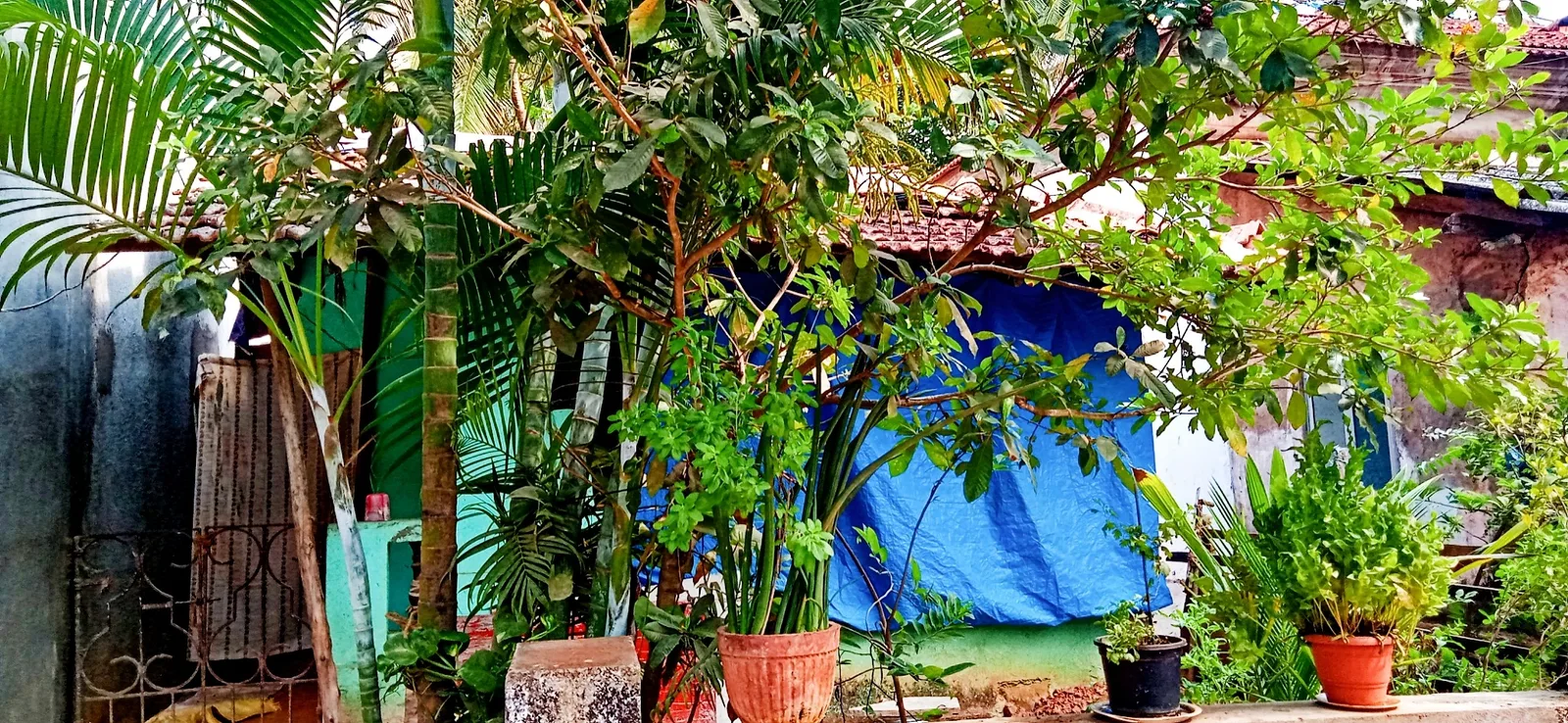
A traditional Goan house is a monsoon machine. Its steep tiled roof sheds water fast, its deep eaves throw that water clear of the walls, its raised plinth keeps the floor above the wet ground, its verandahs take the wind-driven rain before it reaches the rooms, and its lime-plastered walls get wet in July and dry out again by November. Tall openings and a courtyard keep air moving through months of damp.
None of these parts works alone. Cut back the eaves, raise the ground around the plinth, seal the walls in cement or shut every window, and the system fails, usually as damp walls, mould and rot. This guide takes each part in turn, using India Meteorological Department figures for the rain it has to handle and building-science sources for how it works, then sets out what a new Goan house or villa can borrow.
We make curtains, blinds and upholstery rather than buildings, so the last section looks at the soft furnishings that suit a house built this way. For the walls in detail, see living in a laterite house; for the whole house type, our field guide to Goan architecture.
The rain the old houses were built for
The India Meteorological Department's climate summary for Goa gives the scale. Normal annual rainfall for the state is 3,370.7 mm, spread over about 103 rainy days. About 91% of it falls in the southwest monsoon from June to September, and July alone brings about a third: 1,118.5 mm in a normal year. The monsoon sets in around the first week of June and withdraws, in the summary's words, by about the third week of September, though October still averages more than 160 mm.
It does not fall gently. The heaviest one-day total on record at any Goan station is 461.8 mm, at Mapusa on 15 June 1996. From June to August the winds are mostly westerly to south-westerly, off the sea, with Panjim's mean wind speed peaking at 12.8 km/h in July, so rain is driven against west- and south-west-facing walls rather than simply falling on the roof. Humidity follows: Panjim's morning relative humidity is 88% in June and 91% in July, August and September.
Every part of the traditional house answers one of those facts: volume, intensity, wind direction or humidity. Our article on Goa's monsoon rainfall covers the season month by month.
| Measure | Figure | What it asks of a house |
|---|---|---|
| Annual rainfall | 3,370.7 mm | A roof and drainage that move a great deal of water |
| Share falling June–September | About 91% | Walls that can get wet for months and then dry |
| July rainfall | 1,118.5 mm | Gutters, valleys and drains that cope at peak |
| Heaviest day on record | 461.8 mm (Mapusa, 1996) | Eaves and plinths with a margin for extremes |
| Monsoon wind | Westerly to south-westerly | Protection for the sea-facing walls |
| Panjim morning humidity, Jul–Sep | 91% | Ventilation, and materials that tolerate damp |
A steep tiled roof and deep eaves
The roof is the first defence and the one that matters most. Old Goan roofs are pitched timber frames carrying clay tiles, in later houses the interlocking Mangalore pattern. The Bureau of Indian Standards' code of practice for Mangalore-tile roofs, IS 2858:1984, sets the pitch at not less than 24° and not more than 45°, and adds that in areas of heavy rainfall the minimum may not give full protection, so the pitch should be increased and each tile screwed or tied down. It asks for a head lap of at least 75 mm where the tile design does not fix one.
The same code covers the edge of the roof. At the eaves, it says, the lowest course of tiles should overhang far enough that the water draining off the roof discharges clear into the gutter. Against wind, the bottom course and preferably several above it should be tied to the battens with galvanised wire, and the eaves tiles held down with a steel flat. These details explain why a well-kept Goan roof survives storms that strip a carelessly laid one.
Then comes the overhang itself. The Goan house carries its roof well beyond the walls. A 2014 paper on Goan houses from Government Polytechnic Panaji describes traditional roofs as simple two-way or four-way slopes with huge overhangs shading the verandahs, and an essay on Goan architecture in Question of Cities notes that the sloping Mangalore-tiled roofs aid both cooling and quick drainage in the heavy monsoon. Deep eaves keep the rain off the upper walls and the window heads, and they keep the high sun off the openings in the dry months.
If one change has done most damage to old Goan houses, it is cutting back the eaves. Keep the overhang, and keep the gutters beneath it clear.
Planning something like this?
We visit homes across North and South Goa, measure on site, and bring samples to see in your own light.
Plinth, verandah and the house in layers
Below the roof, the house is arranged in layers that keep water away from the rooms. The Question of Cities essay puts it simply: high ceilings, verandahs and raised plinths protected houses from heat and dampness, while courtyards and high openings pulled air through. The plinth lifts the floor clear of standing water and rain splash, and the steps up to the door are as practical as they are ceremonial. A raised plinth only works, though, if the ground around it stays lower; paving, soil or concrete built up against the base over the years sends runoff straight into the wall.
The verandah and the balcão are the next layer. With the monsoon wind blowing from the west and south-west, rain does not fall vertically on a Goan house; it arrives at an angle, and the verandah takes it before it reaches the doors and shutters behind. The space is designed to get wet, which is why its floors are hard and its seats are masonry.
There was once a seasonal layer, too. Goan families wove mats from coconut palm leaves, mollam in Konkani, and hung them on balcões and porches; Gomantak Times describes them as a covering that protected the house from the rains and was gradually replaced by plastic sheets. Asia InCH, an encyclopedia of intangible cultural heritage, records palm fronds plaited into covers to protect mud walls, rain shields and window shutters. Chiks and outdoor blinds do the same job today.
Walls that get wet and dry out
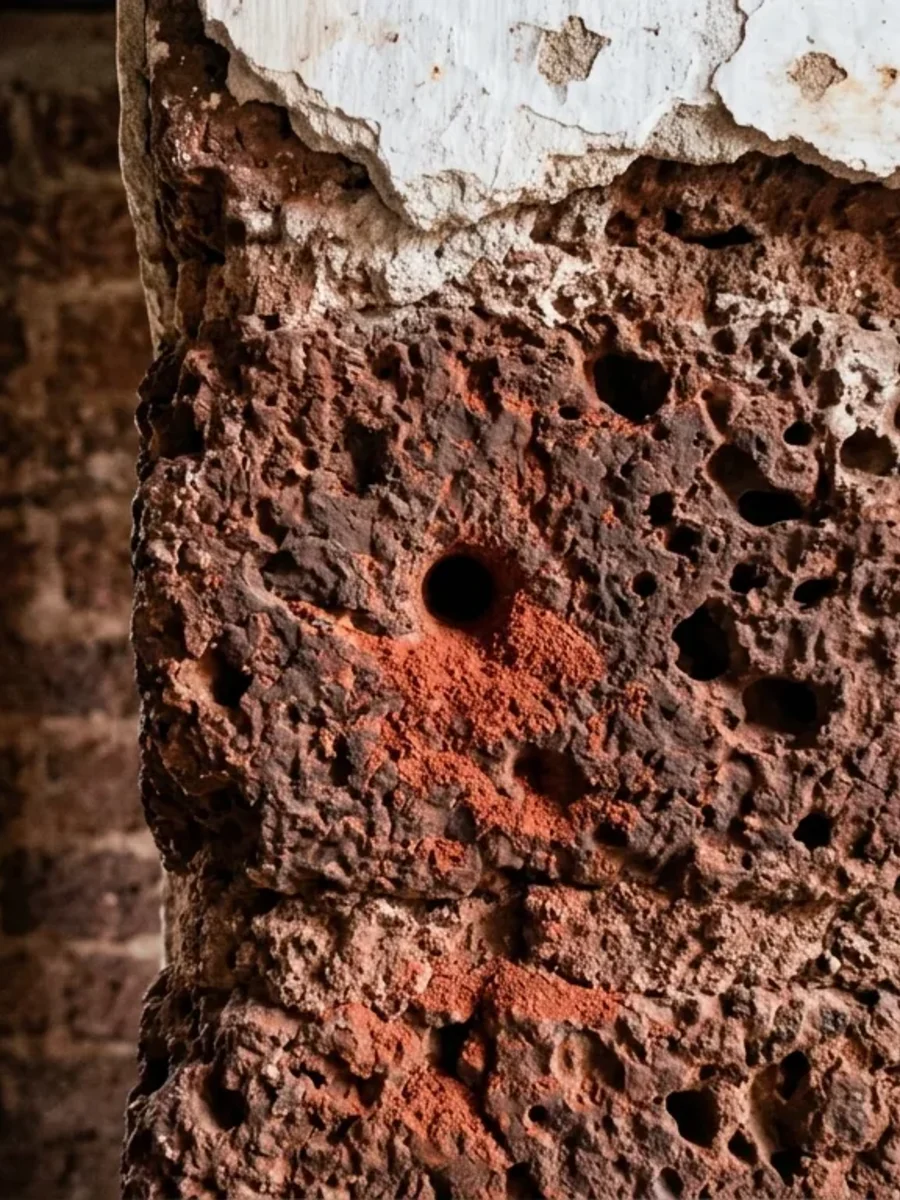
The walls of an old Goan house, laterite or mud with lime plaster and limewash, are not waterproof and were never meant to be. They take up moisture in the monsoon and release it in the dry months. The Society for the Protection of Ancient Buildings defines breathable materials as ones permeable enough for absorbed and surface moisture to evaporate in ordinary drying conditions, quickly enough that it does not build up and cause decay or mould. As a reference, it gives 19 mm of non-hydraulic lime render a vapour resistance of about 1.0 MNs/g, and suggests that materials for older buildings should be no higher than about 2.5.
Seal that wall with cement render or plastic paint and the moisture that still gets in cannot get out; it moves inward instead, as damp patches, salt bloom and blown plaster. Our laterite article, linked above, explains the mechanism, and dampness in walls covers finding the source before paying for a cure.
Thickness helps too. A deep wall can absorb a great deal before any moisture reaches the inside face, and it has a large surface to dry from when the rains stop. That is why the order of protection matters: roof and eaves keep most of the water off, the plinth keeps the base dry, the verandah takes the driven rain, and the wall only has to cope with what is left.
Air: cross-ventilation and the closed room
Moving air is what lets the whole house dry. Tall windows and doors on opposite sides of rooms, rooms that open into each other, and in many houses a courtyard, keep air passing through even on still, humid days. Shutters let the house stay open to the breeze while keeping out the worst of the rain and sun.
Modern codes reach the same conclusion. India's residential energy code, the Eco-Niwas Samhita, sets a minimum openable window-to-floor area ratio for each climate zone to ensure enough potential for natural ventilation. The figure for the warm-humid zone is 16.66%, the highest of any zone, against 10% for hot-dry and 8.33% for cold climates. Humid places need the most openable area.
The traditional house has a weak point here, and it is the closed room. A room shut for weeks in the monsoon, whether because the family is away or because it has been sealed for air conditioning, loses its ventilation and gains damp. The US Environmental Protection Agency advises keeping indoor humidity below 60%, ideally 30–50%, to limit mould. If a room must stay shut, run a dehumidifier; if the house will be closed, have someone open it on dry days. Our guide to humidity in Goa covers both.
What a new Goan house can borrow
Most new houses in Goa are built in reinforced concrete, and that is not the problem in itself. The problem is copying the look of the old house while dropping the parts that did the work. The Question of Cities essay is blunt about the result: new buildings that do not drain the rain the way older ones did, wrapped in plastic sheeting every monsoon.
The table sets out the features worth carrying into a new house or villa, and what to watch. None of it requires pastiche. A flat-roofed modern house can have deep overhangs, a raised floor, sheltered outdoor rooms and good cross-ventilation. Our article on Goan house design without pastiche goes further, and our guide to keeping a house cool without AC covers shade and airflow in the dry months.
| Feature | What it does | In a new house | Watch for |
|---|---|---|---|
| Steep pitched roof | Sheds water quickly | Pitched tile or a well-drained roof with generous falls | Tiles tied down at eaves and edges |
| Deep eaves | Keep rain off walls and window heads | Overhangs or sunshades on every exposed face | Gutters sized for monsoon peaks |
| Raised plinth | Keeps floors above standing water and splash | Floor level well above finished ground | Paving or soil built up against the base |
| Verandah or balcão | Takes wind-driven rain before the doors | Covered outdoor rooms on the sea-facing sides | Outdoor-grade furniture and fabrics |
| Breathable walls | Let walls dry after the rains | Breathable finishes; no sealed coatings on masonry | Cement patches on old walls |
| Cross-ventilation | Dries the house through the season | Openings on opposite walls; usable shutters or screens | Rooms sealed shut for AC |
Soft furnishings for a house that breathes
Textiles should work with this system, not against it. On verandahs and balcões, use shade that can be rolled up or taken down: split-cane bamboo and chik blinds are the closest modern relative of the old palm-leaf screens, and outdoor blinds in solution-dyed fabric give more control on the windward side. Cushions on masonry seats need quick-drying fillings and removable covers, and are best brought in for the wettest weeks.
Inside, choose curtains that let air through and dry quickly, such as unlined or lightly lined linen and cotton, and hang them so they clear the windows and shutters completely and stand a little off the walls. Keep coated blackout to bedrooms that are cooled or dehumidified. Fitted mosquito screens let the house stay open in the evening, which is when the monsoon air is stillest and the insects busiest.
If the house will be closed for the season, the best thing for its textiles is to take them down, clean them and store them dry before the rains, and rehang them in October. Our monsoon take-down and storage service does exactly that, and our before-the-monsoon guide lists the rest of the jobs. When you want to plan the furnishings for an old house or a new one, talk to us.