 Drapehaus
Drapehaus
Preparing the room
Drapehaus
Preparing the room
Problem
Goan architecture produces a lot of windows that are not rectangles. Arched heads in Portuguese-era houses, deep bays, angled gable glazing in modern villas, and a great many openings that are nominally square and measurably are not.
By the Drapehaus studio · 19 September 2026 · How we write
There are three possible approaches to any of them: follow the shape, ignore the shape, or leave the window undressed and let the shape be the feature. Choosing correctly between those is most of the job, and the default instinct — follow the shape — is frequently the wrong one.
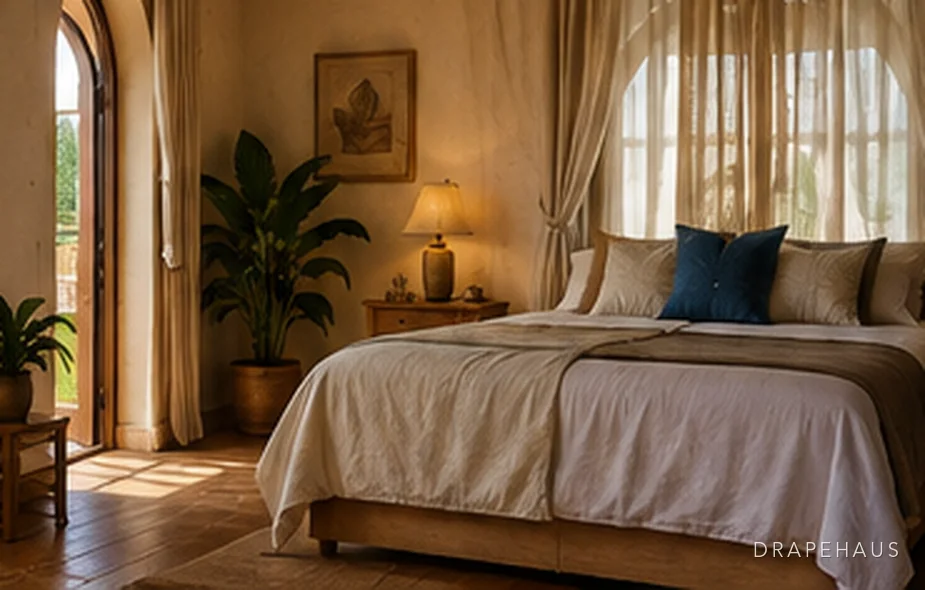
The most common good answer for an arched window is a straight track fitted above the top of the arch, with curtains that stack entirely clear of the opening. The arch stays visible and intact, the curtain does its job in the evening, and nothing fights anything.
Arch-following treatments — shaped rods, fan blinds, custom curved track — exist and can be beautiful, but they are expensive, they are fixed in place, and by definition they obscure the arch, which is usually the reason the window is worth looking at.
The test is simple: is the arch a feature you want to see, or an inconvenience you want to cover? If it is a feature, go straight and high. If the room needs genuine blackout and the arch is incidental, a shaped solution or a straight blind oversized to cover the whole opening is reasonable.
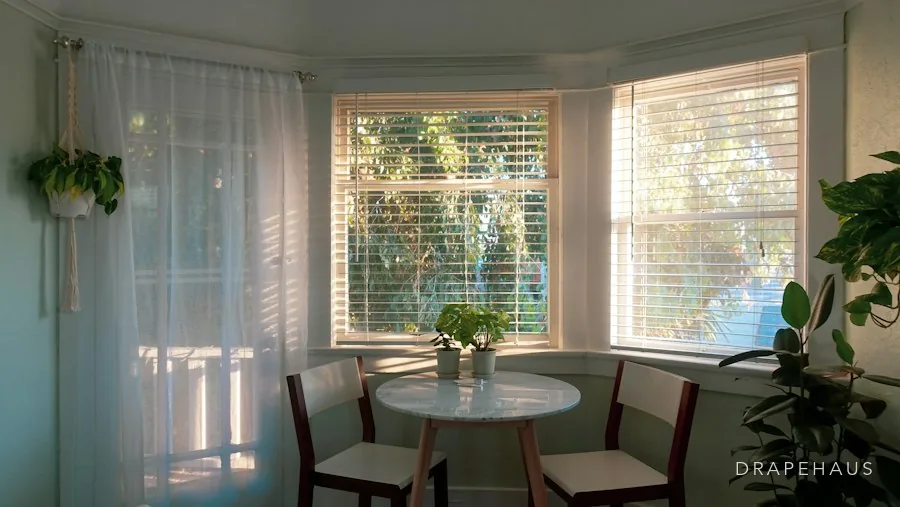
Bay windows need track that turns corners, and the quality of that bend is what separates a good installation from a poor one. Properly bent track follows the bay smoothly and lets a single curtain traverse the whole run. Light-duty push-fit corner joints catch the gliders and the curtain snags at every angle.
For deep bays, separate curtains on each face are often better than one continuous run, because each panel can be drawn independently and there is no fighting around the corners. It also means a torn or stained panel can be replaced without remaking the whole set.
Angled and triangular gable glazing is the hardest case. Fixed or fan-shaped treatments are the usual answer; a straight blind across the base of the triangle handles the glare at eye level and leaves the peak clear, which is often enough.
Rather see it in your own room?
We bring samples to the house, measure every window, and specify for the light and exposure you actually have.
More on this — tap a heading to read
Older Goan openings are frequently out of square by two or three centimetres across their width, and restoration work often makes this worse rather than better. This is normal and not a defect.
It matters because rigid treatments cannot follow it. A roller blind made to one dimension in a tapering reveal leaves a visible wedge of light down one side that cannot be adjusted away. Gathered curtains absorb the same irregularity invisibly.
Where a blind is wanted in an irregular opening, fit outside the reveal and oversize deliberately, covering the irregularity instead of trying to fit within it. That is a decision to make when specifying, not a compromise to discover on installation day.
A rectangular window needs a width and a drop. An irregular one needs a template. For arches we measure the springing points, where the curve begins on each side, the height at the crown, and several points along the curve, or trace the arch onto paper. Few Goan arches are true semicircles; many are segmental, slightly flattened or subtly asymmetric.
For bays, each face is measured separately, along with the angle between faces and the depth of the bay. The angles are rarely identical, even in modern construction, and a track bent to a standard angle will not sit flush. For any old opening, we take diagonals as well as widths and drops. The difference between the diagonals shows how far out of square the opening is, and it decides whether a blind can fit inside the reveal.
Bendable aluminium tracks can be curved on site or in the workshop to follow a bay or a gentle curve. The radius of the bend matters: too tight and the gliders bind, so the track manufacturer's minimum bending radius must be respected. Ceiling fixing is often simpler for bays, because the ceiling line is continuous while the wall line is broken by corners.
Poles for bays use angled or flexible joints at each corner. Passing brackets let rings travel past a bracket so a curtain can move freely along a long pole, while ordinary brackets stop the rings at each support. For arched windows, a straight pole or track above the arch is the simplest hardware. Where a shaped treatment is chosen, the curved rod needs fixing at several points around the arch, and the fabric is usually fixed in place, gathered on the curve and held back with tiebacks.
In Portuguese-era houses, the window is often the most valuable element of the room. Original arched frames, timber shutters, carved mouldings and oyster-shell panes should be left intact and visible wherever possible. The treatment should work with the window rather than cover it. Many of these windows were designed with internal shutters for light and privacy, and working shutters may make a curtain unnecessary. Where a curtain is still wanted for softness or evening privacy, a simple pole above the architrave with an unlined curtain stacking fully clear is usually the right choice.
Avoid fixing into original mouldings, carved timber or decorative plaster, and choose hardware that sits lightly on the wall. Anything that would be difficult to remove without leaving damage is worth reconsidering. Where a bracket has to go near original work, fixing through an existing hole or into a plain section of wall a little further out is usually possible, and a slightly wider track costs far less than a damaged moulding.
Arched fanlights and gable glazing often sit high on the wall, where they catch sun that lower windows miss. In the dry season from November to May, an unshaded fanlight on a west or south elevation can put a patch of hard sun across the room in the afternoon. A fixed solar film or a simple fixed fabric panel can deal with this without affecting how the arch looks. In the monsoon, the same windows may be the main source of daylight in a room darkened by cloud, so any treatment on them should be light and allow daylight through rather than blocking it.
Shaped and fixed treatments are difficult for guests to use and easy to damage. In a let property, the better choice is usually a straight track above the arch or across the bay, with a curtain that anyone can draw without thinking. It is also easier to clean and to replace. Where the opening needs darkness for sleep, oversizing a straight treatment is more reliable than a shaped one. A curtain that extends well beyond the frame on each side and above the arch blocks light at the edges, which is where shaped treatments tend to leak.
Diagnosis
WhyA shaped treatment covers the arch, which is the thing worth seeing.
FixStraight track above the arch with curtains stacking clear of the opening. Let the arch be visible.
WhyLight-duty push-fit corner joints rather than properly bent track, so gliders catch at each angle.
FixProperly bent track, or separate curtains on each face of the bay drawn independently.
WhyThe opening is out of square and a rigid blind cannot follow a tapering reveal.
FixFit outside the reveal and oversize to cover the irregularity, or use a gathered curtain which hides it entirely.
WhyStandard treatments assume a rectangle; the geometry defeats them.
FixA straight blind across the base of the triangle controls eye-level glare and leaves the peak clear. Often sufficient.
WhyA straight treatment stopping at the springing line, or a shaped one that does not seal to the arch, leaves gaps.
FixMount the straight track higher and wider so the curtain overlaps the arch, or fit a fixed shaped panel behind the main curtain.
WhyThe track follows the bay but there is no room at the ends, so the stacked fabric sits over the window.
FixExtend the track beyond the bay ends where the walls allow, or split into separate curtains that stack on each face.
WhyThe opening was measured as a regular shape, but the arch or angle was irregular in reality.
FixMake a paper template of the actual opening, check it on site, and build the treatment to the template.
Checklist
Decide whether the shape is a feature or an inconvenience
Default to straight track above an arch, not a shaped one
Specify properly bent track for bays, never corner joints
Check every old opening for square before choosing blinds
Oversize deliberately where a reveal is irregular
Consider leaving a beautiful opening undressed entirely
Template every arch rather than assuming it is a true semicircle
Measure each face and angle of a bay separately
Respect the minimum bending radius on curved track
Preserve original shutters, mouldings and shell panes where they exist
From the Journal
All articlesFAQ
Usually with a straight track fitted above the top of the arch, so the curtains stack clear of the opening and the arch stays visible. Shaped rods and fan blinds exist but they cover the arch, which is normally the reason the window is worth having.
Properly bent track that follows the bay smoothly, so a single curtain can traverse the whole run without catching. Light-duty push-fit corner joints snag the gliders at every angle. On a deep bay, separate curtains on each face are often better still.
The opening is out of square, which is very common in older Goan buildings. A rigid blind cut to a single dimension cannot follow a tapering reveal. Fit outside the reveal and oversize deliberately, or use a gathered curtain, which hides the irregularity completely.
A straight blind across the base of the triangle deals with glare at eye level and leaves the peak clear, which is usually enough. Fully shaped fixed treatments are possible but expensive, permanent, and they hide the geometry that made the window interesting.
Not in the usual sense, because a roller has to be straight. For an arch, a roller can cover the rectangular part below the springing line and leave the curve clear, or be oversized to cover the whole arch from outside. For a fully shaped cover, a fixed fabric panel or fan shade is used instead.
Measure the width at the springing points, the height to the springing line and to the crown, and the distance from the crown to the ceiling. For a shaped treatment, make a paper template of the arch. For a straight track above the arch, the key figures are the overall width and the height from the top of the arch to the ceiling.
For most bays, curtains on a properly bent track or separate curtains on each face, depending on how the bay is used. Roller or Roman blinds fitted to each face give a cleaner look and leave the window seat clear. The choice depends on whether the bay is a sitting space, a view or simply a large window.
Only as much as the room needs. If the window has working shutters, they may already provide privacy and shade. Where a curtain is needed, a straight pole above the architrave with a curtain that stacks clear keeps the arch visible. Avoid fixing into original timber, mouldings or decorative plaster.
Yes. A straight track can be fixed level at or above the highest point, with the curtain made to the full drop, so the slope is covered. Alternatively, the track can follow the slope and the curtain be made with a sloping heading, but it will not draw well uphill. Fixed panels held back with tiebacks are another option for angled glazing.
Keep reading