 Drapehaus
Drapehaus
Preparing the room
Drapehaus
Preparing the room
Problem
Salt air is the reason expensive curtains fail in Goa while plainer, less costly ones a few kilometres inland last for years. It is not a quality problem and it is not bad luck. It is a specification problem, and it is almost entirely predictable once you understand the two separate mechanisms at work.
By the Drapehaus studio · 19 September 2026 · How we write
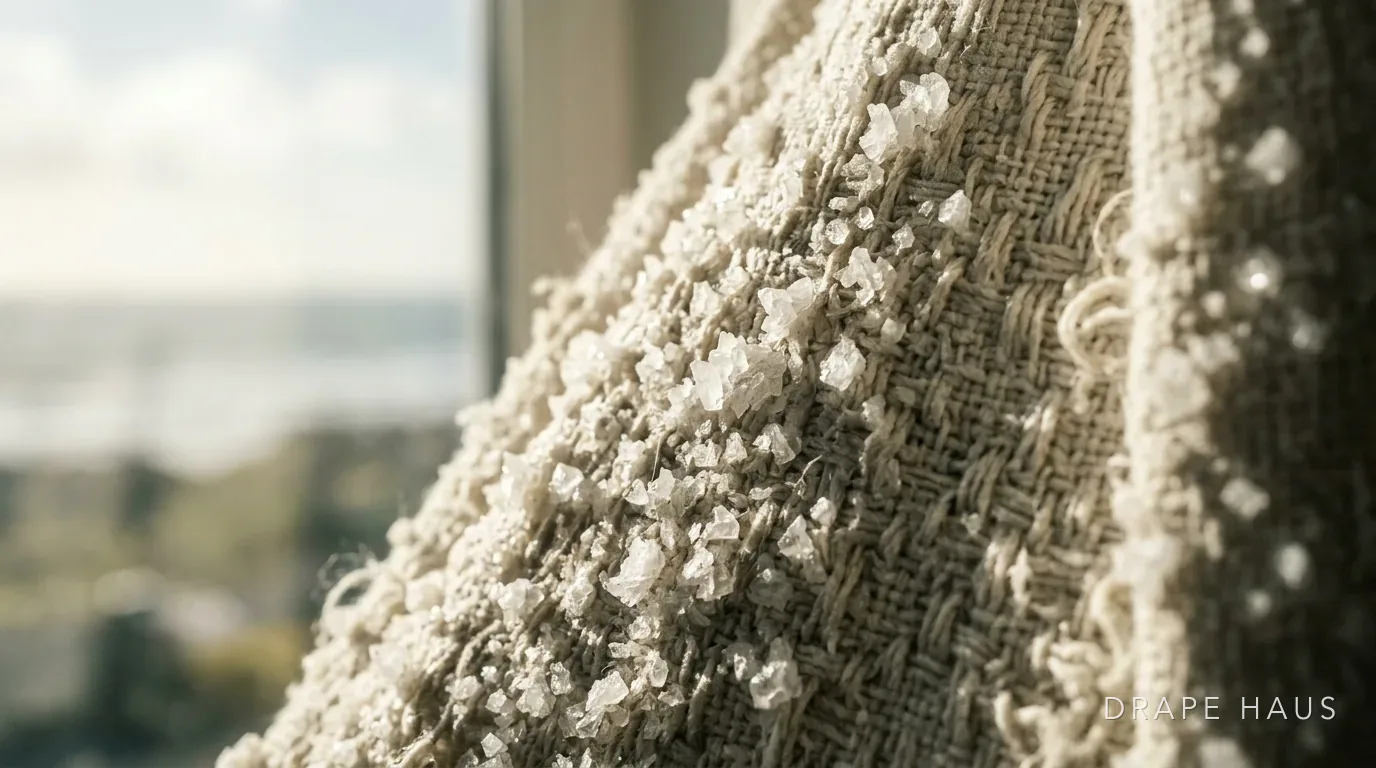
Most people assume salt is corrosive in the way acid is — that it attacks fabric chemically. It does not, really. The damage comes from abrasion and from moisture, and understanding that is what makes the right specification obvious.
The first is mechanical. Airborne salt crystals are hard and angular, and they settle into the weave of any fabric exposed to onshore wind. Every time the curtain moves — every draw, every gust through an open window — those crystals work against the fibres like a very fine abrasive. Over a season it dulls colour and weakens the yarn, and it shows first at the leading edge and the hem where handling adds to the movement.
The second is moisture, and it is the more destructive of the two. Salt is hygroscopic: it actively pulls water vapour out of the air and holds it. A curtain carrying salt is therefore a curtain that is permanently slightly damp, even on a clear February afternoon with the windows open. That sustained low-level moisture is exactly the condition mildew needs, which is why coastal curtains spot even in properties that are occupied and ventilated.
Natural fibres suffer far more from the second mechanism because they absorb moisture readily. Synthetics largely do not, which is the whole basis of the recommendation that follows.
Closer than about two hundred metres from the water, salt deposition is heavy and visible — you can see it on glass within days of cleaning. Everything in this section applies at full strength.
Out to roughly a kilometre, salt is still present in meaningful quantity on anything exposed to onshore wind, particularly on upper floors and west-facing elevations with no shelter. Fibre choice still matters a great deal; hardware choice matters absolutely.
Between one and three kilometres the effect tapers, and the dominant problem shifts from salt to ordinary monsoon humidity. Natural fibres become viable again provided the room gets airflow.
Beyond about three kilometres, standard humid-climate rules apply and salt is no longer the limiting factor. These distances are rules of thumb rather than hard lines — a sheltered ground-floor room at eight hundred metres may see less salt than an exposed top floor at two kilometres.
Rather see it in your own room?
We bring samples to the house, measure every window, and specify for the light and exposure you actually have.
More on this — tap a heading to read
Solution-dyed acrylic is the best available answer. The pigment is added to the liquid polymer before the fibre is extruded, so colour runs through the material rather than sitting on the surface. Strong sun does not bleach it and salt abrasion does not expose undyed core. It is what outdoor and marine fabrics are made from, for exactly these reasons.
Good polyester and polyester blends are the practical second choice and considerably less costly. Polyester absorbs very little moisture, so the hygroscopic mechanism has much less to work with.
Untreated cotton and linen will spot with mildew within a season or two close to the water. Silk and viscose are the worst possible choices — both watermark permanently and degrade quickly.
For hardware, marine-grade stainless steel, anodised aluminium or properly powder-coated components. Untreated mild steel will corrode within one monsoon and bleed rust down the wall below it, which on lime plaster is close to impossible to remove.
Distance on a map is only the starting point. Before we specify anything near the sea we look for the evidence the building already carries: a grey bloom on window glass a few days after cleaning, white crust in the corners of aluminium frames, pitting on door hinges, and rust tracks below any exposed steel. Each of these tells you how much salt is actually reaching that elevation, which is the number that matters.
Orientation comes next. The monsoon wind in coastal Goa blows from the west and south-west, off the sea, and IMD records mean wind at its strongest in July. A west-facing upper room with nothing between it and the water takes the full load; the same house's east rooms, sheltered behind the building's own mass, may see a fraction of it.
Finally, look at how the room is used. A window that stays open for the breeze every evening admits far more salt than one kept shut behind a screen door. Two rooms in the same house can warrant different specifications, and it is worth writing that down room by room rather than applying one rule to the whole property.
Corrosion rarely starts on the visible rod. It starts in the parts nobody chose: the screws, the wall plugs, the steel spring inside a bracket, the small fixing that holds a finial on. A marine-grade pole mounted with zinc-plated screws will still stain the wall, because the screw heads rust first and the runoff tracks down the plaster.
We therefore specify the fixing set as carefully as the rod. Stainless screws of the same grade as the bracket, nylon or stainless gliders rather than plated steel, and plastic isolating washers wherever an aluminium track meets a steel bracket. Contact between dissimilar metals in salty moisture sets up a small galvanic cell, and the less noble metal corrodes quickly. Operation matters too. Salt crystals build up in track channels and make gliders drag, which tempts people to pull harder on the fabric. A track with an open, easily wiped channel, or a wand that keeps hands off the leading edge, protects both the mechanism and the curtain itself.
The useful moment to specify or replace coastal curtains is the dry season, roughly November to May, when fabric can be measured, made and hung without arriving damp and walls can be drilled and patched with plaster that will actually cure. Hardware fitted in the rains goes into masonry that is already wet.
The most important maintenance moment is just after the monsoon withdraws, which IMD now puts at around mid-October for this part of the coast. By then a season of onshore wind has loaded every exposed fabric with salt. A proper wash, or at least a thorough rinse of sheers and a wipe of every bracket, removes that load before the dry months bake it into the fibres. A lighter check before the rains is also worthwhile: tighten fixings, replace any glider that has begun to stick, and confirm that curtains clear the floor so hems will not wick water once the wet season starts.
In a family home near the sea, owners notice early signs and act on them. In a let villa or homestay, guests do not, and housekeeping teams are rarely briefed to look for salt bloom or a sticking track. Problems surface only when a guest photographs a rust streak or a mildewed hem, and by then the damage is several months old.
For rental properties we lean towards the more robust end of every choice: solution-dyed fabric even where polyester would be adequate, sealed-bearing blind mechanisms, simpler hardware with fewer small parts, and removable, washable panels on hooks so a caretaker can take curtains down for the post-monsoon wash without calling anyone. Heavy-use rooms in hospitality also justify a higher abrasion rating on any upholstery-weight fabric. Martindale results in the severe domestic or contract bands are a reasonable target for a curtain that dozens of different guests will draw each season.
The most common failure we are called to is not a curtain that wore out; it is a wall that was ruined by the hardware. Rust runoff on lime plaster soaks into the surface, and once it has set, cleaning moves it around rather than removing it. The fix is usually replastering and repainting a section of wall, which is disruption out of all proportion to the original bracket.
The second pattern is premature replacement. A natural-fibre curtain chosen for its look can spot, fade at the leading edge and weaken along the hem within a couple of seasons, and then the whole set is replaced at once. Specifying correctly the first time is almost always the more economical path over the life of the room, even when the fabric itself costs more per metre.
Diagnosis
WhySalt abrasion concentrated where the curtain is handled and moves most, combined with UV on an exposed elevation.
FixSolution-dyed acrylic, where colour runs through the fibre so abrasion does not expose undyed material.
WhyHygroscopic salt holds moisture in the fabric permanently, so ventilation alone never gets it fully dry.
FixSwitch to synthetic fibres that do not absorb moisture, and wash out accumulated salt at the end of each monsoon.
WhyUntreated mild steel corroding in salt air, with runoff staining porous plaster.
FixMarine-grade stainless, anodised aluminium or powder-coated hardware. Keep dissimilar metals from touching, which accelerates corrosion.
WhyThis is the hygroscopic effect and it is a warning sign, not a quirk. That fabric is heading for mildew.
FixWash to remove salt load, improve airflow behind the curtain, and reconsider the fibre if it recurs.
WhySalt crystals and fine sand accumulate in the channel, and plated components begin to corrode, adding friction every time the curtain is drawn.
FixWipe the channel with a damp cloth after the monsoon, replace steel gliders with nylon ones, and choose tracks with an open, cleanable profile.
WhyUnprotected aluminium forms a powdery oxide in salty moisture; it is cosmetic at first but roughens the surface and marks fabric.
FixSpecify anodised or powder-coated aluminium, and rinse and dry exposed sections at the end of each wet season.
WhyFine open weaves trap salt and airborne dust together; the salt holds moisture and the grime binds into the fibre.
FixWash sheers more often than heavier curtains near the sea, and choose polyester voile, which releases soiling readily and dries quickly.
Checklist
Establish the actual distance to the water before choosing fibre
Specify synthetics within a kilometre; solution-dyed acrylic under 200m
Marine-grade or anodised hardware without exception near the coast
Never put dissimilar metals in contact
Rinse or wipe hardware at the end of each monsoon
Wash fabric seasonally to remove accumulated salt, not just dirt
Inspect glass, hinges and frames for salt bloom before specifying anything
Specify screws, gliders and washers to the same grade as the brackets
Isolate aluminium tracks from steel with nylon or plastic washers
Schedule a full wash and hardware wipe-down soon after the monsoon withdraws
From the Journal
All articlesFAQ
Heavily within about two hundred metres of the water, meaningfully out to roughly a kilometre on exposed elevations, and tapering to insignificance past about three kilometres, where ordinary monsoon humidity becomes the dominant issue instead. Exposure matters as much as distance — a sheltered ground floor sees less than an exposed top floor further away.
Solution-dyed acrylic. The colour is locked into the fibre before it is spun, so sun cannot bleach it and abrasion cannot expose undyed core. Polyester blends are a less costly and still very serviceable second choice. Avoid untreated cotton, linen, silk and viscose entirely.
Salt in the fabric is drawing moisture out of the air and holding it. It is hygroscopic, so the curtain never fully dries regardless of how sunny it is. That permanently damp state is what leads to mildew, so treat it as an early warning rather than a curiosity.
Within a kilometre of the sea, yes. Untreated mild steel corrodes within a single monsoon and the runoff stains the wall beneath it permanently. Marine-grade stainless, anodised aluminium or powder-coated components cost more and are the single best-value upgrade in a coastal specification.
Close to the water, pure linen is a poor choice: it absorbs moisture, holds salt and spots with mildew quickly. If you love the look, a linen-effect polyester or a blend with a high synthetic content gives a similar texture with far less risk. Pure linen becomes more realistic a few kilometres inland in a well-ventilated room.
At least once a year, ideally soon after the monsoon ends, to remove the salt load that has built up over the wet season. Sheers in exposed rooms benefit from a second wash before the rains. The aim is not only cleanliness: removing salt removes the hygroscopic effect that keeps fabric damp.
Usually the screws. Brackets are often supplied with plated steel fixings, and those corrode first even when the rod and bracket are stainless. Replace them with stainless screws of the same grade and isolate any contact between different metals, then treat or repaint the stained plaster once the source has stopped.
Not automatically. A roller blind has less fabric to trap salt, but its mechanism has springs, chains and brackets that can corrode. Where blinds are used near the sea, choose sealed or plastic-bodied mechanisms and polyester or PVC-coated fabric. Many coastal rooms work best with both: a blind for control and an unlined curtain for softness.
Keep reading