 Drape Haus
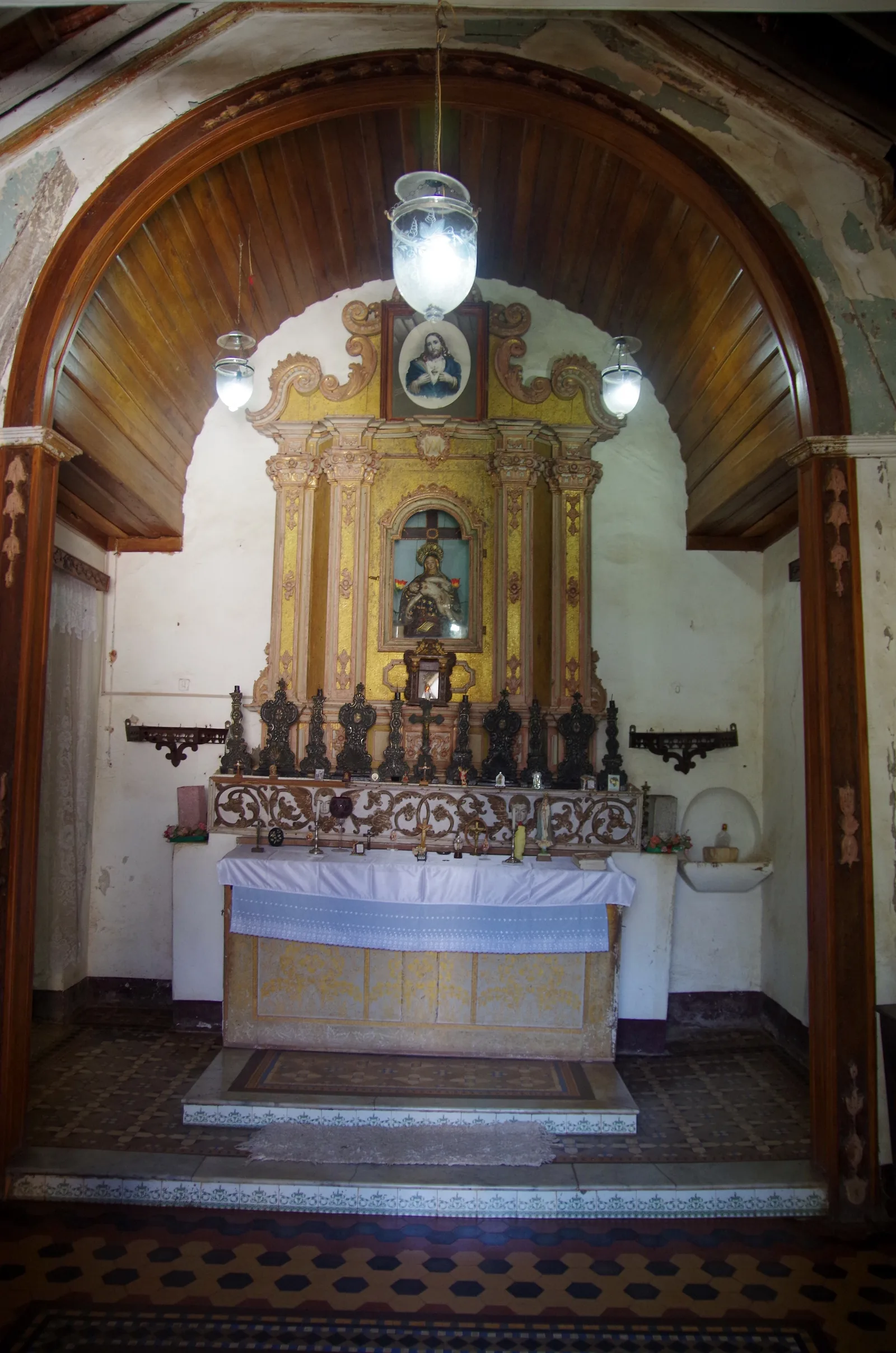
In Portuguese, an oratório is a cabinet or niche for devotional images, a domestic chapel, or simply a place of prayer. In Goan homes the same thing is most often just called the altar. A Gomantak Times feature on the custom describes it as the one feature you will find in the average Goan Catholic home: an altar given pride of place on a wall of the entrada in a traditional house, or of the living room in a modern one, where the family gathers each day at prayer time.
Practices vary from family to family and village to village, and we describe only what published sources record. What they record is consistent enough to be useful. The altar can be ornate carved wood in the style of its period or a simple glass-fronted cabinet. It holds statues, a crucifix, pictures, flowers and candles. It is used every day, not kept for show.
That daily use is what makes care important. Altar cloths and lace sit beside open flames. Painted statues and carved timber spend the monsoon in air that is damp for months. This guide sets out what the sources say about the oratório, then turns to the practical side: fabrics, flame safety, care of wood and statues, and storing festive textiles through the rains.
What the oratório is, and where it sits
The Gomantak Times account is the clearest recent description. It places the altar on a wall of the entrada, the entrance hall of a traditional house, or of the living room in a newer one. It notes that the altar might be ornate wood, reflecting the style and workmanship of its era, or plain glass with no ornament, and that what matters is its role: as a church gathers a parish, the home altar gathers the family, young and old, at prayer time each day.
The same feature records how the objects on it have changed. In the 1950s and 1960s, it says, a picture of the Sacred Heart of Jesus, a crucifix and a statuette of St Anthony were the essential items, with flowers and candles. From the 1990s more decorative figurines in many designs and colours began to appear. In Portuguese times, a priest quoted in the piece recalls, rosaries, statues and medals came mostly from Portugal and Italy.
Larger houses went further and had a chapel. Writing on Goan house plans describes a front door leading to a foyer, and from there to the sala, the sala de visita and, in some houses, the family chapel. The Government of Goa's overview of the heritage mansions mentions houses with their own small chapels. Our guide to the Portuguese house plan shows where the chapel sits in the sequence of rooms.
Old oratories and the devotional art of Goa
The portable oratory cabinet has a long history in Goa. A London auction catalogue note on a 17th-century example from Goa, made of teak, ebony with silver mounts, ivory and gilt copper, explains that oratories of this type were used in domestic interiors as private praying altars, and perhaps in monastic cells. Such a piece opened on hinged doors to reveal carved scenes inside, much as a church altarpiece does at a larger scale.
Goan workshops also produced devotional figures in ivory. The Victoria and Albert Museum holds several, including a group of the Christ Child as the Good Shepherd made in Goa in about 1650. The museum notes that this subject is common in Indo-Portuguese ivories and seems to be unique to Goa, and that the sleeping, seated pose of the Child recalls images of the Buddha in Indian art.
Families have their own stories of the same mixing. At the Figueiredo house in Loutolim, the family told a writer for The National that the craftsmen who worked on the house came mostly from the local Hindu community, carved deities into the furniture and draped a sari over the marble Virgin Mary at the family altar. If you have inherited an old altar or its figures, treat them as both devotional objects and historic ones. Pieces with ivory, old paint or gilding need specialist advice before any cleaning, repair or sale. For the wider furniture tradition, see our guide to Goan furniture.
Planning something like this?
We visit homes across North and South Goa, measure on site, and bring samples to see in your own light.
Prayer at home: the ladainha and the house cross
The home altar is part of a wider pattern of prayer that brings neighbours into the house. A history of the ladainha, the sung litany, on the Goan Churches site describes ladainhas held throughout the year: to commemorate the enthronement of the Sacred Heart of Jesus, which may coincide with a wedding anniversary or a birthday, or in devotion to a saint on the feast day. It records that it is a tradition for Catholic homes to have a cross in front of the house, where the family holds an annual ladainha, and that ladainhas at crosses and small chapels are most frequent in May.
The same account calls the ladainha a kind of folk oratorio, sung and recited, with hymns and prayers, and notes that after it come hymns such as the Salve Rainha and, always, one in honour of St Francis Xavier. It is a reminder that the word oratorio in Goa can point to music as well as furniture.
For the house, a ladainha means guests standing or seated in the entrada, the sala or the balcão, often in the evening, with candles lit at the altar or the cross. It is worth thinking about seating, light and the position of curtains before the occasion rather than on the night, which is where the next two sections come in.
Altar cloths, lace and drapes
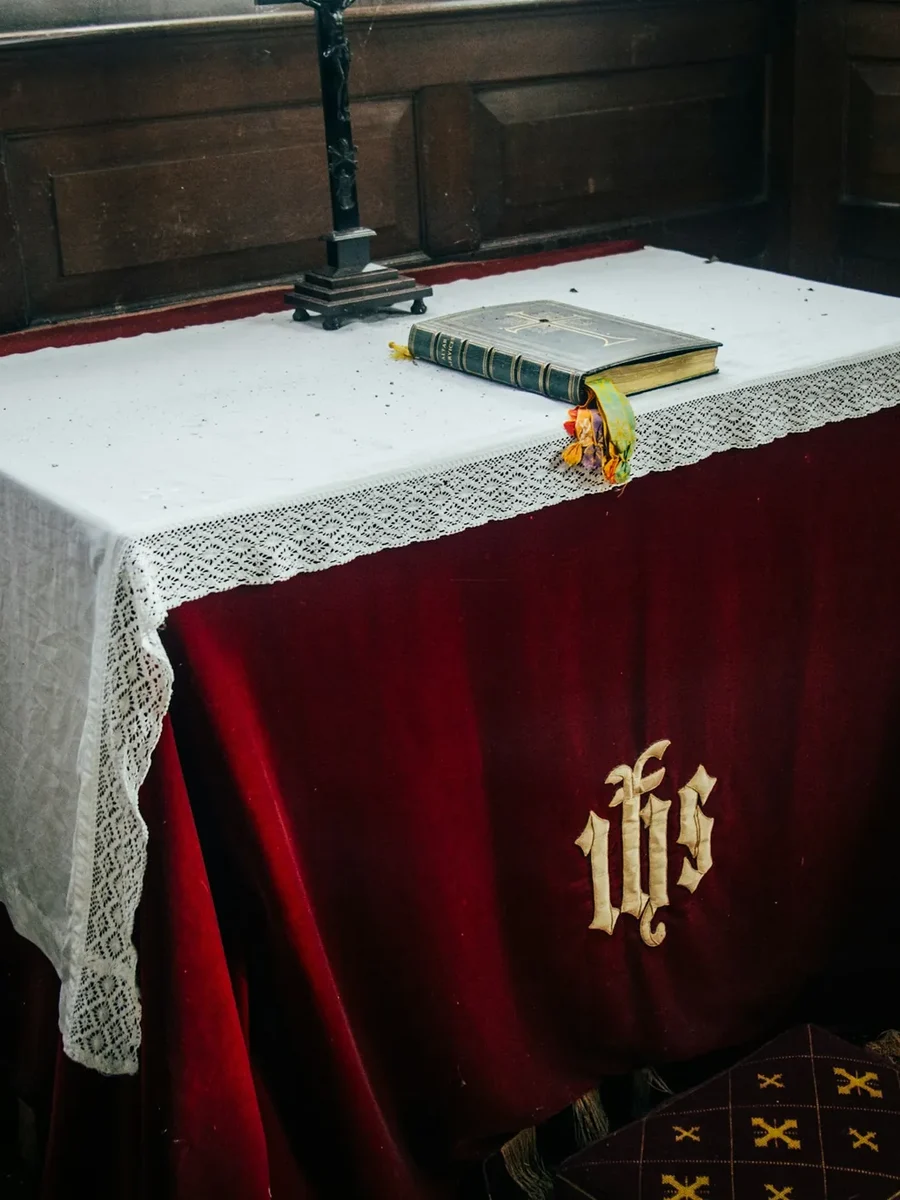
Most home altars carry at least one cloth: a white cloth on the shelf or table top, often edged with lace or crochet, and sometimes a runner or a small frontal hanging in front. Some niches have a backdrop of fabric behind the statues or a pair of small curtains that close across the front. Many of these cloths are family pieces, made or given long ago, and they deserve the same care as any heirloom textile.
For everyday cloths, cotton and linen are the sensible choices. They wash well, they take starch, and they do not hold a static charge that attracts dust. Wash old lace by hand in lukewarm water with a mild, unperfumed detergent, support it flat while wet rather than lifting it by a corner, and dry it flat in the shade, never wrung or hung in direct sun. Iron it face down on a towel so the raised work is not crushed. A heavily soiled or fragile family piece is better left to a textile conservator than risked in a washing machine.
For backdrop drapes and niche curtains, choose a fabric that will not catch easily, keep it well short of the candles, and make it removable for washing. We make small drapes, backdrops and niche curtains to measure; we do not make vestments or embroidered liturgical linens, which are specialist work. For churches and chapels, our article on church curtains and drapes covers the larger pieces.
Candles, oil lamps and fabric: keeping the altar safe
An altar combines everything a fire officer worries about: open flame, cloth, dry flowers, paper pictures and timber, often in a corner of the house where nobody is watching. The US Fire Administration, citing the National Fire Protection Association, notes that on average about 20 home candle fires are reported in the United States every day, and its advice is simple: keep candles at least 12 inches, about 30 cm, from anything that can burn, use stable holders that cannot be knocked over, and blow candles out when you leave the room or go to bed.
Those are American figures and American guidance, but they make a sensible reference point in Goa too. Measure the gap on your own altar. If a lace edge, a niche curtain or a garland hangs within 30 cm of a flame, move the cloth or the candle. Put candles and oil lamps on metal or glass trays rather than directly on cloth. Keep niche curtains tied back when anything is lit, and never leave a lamp burning in a closed house.
Battery candles and small warm-white electric lamps solve most of the problem for everyday use, and the Fire Administration suggests flameless candles as an alternative. During power cuts, use a torch rather than extra candles. Where a backdrop drape must sit near a lamp, a fabric made from inherently flame-retardant fibre is safer than an ordinary cotton, because its resistance is in the fibre rather than in a finish that can wash out; ask to see the fabric's test documentation before you buy.
Keep every flame at least 30 cm from cloth, lace, flowers and paper, and never leave it burning in an empty room.
Caring for carved wood and statues in humid air
Museum guidance treats relative humidity above 75% as damp, the point at which mould becomes a real risk. The India Meteorological Department's climate summary for Goa gives mean relative humidity of 87% to 91% in the morning and 83% to 87% in the afternoon from June to September, so for four months the air sits well above that line. An altar fixed to an outside wall, or closed behind glass doors, can stay damp for weeks. Mould shows first on the unfinished backs of cabinets, the undersides of shelves and the bases of plaster statues.
Air is the main defence. Leave a small gap between a free-standing altar and the wall, open glass doors for an hour on dry days, and avoid covering statues in plastic, which traps moisture against them. In a closed house, a dehumidifier in the room does more good than any treatment applied to the wood. Our guide to fungus on wooden furniture explains how to clean mould from timber safely, and the advice on termites in wooden furniture covers the other monsoon threat to carved work.
Statues need gentler handling than the wood. Dust painted and gilded figures with a soft, dry brush, never a damp cloth, and do not use household cleaners or polish on them. Flaking paint, lifting gilding and cracks in old plaster or wood are signs to stop and ask a conservator, not to touch up with modern paint. Lift a figure by its base with both hands, never by an outstretched arm or a halo.
Dressing the altar through the year, and storing festive cloths
Many families change the altar for Christmas, Lent and Easter, the parish feast and family occasions, but how they do it is a family matter and varies widely. If you want the cloths to follow the Church's seasons, the General Instruction of the Roman Missal sets out the colours used for vestments: white for the Christmas and Easter seasons, violet or purple for Advent and Lent, red for Palm Sunday, Good Friday and Pentecost, and green for Ordinary Time, with rose permitted on two Sundays. A set of runners in those colours, made to the altar's size, is a simple way to mark the year. Our seasonal pages for Christmas and Easter cover dressing the rest of the house.
Festive textiles spend most of the year in storage, and in Goa that means through the monsoon. A University of Nebraska–Lincoln extension guide on storing heirloom textiles gives rules that suit altar cloths and lace well. Store them flat if possible, or rolled loosely on a padded tube, rather than folded; if they must be folded, use as few folds as possible and refold them from time to time. Keep them away from outside walls, out of plastic bags, which trap moisture and invite mildew, and out of direct contact with wood and ordinary cardboard, which give off acids as they age.
Line drawers and boxes with acid-free tissue or washed, unbleached cotton, and avoid coloured tissue, which can stain damp fabric. The same guide suggests replacing acid-free tissue about every five years. Wash and dry everything fully before it goes away; a cloth put away with wax or flower stains on it in April will carry mould by August. If you are ready to replace a backdrop or a set of runners, send us the altar's measurements and a photograph.