 Drape Haus
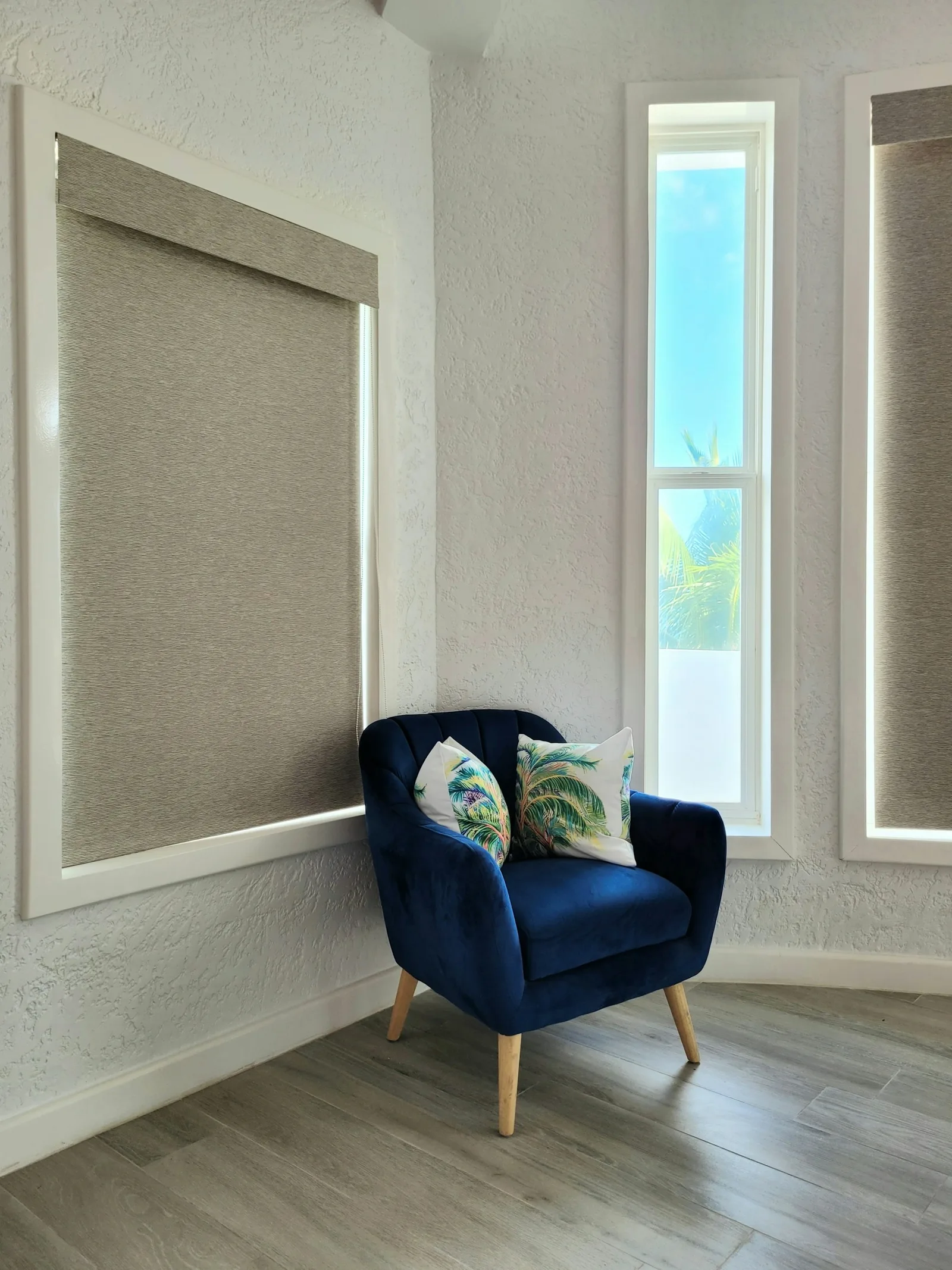
Roller blinds are a single panel of fabric wound round a tube at the head of the window and lowered or raised by a chain, a spring or a motor. Their pros are simplicity, a clean flat look, a slim roll that leaves the whole window clear when raised, a wide choice of fabrics from see-through sunscreen to full blackout, and the easiest motorisation of any blind. Their cons are light leaking at the sides when they are fitted inside a recess, little softness or insulation, no way to angle the light as slatted blinds can, and a look that can feel plain in a large living room.
In a Goan home most of those pros and cons come down to two decisions: the fabric and the fitting. The same tube carries a sunscreen that keeps the view of the paddy fields, a coated blackout that makes a bedroom dark at noon, or a wipeable PVC face for a bathroom. Fitted inside a recess without channels, any of them leaks light at the edges; fitted with a cassette and side channels, the darkest of them is as dark as a blind can be.
This guide sets out what rollers do well, where they fall short, how coated and woven fabrics cope with monsoon humidity, the safety rules for chains around children, and the rooms where a curtain or a Roman blind is the better choice. You can try fabrics and sizes on your own window in our roller blind simulator.
Why roller blinds are so popular
The mechanism is about as simple as window furnishing gets: a tube, a clutch or spring at one end (or a motor inside the tube), brackets, and a weighted bar at the bottom of the fabric. There is little to go wrong and little to clean. When the blind is raised, all that remains is a slim roll or a closed cassette at the head of the window, so a view, a carved frame or a run of oyster-shell panes is not competing with a stack of fabric.
The US Department of Energy describes roller shades as raised and lowered from a roller bar at the top of the window, usually fitted inside the window casing or just outside it, in a variety of fabrics, colours and weaves. It is equally clear about their limit: they offer only a small amount of insulation and are most effective for privacy, room darkening and blocking sunlight. That is a fair summary of what a roller is for.
Rollers also suit the way many Goan homes are built and used. Modern flats and villas have aluminium or uPVC sliding windows set in plain recesses, exactly the openings a roller fits neatly. Tall stair windows and double-height glass are easiest to cover with a motorised roller. And in a closed holiday home, a roller left down protects floors and upholstery from the sun with nothing hanging against the glass to gather damp.
- Clean, flat look; nothing left on the window when raised
- Fabrics from see-through sunscreen to full blackout on the same mechanism
- Fits neatly inside plain recesses and on sliding windows
- The easiest blind to motorise, for high and hard-to-reach glass
- Synthetic and coated fabrics that cope with humidity
Fabric choices: translucent, sunscreen, dim-out and blackout
Choosing a roller is choosing its fabric, and the four families do different jobs. Translucent or light-filtering fabrics are closed weaves that let a soft, even glow through and give privacy without any view. Sunscreen or solar fabrics are open technical weaves you can see through. Dim-out fabrics darken a room well but let a faint glow through the cloth. Blackout fabrics are fully opaque, usually with a coated back.
Sunscreens are specified by openness factor, the share of the weave that is open. The Department of Energy explains the trade-off: greater openness gives less protection against glare and solar heat but more view and more light. A tight weave suits a west-facing living room at four in the afternoon; a more open one suits a north-facing study where the view matters more than the heat. Colour matters too: a dark sunscreen is usually easier to see through, and a pale one reflects more light back.
One trap catches almost everyone. A sunscreen is see-through from the darker side towards the brighter one. By day, the outside is brighter, so you see out and passers-by see little in. After dark, with the lights on inside, the situation reverses and the room is on display. A sunscreen alone is not a night-time privacy blind; pair it with a second blind or curtains, or choose a translucent fabric where privacy matters more than view. Our guide to zebra blinds covers the striped day-and-night alternative.
| Fabric | Light and view | Privacy at night | Best for |
|---|---|---|---|
| Sunscreen (solar) | Cuts glare and heat; keeps the view | Poor once lights are on | Living rooms, offices, west glass |
| Translucent / light-filtering | Soft glow, no view | Good | Studies, kitchens, dressing rooms |
| Dim-out | Darkens; faint glow through the cloth | Good | Guest rooms, media rooms |
| Blackout (coated) | Opaque; dark if edges are sealed | Complete | Bedrooms, nurseries, shift sleepers |
| PVC-faced | Varies by fabric; face wipes clean | Depends on opacity | Bathrooms, kitchens, utility rooms |
Planning something like this?
We visit homes across North and South Goa, measure on site, and bring samples to see in your own light.
Side light gaps, and how cassettes and channels close them
The commonest complaint about rollers is the line of light down each side. It is built into the design. Fitted inside a recess, the tube needs room for its brackets and clutch, so the fabric is always a little narrower than the opening and leaves a narrow gap at each edge. With a translucent fabric nobody notices. With blackout in a bedroom at six in the morning, those two bright lines are the first thing you see.
There are three ways to deal with it. Face-fixing puts the blind outside the recess, above and wider than the opening, so the fabric overlaps the wall on every side; it is darker, though some light still escapes round the overlap. A cassette encloses the roll at the top, closing the gap where light spills over the tube and hiding the mechanism. Side channels are slim profiles fixed to each side of the recess, with the fabric running inside them and a sealed bottom bar; with a blackout fabric they give the darkest result any blind can. Our blackout blinds are usually fitted this way.
Each fix has a cost. Face-fixing needs flat wall above and beside the window and hides a little more of the frame. Channels are visible on the reveal and need a reasonably true recess, which old laterite houses with hand-plastered reveals do not always have. A good fitter will measure the recess at several points and tell you which approach suits the wall.
Inside the recess without channels, a roller always leaks light at the sides. If the room must be dark, plan face-fixing or side channels from the start.
Coated or woven roller fabric in humid Goan rooms
Most roller fabrics are synthetic, often with a coating on the back or the face. That is a real advantage in Goa, where the India Meteorological Department records morning humidity of 87 to 91 percent through the monsoon. Coated fabrics take up very little water, hold their shape and can be wiped. The Canadian Conservation Institute names cotton, linen and rayon as the fibres most vulnerable to mould, and notes that synthetics resist it unless they are soiled or carry finishes that feed it.
That last condition is the important one. A roller lowered against a window all monsoon collects dust, salt from sea air and, in an air-conditioned room, condensation from the cold glass. The US Environmental Protection Agency treats condensation on windows as a sign of high humidity and advises drying wet surfaces quickly. Dust plus damp is enough for small dark spots to appear on the back of even a polyester blind. Woven, uncoated and natural-look fabrics, linen-effect rollers especially, are more prone to spotting and harder to clean once it starts.
So in rooms that stay humid, choose a coated or PVC-faced fabric over a natural-look weave, raise the blind sometimes so the fabric can air, and never roll it up while wet. Dust it regularly with a soft brush; our guide to cleaning fabric blinds explains spot-cleaning coated fabrics without leaving tide marks. Near the sea, the hardware matters as much as the cloth: brackets, chains and bottom bars in aluminium, stainless steel or plastic rather than plated steel, which rusts and marks the fabric.
Child-safe chains and motorised rollers
Every corded or chained blind needs to be fitted with children in mind. The US Consumer Product Safety Commission states that cordless window coverings are the only way to eliminate the strangulation hazard. Where a looped chain is used, it advises anchoring the loop to the wall or floor so it stays taut but operable, and moving cots, beds and furniture away from windows. The UK's Royal Society for the Prevention of Accidents adds that a blind with a looped cord or chain should never be fitted in a child's bedroom, that cleats should be at least 1.5 m from the floor, and that cords should not be cut, which does not remove the risk.
RoSPA also notes that safety standards changed in 2014, so new blinds with looped cords or chains come with a safety device already fitted or supplied for installation. That device only protects anyone if it is actually fixed to the wall, so check that it has been. In children's rooms, spring-operated or motorised rollers, which have no loop at all, are the safer specification.
Motors solve two other problems. They make high windows usable: a stair window or the top lights of a double-height room can be covered without a ladder or a long chain. And they make the blind actually move. The Department of Energy cites its own study finding that 75 percent of residential window coverings stay in the same position every day; a timer that lowers sunscreens over the hottest hours does what most owners mean to do and do not. For Goa's power cuts, choose a rechargeable battery motor or a wired motor with a backup; our motorised blinds page explains the options.
Heat: what an interior roller can and cannot do
A roller inside the glass stops light and glare well, and it helps with heat, but less than many expect. The sun's energy has already passed through the glass by the time it reaches the blind. The Pacific Northwest National Laboratory's guidance on window attachments reports a study in which interior roller shades cut the hours a home spent in dangerous heat by about 18 percent, against about 55 percent for exterior shades.
That makes the interior roller a useful step on a hot west wall, not a complete answer. A pale or reflective back on a sunscreen helps more than a dark one, and keeping it lowered through the afternoon matters more than the fabric. For a sit-out or a glass wall that bakes every afternoon, an outdoor blind that stops the sun before it reaches the glass does far more. Our guide to heat blocking curtains explains the same principle for curtains.
Where rollers work best, and where a curtain or Roman blind looks better
Rollers are the right answer in bedrooms that must be dark, with blackout in side channels or a double roller with a sunscreen in front; in studies and home offices, where a sunscreen cuts screen glare and keeps daylight; in kitchens and bathrooms, with a wipeable PVC face; on high and hard-to-reach glass, motorised; and in rentals, where guests understand them at once and housekeeping can wipe them between stays.
They are a weaker choice where a room needs softness. A large living room with hard floors and high ceilings feels bare with nothing but flat blinds, and rollers do little for echo; dress curtains alongside give warmth, sound absorption and a frame. In an older Goan house, arched windows and deep, irregular reveals suit curtains or a carefully made Roman blind better than a straight roller. Very wide openings may exceed the fabric width, forcing a seam or a split into two blinds. Sliding doors used all day are often better served by a curtain or vertical blind that draws aside than by a roller that has to go fully up every time.
A roller and a curtain together is often the best of both: the roller does the practical work of light, privacy and darkness close to the glass, and the curtain gives softness and frames the window. Our comparison of curtains and blinds works through each room. When you are ready, see our roller blinds page; we bring fabric samples to hang against your own window, measure each recess and recommend the fitting.