 Drapehaus
Drapehaus
Preparing the room
Drapehaus
Preparing the room
Material
Blackout is the most commonly requested and most commonly failed specification in this business. Rooms are sold as having blackout curtains and then flood with light at six in the morning, and the owner concludes the fabric was not good enough.
By the Drapehaus studio · 19 September 2026 · How we write
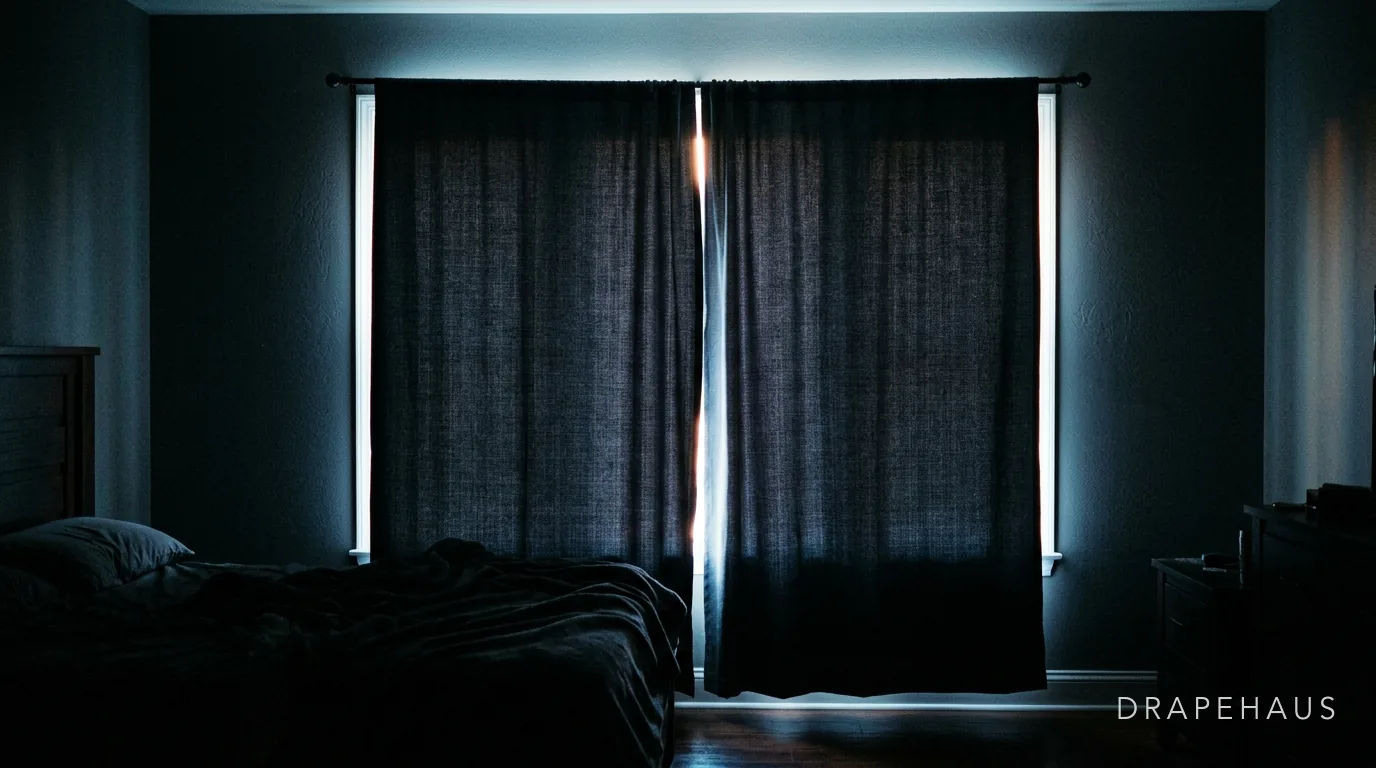
The fabric was almost certainly fine. Blackout is a geometry problem, not a fabric problem — light does not come through a properly made blackout curtain, it comes around it. Solving that is about size, returns and light paths.
The second issue is specific to this climate: several common blackout constructions do not survive sustained heat and humidity, and fail within a couple of seasons.
Light finds every path. It comes over the top of the curtain if there is no pelmet or ceiling track, down each side if the curtain does not extend well past the opening, through the middle where two curtains meet if there is no generous overlap, and underneath if the hem sits high.
A curtain that extends thirty centimetres past the opening on each side, returns to the wall at each end, overlaps generously in the centre and either runs from the ceiling or sits behind a pelmet will produce a genuinely dark room in ordinary fabric.
Where the window sits in a reveal, a blackout roller fitted tight inside it with side channels beats any curtain and costs considerably less. Side channels are the part that matters — a roller without them still leaks down both edges.
Three-pass acrylic-coated blackout is the standard we specify. Three layers of acrylic coating are applied to a base cloth, producing full opacity. It is far less breathable than an uncoated lining, which is why it must hang with an air gap behind it, but it stays supple and tolerates heat and humidity reasonably.
Foam-backed blackout costs less and fails here. The coating is a vapour barrier, so moisture reaching the face fabric cannot escape backwards, and the foam itself degrades under sustained heat — cracking, stiffening and eventually shedding as a powder. Two to three seasons is typical before it looks bad.
Interlining should not be used in Goa at all, for the reasons set out in the monsoon guidance. Where extra weight and body are wanted, a heavier face fabric achieves it without creating a permanently damp sandwich.
For rooms that genuinely need darkness, our preference is usually to separate the functions: a plain lined curtain for appearance and a blackout roller behind it for performance. Each does one job well and the roller can be replaced independently when it wears.
Rather see it in your own room?
We bring samples to the house, measure every window, and specify for the light and exposure you actually have.
More on this — tap a heading to read
Before replacing anything, it is worth finding the actual light paths, and this is easy to do on site. Close everything, stand in the room just after sunrise, let your eyes adjust for a minute and look at the edges of the window. Light leaks show as bright lines: along the top, down each side, at the centre where curtains meet, and along the floor.
Smaller leaks are worth noting too. Pinpricks of light in straight rows usually mean needle holes where the lining has been stitched through, which is why well-made blackout curtains keep stitching through the coated layer to a minimum. A general glow through the fabric, rather than at its edges, points to a coating that has cracked, thinned or worn, which you can confirm by holding the lining up to a bright window.
Once the paths are known, the fix is usually obvious and often small. A pelmet, a return, a wider overlap or a set of side channels may achieve more than a completely new curtain would.
Not all darkening fabrics are coated. Triple-weave fabrics carry a layer of black yarn woven into the middle of the cloth, between two decorative faces. There is no coating to crack, peel or shed, the fabric is soft and drapes like an ordinary curtain, and most versions wash well. For a humid climate that is a genuine advantage.
The trade-off is that most woven constructions are dim-out rather than full blackout. They cut light substantially, enough for most living rooms and many bedrooms, but a small amount still passes through in bright sun. Coated three-pass linings and PVC-coated roller fabrics remain the options for total darkness.
It helps to be clear which of the two a room needs. A guest bedroom facing east, a home cinema or a room for a shift worker needs true blackout. A family living room that wants the television visible in the afternoon usually needs dim-out, and the woven fabric will age better.
A blackout roller performs only as well as its edges. The best arrangement has a cassette or headbox enclosing the roll so light cannot spill over the top, side channels that capture both edges of the fabric, and a bottom bar that seats into a sill channel or against a flat sill. Each part closes one light path, and leaving any of them out reopens it.
Where the window has no usable reveal, the roller can be face-fixed outside the opening with a generous overlap on every side. That will not be as dark as a channelled system, but combined with a curtain in front it comes close.
Near the sea, specify aluminium cassettes and channels with a powder-coated or anodised finish, and stainless fixings, because plated steel components corrode and stain. On any roller operated by a chain or cord, a tensioning device that holds the loop taut against the wall is a basic child-safety requirement, not an optional extra.
In a let villa or a homestay, darkness in the bedrooms is one of the things guests notice most, particularly in east-facing rooms where the sun is up early. Blackout is worth getting right in these rooms before almost anything else, and the separate-roller approach is especially suited to them because it survives heavy handling.
Washing is the other rental problem. Coated linings do not tolerate aggressive machine washing or hot tumble drying, and a curtain with a lining sewn in has to be treated as gently as its most delicate layer. A detachable lining, hooked onto the same track or heading as the face fabric, lets the face be washed normally while the lining is wiped or gently cleaned on its own.
Where a registered property needs fire-rated furnishings, blackout linings and roller fabrics are available with flame-retardant certification. Ask for the certificate for the exact product, since the face fabric and the lining are each tested in their own right.
A blackout curtain also changes how a room handles heat. A lining with a white or light-coloured backing facing the glass reflects a good share of the sun back out; the US DOE Energy Saver guidance reports that medium-coloured drapes with white plastic backings reduce heat gain by around 33 percent. A dark backing absorbs that heat and radiates it into the room instead.
The same sealing that makes a room dark also traps air between curtain and glass. In an air-conditioned bedroom this is useful insulation. In a room left shut and unconditioned during the monsoon, with humidity routinely above 80 percent, that still pocket of air behind a sealed curtain is exactly where mustiness starts.
The routine that prevents it is simple: open blackout curtains fully during the day whenever the room is not in use, keep an air gap behind them, and never leave them closed across a shut window for weeks at a time.
Diagnosis
WhyLight coming around the curtain, not through it — over the top, down the sides and at the centre gap.
FixExtend well past the opening, return to the wall, overlap generously in the centre, and close the top with a pelmet or ceiling track.
WhyFoam-backed construction degrading under sustained heat and humidity.
FixReplace with three-pass acrylic-coated blackout, or move the function to a separate roller behind a plain curtain.
WhyFitted without side channels, so there is an open path at each edge of the fabric.
FixSide channels are what make a blackout roller actually black out. Retrofit them or specify them from the start.
WhyA vapour-barrier lining trapping moisture between the layers.
FixUse a three-pass lining hung with an air gap behind it, and never interline. Separate blackout onto a roller if full darkness is needed.
WhyNeedle holes where the coated lining has been stitched through, each one a small light path.
FixChoose a make-up that keeps stitching through the coated layer to a minimum, or add a roller behind.
WhyCoated linings do not tolerate aggressive washing or hot tumble drying, and the coating cracks.
FixUse detachable linings so the face fabric can be washed separately, and clean the lining gently.
WhyA sealed curtain across a shut window traps still, humid air against the glass and wall.
FixOpen blackout curtains fully during the day and keep an air gap behind them, especially in the monsoon.
Checklist
Extend the curtain 30cm past the opening on each side
Return the curtain to the wall at both ends
Overlap generously where two curtains meet
Close the top with a pelmet or ceiling-fixed track
Use side channels on any blackout roller
Specify three-pass acrylic, never foam-backed
Check the room at sunrise to find the real light paths first
Decide whether the room needs true blackout or dim-out
Use detachable linings where curtains will be washed often
Fit a white or light backing towards the glass on sunny windows
From the Journal
All articlesFAQ
Because light is coming around the curtain rather than through it — over the top, down each side, and through the gap where two curtains meet. Blackout is a geometry problem. Extend well past the opening, return to the wall and close the top with a pelmet or ceiling track.
Three-pass acrylic-coated blackout. It gives full opacity, stays supple and tolerates heat and humidity, provided the curtain hangs with an air gap behind it. Avoid foam-backed blackout, which is a vapour barrier and degrades within two or three seasons here, cracking and shedding.
If you want genuine darkness, yes. Without them there is an open light path down each edge of the fabric, and a roller blind with an unchannelled edge will always leak a visible line of light at sunrise.
A separate blackout roller behind a plain lined curtain is usually better. Each layer does one job well, the roller with side channels outperforms any lining on light control, and it can be replaced independently when it wears out.
Blackout blocks essentially all light passing through the fabric; dim-out cuts it substantially but lets a little through in bright sun. Coated three-pass linings and PVC-coated roller fabrics are blackout. Most woven triple-weave fabrics are dim-out. Remember that neither stops light coming around the edges, which is usually the bigger leak.
It depends on the construction. Woven blackout and dim-out fabrics usually wash well. Coated linings do not tolerate aggressive washing or hot tumble drying, and the coating can crack. The practical answer is a detachable lining, so the face fabric can be washed normally and the lining cleaned gently on its own.
They can, if the backing facing the glass is white or light and the curtain is sealed at the edges. US DOE Energy Saver guidance reports that medium-coloured drapes with white plastic backings reduce heat gain by around a third. External shading does considerably better, because it stops the heat before it reaches the glass.
For durability in humidity, often yes, because there is no coating to crack or peel and it washes easily. But most woven constructions are dim-out rather than total blackout. For a room that must be completely dark, use a coated lining or pair a woven curtain with a channelled blackout roller behind it.
Keep reading
