 Drape Haus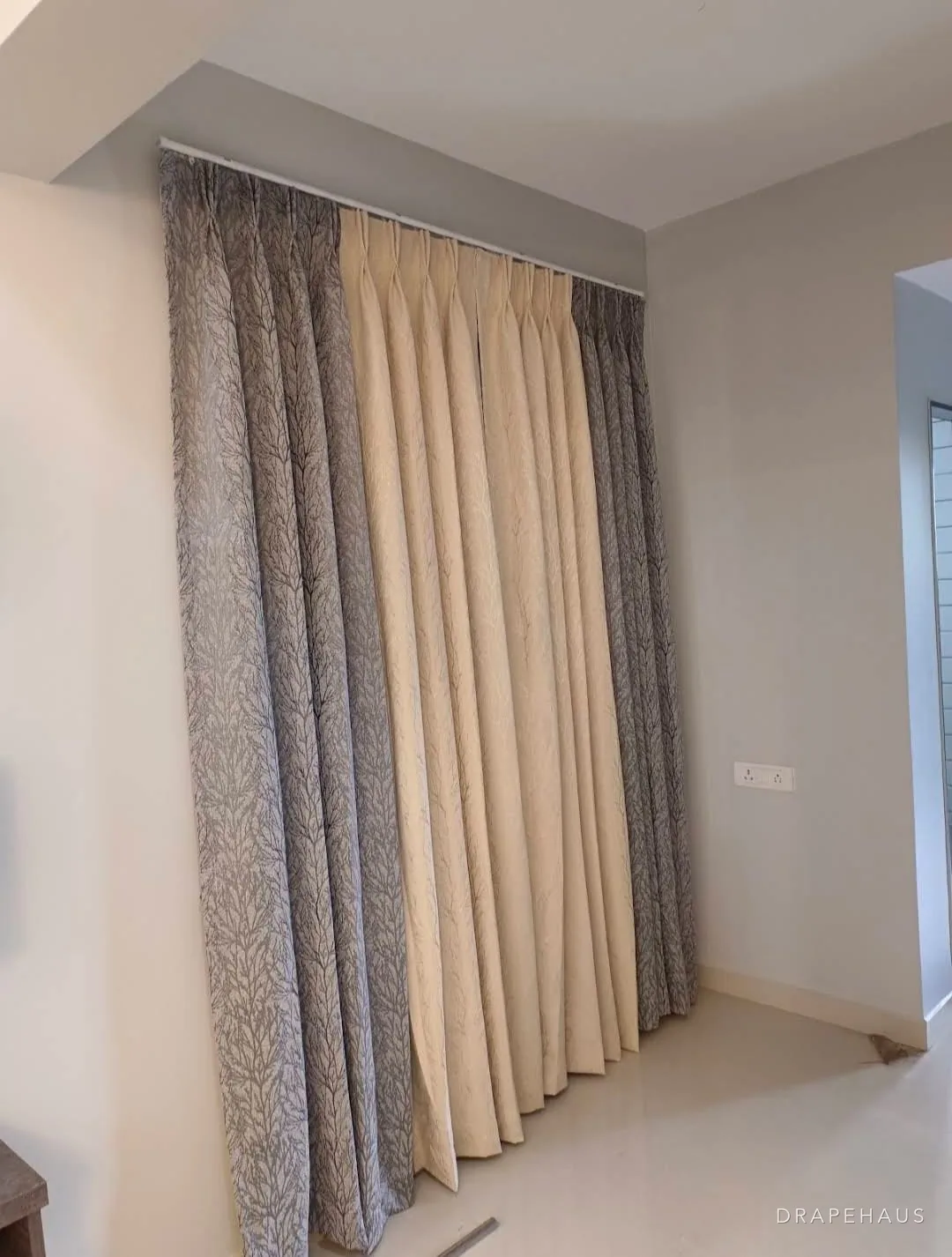
Heat blocking curtains do help, but less than the packet usually suggests, and much less than shade on the outside of the window. The US Department of Energy's guidance is careful on this point: how much a curtain cuts heat depends on its weave and colour, and it is hard to generalise. The best figure it gives is that medium-coloured draperies with white plastic backings reduced heat gain by 33% in the studies it cites. An awning on a west-facing window, by the same guidance, can cut solar heat gain by up to 77%.
The gap between those numbers is the whole story. A curtain hangs inside the glass, so the sun's energy is already in the room by the time it reaches the fabric. The best a curtain can do is send some of it back out through the window and stop the rest from spreading into the room. Shade outside the window stops the energy before it gets in.
That does not make curtains pointless. In a Goan room that takes the low afternoon sun, a well-made, light-backed curtain on the right track, closed at the right time, makes a real difference to comfort and to the air conditioner. This guide sets out what works, in order of how much it helps, and how to judge the claims on a thermal curtain before you buy one.
How sun through a window heats a room
Sunlight reaches a window in two forms. The Building America Solution Center, run by Pacific Northwest National Laboratory for the US Department of Energy, separates direct beam radiation, the parallel rays that cause glare and heat surfaces intensely, from diffuse radiation, the scattered light from the sky that makes a pleasant source of daylight. To keep a room cool you block the direct beam and keep as much of the diffuse light as you can.
Once direct sun passes through glass, it lands on the floor, the sofa and the walls. Those surfaces warm up and give the heat back to the room air, where it stays, because ordinary glass lets sunlight in far more easily than it lets the resulting warmth out. The Department of Energy puts it plainly for its own market: in cooling seasons, about 76% of the sunlight falling on standard double-pane windows enters the home to become heat. Most Goan windows are single-glazed, so treat that figure as a reference point, not a local measurement.
Surfaces in direct sun get much hotter than people expect. The Canadian Conservation Institute notes that sunlight can warm a surface 40°C above the surrounding air, or more. That is why a tiled floor by a west window is hot underfoot at five o'clock, and why a dark, unlined curtain in full sun becomes a warm panel radiating into the room.
Why west-facing windows are the problem
The Solution Center's shading guidance points out that in summer the sun shines on east and west walls for many more hours than on north and south ones, and that low morning and evening sun is best handled by vertical shading in front of the window, because horizontal eaves and overhangs only catch a high sun. Its advice for adding shade to an existing house is to deal with skylights first, then east and west windows, then south, then north, and it adds that at very low latitudes north-facing windows should not be neglected either.
In Goa the west is worst, because afternoon sun arrives when the house has already been warming all day. It comes in under the eaves, almost level, and reaches deep into the room. Our guide to west-facing glare covers the light side of that problem; the heat side is what this article is about.
Timing matters too. The India Meteorological Department's climate summary for Goa records that skies are generally clear or lightly clouded from November to April, and heavily clouded from June to September. It also notes that days in November are as hot as those in April and May. In practice the heat problem through glass runs from late October to the monsoon, and during the rains the cloud does much of the shading for you.
Planning something like this?
We visit homes across North and South Goa, measure on site, and bring samples to see in your own light.
Inside or outside the glass: the decision that matters most
Every authoritative source on this says the same thing. The Solution Center explains that interior attachments can be less effective than comparable exterior shading because they do not block direct sunlight until it has already passed through the window, and that it is harder to reflect heat back out than to stop it before it arrives. Exterior shading, it says, is typically more effective at reducing solar heat gain.
The size of the difference is striking. The Solution Center cites a study of a home without air conditioning during the 2021 heat wave in Portland, Oregon: using interior roller shades would have cut the hours spent in the 'danger' or 'extreme danger' heat bands by about 18%, insulating interior shades by about 23%, and exterior shades by about 55%. Even plain insect mesh shows the effect: research it cites found exterior insect screens reduced solar heat gain by 46% against 14% for the same screens fitted inside.
So if a room is genuinely unusable in the afternoon, look outside the window first. An awning, an outdoor roller blind or a fixed screen on a west wall does more than any curtain. We make and fit awnings and outdoor shade and outdoor blinds for exactly this reason. Where outside shading is not allowed, as in many apartment buildings, solar-control window film on the glass is the next step; the Department of Energy notes that east- and west-facing windows benefit most from films, and warns that tinted films can damage the seals of sealed double-glazed units. Film is not something we fit, but it is worth asking a specialist about before spending heavily on interior treatments.
Shade outside the glass stops heat getting in. A curtain inside the glass can only send some of it back.
What a thermal or heat blocking label actually means
Thermal, heat blocking, energy saving and insulating are descriptions, not ratings. There is an independent rating scheme in the United States, the Attachments Energy Rating Council, which the Solution Center describes as giving products a Warm Climate Rating for how well they prevent heat gain. As of 2020 it rated storm windows, blinds, cellular shades, roller shades, pleated shades and solar screens. Curtains and drapes were not on that list. For a curtain, the words on the label tell you what the maker intends, not what has been measured.
Behind the label, a heat blocking curtain is usually one of a few constructions. Some have a foam or acrylic coating on the back, which is also what makes most blackout linings opaque. Some have a metallised or pearl-white backing meant to reflect sunlight. Some are simply very dense weaves, or a face fabric with an interlining sandwiched between it and a lining. Each one slows heat differently, and the part that matters most in a hot climate is the face that meets the sun.
Insulation is a cold-climate idea. A thick, insulating curtain is mainly designed to keep a warm room from losing heat through cold glass at night, which is where the Department of Energy's figure of up to 10% less heat loss for conventional draperies comes from. In Goa the problem is solar gain by day, so what you want is a back face that reflects sunlight and a fit that keeps the hot air behind the curtain from mixing with the room. A dense, dark, insulating curtain with a dark back can still turn into a radiator.
For comparison, the most effective interior product in the Department of Energy's guidance is the cellular or honeycomb shade, which it says can cut unwanted solar heat through windows by up to 60% when installed with a tight fit. If heat is the main reason for buying, honeycomb blinds behind a decorative curtain are worth considering.
Lining colour: the side that faces the glass
When a curtain is drawn against the sun, the lining does the work. A white or light lining reflects a good share of the sunlight back out through the glass before it turns into heat. A dark lining absorbs it, warms up, and passes that warmth to the room. The Department of Energy's 33% figure is for medium-coloured draperies with white plastic backings: the colour facing the room was ordinary, the colour facing the window was white.
This is good news for anyone who wants a deep colour inside. A charcoal, indigo or rust curtain with a white or light reflective lining behaves far better in the sun than the same fabric unlined. It also lasts longer, because the lining takes the sun that would otherwise fade the face fabric. Our blackout linings guide explains the difference between coated, foam-backed and interlined constructions.
| Construction | What happens to the sun's heat | Comment |
|---|---|---|
| Sheer or voile alone | Most of it passes straight through | Cuts glare, not heat; a daytime privacy layer |
| Unlined light-coloured cotton or linen | Some reflected, much passes through the weave | Pleasant light; little heat control |
| Unlined dark fabric | Absorbed by the fabric, which heats up and radiates into the room | The poorest choice for a sunny west window |
| Any face fabric with a white or light lining | A share reflected back out through the glass | The practical standard for sunny windows |
| Face fabric with a white-backed blackout lining | Reflects light and blocks it completely | Best curtain option; must still fit well at the edges |
| Cellular (honeycomb) blind, tight fit | Up to 60% of unwanted solar heat cut, per US DOE guidance | Combine with a curtain for looks |
Fit: the hot air trapped behind the curtain
When a lined curtain is closed against the sun, the air between the fabric and the glass gets hot. Hot air rises. If the curtain hangs from a rod a little below the ceiling with open sides, that air spills out over the top and round the edges, and the room warms anyway. Close the top and sides and the warm pocket stays largely where it is, against the glass.
The Department of Energy's advice on fitting draperies was written for keeping heat in during cold weather, but the geometry is the same: hang the curtain close to the window, fit a cornice at the top or take the curtain up to the ceiling, overlap the two halves in the centre, and close the sides against the wall. A ceiling curtain track or a pelmet, a track that runs well past the frame, and curtains that return to the wall at each end do all of this, and they also stop light leaking round the edges.
There is a Goan limit to sealing. Through the monsoon, a curtain clamped against a window that is wet with rain or condensation will grow mildew. The Solution Center, discussing condensation behind interior shades, suggests leaving the bottom rail about half an inch, roughly a centimetre, off the sill so a little air can move along the glass. A small gap at the hem, curtains drawn back on dry monsoon days, and a breathable lining keep the heat benefit in the hot months without the damp penalty in the wet ones.
Using curtains to keep heat out: timing and power cuts
A heat blocking curtain only works when it is closed. The Department of Energy cites its own study finding that 75% of residential window coverings stay in the same position every day. The Solution Center's guidance for cooling is simple: close attachments during the day and open them at night if it is cooler outside than in. In Goa that means closing west-facing curtains before the sun reaches the glass, not after the room is already hot, and opening them after sunset to let the room cool.
Automation helps more than people expect. The Solution Center notes that most homes have operable shading but few households operate it consistently, and that motorised, scheduled shades can manage solar gain even when nobody is home. A motorised curtain on a timer closes a west window at two o'clock every afternoon, whether or not you remember. For houses that are shut for months, this matters for the furniture as much as the temperature.
Shade also buys time when the power fails. The Solution Center describes window attachments as increasing a home's 'hours of safety' during extreme heat, particularly when air conditioning has failed or is not available. In a Goan power cut on an April afternoon, a bedroom whose west curtains have been closed since noon stays bearable far longer than one where the sun has been on the floor all day.
On savings, keep expectations honest. The Solution Center reports Department of Energy field studies in which optimised use of high-efficiency interior and exterior shades gave whole-home summer cooling savings of 15% to 25%. That is a US result, for rated shading products used well, and not a promise for a single curtain in a Goan flat. Earlier modelling by Lawrence Berkeley National Laboratory for the Department found that in its warm southern climate zone every type of window attachment it studied saved energy. Curtains help; how much depends on the window, the lining and whether anyone closes them.
What to do, window by window
Put the effort where the sun is. Most houses have one or two windows that cause most of the heat, and they are nearly always west-facing glass or large sliding doors onto an unshaded balcony. Treat those properly and leave the rest light.
- West-facing living-room glass: outside shade if possible; otherwise a sheer for glare plus a white-lined curtain on a double track, closed through the afternoon
- Air-conditioned bedroom facing west: a blackout curtain with a white back, on a ceiling track with returns, closed from early afternoon
- Sliding doors onto an open balcony: an awning or outdoor blind over the balcony edge does more than anything inside
- Rental flat where nothing can be fixed outside: a lined curtain plus a honeycomb or solar-control roller blind behind it
- Skylights and roof glazing: shade these first; interior fabric alone does little against overhead sun
- North- and east-facing windows: usually a sheer and an ordinary lined curtain are enough