 Drape Haus
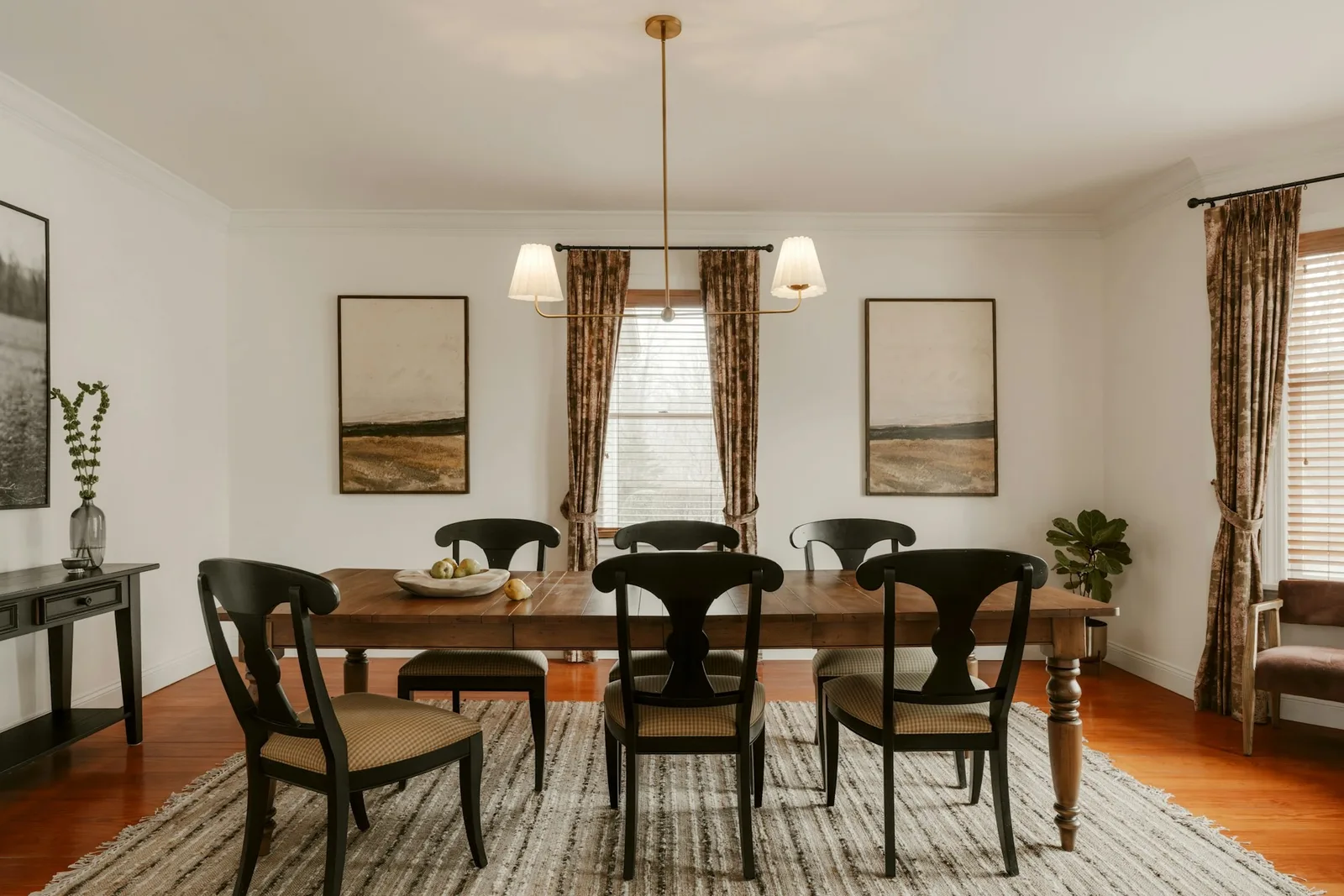
The rug under a dining table should reach about 60 cm (2 ft) past every edge of the table, so the chairs stay on it when people pull them back to sit down. For a typical six-seater table of about 107 × 183 cm (3.5 × 6 ft), that points to an 8 × 10 ft rug, about 2.4 × 3.0 m. An eight-seater of about 107 × 244 cm needs 9 × 12 ft, about 2.7 × 3.7 m. A round table wants a round or square rug about 120 cm wider than the table's diameter.
That allowance is the whole point. A rug only as big as the table looks tidy until someone sits down: the back legs of the chair drop off the edge, the chair rocks, catches the rug and slowly wears a line along it. A rug that is too big for the room is the opposite problem, crowding the walls and running under sideboards.
Our rug size planner works this out from your room and table and marks the standard size that fits. This guide explains the reasoning behind it, covers the shapes and situations it does not, and deals with the part that matters most in a Goan dining room: what happens when the fish curry goes over.
The chair allowance: why 60 cm on every side
A dining chair moves more than any other piece of furniture in the house. It is pulled out, sat on, shuffled forward, pushed back at the end of the meal and dragged out again for the next course. The rug has to hold all four legs through that whole movement, on every side of the table where someone sits. That is why a dining rug is sized from the table outwards, not from the room inwards.
Kitchen planners give a useful sense of how much floor a seated diner takes up. The planning guidelines of the National Kitchen & Bath Association, an American trade body, allow 32 inches, about 81 cm, from the table edge to a wall behind a seated diner when nobody needs to pass. To edge past behind them takes 36 inches, about 91 cm, and to walk past comfortably 44 inches, about 112 cm. Those figures include the person as well as the chair.
The rug only has to carry the chair legs, not the person's back, so about 60 cm past the table edge holds most chairs in normal use. Large carver chairs, deep upholstered dining chairs, or a family that likes to lean back at the end of a long lunch can push the back legs further, and for them 70 to 75 cm is safer if the room allows it. The simplest check is in the steps below: pull out one of your own chairs and measure.
Size the rug from the table out: table length plus about 120 cm, table width plus about 120 cm. Then check the room still has floor around it.
Rug sizes for four, six and eight seats
The table below follows our rug planner exactly. It takes a typical table for each number of seats, adds two feet on every side, and picks the smallest standard rug that covers that area. It also checks that the room leaves at least 1.5 ft, about 46 cm, of bare floor beyond the rug on each side, because a rug that runs up to the skirting looks like a badly fitted carpet and traps chairs against the wall.
Two results surprise people. First, a four-seater and a six-seater usually land on the same 8 × 10 ft rug, because the next size down, 6 × 9 ft, is too narrow for chairs on both sides even of a small table. Second, the room has to be larger than most people expect: an 8 × 10 ft rug needs a dining area of at least about 11 × 13 ft (3.4 × 4.0 m) to keep that border of floor, and a 9 × 12 ft rug needs about 12 × 15 ft (3.7 × 4.6 m).
If your room is smaller than that, the planner still shows the largest standard size that fits, but it will not meet the chair allowance. That is a real decision rather than a rounding error, and the section on skipping a rug covers it. Made-to-measure rugs and wall-to-wall pieces can be cut between the standard sizes, which helps in a room that is just a little short.
| Table | Typical table size | Area the chairs need | Advised rug | Smallest room for it |
|---|---|---|---|---|
| 4 seats | 3 × 4 ft (91 × 122 cm) | 7 × 8 ft | 8 × 10 ft (2.4 × 3.0 m) | about 11 × 13 ft (3.4 × 4.0 m) |
| 6 seats | 3.5 × 6 ft (107 × 183 cm) | 7.5 × 10 ft | 8 × 10 ft (2.4 × 3.0 m) | about 11 × 13 ft (3.4 × 4.0 m) |
| 8 seats | 3.5 × 8 ft (107 × 244 cm) | 7.5 × 12 ft | 9 × 12 ft (2.7 × 3.7 m) | about 12 × 15 ft (3.7 × 4.6 m) |
| 10 or more | measure your table | table + 4 ft each way | 10 × 14 ft (3.0 × 4.3 m) or made to measure | rug + 3 ft each way |
Planning something like this?
We visit homes across North and South Goa, measure on site, and bring samples to see in your own light.
Round, oval and extending tables
Round tables follow the same rule in a circle. Add about 60 cm all round, so the rug's diameter is the table's diameter plus about 120 cm. A 120 cm round table for four therefore wants a rug of about 240 cm, roughly 8 ft, across. A round rug echoes the table and suits a square room or a dining corner; a square rug of the same width holds the chairs just as well and often sits better in a rectangular room, where its straight edges line up with the walls. Our planner works in rectangles, so for a round table use the arithmetic here, then check the room has floor to spare.
Oval tables and racetrack tables take a rectangular or oval rug with the same allowance on every side. An oval rug looks graceful under an oval table but is harder to find in standard sizes; a rectangle is the practical choice and nobody will notice the corners once the chairs are in.
Extending tables raise the question of which size to plan for. If the leaf goes in a few times a year, for Christmas lunch or a wedding party, size the rug for the table closed and accept that the end chairs will sit partly off it on those days. If the table is extended most weekends, size for the extended length. A third option, often the best in a Goan house where big gatherings spill onto the balcão or verandah anyway, is to roll the rug away before the party and put it back afterwards.
Low pile and flatweaves: rugs that let chairs slide
Under a dining table, the surface matters as much as the size. Chairs need to slide back without catching, and a thick or shaggy pile grips the legs, tilts the chair and wears into tracks. Flat, tight surfaces work best: cotton dhurries, flatweaves and kilims, and wool rugs with a short, dense pile. Our dhurries and flatweaves are made for exactly this kind of floor.
Felt pads on the chair feet help any rug. They let chairs glide, spread the load of the legs and stop sharp or metal feet cutting into the weave. Check them every few months; pads that have picked up grit act like sandpaper.
Pattern and colour decide how the rug looks after a year of meals. A plain pale rug shows every grain of rice and drip of gravy. A mid-tone with a busy, small-scale pattern, a striped dhurrie, or the dense field of a traditional rug hides crumbs and minor marks between cleans. If the dining room opens off the living room, choose a rug that relates in colour to the one under the sofa without matching it exactly, so the two areas read as separate rooms.
Spills, feasts and cleaning a dining rug
Every dining rug will meet curry, dal, wine and children's juice, and in a Goan house there is also the feast-day lunch when the extended family gathers round the table. The Carpet and Rug Institute, the American industry body, gives the same first-aid rules for any spill: act quickly, scoop up semi-solid food with a spoon, then blot liquids with a dry, white, absorbent cloth or plain white paper towel, never a printed one that could transfer dye. Do not scrub or brush, which frays the surface. Work any cleaner from the edge towards the centre and finish by blotting with clean water.
Turmeric and oil-based gravies are the hardest stains, because the colour is strong and the oil carries it into the fibre. Blot as much as you can at once rather than rubbing it in. On a wool or hand-knotted rug, if the stain stays, a professional rug cleaner is safer than another round of home remedies. Cotton dhurries and flatweaves are the forgiving choice for family dining, because many can be washed whole.
Washing is where Goa's climate comes in. The India Meteorological Department records morning humidity of 87 to 91 percent from June to September, and a heavy cotton rug washed in July may take days to dry. The US Environmental Protection Agency advises drying wet materials within 24 to 48 hours to prevent mould. Plan full washes for the dry months, spot-clean during the rains, and never put a damp rug back down on a tiled floor.
Rug pads on tiles, marble and oxide floors
Most Goan dining rooms have hard, smooth floors: vitrified tiles, marble, polished oxide or old mosaic. A rug on these creeps every time a chair is pushed back, bunches at one end and becomes a trip hazard. The NHS lists rugs among the things people trip on at home, and a creeping edge is how it happens. An underlay or rug pad cut slightly smaller than the rug, so its edge does not show, holds the rug in place and softens the chair traffic.
Choose the pad for the floor and the climate. A thin, grippy pad stops a flatweave walking on tiles. A felt-and-rubber pad adds cushioning under a heavier rug. Avoid solid plastic sheets in the monsoon: tiled floors can be cool and damp underneath, and a pad that does not breathe traps that moisture against the back of the rug. Lift the rug and pad on dry days and let the floor air, especially after mopping.
When to skip a dining rug altogether
Sometimes the honest answer is no rug. If the dining area is too small for a rug that holds the chairs, a rug that does not is worse than bare floor: it adds a trip edge exactly where people stand up. In a narrow dining space with a wall on one side, a bench along the wall instead of chairs can make a smaller rug work, because only one side needs the allowance.
Skip it, too, if the table sits on a route that people cross with trays and plates from the kitchen, if there are toddlers in the high-chair stage who throw food daily, or if an older family member uses a walking frame or is unsteady on their feet. In a house close to the beach or by a pool, where people come to the table in wet feet and sandy clothes, a rug under the table holds grit and damp that a mopped floor does not.
The alternatives still warm a room. A runner on the sideboard, upholstered seat pads, curtains with some weight, a strong wall or a hanging light over the table all bring the softness a rug would. Our ideas for dining room walls may help, and if you want a rug elsewhere in the house, our guide to the best rugs for humid homes covers fibres that cope with the rains. When you are ready, our dining room rugs page sets out the weaves we bring to a home visit.
How to measure for a dining rug
You need a tape measure, one of your dining chairs and five minutes.
Measure the table
Measure the table's length and width, or its diameter if it is round. If it extends, measure it closed and open, and decide which you will plan for.
Measure your own chair allowance
Pull a chair out as you would to sit down, and measure from the table edge to the back of its rear legs. Add a few centimetres. For most chairs this comes to about 60 cm; for large carvers it can be more.
Work out the rug size
Add twice that allowance to the table length and twice to the width. For a round table, add twice the allowance to the diameter. Round up to the nearest standard or made-to-measure size.
Check the room
Measure the dining area wall to wall, and subtract the rug size. You want at least about 45 cm of bare floor on every side, and more where people walk past with plates.
Mark it out
Lay masking tape or newspaper on the floor at the rug size, put the chairs in place and walk round the table. Check doors, sideboard drawers and the kitchen route all clear the edge.
Try it in the planner
Enter the room size and number of seats in our rug planner to see the advised standard size drawn to scale, then book a visit if you want it confirmed against the real furniture.