 Drape Haus
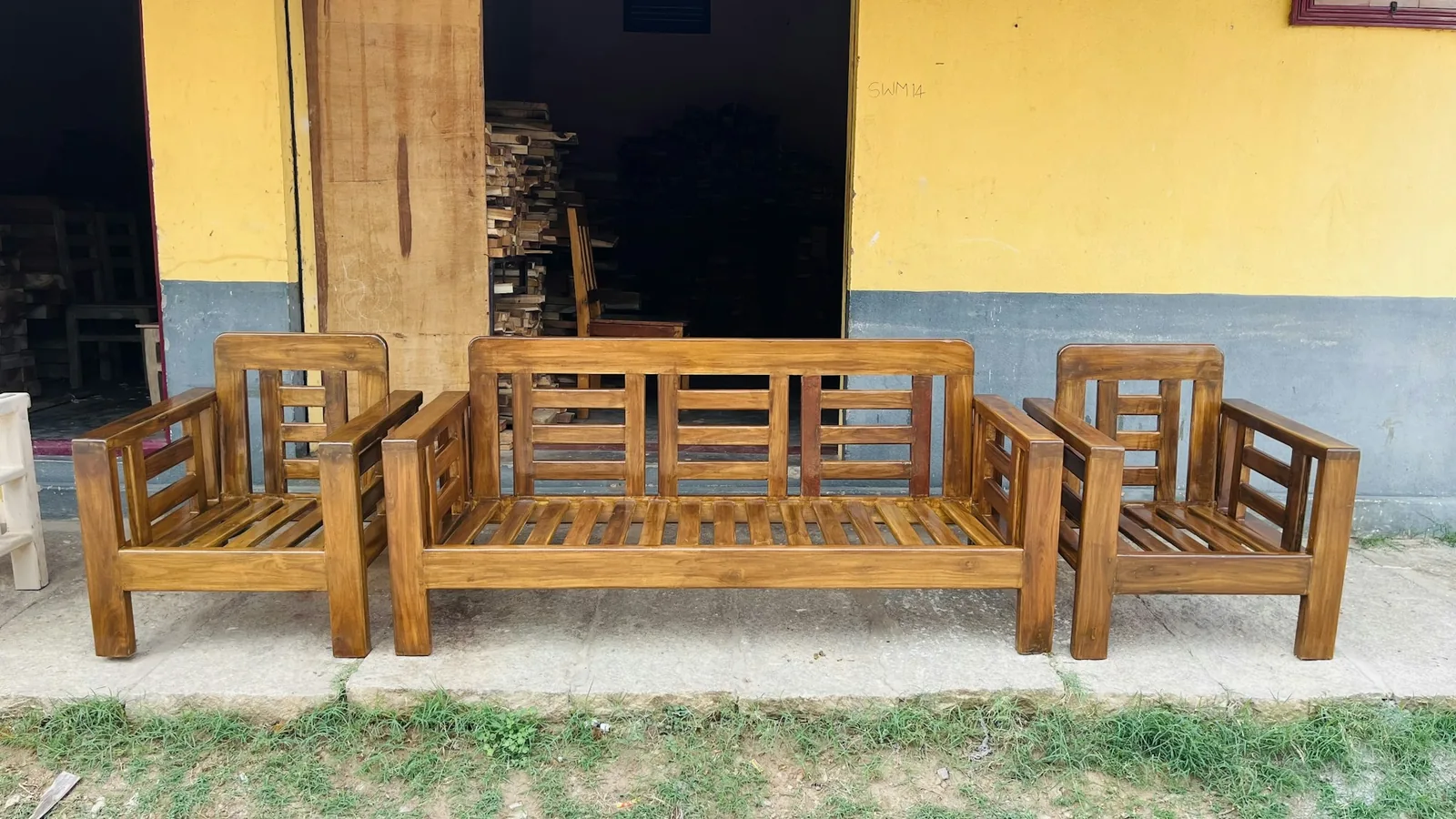
The best wooden sofa for a humid home is made from a naturally durable hardwood, used as heartwood, properly dried, joined with real joinery and sealed on every surface, not just the parts you see. Teak and sheesham meet that description most easily. Mango and rubberwood can make good-looking frames, but they rely far more on treatment and finish to survive insects and damp.
Species is only the first decision. Two sofas in the same timber can behave very differently through a Goan monsoon depending on how the wood was dried, which part of the tree it came from, how the joints were cut and whether the underside was finished. Those are the details a buyer can check, and they are the ones this guide concentrates on.
Below, the four timbers most often sold for wooden sofas in India are compared on published figures for density, hardness, movement and natural durability, followed by finishes, joinery, the choice between cushions and cane, and a care routine for the wet and dry seasons.
Teak, sheesham, mango and rubberwood compared
The table brings together published figures for each timber. Density and hardness tell you how well a frame resists dents and holds screws. Shrinkage figures, measured from green to oven-dry, tell you how much the wood can move as humidity changes; the tangential figure, across the growth rings, is always the larger. Durability ratings describe how well the heartwood resists decay without treatment.
Teak's reputation is earned. Its heartwood is rated very durable, and its volumetric shrinkage of 7.2 per cent is low for its density, which is why it stays stable where humidity swings. Sheesham, also called sissoo, is denser and markedly harder, with good decay resistance rated durable to very durable; it is heavier to carry and takes a fine polish. Both make excellent frames when the heartwood is used.
Mango and rubberwood are a different proposition. Mango is rated anywhere from moderately durable to perishable and is susceptible to both fungal and insect attack. Rubberwood is perishable, with very little natural resistance to decay, and is prone to fungal staining and insects. Both are plantation by-products, mango from orchards past their fruiting life and rubberwood from latex plantations at the end of tapping, which gives them a sound environmental story. In Goa they can work indoors, provided the timber has been treated and the finish is complete and kept intact.
| Timber | Dried density | Janka hardness | Shrinkage: tangential / radial / volume | Natural decay resistance |
|---|---|---|---|---|
| Teak (Tectona grandis) | 655 kg/m³ | 1,070 lbf | 5.3% / 2.6% / 7.2% | Very durable |
| Sheesham (Dalbergia sissoo) | 770 kg/m³ | 1,660 lbf | 5.3% / 3.1% / 8.4% | Durable to very durable |
| Mango (Mangifera indica) | 675 kg/m³ | 1,070 lbf | 5.5% / 3.6% / 8.9% | Moderately durable to perishable; fungus and insects |
| Rubberwood (Hevea brasiliensis) | 595 kg/m³ | 960 lbf | 5.1% / 2.3% / 7.5% | Perishable; staining and insects |
Durability ratings apply to heartwood. Pale sapwood of any of these species has little natural resistance to insects or decay.
How wood moves in Goan humidity
Wood takes up moisture from the air and gives it back, swelling and shrinking as it does. The US Forest Products Laboratory's Wood Handbook puts the moisture content of interior wood typically at 6 to 12 per cent, and notes that decay begins when wood stays above about 20 per cent. A closed Goan house in August, with humid air and no airflow, pushes furniture towards the top of that range for weeks at a time.
Movement is not even in every direction. In all four timbers above, wood shrinks and swells about one and a half to two times as much along the growth rings as across them, which is why the shrinkage figures have two values. A wide seat rail or back panel made from flat-sawn boards moves more than one made from quarter-sawn timber, and in a frame that movement either is allowed for in the design or shows up as split panels, opened joints and sticking drawers.
Drying is what keeps that movement within bounds. Timber that was sold green or only partly dried keeps shrinking after the sofa is built, and does so most sharply in the first dry season, when the air in April can be far drier than the air in August. Ask how the timber was dried and for how long it rested before machining. A seller who cannot answer is telling you something.
Planning something like this?
We visit homes across North and South Goa, measure on site, and bring samples to see in your own light.
Termites and borers: which timbers they prefer
Two kinds of insect trouble wooden furniture in Goa. Termites come up from the ground or through walls, and eat timber from inside, often leaving a thin intact skin. Powder-post beetles fly in, and their larvae tunnel inside the wood for months before emerging. The Natural History Museum in London describes the common powder-post beetle as originally tropical, attacking the sapwood of wide-pored hardwoods with a starch content above about 3 per cent, and leaving exit holes 1.5 to 2 mm across with a fine, flour-like dust beneath.
That starch preference is why sapwood and starchy plantation timbers are most at risk, and why mango and rubberwood need preservative treatment before they are made into furniture. Teak and sheesham heartwood resist insects far better, but a frame that includes strips of pale sapwood on edges or underside is only as resistant as its weakest part. Look for colour bands along edges and on the underside of rails.
Treatment should happen before the frame is finished, because once a film finish is on, preservatives cannot reach the wood. After that, the defence is attention. Check the underside, the feet and the back of the frame once a year for small round holes or powder. Our guide to termites and timber covers signs and next steps, and our article on fungus on wooden furniture deals with surface mould, which is a different problem.
- Fine powder on the floor under a leg, or on a rail
- Small round exit holes, about 1.5 to 2 mm across
- Earthen tubes on the wall or skirting behind the sofa
- Wood that sounds hollow or dents easily when pressed
Oil, PU or lacquer: finishes for a monsoon climate
A finish does not stop wood absorbing moisture; it slows it. The Wood Handbook is clear that coatings always fail eventually, from wear, movement at joints and fixings, and that a film-forming finish applied to all sides, including the end grain, reduces moisture change by slowing water movement into and out of the wood. The same chapter warns that uneven coating, a finished face with a bare back, is a common cause of checking, warping and cupping.
That is the single most useful thing to check on a wooden sofa in a humid house. Turn it over. If the show faces are glossy and the underside, the inside of the rails and the back panel are raw, the frame will take up and lose moisture unevenly every monsoon. A well-made frame has every surface sealed, and the end grain at the feet sealed with particular care, since liquid water enters end grain 10 to 100 times faster than through the other faces.
Oil finishes soak into the wood and leave little film. They look natural, are easy to renew and hide small scratches, but they give the least protection against humid air and need re-oiling, more often on arms and seat rails. Polyurethane forms a tough, water-resistant film that resists spills and mopping splashes well; when it eventually wears through, patch repairs can be visible. Lacquer and traditional polish give a deep, smooth look and are repaired more easily by a polisher, but are less tolerant of heat, water and alcohol. In Goa, a satin or matt film finish, applied to every surface, is the practical choice for most living rooms.
| Finish | Protection from humid air | Wear and spills | Repair |
|---|---|---|---|
| Penetrating oil | Lowest; needs renewing | Marks easily but hides scratches | Easy: wipe on fresh oil |
| Polyurethane (PU) | Good when every surface is coated | Tough; resists water and heat well | Patches can show; worn areas recoated |
| Lacquer or polish | Good as a film | Less tolerant of heat, water and alcohol | A polisher can blend repairs |
Joinery and construction to check in the shop
Wood that moves needs joints that can take it. The strongest sofa frames are joined with mortise and tenon or dowelled joints, glued, and reinforced at the corners with blocks under the seat. Screws driven into end grain, or joints held only by nails and glue, loosen as the timber swells and shrinks, and a loose joint in a sofa gets worse every time someone sits down heavily.
You can check a lot without tools. Rock the sofa from one end: a good frame moves as a single piece without creaks or give at the joints. Look under the seat for corner blocks and how the seat slats or webbing are fixed. Check that the legs are part of the frame or firmly jointed into it rather than bolted onto a thin rail. Run a hand along the arms and front rail for splits, filled cracks or knots near joints.
Look at the seat support too. Slats should be thick enough not to flex under a person and spaced so that air reaches the underside of the cushions. A solid board under a cushion traps moisture against the foam in the monsoon; slats or webbing let it breathe.
- Mortise and tenon or dowelled joints, glued, not screws into end grain
- Corner blocks under the seat frame
- Heartwood throughout, with no pale sapwood strips on rails or legs
- Finish on the underside, inside rails and back panel, not just the show faces
- Slatted or webbed seat that lets air through to the cushions
- No movement or creak when the sofa is rocked from one end
Cushioned seats or traditional cane
Many older Goan houses have wooden sofas and settees with woven cane seats and backs, and many families want to keep the look. Cane is cool, light and breathable, which makes it pleasant in April and May, and it dries quickly. Its weaknesses are wear and moisture: the weave stretches and sags under daily use, and in a damp, closed room it can grow mould and go brittle as it dries out again. A cane seat that is sat on every day will need reweaving in time.
Loose cushions on a slatted or webbed seat are more comfortable for long sitting and far easier to refresh. The cushions take the wear, and new foam or covers bring the sofa back to life without touching the frame. Cushions also absorb humidity, though, so the cover fabric and the foam matter: a breathable weave over fibre-wrapped foam on slats dries out between rains, while a thick cushion on a solid board stays damp.
A common compromise keeps cane on the back, where it gives airflow without heavy wear, and puts a loose cushion on a cane or slatted seat. Our sofa cushions service makes cushions to the frame's inside measurements, and sofa covers can be made removable so they can be washed after the monsoon. You can test cover colours against the wood in the sofa fabric simulator.
Choosing between a wooden sofa set and a single piece
Wooden sofa set designs are usually sold as a three-seater with a two-seater, or a three-seater with a pair of armchairs, often with a matching centre table. Buying the pieces together guarantees the same timber, polish colour and seat height, which is hard to match later because wood darkens or lightens with age and light. If you are buying only one piece now, ask whether the same timber and finish will be available for additions.
If you already own an old wooden sofa, the best wooden sofa may be the one you have. A sound teak or rosewood frame with loose joints can usually be reglued, treated, refinished and given new cushions, keeping the original carving and proportions. Our wooden sofas page covers new frames made to size, and we can make fresh cushions for an existing frame. Send us photographs and the inside measurements of the seat for a cushion quote.